

More Than Just Family: How to Use Eonni and Oppa Like a Real Native
안녕하세요! (Annyeonghaseyo!) Hello there, beautiful souls! I am your chief editor at Daily Hangul.
If you have ever watched a single K-Drama or listened to a K-Pop song, you have definitely heard the words 언니 (Eonni) and 오빠 (Oppa). They sound so warm, cozy, and incredibly stylish. But when you actually try to use them in real life, your heart might start racing.
“Can I call my male coworker ‘Oppa’ if he is older?”
“Will my older female friend find it weird if I call her ‘Eonni’?”
“Wait, I am a guy—can I use these words too?”
If these questions have kept you up at night, you are in the perfect place. Today, we are going to unlock the secrets of these magical words so you can use them with absolute confidence. Let’s dive in!
Phase 1: The ‘Oppa’ Trap (A True Story of Cultural Confusion)
Let me tell you a quick story about one of my favorite former students, Sarah. She was a huge fan of K-Dramas and loved the word 오빠 (Oppa). To her, it was the ultimate cute nickname for any handsome older Korean guy.
On her very first business trip to Seoul, she sat down in a formal meeting room with our team. Wanting to show off her friendly Korean, she looked at our senior department manager—a gentleman in his late 40s—and said with a bright smile:
“오빠, 이 서류 좀 봐주세요!”
(Oppa, please look at this document!)
The room went dead silent. The manager’s face turned bright red, and Sarah’s local colleague nearly choked on her iced americano.
Why? Because while 오빠 (Oppa) is incredibly common, using it in the wrong context (like a formal corporate boardroom!) can create a hilariously awkward misunderstanding. In Korea, these family terms carry deep cultural rules about respect, hierarchy, and closeness.
By the end of this guide, you will know exactly when to say these words to make native speakers instantly smile, and when to keep them tucked away.
Phase 2: Deep Dive into the Core Terms
Let’s break down the three most essential terms you need to know to talk about older siblings and close friends.
1. 언니 (Eonni)
- Pronunciation: [Eon-ni] / Sound-alike: “Uhn-nee”
- Meaning: Older sister (used only by females to address older females).
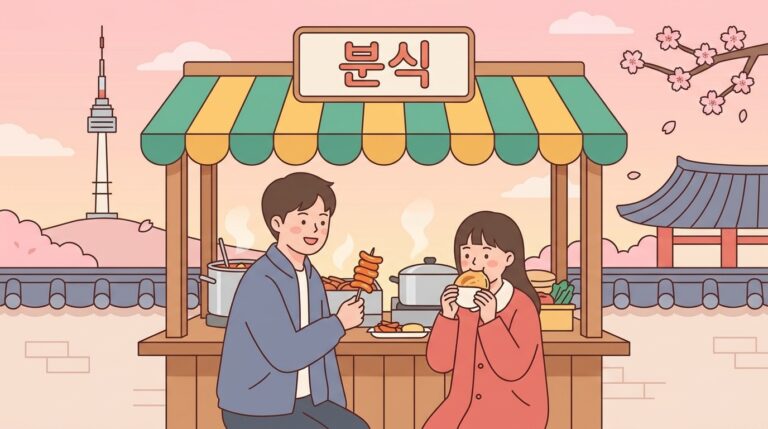
- K-Culture Moment: Think of your favorite K-Drama where two female friends are sitting at a late-night street food tent (포장마차 pojangmacha) sharing spicy rice cakes. The younger girl leans in and says, “언니, 제 고민 좀 들어주세요…” (Eonni, please listen to my worries…).
- Editor’s Insight: Calling an older female friend “Eonni” is like a magic key. It instantly breaks down walls and signals, “I want to be close friends with you!”
- Situation Spectrum:
- Close Friends / Casual: ✅ (Perfect!)
- Coworkers (Same rank, close age): ⚠️ (Only if you both agreed to speak casually)
- Boss / Elders (Formal setting): 🚫 (Too informal!)
2. 오빠 (Oppa)
- Pronunciation: [O-ppa] / Sound-alike: “Oh-pah” (make sure to crisp up the ‘pp’ sound!)
- Meaning: Older brother (used only by females to address older males).
- K-Culture Moment: You hear this in every romantic K-Drama when the female lead realizes she has feelings for her older male friend. It’s also used by K-Pop fans worldwide to cheer on their favorite male idols!
- Editor’s Insight: Be careful! Because “Oppa” is also what girls call their boyfriends, using it with a male stranger or a professional colleague can sound like you are flirting. Always wait until you are socially close before using it!
- Situation Spectrum:
- Close Older Male Friends / Boyfriend: ✅ (Incredibly natural)
- Male Colleagues at Work: ⚠️ (Only in casual, after-hours settings if you are already close)
- Elderly Men / Strangers: 🚫 (Never use this; it can sound highly inappropriate)
3. 친언니 / 친오빠 (Chin-eonni / Chin-oppa)
- Pronunciation: [Chin-eon-ni / Chin-o-ppa] / Sound-alike: “Cheen-uhn-nee” / “Cheen-oh-pah”
- Meaning: Biological older sister / Biological older brother.
- K-Culture Moment: When explaining your actual family tree to a Korean friend. Since Koreans call non-related friends “Eonni” and “Oppa,” you need a special word to say “No, we actually share the same parents!”
- Editor’s Insight: The word 친 (chin) means “real” or “related by blood.” Adding this prefix makes your family relationship instantly clear.
- Situation Spectrum:
- Describing your family to anyone: ✅ (Universal and highly clear)
🤔 Think About It: Language and Collective Identity
Have you noticed that Koreans often use family titles for people who aren’t actually related to them? Why do you think Korean society values these mock-family relationships so much? In many Western cultures, calling a non-family member “brother” or “sister” is reserved for very specific communities. In Korea, it is a daily social fabric. How does your native language handle showing closeness with older friends?
Phase 3: Textbook Korean vs. Real-World Korean
When you open an old-school textbook, the sentences can sound like they were written by a robot. Let’s look at how real Koreans actually talk!
Scenario 1: Introducing your older sister
- 📖 Textbook Korean: “저의 언니는 은행원입니다.” (Jeo-ui eon-ni-neun eun-haeng-won-im-ni-da.)
- Translation: “My older sister is a bank employee.” (Super stiff and formal!)
- 🗣️ Real-World Korean: “우리 언니 은행에서 일해!” (Uri eon-ni eun-haeng-e-seo il-hae!)
- Translation: “My sister works at a bank!” (Warm, casual, and incredibly natural.)
- 💡 Why is it different? Koreans rarely use the word “저의” (my) when talking about family. Instead, they use 우리 (uri), which means “our.” This reflects Korea’s collective culture—she isn’t just my sister, she belongs to our shared circle!
Scenario 2: Asking an older male friend if he has eaten
- 📖 Textbook Korean: “오빠, 식사하셨습니까?” (Oppa, sik-sa-ha-syeot-seup-ni-ka?)
- Translation: “Oppa, did you have a meal?” (Sounds like you are reporting to a military general!)
- 🗣️ Real-World Korean: “오빠, 밥 먹었어?” (Oppa, bap meog-eot-seo?)
- Translation: “Oppa, did you eat?” (Warm, affectionate, and perfect for daily chats.)
Phase 4: K-Culture Deep Dive & Non-Verbal Etiquette
4-1. The Art of Nunchi (눈치) & Body Language
When addressing someone as Eonni or Oppa, your voice tone and body language matter just as much as the word itself!
* The Head Tilt: When calling out “Eonni!” or “Oppa!”, a slight, playful tilt of the head with a bright smile adds a layer of warmth.
* The Respectful Distance: Even if you call someone Oppa or Eonni, if they are several years older than you, always use polite verb endings (요 -yo) until they explicitly tell you to drop the formalities. It shows you have great 눈치 (Nunchi – social intuition)!
4-2. The K-Pop Fan Phenomenon
In the K-Pop world, fans call male idols “Oppa” regardless of their actual age gap! Even if an idol is younger than the fan, fans playfully yell “He is handsome, so he must be my Oppa!” (잘생기면 다 오빠!). While this is fun in fandom spaces, remember to keep this playful rule out of professional Korean work environments.
Phase 5: Interactive K-BBQ Roleplay Scenario
Let’s put you right in the middle of a classic K-BBQ dinner! You are dining with your close female coworker, Min-ji, and she has brought along her biological older brother, Jun-woo.
The Setting: A lively, smoky Samgyeopsal (삼겹살) restaurant in Hongdae. The pork is sizzling on the grill, and K-Pop music is buzzing in the background.
Cast:
- You (A2 Level Korean Learner)
- Min-ji (Your supportive colleague)
- Jun-woo (Min-ji’s older brother, who is 3 years older than you)
The Script
- Min-ji (🎭 Waving her hand happily): “여기야, 여기! 진짜 보고 싶었어!”
(Yeo-gi-ya, yeo-gi! Jin-jja bo-go sip-eot-seo! / Over here! I really missed you!) - You (🎭 Smiling warmly): “민지 씨, 안녕! 보고 싶었어요!”
(Min-ji ssi, an-nyeong! Bo-go sip-eot-seo-yo! / Hi Min-ji! I missed you too!) - Min-ji (🎭 Pointing to the handsome guy next to her): “인사해! 여기는 우리 오빠야. 오늘 고기 사준대!”
(In-sa-hae! Yeo-gi-neun u-ri o-ppa-ya. O-neul go-gi sa-jun-dae! / Say hello! This is my older brother. He said he’ll buy us meat today!) - Jun-woo (🎭 Bowing politely with a gentle smile): “안녕하세요! 민지한테 얘기 많이 들었어요.”
(An-nyeong-ha-se-yo! Min-ji-han-te yae-gi ma-ni deul-eot-seo-yo. / Hello! I’ve heard a lot about you from Min-ji.) - You (🎭 Feeling a bit nervous but polite): “안녕하세요, 준우… 씨? 처음 뵙겠습니다.”
(An-nyeong-ha-se-yo, Jun-woo… ssi? Cheo-eum boep-geot-seum-ni-da. / Hello, Mr. Jun-woo? Nice to meet you.) - Min-ji (🎭 Laughing out loud, waving her chopsticks): “아이구, 너무 딱딱해! 준우 씨가 뭐야~ 그냥 오빠라고 불러!”
(Ai-gu, neo-mu ttak-ttak-hae! Jun-woo ssi-ga mwo-ya~ Geu-nyang o-ppa-ra-go bul-reo! / Oh my, so stiff! What do you mean ‘Jun-woo ssi’~ Just call him Oppa!) - Jun-woo (🎭 Putting some cooked meat on your plate): “맞아요, 편하게 오빠라고 부르세요. 고기 더 먹어요!”
(Ma-ja-yo, pyeon-ha-ge o-ppa-ra-go bu-reu-se-yo. Go-gi deo meog-eo-yo! / That’s right, please feel free to call me Oppa. Eat more meat!) - You (🎭 Taking a deep breath, trying your best): “와, 정말요? 고마워요, 오빠!”
(Wa, jeong-mal-yo? Go-ma-wo-yo, o-ppa! / Wow, really? Thank you, Oppa!) - Jun-woo (🎭 Laughing happily, looking pleased): “하하, 오빠 소리 들으니까 기분 좋네요. 맛있게 먹어요!”
(Ha-ha, o-ppa so-ri deul-eu-ni-ka gi-bun joh-nae-yo. Ma-sit-ge meog-eo-yo! / Haha, hearing ‘Oppa’ makes me feel great. Enjoy your meal!) - Min-ji (🎭 Clapping her hands): “좋아! 우리 오늘 맛있는 고기 먹고 재미있게 놀자!”
(Joh-a! U-ri o-neul ma-sit-neun go-gi meog-go jae-mi-it-ge nol-ja! / Great! Let’s eat delicious meat and have fun today!)
🔀 Decision Point: What would you do next?
Imagine Jun-woo asks you if you like Korean spicy stew (찌개 jjigae). How do you reply to him?
- Option A: “오빠, 저는 김치찌개 아주 좋아해요!” (Oppa, I love Kimchi stew!)
- Option B: “준우 씨, 김치찌개 먹고 싶어요.” (Jun-woo ssi, I want to eat Kimchi stew.)
- Option C: “야! 고기나 구워라!” (Hey! Just grill the meat!)
🏆 Best Choice: Option A
Perfect! Since both Min-ji and Jun-woo explicitly invited you to call him “Oppa,” using “Oppa” while keeping the polite ~해요 (~haeyo) verb ending is the absolute sweet spot. It is friendly, respectful, and makes you sound like a total natural!
⚠️ Risky Choice: Option B
Not terrible, but switching back to “Jun-woo ssi” after they asked you to say “Oppa” might make you seem slightly cold or distant, as if you are rejecting their invitation to be close friends.
🚫 Terrible Choice: Option C
Oh dear! This is extremely rude slang used only between childhood best friends or angry characters in K-Dramas. Avoid this at all costs if you want to keep your BBQ invitation privileges!
Phase 6: 10-Second Emotional Shadowing Drill
To sound like a native speaker, you need to master the emotional melody of Korean. Practice these sentences out loud by mimicking the emotion cues!
- [🥺 Sweetly & Asking for a favor]
- “오빠… / 이것 좀 / 도와줘요~”
- [O-ppa… / i-geot jom / do-wa-jwo-yo~]
- Translation: “Oppa… can you please help me with this?”
- [😊 Joyfully & Expressing Gratitude]
- “언니! / 진짜 / 고마워요!”
- [Eon-ni! / jin-jja / go-ma-wo-yo!]
- Translation: “Eonni! Thank you so much!”
Phase 7: K-Culture Mini Dictionary
Here are 4 cultural terms that will help you understand how Koreans connect with each other:
- 호칭 (Hoching – Title/Address): The specific titles used to address people based on their relationship, age, and status. Using the right Hoching is the foundation of Korean manners.
- 우리 (Uri – Our/We): A beautiful word reflecting the collective nature of Korean society. Used instead of “my” when talking about family, school, or country.
- 인싸 (Inssa – Insider): A popular slang term for someone who is outgoing, social, and has lots of friends. Using “Eonni” or “Oppa” correctly is a key Inssa skill!
- 야자타임 (Yaja-time): A fun game played during social gatherings where age hierarchy is temporarily reversed. For a limited time, younger people can speak casually to older ones!
Phase 8: Traveler’s Survival Kit
Even if you aren’t talking to siblings, these warm terms can save the day when you are exploring Seoul!
Survival Phrases for Travelers
- “이모님, 여기 물 좀 주세요!” (I-mo-nim, yeo-gi mul jom ju-se-yo!)
- Meaning: “Auntie, please give us some water here!”
- Pro Tip: When eating at casual local diners, calling the older female owner “이모님 (Imonim – Auntie)” instead of a cold “Excuse me” will often get you free extra side dishes!
- “사장님, 이거 얼마예요?” (Sa-jang-nim, i-geo eol-ma-yeo-yo?)
- Meaning: “President/Owner, how much is this?”
- Pro Tip: Use this at traditional street markets like Namdaemun or Gwangjang Market to make the shopkeepers feel respected.
📌 Editor’s Travel Note: When navigating the bustling streets of Seoul, Google Maps doesn’t always show the best walking routes. Make sure to download the Official Naver Map App or the KakaoMap App for real-time subway and walking directions!
Phase 9: One Step Deeper — Age and Connection
In many Western cultures, asking someone’s age upon first meeting is considered impolite. However, in South Korea, it is often one of the first questions you will be asked!
This isn’t because Koreans are nosy. Rather, they are trying to figure out their social alignment with you. By knowing your age, they can determine the perfect 호칭 (Hoching) and verb endings to use. It is their way of establishing a comfortable, respectful connection with you.
💬 Your Turn!
How does your hometown culture show closeness to older friends or mentors? Do you have any words similar to “Eonni” or “Oppa”? Let us know in the comments below! We love reading your cultural stories.
Phase 10: FAQ & Common Mistakes
Q: Can a male student call an older male friend “Oppa”?
A: No! “Oppa” is strictly used by females. If you are a male and want to address an older male friend or brother, you should use 형 (Hyeong – Older brother for males).
Q: Can I use “Eonni” or “Oppa” at a job interview or professional meeting?
A: Absolutely not! In professional corporate spaces, you should always use the person’s job title followed by 님 (nim), such as 매니저님 (Manager-nim) or 부장님 (Director-nim).
Q: Does calling someone “Oppa” mean I want to date them?
A: Not necessarily, but context is everything! While it is highly common among platonic friends and biological siblings, it is also the most common title for boyfriends. Use it warmly, but avoid overly flirtatious intonations if you want to keep things strictly friendly!
🚨 Common Mistakes Warning Board
- Mistake 1: Calling your boss “Oppa” or “Eonni” in the office.
- Correct Action: Use their professional title + “님” (e.g., “대리님 Daeri-nim”).
- Mistake 2: Pronouncing “Oppa” like “Oh-bah” with a soft ‘b’ sound.
- Correct Action: Make sure to tense your lips to make a sharp, double ‘p’ sound: “Oh-PPah!”
- Mistake 3: Using these words for people who are significantly older (like your parents’ age).
- Correct Action: Use “이모님 (Imonim – Aunt)” or “삼촌 (Samchon – Uncle)” instead.
Phase 11: Your Weekly Action Mission
Ready to put your knowledge into action? Try these three fun challenges this week!
- 🥉 Bronze Mission: Look at yourself in the mirror and practice saying “언니, 고마워요!” (Eonni, thank you!) and “오빠, 밥 먹었어요?” (Oppa, did you eat?) with a warm, natural smile.
- 🥈 Silver Mission: Find your favorite K-Drama on Netflix, watch for 15 minutes, and count how many times the female characters say “Oppa” or “Eonni.” Pay attention to their tone!
- 🥇 Gold Mission: If you have a Korean language partner or friend who is older than you, ask them politely if you can call them Eonni or Oppa. Say: “언니/오빠라고 불러도 돼요?” (Eon-ni/O-ppa-ra-go bul-reo-do dwae-yo? / Can I call you Eonni/Oppa?)
Phase 12: Interactive Quiz Challenge
Let’s test your new skills! Can you get a perfect score?
1. Situation Quiz
You are a female learner. You want to ask a close female friend who is 2 years older than you if she wants to drink coffee together. Which phrase is best?
* A) “언니, 커피 마실래요?”
* B) “누나, 커피 마실래요?”
* C) “야, 커피 마셔!”
🔍 Click here to check the Answer & Explanation
Correct Answer: A
- Why: Since you are female and she is an older female, “언니 (Eonni)” is perfect. Option B (Nuna) is only used by males to older females. Option C is too impolite!
2. Fill in the Blank
Complete the natural Korean sentence below:
- “우리
______ (Chin-oppa)는 대학생이에요.”
🔍 Click here to check the Answer & Explanation
Correct Answer: 친오빠 (Chin-oppa)
- Why: To specify that he is your biological older brother and not just a friend, you add the prefix 친 (chin-).
3. True or False?
“A foreign male student can call his handsome older male friend ‘Oppa’ if they are very close.”
- True
- False
🔍 Click here to check the Answer & Explanation
Correct Answer: False
- Why: A male should never use “Oppa.” He should use 형 (Hyeong) to address older males.
We hope this guide makes you feel like an absolute lifestyle insider next time you speak Korean! Keep practicing, stay warm, and see you in the next lesson!
다음에 또 만나요! (See you next time!)







