

Master Han River Summer Festivals Like a Local: The C2 Guide to Outdoor Concert Etiquette in Seoul
안녕하세요! Welcome back to Daily Hangul. I’m your chief editor and senior Korean culture navigator.
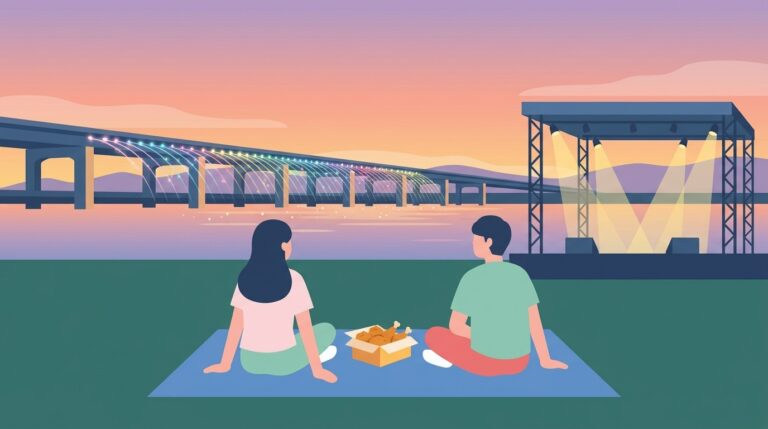
Imagine this: The sun is slowly dipping below the Seoul skyline, casting a golden-orange hue over the shimmering Han River. A cool breeze rustles the leaves of the weeping willows at Banpo Hangang Park. You have a cold can of local craft beer in one hand, a freshly delivered box of crispy Korean fried chicken in the other, and the soulful tunes of an indie acoustic band echoing from the outdoor stage. Around you, thousands of locals are gathered, yet there is a strange, beautiful harmony—no chaotic shoving, no loud altercations, and surprisingly little trash.
If you have ever felt intimidated by the unspoken social codes of large-scale Korean outdoor gatherings, you are not alone. Many of my advanced students—even those who speak fluent Korean—admit to feeling a sudden wave of social anxiety (or 눈치, nunchi) when navigating these highly organized, collective public spaces. Today, we are going to demystify the linguistic and cultural nuances of the Hangang Summer Festival (한강 썸머 페스티벌) and outdoor concerts, elevating your Korean fluency to a true native level.
Phase 2: In-Depth Linguistic Analysis of 3 Key Expressions
To navigate an outdoor concert in Korea like a seasoned local, you need more than just dictionary definitions. You need to understand the social weight behind these three crucial expressions.
1. 돗자리를 깔다 (Dot-ja-ri-reul kkal-da)
- Pronunciation: dot-ja-ri-reul kkal-da (Sounds like: “dote-jah-ree-reul kkal-dah” – soft ‘k’ sound on 깔)
- Meaning: Literally “to unfold a picnic mat,” but pragmatically, it refers to establishing your personal, temporary sanctuary in a public space.
- K-Culture Moment: You will see this phrase in almost every slice-of-life K-Drama (think Hospital Playlist or Our Beloved Summer), where friends or lovers find a quiet grassy patch by the Han River and symbolically declare their shared space by saying, “여기 돗자리 깔까?” (Yeo-gi dot-ja-ri kkal-kka? / “Shall we lay down our mat here?”).
- Editor’s Insight: Unfolding a dotjari is a subtle art of spatial negotiation. In Korea’s dense urban environment, the mat represents temporary private property. Once laid, others will actively avoid stepping on even the corner of your mat. It is a vital boundary of mutual respect.
- Situation Spectrum:
- Casual (Friends): ✅ (Extremely common, relaxed)
- Semi-formal (Coworkers): ✅ (Perfect for a casual team-building picnic)
- Formal (Elders/Superiors): ☀️ (Slightly awkward; if with seniors, use “돗자리를 준비했습니다” to show proactive politeness)
- — Think About It: Why does Korean culture place such high emphasis on the temporary boundaries of a plastic picnic mat? How does this concept of shared but respected space compare to outdoor festival dynamics in your home country?
2. 떼창 (Tte-chang)
- Pronunciation: tte-chang (Sounds like: “tteh-chahng” – emphasize the tense double ‘t’ sound)
- Meaning: Literally “flock/herd singing.” It refers to the phenomenon where the entire audience sings along to a song in perfect, booming unison.
- K-Culture Moment: International artists like Coldplay, Oasis, and Eminem have openly expressed awe at Korean ttechang culture. During live concerts, the crowd often sings not just the chorus, but the guitar riffs and instrumental solos as well!
- Editor’s Insight: While ttechang is a glorious expression of collective passion, it requires immaculate nunchi. Singing along during a high-energy K-Pop or rock festival is highly encouraged. However, doing so during a quiet, acoustic indie performance by the Han River might earn you some subtle, icy glares. Know the genre before raising your voice.
- Situation Spectrum:
- Casual: ✅ (The life of the party)
- Semi-formal: ☀️ (Keep your volume moderate)
- Formal: ⚫ (Generally inappropriate unless explicitly invited by the performer)
- — Think About It: Ttechang is the ultimate form of collective effervescence in Korea. How does this collective vocal participation reflect the broader Korean societal value of Jeong (껑, mutual affection and deep bonding)?
3. 뒷정리 (Dwit-jeong-ri)
- Pronunciation: dwit-jeong-ri (Phonetically pronounced as dwin-jeong-ni due to nasalization rules)
- Meaning: Literally “back-cleaning” or “tidying up after oneself.”
- K-Culture Moment: If you watch reality travel shows like I Live Alone (나 한따 산다), you will notice that guests always make a big show of their proactive dwit-jeong-ri before leaving a campsite or park. It is the ultimate litmus test of a person’s character.
- Editor’s Insight: In Korea, leaving even a single cup behind is a major social faux pas. The Han River parks have strict recycling and trash disposal systems. Proper dwit-jeong-ri is not just about cleanliness; it is an act of civic duty that shows you respect the space and the people who will use it after you.
- Situation Spectrum:
- Casual: ✅ (Mandatory for maintaining social standing among peers)
- Semi-formal: ✅ (Shows professionalism and reliability)
- Formal: ✅ (Non-negotiable; always take the initiative)
- — Think About It: How does the linguistic structure of compounding “back/after” (뒤) with “organization” (정리) reflect the long-term, consequence-aware mindset of Korean social etiquette?
Phase 3: Textbook Korean vs. Real Korean Showcase
When you are actually on the grassy fields of the Han River, textbook phrases can sound stiff, robotic, or even borderline rude. Let’s look at how to sound like a naturally polite, sophisticated native.
Situation 1: Negotiating Picnic Space with Neighbors
- 해 Textbook: “여기에 돗자리를 깔아도 되겠습니까?” (Yeo-gi-e dot-ja-ri-reul kkal-ah-do doe-gess-seup-ni-ka? – “May I lay down a picnic mat here?”)
- 해 Real Korean: “혹시 저희가 여기 조금만 붙여서 깔아도 괜찮을까요?” (Hok-shi jeo-hui-ga yeo-gi jo-geum-man bu-chyeo-seo kkal-ah-do gwen-chan-eul-kka-yo? – “Excuse us, would it be alright if we set up our mat slightly close to yours?”)
- 해 Why the difference? The textbook version is too transactional and clinical. The real version uses softeners like “혹시” (by any chance) and “조금만” (just a little bit) to minimize any perceived intrusion on their personal space.
Situation 2: Asking Someone to Lower a Blocking Sign/Picket
- 해 Textbook: “당신의 응원 도구가 내 시야를 가립니다. 내려주세요.” (Dang-shin-ui eung-won do-gu-ga nae shi-ya-reul ga-rip-ni-da. Nae-ryeo-ju-se-yo. – “Your cheering tool blocks my vision. Lower it.”)
- 해 Real Korean: “죄송한데, 시야를 조금 가려서요… 슬로건 조금만 내려주시면 감사하겠습니다!” (Joe-song-han-de, shi-ya-reul jo-geum ga-ryeo-seo-yo… seul-lo-geon jo-geum-man nae-ryeo-ju-shi-myeon gam-sa-ha-gess-seup-ni-da! – “I am sorry, but it’s blocking my view slightly… I’d be so grateful if you could lower your slogan banner just a bit!”)
- 해 Why the difference? Direct statements of grievance in Korea can trigger defensive reactions. Native speakers state the consequence (“it blocks my view slightly…”) using an unfinished sentence structure (가려서요…), which naturally invites cooperation without sounding confrontational.
Phase 4: K-Culture Deep Dive & Non-Verbal Manners
4-1. The Invisible Grid and “Nunchi”
When entering a crowded Han River lawn during festival season, look down. You will notice an invisible, self-organizing grid. Picnic mats are perfectly aligned with just enough space between them for a single person to walk through. This is physical nunchi in action.
* The Non-Verbal Rule: Never step on anyone else’s mat, even if it’s unoccupied. If you accidentally step on one, immediately apologize with a slight bow of the head and say “죄송합니다” (joe-song-hap-ni-da).
4-2. The Delivery Zone (배달존 – Bae-dal-jon) Culture
One of the wonders of Korea is that you can order gourmet food directly to an open public park. However, due to the massive crowds, delivery riders cannot wander the grass searching for you.
* The Survival Hack: You must walk to the designated “Delivery Zone” (배달존) near the park entrance to collect your food. When ordering via food apps, make sure to search the official Seoul Metropolitan Government Han River Park Guide to locate the exact delivery zone coordinates for Banpo or Yeouido parks.
Phase 5: Interactive Roleplay Scenario
The Setting: It’s 7:30 PM. The breeze is refreshing. You are sitting at Banpo Hangang Park with Min-jun, a warm, energetic local friend who has brought a speaker, snacks, and a massive picnic mat.
Cast:
- You (Advanced Learner)
- Min-jun (민꾼 – Your friendly Korean guide)
- Turn 1 (Min-jun): (Excitedly pointing at an open grassy patch near the stage) “야! 저기 명당 찾았다! 얼른 가서 돗자리 깔자!”
(Ya! Jeo-gi myeong-dang cha-jatt-da! Eol-leun ga-seo dot-ja-ri kkal-ja! / “Hey! I found the perfect spot over there! Let’s run and unfold our mat!”) -
Turn 2 (You): (Giggle and pick up the corner of the mat) “진짜 명당이네! 내가 한쪽 잡을게. 같이 까자.”
(Jin-짜 myeong-dang-i-ne! Nae-ga han-jjok jab-eul-ge. Gat-i kkal-ja. / “Wow, that really is the perfect spot! I’ll grab one side. Let’s unfold it together.”) -
Turn 3 (Min-jun): (Adjusting the corners of the mat with satisfying precision) “완벽해! 자, 이제 페스티벌의 하이라이트인 치맥을 시켜야지?”
(Wan-byeok-hae! Ja, i-je pe-seu-ti-beol-ui ha-i-ra-i-teu-in chi-maek-eul shi-kyeo-ya-ji? / “Perfect! Now, we have to order ‘Chimaek’ (chicken & beer), the ultimate highlight of the festival, right?”) -
Turn 4 (You): (Nodding eagerly) “당연하지! 내가 배달 앱으로 시켜볼게. 치킨이랑 생맥주 주문한다?”
(Dang-yeon-ha-ji! Nae-ga bae-dal aep-eu-ro shi-kyeo-bol-ge. Chi-kin-i-rang saeng-maek-ju ju-mun-han-da? / “Of course! I’ll order via the delivery app. I’m ordering chicken and draft beer, okay?”) -
Turn 5 (Min-jun): (Looking around at the growing crowd) “응, 근데 여기 배달존 2번이랑 가까우니까 거기로 주소 지정해줘!”
(Eung, geun-de yeo-gi bae-dal-jon i-beon-i-rang ga-kka-u-ni-ka geo-gi-ro ju-so ji-jeong-hae-jwo! / “Yeah, but since we are close to Delivery Zone 2, set that as the address!”) -
Turn 6 (You): (Typing quickly on the phone) “알았어. 배달존 2번으로 설정 완료! 치킨 오기 전에 무대 소리 좀 들어볼까?”
(Ah-rass-eo. Bae-dal-jon i-beon-eu-ro seol-jeong wan-ryo! Chi-kin o-gi jeon-e mu-dae so-ri jom deu-reo-bol-ka? / “Got it. Set to Delivery Zone 2! Shall we listen to the stage sounds before the chicken arrives?”) -
Turn 7 (Min-jun): (Singing along quietly to an acoustic song) “와, 이 노래 진짜 좋다. 어? 다음 곡 내가 진짜 좋아하는 곡인데!”
(Wa, i no-rae jin-짜 jot-da. Eo? Da-eum gok nae-ga jin-짜 jo-ah-ha-neun gok-in-de! / “Wow, this song is so good. Oh? The next song is one I absolutely love!”) -
Turn 8 (You): (Noticing the crowd starting to hum and sing along) “사람들 벌써 떼창 준비하는 것 같은데? 우리도 목소리 좀 풀어야겠어.”
(Sa-ram-deul beol-sseo tte-chang jun-bi-ha-neun geot gat-eun-de? U-ri-do mok-so-ri jom pul-eo-ya-gess-eo. / “Looks like people are already getting ready to sing along! We need to warm up our vocals too.”) -
Turn 9 (Min-jun): (Chuckling) “맞아, 한국 페스티벌은 떼창이 국룰이지! 자, 치킨 도착했다는 문자 왔다. 배달존 갔다 올게!”
(Maj-a, han-guk pe-seu-ti-beol-eun tte-chang-i gung-nul-i-ji! Ja, chi-kin do-chak-haett-da-neun mun-ja watt-da. Bae-dal-jon gat-a ol-ge! / “Indeed, singing along is the unspoken rule at Korean festivals! Oh, I just got a text that the chicken arrived. I’ll run to the delivery zone and back!”) -
Turn 10 (You): (Smiling) “갔다 와! 난 그동안 돗자리 정리해두고 맥주 세팅해놓을게.”
(Gat-a wa! Nan geu-dong-an dot-ja-ri jeong-ri-hae-du-go maek-ju se-ting-hae-nohl-ge. / “Hurry back! I’ll tidy up the mat and prep the beers while you’re gone.”)
ᄑ Decision Point
Min-jun returns with the food, but you notice a group of tourists nearby who have accidentally sat on the corner of your mat because they didn’t bring one. How do you handle this politely without creating an awkward scene?
- Option A: Stand up and tell them coldly: “여기 저희 자리예요. 비켜주세요.” (This is our spot. Please move.)
- Option B: Smile warmly and say: “아, 안녕하세요! 혹시 자리가 좁으시면 저희 돗자리 조금 비켜드릴까요? 아니면 같이 앉으실래요?” (Oh, hello! If you’re tight on space, should we adjust our mat for you? Or would you like to sit with us?)
- Option C: Say nothing but glare at them intensely until they feel uncomfortable and move away.
해 Best Choice Analysis: Option B
Option B is the masterclass in advanced Korean hospitality and social harmony. By framing it as a generous offer (“Should we adjust our mat?”), you avoid making them feel embarrassed while gently signaling that they have crossed into your boundary. They will likely apologize and adjust their position gracefully.
해 Bad Choice Analysis: Option A & C
- Option A is too aggressive and confrontational for a relaxed summer festival context.
- Option C (passive-aggressive nunchi glaring) is unfortunately common but creates toxic energy in what should be a peaceful community space.
Phase 6: 10-Second Shadowing Drill
To sound truly natural, you must master the rise and fall of emotional inflection in Korean. Practice these two native-level phrases with the specified emotional energy.
Drill 1: Expressing Absolute Awe at the Scene
- Phrase: “야, / 한강 바람 / 진짜 예술이다!”
- Phonetic Guide: ya, / han-gang ba-ram / jin-jja ye-sul-i-da!
- Emotional Cue: [ᄅ Joyful & Breezy] Raise your tone slightly on “야” and prolong “예술이다” (means “is literally art/masterpiece”) with a sigh of satisfaction.
Drill 2: Hyping Up for a Crowd Sing-along
- Phrase: “이번 노래는 / 무조건 / 떼창 각이야!”
- Phonetic Guide: i-beon no-rae-neun / mu-jo-geon / tte-chang gak-i-ya!
- Emotional Cue: [ᄃ Pumped & Confident] Deliver “무조건” (absolutely) with punchy, crisp pronunciation, and end with a rising, excited pitch on “각이야” (modern slang meaning “it’s definitely time/destined for”).
Phase 7: K-Culture Mini Dictionary
| Word (Hangeul) | Romanization | Real-world Contextual Meaning |
|---|---|---|
| 돗자리 | Dot-ja-ri | The ultimate symbol of Han River freedom. Always buy the thicker, foil-backed version at convenience stores for maximum comfort. |
| 떼창 | Tte-chang | The collective voice of a Korean crowd. A sacred ritual of mutual appreciation between artists and fans. |
| 분리수거 | Bun-ri-su-geo | Detailed recycling separation. Essential for post-festival clean-up to avoid heavy city fines. |
| 배달존 | Bae-dal-jon | Designated meeting spots for food delivery apps at Han River parks, preventing chaotic crowds from blocking delivery riders. |
Phase 8: Traveler’s Survival Kit
Survival Expressions for Festivals
- “돗자리 혹시 어디서 팔아요?” (Dot-ja-ri hok-shi eo-di-seo pal-ah-yo?)
- Pro Tip: If you forgot your mat, ask this at any park convenience store (편의점 – pyeon-ui-jeom). They usually stock them right at the entrance.
- “여기 남은 음식물은 어디에 버려야 해요?” (Yeo-gi nam-eun eum-shik-mul-eun eo-di-e beo-ryeo-ya hae-yo?)
- Pro Tip: Leftover food must be discarded in dedicated food waste bins, not general trash bins.
- “실례지만 사진 한 장만 찍어주실 수 있으세요?” (Shil-rye-ji-man sa-jin han jang-man ddik-eo-ju-shil su is-seu-se-yo?)
- Pro Tip: The golden phrase to ask friendly strangers to take your picture with the sunset in the background.
ᄑ Editor’s Travel Note
Before heading to the festival, make sure you download the Naver Map App instead of Google Maps, which does not update pedestrian pathways inside Han River parks in real-time. Additionally, pre-load your T-money card because nearby subway stations (like Yeouinaru or Sinbanpo) get incredibly congested after concerts, causing long lines at ticket machines.
Phase 9: Deep Thoughts — “한 발 더 깊이” (Going Deeper)
In many Western cultures, outdoor music festivals are associated with absolute personal liberation—dancing wherever you want, leaving footprints in the mud, and expressing individuality without restraint. In contrast, Korean outdoor festivals are masterpieces of collective coordination. The seamless alignment of picnic mats, the organized queues at food stalls, and the synchronized ttechang reflect a societal contract where individual joy is optimized through collective order.
This is not to say Koreans do not know how to let loose; rather, they believe that true collective enjoyment is only possible when everyone respects the shared boundaries of public space. It is a modern evolution of Korea’s traditional community-centric mindset adapted to a hyper-dense urban metropolis.
- ᄒ Your Turn: How does your culture balance collective social responsibility with individual freedom at music festivals? Do you prefer strict order or spontaneous chaos? Share your thoughts in the comments below!
Phase 10: FAQ & Common Mistakes
Q: Can I bring alcoholic drinks to the Han River Summer Festival?
A: Yes! Consuming alcohol (like beer or makgeolli) is completely legal in outdoor public parks in Korea. However, public intoxication that disrupts others is highly frowned upon and can result in park rangers asking you to leave.
Q: Is it okay to stand up and dance during a ballad or acoustic performance by the river?
A: Generally, no. If the crowd is seated on mats, standing up will block the view of everyone behind you. Unless the artist specifically tells everyone to stand up (“모두 일어서세요!” – Mo-du il-eo-seo-se-yo!), keep seated.
Q: What should I do if I can’t find a trash can near my mat?
A: Do not leave your trash on the grass. You must gather all your belongings and walk to the designated massive recycling stations located near the public restrooms and exits.
ᄑ Common Mistakes Warning Board
- Mistake 1: Throwing plastic cups with remaining liquids into the general recycling bin.
- Correct Action: Empty all liquids into the designated sink/bin first, then flat-crush the plastic cup for recycling.
- Mistake 2: Walking across other people’s picnic mats as a shortcut.
- Correct Action: Always walk around the perimeter of the mats, utilizing the small pedestrian corridors.
- Mistake 3: Singing ttechang so loudly that you drown out the artist’s actual voice during intimate, low-tempo songs.
- Correct Action: Match the volume and energy of the crowd around you.
Phase 11: Action Missions
- ᄇ Bronze (The Solo Mirror Challenge): Practice the two emotional shadowing drills from Phase 6 until your tone shifts naturally from relaxed joy to high-energy excitement.
- ᄉ Silver (The Social Media Challenge): Take a scenic picture of a local park or outdoor area in your city, post it, and caption it in natural Korean using: “오늘 날씨 진짜 대박! 당장 돗자리 깔고 싶다!”
- ᄀ Gold (The Real-World Challenge): Next time you attend an outdoor concert or picnic in Korea, navigate to the nearest “배달존” (Delivery Zone) and successfully order food using a local delivery app without getting lost!
Phase 12: Interactive Quiz Challenge
Test your cultural and linguistic mastery below!
1. Situational Judgment
Which of the following actions demonstrates the best nunchi when arriving at a crowded Han River festival?
* A) Finding a tiny gap between two mats and unfolding your massive family-sized mat over their corners.
* B) Politely asking nearby groups if you can align your mat closely, ensuring you leave walking space.
* C) Laying your mat directly in front of the stage standing zone so no one can stand in front of you.
ᄑ Click to reveal the Answer & Explanation
Correct Answer: B
Option B shows respect for existing boundaries while maximizing space efficiently. Option A violates the sacred ‘picnic mat sovereignty,’ and Option C disrupts the crowd flow of the venue.
2. Fill-in-the-Blanks
Complete the dialogue:
“우리가 좋아하는 밴드가 드디어 나온다! 이번 곡은 진짜 모두가 다 같이 (ᄀᄀᄀ) 부를 것 같아!”
ᄑ Click to reveal the Answer & Explanation
Correct Answer: 떼창으로 (or 떼창하며)
The context of a crowd singing along in unison requires the word 떼창 (tte-chang).
3. True or False
True or False: In Korea, it is considered perfectly acceptable to leave your recyclable trash right next to your folded picnic mat when you leave, as park cleaners will sort it later.
ᄑ Click to reveal the Answer & Explanation
Correct Answer: False
Leaving any trash on the lawn, even if bundled, is highly frowned upon and considered poor civic manners. You must carry it to the official recycling stations.







