

How to Ask for Quiet in a Korean Library Without Sounding Rude
Phase 1: Welcome! Let’s Walk into a Dreamy Seoul Book Cafe
안녕하세요! (An-nyeong-ha-se-yo!) Welcome back to Daily Hangul, your cozy corner for learning real, breathing Korean. I’m your senior editor and local guide, and today, I want to take you on a little sensory trip.
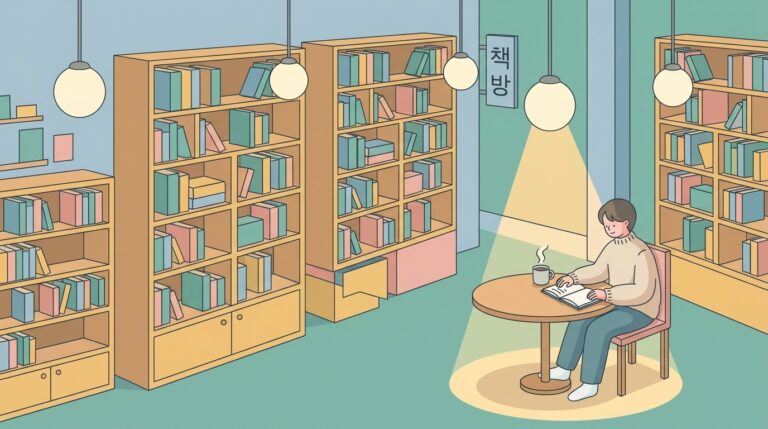
Imagine this: You’ve just walked into the breathtaking Starfield Library (별마당 도서관) in the heart of Gangnam, Seoul. Towering, 13-meter-tall wooden bookshelves reach toward a glowing glass ceiling. The air smells like fresh paper and roasted coffee. You find a perfect seat, pull out your laptop, and just as you get comfortable… BEEP!
Your phone rings at maximum volume. Or perhaps, the group next to you starts laughing loudly while you are trying to study.
Suddenly, the cozy magic fades. You feel everyone’s eyes on you, or you find yourself wondering: “How do I politely ask them to keep it down without sounding like an angry movie villain?”
Don’t worry! Today, we are going to learn how to master the art of asking for quiet in Korean. By the end of this guide, you won’t just know the words—you’ll understand the subtle social etiquette that will make local Koreans think, “Wow, this person is incredibly polite and culturally savvy!”
This lesson is based on real questions from my beginner students who felt too intimidated to study in quiet Korean spaces. Let’s dive in!
Phase 2: Three Essential Expressions to Master
Here are the top three phrases you need to know. Since you are at the A1 (beginner) level, we will keep these simple, polite, and highly practical.
1. 조용히 해주세요 (Jo-yong-hi hae-ju-se-yo)
- Pronunciation: [Jo-yong-hee hae-joo-seh-yo]
- Sound-alike guide: Think of “Yo” as in “yo-yo”, “Hae” as in “heaven”, and “Se-yo” like saying “say yo!”
- Meaning: Please be quiet. (Literally: “Please do [it] quietly.”)
- K-Culture Moment: You will hear this phrase in almost every school-themed K-Drama. It’s what a polite librarian or a classmate whispers when someone’s headphones are leaking sound.
- Editor’s Insight: This is the safest, most standard polite way to ask for quiet. It is not rude, but because it is direct, adding a gentle smile makes it much softer.
- Situation Spectrum:
- Friends & Casual: ⚠️ (Use “조용히 해줘” instead)
- Coworkers & Semi-formal: ✅
- Bosses & Elders: ⚠️ (Better to let the staff handle it, but polite enough if necessary)
- 🤔 Think About It: Why do you think Korean uses the verb “하다” (to do) here instead of a direct command like “Be quiet”? In Korean culture, framing requests as “doing an action for someone” (해 주다) naturally softens the demand!
2. 조금만 살살 말해주세요 (Jo-geum-man sal-sal mal-hae-ju-se-yo)
- Pronunciation: [Jo-geum-man sal-sal mahl-hae-joo-seh-yo]
- Sound-alike guide: “Sal-sal” sounds like the “sal” in “salad.” Say it twice softly!
- Meaning: Please speak a little more softly.
- K-Culture Moment: In cozy indie music cafes in Hongdae, you might hear patrons whispering this to friends so they don’t disturb the acoustic performance.
- Editor’s Insight: This is a hidden gem of a phrase! “살살” (sal-sal) is an adorable mimetic word meaning “gently” or “softly.” Using this phrase shows you have a high level of empathy and vocabulary.
- Situation Spectrum:
- Friends & Casual: ✅
- Coworkers & Semi-formal: ✅
- Bosses & Elders: ✅
3. 쉿! (Swit!)
- Pronunciation: [Shee-t!]
- Sound-alike guide: Exactly like the English “Shh!” but ending with a very soft, clipped “t” sound at the back of your throat.
- Meaning: Shh! / Quiet!
- K-Culture Moment: Used playfully by K-Pop idols in music videos when they want to share a secret with the camera.
- Editor’s Insight: Only use this with close friends or children! Using “쉿” with a stranger in a Korean library can come across as aggressive or childish.
- Situation Spectrum:
- Friends & Casual: ✅
- Coworkers & Semi-formal: 🚫
- Bosses & Elders: 🚫
Phase 3: Textbook Korean vs. Real Korean
Let’s compare what textbooks teach you versus what Koreans actually say in real life.
Situation 1: Asking someone to lower their voice in a study cafe
- 📖 Textbook Korean: 정숙해 주십시오. (Jeong-suk-hae ju-sip-si-o.)
- What it means: “Please maintain silence.”
- 🗣️ Real Korean: 목소리 조금만 낮춰주세요. (Mok-so-ri jo-geum-man nat-chwo-ju-se-yo.)
- What it means: “Please lower your voice just a little bit.”
- 💡 Why is it different? “정숙” is an extremely formal hanja (Chinese character) word. You will see it printed on signs, but if you say it out loud to a human, you will sound like a 19th-century royal guard! The real Korean phrase focuses gently on the “voice” (목소리) rather than ordering the person’s character.
Situation 2: Asking your friend to stop talking loudly in a bookstore
- 📖 Textbook Korean: 잡담하지 마세요. (Jap-dam-ha-ji ma-se-yo.)
- What it means: “Do not gossip/chatter.”
- 🗣️ Real Korean: 우리 조금만 조용히 하자. (U-ri jo-geum-man jo-yong-hi ha-ja.)
- What it means: “Let’s be a little quiet.”
- 💡 Why is it different? Koreans love using the collective “우리” (we/us). Instead of saying “You are being noisy,” saying “Let’s be quiet together” removes the blame and keeps the friendship warm.
Phase 4: K-Culture Deep Dive & Non-Verbal Etiquette
4-1. The Magic of “Nunchi” (눈치) and Body Language
In Korea, communication is 70% verbal and 30% non-verbal. When asking for quiet, your body language is actually more important than your grammar!
1. The Gentle Head Tilt (목례 – Mong-nye): When you approach someone to ask them to be quiet, bow your head slightly (about 15 degrees) first. This shows you respect them and are sorry to interrupt.
2. The Hand Shield: When speaking, cup your hand near your mouth as if you are sharing a precious secret. This visual cue instantly signals, “I am trying to keep the volume low, too!”
3. Eye Contact: Avoid staring deeply into their eyes, which can feel confrontational. Instead, look slightly down or at their shoulder level.
4-2. The Evolution of Korean Study Spaces
If you visit Korea, you will see “Study Cafes” (스터디카페 – Se-teo-di Ka-pe) everywhere. Unlike normal cafes, these are hybrid spaces designed for quiet study with individual desks, free snacks, and white noise machines. The golden rule here is absolute quietness. Knowing how to navigate these spaces with proper etiquette is a major part of modern Korean student life!
Phase 5: Roleplay – A Quiet Afternoon in Yeonnam-dong
Let’s put you in a live scenario! You are in a cozy, aesthetic book cafe in Yeonnam-dong. You are studying Korean, but the person next to you is listening to a K-Pop track with leaky headphones.
Cast:
- You: A polite, determined Korean learner.
- Jiwoo (지우): A friendly university student who doesn’t realize her music is loud.
The Script:
- You: 🎭 (Tapping your own shoulder nervously, then looking at Jiwoo)
저기요… 저기…
(Jeo-gi-yo… jeo-gi…)
“Excuse me… excuse me…” -
Jiwoo: 🎭 (Takes off one earphone, looking surprised)
네? 저요?
(Ne? Jeo-yo?)
“Yes? Me?” -
You: 🎭 (Smiling softly, bowing head slightly)
죄송한데, 소리가 조금 커요.
(Joe-song-han-de, so-ri-ga jo-geum keo-yo.)
“I am sorry, but the sound is a little loud.” -
Jiwoo: 🎭 (Blushing slightly)
아! 정말요? 죄송해요. 몰랐어요.
(Ah! Jeong-mal-yo? Joe-song-hae-yo. Mol-las-seo-yo.)
“Oh! Really? I’m sorry. I didn’t know.” -
You: 🎭 (Waving hands gently to show it is okay)
괜찮아요! 조금만 살살… 조용히 해주세요.
(Gwen-cha-na-yo! Jo-geum-man sal-sal… jo-yong-hi hae-ju-se-yo.)
“It’s okay! Just a little softly… please be quiet.” -
Jiwoo: 🎭 (Nodding quickly, turning down the volume)
네, 죄송합니다. 이제 조용히 할게요!
(Ne, joe-song-ham-ni-da. I-je jo-yong-hi hal-ge-yo!)
“Yes, sorry. I will be quiet now!” -
You: 🎭 (Smiling warmly with a small bow)
감사합니다!
(Gam-sa-ham-ni-da!)
“Thank you!”
🔀 Decision Point: Your Phone Rings!
Suddenly, your own phone starts vibrating loudly on the wooden table. What do you do?
- Choice A: Quickly grab it, answer loudly, and say “조용히 하세요!” to the phone.
- Choice B: Pick up the phone, press the volume button to mute it, bow deeply to the room, and run outside to take the call.
- Choice C: Ignore it and hope people think it belongs to someone else.
🏆 Best Choice: Choice B
Pressing mute instantly stops the disturbance. Running outside to take a call shows great respect for the shared space. Saying “죄송합니다” (I am sorry) with a quick nod as you leave will earn you gold stars in cultural manners!
Phase 6: 10-Second Emotion Shadowing Drill
Let’s practice speaking with real emotion! Follow the slash marks / for pauses, and matching the emotional cues in brackets.
- [🥺 Apologetic & Soft]
죄송한데 / 조금만 / 조용히 해주세요.
(Joe-song-han-de / jo-geum-man / jo-yong-hi hae-ju-se-yo.) -
[😊 Friendly & Sweet with a classmate]
우리 / 조금만 / 살살 / 말하자!
(U-ri / jo-geum-man / sal-sal / mal-ha-ja!) -
[🤫 Secretive whisper]
쉿, / 조용히 해야 돼.
(Swit, / jo-yong-hi hae-ya dwae.)
Phase 7: K-Culture Mini Dictionary
| Word (Korean) | Romanization | English Translation | Cultural Meaning & Usage |
|---|---|---|---|
| 북카페 | Buk-ka-pe | Book Cafe | A popular cozy trend in Korea where you can drink delicious lattes while reading from a curated shelf of books. |
| 스터디카페 | Se-teo-di Ka-pe | Study Cafe | High-tech, quiet study rooms used by students and remote workers. Shushing rules are very strict here! |
| 눈치 | Nun-chi | Social Tact / Wits | The unspoken art of reading the room. Essential for knowing when to stay quiet without anyone asking. |
| 매너 | Mae-neo | Manners / Etiquette | Loaned from English, Koreans use this to describe someone who is highly considerate of others in public. |
Phase 8: Traveler’s Survival Kit
If you are traveling in Korea, keep these three phrases in your back pocket:
- 여기 조용히 해야 돼요? (Yeo-gi jo-yong-hi hae-ya dwae-yo?)
- Meaning: “Do I need to be quiet here?”
- Pro Tip: Ask this to staff if you aren’t sure if a cafe is a chatty place or a study-only zone.
- 진동으로 해주세요. (Jin-dong-eu-ro hae-ju-se-yo.)
- Meaning: “Please set [your phone] to vibrate.”
- Pro Tip: Perfect to say gently to a friend whose phone keeps ringing.
- 밖에서 통화해 주세요. (Bak-e-seo tong-hwa-hae-ju-se-yo.)
- Meaning: “Please talk on the phone outside.”
- Pro Tip: Use this if someone is having a loud phone call right next to your study desk.
📌 Editor’s Travel Note:
When traveling through Seoul, navigating quiet spaces is easy when you have the right tools. Download the Naver Map Application to find the quietest neighborhood book cafes near you. Keep in mind that on Korean subways (especially the silent cars), it is custom to keep your phone on silent mode (“진동” or vibration) out of respect for commuters.
Phase 9: Deep Thoughts — “Not Bothering Others” (남에게 피해 주지 않기)
In Western cultures, public spaces are often seen as places for individual freedom. In Korea, however, public spaces are governed by a deep-rooted social philosophy: 남에게 피해 주지 않기 (Nam-e-ge pi-hae ju-ji ank-gi), which translates to “Do not cause harm or inconvenience to others.”
Because Korea has high population density, maintaining harmony in shared spaces requires everyone to self-regulate. Staying quiet in a library isn’t just about following rules; it’s an active way of showing respect to your community.
💬 Your Turn: How do people in your country react when someone is loud in a library? Do you have a word like “Nunchi”? Tell me in the comments below!
Phase 10: FAQ & Avoiding Common Mistakes
Q: Can I use “조용히 해!” (Jo-yong-hi hae!) to tell someone to be quiet?
A: No, absolutely not to strangers! “조용히 해!” is informal and commanding. It sounds like “Shut up!” If you say this to a stranger or an older person, it will cause a major argument. Always add “주세요” (ju-se-yo) to keep it polite.
Q: What should I do if someone is extremely loud and won’t stop?
A: It depends, but usually, ask the staff. In Korea, direct confrontation is often avoided to maintain social peace. It is highly recommended to quietly tell the library clerk or cafe barista: “저기요, 너무 시끄러워요” (Excuse me, it’s too noisy) and let them handle it.
Q: Is whispering allowed in study cafes?
A: Yes, but keep it very brief. Constant whispering can actually be more distracting than a quick normal sentence. Keep it to a minimum!
🚨 Common Mistakes Alert!
- Mistake 1: Saying “쉿!” loudly to a stranger. (Correct Action: Whisper “조금만 조용히 해주세요” with a small bow).
- Mistake 2: Forgetting to put your phone on “Vibrate” (진동) mode when entering. (Correct Action: Make it a habit to switch to silent mode the moment you step inside).
- Mistake 3: Saying “정숙하십시오” out loud. (Correct Action: Use natural, spoken words like “목소리 조금만 낮춰주세요”).
Phase 11: Your Daily Hangul Action Missions!
Complete these missions to put your skills to the test!
- 🥉 Bronze (At-Home Challenge): Record yourself saying “조금만 살살 말해주세요” three times in a soft whisper. Listen to make sure your “sal-sal” sounds gentle!
- 🥈 Silver (Social Media Challenge): Share a picture of your favorite reading spot or book on Instagram, tag
@DailyHangul, and write: “여기서 조용히 하세요! 🤫” - 🥇 Gold (Real-Life Challenge): The next time you visit a quiet cafe or library, practice the “Nunchi Bow” (목례) when passing by someone else’s desk.
Phase 12: Interactive Quiz Challenge
Test your knowledge below! Click on the toggle boxes to reveal the correct answers.
1. Which phrase is the most natural and polite way to ask a classmate to speak softer?
- A) 조용히 해! (Jo-yong-hi hae!)
- B) 조금만 살살 말해줘. (Jo-geum-man sal-sal mal-hae-jwo.)
- C) 정숙하십시오. (Jeong-suk-hap-si-o.)
🔍 Click here for the Answer
Correct Answer: B
Since they are a classmate (friend), using the casual but sweet “조금만 살살 말해줘” is perfect. Option A is too aggressive, and Option C is way too formal!
2. Fill in the blank:
“죄송한데, 목소리 조금만
__________ 주세요.” (Please lower your voice a little bit.)
🔍 Click here for the Answer
Correct Answer: 낮춰 (nat-chwo)
“낮춰 주세요” comes from the verb “낮추다” which means to lower. Together, it means “please lower [it] for me.”
3. True or False: It is polite to look directly into a stranger’s eyes and point your finger when telling them to be quiet in Korea.
🔍 Click here for the Answer
Correct Answer: False!
Direct pointing and intense eye contact can be seen as highly confrontational in Korea. Instead, use a gentle head bow, look slightly down, and cup your hand over your mouth when speaking.
Keep practicing, keep exploring, and enjoy the beautiful quiet spots of Korea! See you in the next lesson!
안녕! (An-nyeong!)







