

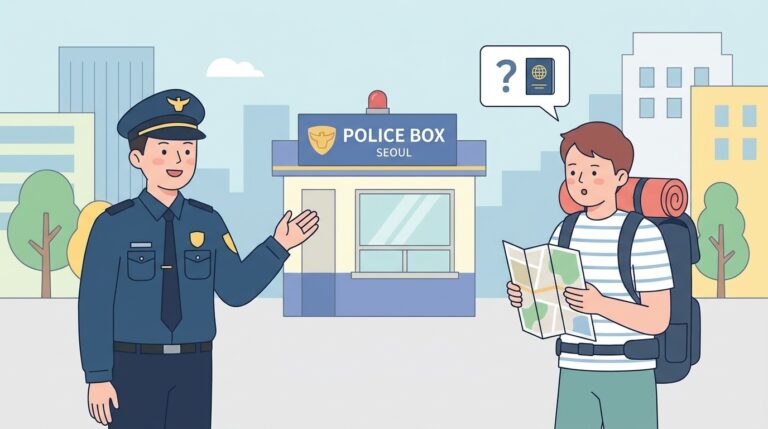
Oh No! I Lost My Passport: Your Ultimate K-Travel Survival Guide
Phase 1: Empathy (Your Panic-Free Safety Net)
안녕하세요! (An-nyeong-ha-se-yo!) Hello, my dear friend! I am your lead editor at Daily Hangul.
Imagine this: You are having the absolute perfect day in Seoul. You just ate a delicious bowl of hot, spicy tteokbokki (떡볶이) in Hongdae, took some beautiful photos under the glowing Han River sunset, and even bought the exact same keychain your favorite K-Pop idol has on their backpack. You reach into your bag to grab your passport for tax-free shopping, and… nothing. Your heart drops. Your hands shake.
We have all been there. In fact, just last month, my student Sarah from Boston called me in tears from a café near Namsan Tower. She had dropped her passport somewhere between the cable car and the photo zone.
But here is the good news: Korea is one of the safest and most honest countries in the world. There is a very high chance someone has already handed your passport to a local police box or a lost and found center!
Learning just a few simple phrases will help you communicate clearly, get your passport back, and turn this scary moment into a warm story of Korean hospitality. Let’s learn how to handle this like a pro!
Phase 2: 3 Core Expressions for Your Emergency Kit
Here are the three most important phrases you need right now. Let’s break them down easily for beginner learners!
1. 여권을 잃어버렸어요 (Yeo-gwon-eul il-eo-beo-ryeo-sseo-yo)
- Pronunciation: [yuh-gwon-eul il-uh-buh-ryuh-ssuh-yo] / Sounds like: “Yuh-gwon” (similar to ‘yawn’ but with a ‘g’) + “eul” + “ill-uh-buh-ryuh-suh-yo”
- Meaning: I lost my passport.
- K-Culture Moment: This is the ultimate dramatic sentence in any travel K-Drama! Picture the main character running through the airport, searching every pocket while dramatic violin music plays in the background.
- Editor’s Insight: The word 여권 (yeo-gwon) means passport. 잃어버렸어요 (il-eo-beo-ryeo-sseo-yo) is the polite past tense of “to lose.” If you say this with a worried face, any local will immediately understand your situation and want to help.
- Situation Spectrum:
- Friend / Casual: ⚠️ (Saying “여권 잃어버렸어” [yeo-gwon il-eo-beo-ryeo-sseo] is okay, but always use the polite form in emergencies!)
- Police / Officers: ✅ (Highly recommended!)
- Formal / Strangers: ✅
- 🤔 Think About It: In Korean, we often drop the word “I” (저는) because the context makes it obvious. It is much more natural to just say “Passport lost!” instead of “I lost my passport.” How does your native language handle this?
2. 분실물 센터가 어디예요? (Bun-sil-mul sen-teo-ga eo-di-ye-yo?)
- Pronunciation: [boon-sil-mool sen-tuh-ga uh-dee-yay-yo?]
- Meaning: Where is the lost and found center?
- K-Culture Moment: You will see this sign at major subway stations like Gangnam or Hongdae, and at big tourist spots. It is your destination for reclaiming lost bags, wallets, and sometimes even plushies!
- Editor’s Insight: 분실물 (bun-sil-mul) means “lost item,” and 센터 (sen-teo) is the Koreanized pronunciation of “center.” This is a great, easy word to memorize because it sounds so close to English!
- Situation Spectrum:
- Friend / Casual: ⚠️
- Police / Officers: ✅
- Formal / Strangers: ✅
- 🤔 Think About It: Notice how “center” became “센터” (sen-teo)? Korean uses many English loanwords (called Konglish). Can you think of other Korean words that sound like English?
3. 도와주실 수 있나요? (Do-wa-ju-sil su in-na-yo?)
- Pronunciation: [doh-wah-joo-shil soo een-nah-yo?]
- Meaning: Can you help me?
- K-Culture Moment: This is the universal phrase of a polite traveler in need. In K-Dramas, this is when the kind local stranger smiles warmly and goes out of their way to solve the main character’s problem.
- Editor’s Insight: This is a very soft, polite way to ask for assistance. It shows respect and invites cooperation instantly.
- Situation Spectrum:
- Friend / Casual: 🚫 (Too formal for close friends)
- Police / Officers: ✅
- Formal / Strangers: ✅
- 🤔 Think About It: Koreans value polite requests. Instead of saying “Help me!” (도와주세요! – do-wa-ju-se-yo!), adding “~실 수 있나요?” (Can you~?) makes it sound much gentler. This shows the cultural importance of politeness and consideration for others.
Phase 3: Textbook Korean vs. Real Korean
When we learn from old textbooks, we might sound like robots. Let’s look at how to sound like a real person in Seoul!
Situation 1: Asking if someone saw your passport
- 📖 Textbook Korean: 제 여권을 본 적이 있습니까? (Je yeo-gwon-eul bon jeok-i it-seup-ni-ka? – “Do you have the experience of seeing my passport?”)
- 🗣️ Real Korean: 혹시 여권 못 보셨나요? (Hok-si yeo-gwon mot bo-syeot-na-yo? – “By any chance, did you see my passport?”)
- 💡 Why is it different? Koreans love using “혹시” (by any chance) to soften a question. Using the negative form “못 보셨나요?” (did you not see?) sounds much more polite and less demanding to a stranger’s ears.
Situation 2: Asking to search together
- 📖 Textbook Korean: 저를 도와서 그것을 찾읍시다. (Jeo-reul do-wa-seo geu-geot-eul chat-eup-si-da. – “Help me and let’s find it.”)
- 🗣️ Real Korean: 같이 한 번 찾아봐 주실 수 있나요? (Ga-chi han beon cha-ja-bwa ju-sil su in-na-yo? – “Could we look for it together once?”)
- 💡 Why is it different? Korean culture is highly community-oriented. Using the word “같이” (together) and “한 번” (once/a try) sounds warm and friendly, making people genuinely want to stop what they are doing to help you.
Phase 4: K-Culture Deep Dive & Non-verbal Manners
4-1. Nunchi (눈치) and Body Language
When you are stressed, your body language speaks louder than words. If you go to a police box (지구대 – ji-gu-dae), follow these local manners:
* Two Hands Rule: When receiving your recovered passport, always hold it with both hands and give a small bow. This shows deep respect and gratitude.
* Soft Eye Contact: Koreans find intense, unblinking eye contact slightly aggressive, especially in stressful situations. Keep your eyes soft, and nod your head frequently to show you are listening.
4-2. The Korean “Honesty” Phenomenon
If you watch K-vlogs, you have probably seen people leave their expensive laptops and wallets on café tables to go to the restroom. This is real! Many Koreans believe in Yang-sim (양심 – conscience). If someone finds your passport, they will usually hand it to:
1. The café or subway staff.
2. The nearest post box (yes, if you drop an item in a red post box, the postal service delivers it to the police!).
3. The nearest police box (지구대).
Phase 5: Interactive Roleplay: At the Hongdae Police Box
Let’s play a game! You have just walked into a cozy, brightly lit police station near Hongdae. An officer with kind eyes looks up at you.
Visual Guide for the Scene:
The Cast:
- You: A panicked traveler who lost their passport.
- Officer Kim: A warm, helpful local police officer.
The Script:
- Officer Kim: (🎭 Smiling warmly) 안녕하세요! 무엇을 도와드릴까요?
(An-nyeong-ha-se-yo! Mu-eot-eul do-wa-deu-ril-kka-yo?)
“Hello! How can I help you?” -
You: (🎭 Looking worried, bowing slightly) 저… 여권을 잃어버렸어요.
(Jeo… yeo-gwon-eul il-eo-beo-ryeo-sseo-yo.)
“Um… I lost my passport.” -
Officer Kim: (🎭 Gasping gently, showing empathy) 아, 정말요? 언제 잃어버리셨어요?
(Ah, jeong-mal-yo? Eon-je il-eo-beo-ri-syeot-eo-yo?)
“Oh, really? When did you lose it?” -
You: (🎭 Thinking hard) 오늘 오후 한 시쯤이요.
(O-neul o-hu han si-jjeum-i-yo.)
“Around 1 PM today.” -
Officer Kim: (🎭 Nodding and typing on his computer) 어디서 잃어버린 것 같아요?
(Eo-di-seo il-eo-beo-rin geot gat-a-yo?)
“Where do you think you lost it?” -
You: (🎭 Pointing outside) 홍대 카페 근처요.
(Hong-dae ka-pe geun-cheo-yo.)
“Near a Hongdae café.” -
Officer Kim: (🎭 Searching the database) 아! 혹시 여권 케이스 색깔이 파란색인가요?
(Ah! Hok-si yeo-gwon ke-i-seu saek-kkal-i pa-ran-saek-in-ga-yo?)
“Oh! By any chance, is your passport case blue?” -
You: (🎭 Eyes widening with hope) 네, 맞아요! 파란색이에요!
(Ne, ma-ja-yo! Pa-ran-saek-i-e-yo!)
“Yes, that’s right! It’s blue!” -
Officer Kim: (🎭 Smiling and retrieving a blue passport from a drawer) 여기 있습니다! 어떤 분이 길에서 주워서 여기 맡겨주셨어요.
(Yeo-gi it-seup-ni-da! Eo-tteon bun-i gil-e-seo ju-wo-seo yeo-gi mat-gyeo-ju-syeot-eo-yo.)
“Here it is! Someone picked it up on the street and left it here.” -
You: (🎭 Taking it with both hands, bowing deeply) 와, 정말 감사합니다! 한국 최고예요!
(Wa, jeong-mal gam-sa-hap-ni-da! Han-guk choe-go-ye-yo!)
“Wow, thank you so much! Korea is the best!”
🔀 Decision Point: What do you say to the person who found it?
Imagine Officer Kim says the finder left their phone number. How do you respond to show proper Korean politeness?
- Option A: “돈 줄게요!” (Don jul-ge-yo! – “I will give you money!”)
- Option B: “정말 감사합니다. 기프티콘 보내드릴게요!” (Jeong-mal gam-sa-hap-ni-da. Gi-peu-ti-kon bo-nae-deu-ril-ge-yo! – “Thank you so much. I will send you a digital gift coupon!”)
- Option C: “왜 제 여권을 가져갔어요?” (Wae je yeo-gwon-eul ga-jeo-gat-eo-yo? – “Why did you take my passport?”)
💡 The Verdict:
- Best Choice: Option B! In modern Korea, sending a “기프티콘” (gifticon – a digital coffee voucher via KakaoTalk) is the ultimate friendly way to say thank you without making things awkward.
- Risky Choice: Option A. Offering direct cash can sometimes feel transactional or slightly awkward for proud locals.
- Worst Choice: Option C. Oh no! This sounds like you are accusing them of stealing it. They were trying to help! Avoid this at all costs.
Phase 6: 10-Second Emotion Shadowing Drill
Speak with feeling! Try saying these sentences out loud, pausing at the / marks.
- [🥺 Worried & Polished]
저… / 여권을 / 잃어버렸어요.
(Jeo… / yeo-gwon-eul / il-eo-beo-ryeo-sseo-yo.)
“Um… / my passport… / I lost it.” -
[😭 Panicked & Urgently Seeking Help]
도와주실 수 / 있나요? / 제발요!
(Do-wa-ju-sil su / in-na-yo? / Je-bal-yo!)
“Could you please help me? / Can you? / Please!” -
[😊 Joyful & Grateful]
찾았다! / 정말 / 감사합니다!
(Cha-jat-da! / Jeong-mal / gam-sa-hap-ni-da!)
“Found it! / Really / thank you so much!”
Phase 7: K-Culture Mini Dictionary
| Word (Korean + Romanization) | English Translation | Real-world Context |
|---|---|---|
| 분실물 (Bun-sil-mul) | Lost Item | You will see this word on lockers, subway information desks, and airport signs. |
| 대사관 (Dae-sa-gwan) | Embassy | If your passport is truly gone, you must visit your country’s 대사관 in Seoul to get a temporary one. |
| 경찰서 (Gyeong-chal-seo) | Police Station | The main office where you can report lost items. For small neighborhood boxes, ask for a “지구대” (ji-gu-dae). |
| 임시여권 (Im-si-yeo-gwon) | Emergency Passport | The temporary travel document you get from your embassy to go back home. |
Phase 8: Traveler’s Survival Kit
Survival Expressions TOP 3
- 지갑도 같이 잃어버렸어요. (Ji-gap-do ga-chi il-eo-beo-ryeo-sseo-yo.)
- Meaning: I lost my wallet too. (Use this if you lost your whole bag!)
- 경찰서가 어디에 있나요? (Gyeong-chal-seo-ga eo-di-e in-na-yo?)
- Meaning: Where is the police station?
- 제 전화번호는 … 입니다. (Je jeon-hwa-beon-ho-neun … im-ni-da.)
- Meaning: My phone number is …
📌 Editor’s Travel Note:
- The Magic Portal: Before going to the police station, check the Official LOST112 Portal online. It is Korea’s national database for lost and found items. Every single item found by police or citizens is uploaded here with photos!
- Getting Around: To find the nearest police box easily, download and use the Naver Map App Download Page. Google Maps does not work well for walking directions in South Korea!
Phase 9: Deep Thoughts — “Conscience and Trust”
Why does Korea have such a high recovery rate for lost items? It comes down to a deep cultural belief in Jeong (정)—a feeling of warm connection and empathy toward others—combined with the concept of Yang-sim (양심), or conscience.
Koreans put themselves in the shoes of the person who lost the item. They think, “If I lost my precious passport in a foreign country, I would be so scared. I must help them find it!” This strong community spirit makes the streets of Korea incredibly safe for travelers.
💬 Your Turn: How does your home country handle lost items? Is there a central lost-and-found website like LOST112? Let me know in the comments below!
Phase 10: FAQ & Avoiding Mistakes
Q: Can I go to any police box to find my passport?
A: Yes! Any neighborhood police box (지구대) can log into the central system to check if your passport has been found anywhere in the city.
Q: What should I do if my passport is not in the system?
A: Don’t wait too long! If it doesn’t show up within 24 hours, contact your country’s 대사관 (embassy) in Seoul immediately to apply for an emergency passport (임시여권).
Q: Is there a fee for recovering lost items at the center?
A: No, absolutely not. The service is 100% free of charge. It is a public service!
🚨 Common Mistakes Warning!
- Mistake: Saying “내 여권 내놔” (Nae yeo-gwon nae-nwa).
- Why: This means “Give me my passport!” in a very rude, demanding slang.
- Correct Action: Say “여권 혹시 찾을 수 있을까요?” (Yeo-gwon hok-si cha-jeul su i-sseul-kka-yo? – “Could I perhaps find my passport?”).
- Mistake: Panicking and shouting in English at the staff.
- Why: This can trigger “foreigner anxiety” in shy staff members, making them freeze.
- Correct Action: Take a deep breath, bow slightly, and use our warm, polite Korean phrases!
Phase 11: Action Mission!
- 🥉 Bronze (At-Home Challenge): Practice saying “여권을 잃어버렸어요” in front of the mirror 3 times with your best worried face.
- 🥈 Silver (Network Challenge): Share this guide on your social media with the hashtag
#DailyHangulto save your fellow travelers from a vacation nightmare! - 🥇 Gold (Real-Life Challenge): Next time you visit a café in Seoul, look around for the “분실물” (lost and found) corner or box. Recognizing the word in real life is a huge win!
Phase 12: Interactive Quiz
Let’s test your survival skills!
1. Match the Phrase!
What should you say when you want to ask “Where is the lost and found?”
* A) 대사관이 어디예요?
* B) 분실물 센터가 어디예요?
* C) 여권을 주세요!
Check Answer
Correct Answer: B!
– A means “Where is the embassy?”
– C means “Give me the passport!” (Too aggressive!)
– B is the perfect phrase for finding the lost and found center!
2. True or False?
If you find a lost item on a Seoul street, you can drop it inside a red public post box, and the post office will send it to the police station.
* A) True
* B) False
Check Answer
Correct Answer: A (True)!
This is a unique and wonderful service in Korea. The postal workers collect lost items from post boxes and register them into the lost-and-found system!
3. Complete the Conversation
Officer: “무엇을 도와드릴까요?” (How can I help you?)
You: “여권을 ______________.”
* A) 먹었어요 (ate)
* B) 좋아해요 (like)
* C) 잃어버렸어요 (lost)
Check Answer
Correct Answer: C!
Unless you had a very strange lunch, you definitely did not eat (먹었어요) or like (좋아해요) your lost passport. 잃어버렸어요 (lost) is the correct word!






