

Clearing the Air: How to Untangle Misunderstandings and Make Up in Korean Like a Pro
안녕하세요! (An-nyeong-ha-se-yo!) Welcome back to Daily Hangul. I’m your Chief Editor and cultural guide, your go-to Korean friend who knows exactly where textbooks leave you hanging and where real life begins.
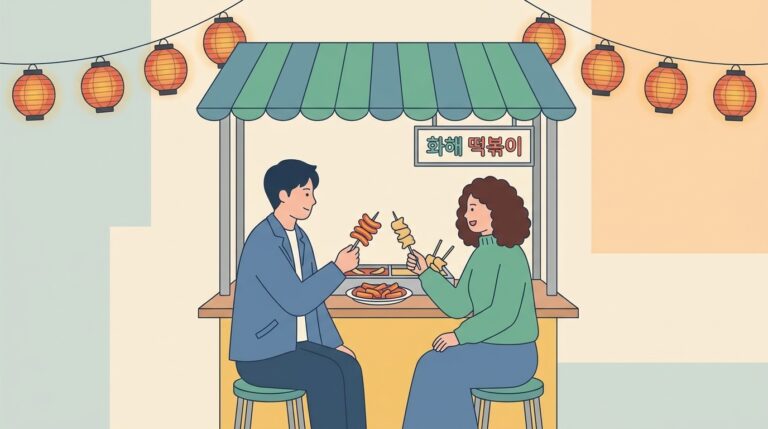
Imagine this: You’re hanging out with your Korean friend, Minjun, at a cozy, neon-lit pojangmacha (포장마차 – street food tent) in Seoul. You make a light joke, but Minjun suddenly goes quiet. He starts playing with his chopsticks, barely looking at you. The atmosphere instantly freezes colder than a Seoul winter night. You think, “Oh no, did I say something wrong? How do I fix this without making it weirder?”
In Korea, relationships are deeply rooted in unspoken vibes, or Nunchi (눈치). Misunderstandings happen to everyone, but knowing how to untangle them—what we call “풀다” (pul-da – to untie/resolve)—is an art form. Today, we’re going beyond robotic textbook apologies and learning how to actually heal a rift, warm up a frozen atmosphere, and make your bond even stronger.
By the end of this guide, you’ll know exactly how to turn a tense moment into a heartwarming memory over a plate of sizzling Korean food!
1. Deep Dive: Three Core Expressions to Melt the Ice
When a misunderstanding occurs, jumping straight into a dry “I’m sorry” (미안합니다) can sometimes feel cold or clinical. Instead, use these three emotionally resonant phrases to explain your heart.
① 오해하지 마세요 (O-hae-ha-ji ma-se-yo)
- Pronunciation: O-hae-ha-ji ma-se-yo (Sound-alike: “Oh-heh-hah-jee mah-seh-yo”)
- Meaning: “Please don’t misunderstand” or “Please don’t get the wrong idea.”
- K-Culture Moment: This is the ultimate K-Drama starter pack phrase! Think of the scene where the main character runs after their friend to explain why they were spotted with a rival. Before explaining the facts, they always say, “오해하지 마세요!”
- Editor’s Insight: This phrase acts as an emotional shield. It gently asks the other person to pause their judgment and listen to your true intention. For close friends, simply drop the “요” (yo) and say: “오해하지 마 (O-hae-ha-ji-ma).”
- Situation Spectrum:
- Friends/Casual: ✅
- Colleagues/Semi-formal: ✅
- Bosses/Formal: ✅ (For high formal, use “오해 없으시길 바랍니다” – I hope there is no misunderstanding)
- 🤔 Think About It: Starting with “Please don’t misunderstand” shows that you care deeply about how your actions affected the other person’s peace of mind. Why do you think acknowledging the other person’s potential reaction first is so powerful in Korean culture?
② 그런 뜻이 아니었어요 (Geu-reon tteu-si a-ni-eot-seo-yo)
- Pronunciation: Geu-reon tteu-shi ah-nee-eot-suh-yo (Sound-alike: “Koo-ryeon tteu-shee ah-nee-ut-suh-yo”)
- Meaning: “I didn’t mean it that way” (Literally: “It was not that kind of meaning.”)
- K-Culture Moment: Incredibly useful when texting on Kakaotalk. Without facial expressions, a short Korean text can sound blunt. If someone replies with a simple “?” or “…”, this is your immediate rescue sentence.
- Editor’s Insight: This doesn’t argue who is right or wrong. It simply clarifies your intention. It says, “My words came out wrong, but my heart is clean.”
- Situation Spectrum:
- Friends/Casual: ✅ (그런 뜻 아니었어 – Geu-reon tteu-si a-ni-eot-seo)
- Colleagues/Semi-formal: ✅
- Bosses/Formal: ✅
- 🤔 Think About It: Korean is a high-context language where the “뜻” (meaning/intention) behind words carries more weight than the literal dictionary definition. Have you ever said something in your native language that was taken completely out of context?
③ 서운했다면 미안해요 (Seo-un-haet-da-myeon mi-an-hae-yo)
- Pronunciation: Seo-un-het-dah-myeon mee-ahn-heh-yo
- Meaning: “I’m sorry if I hurt your feelings / if you felt left out.”
- K-Culture Moment: Perfect for situations when you forgot to invite a friend to a gathering, or forgot to reply to their message, causing them to feel neglected.
- Editor’s Insight: This uses the untranslatable word 서운하다 (seo-un-ha-da), which is a mix of sadness, mild disappointment, and feeling neglected by someone you love. Saying this shows you possess incredibly high-level cultural empathy.
- Situation Spectrum:
- Friends/Casual: ✅ (서운했다면 미안해 – Seo-un-haet-da-myeon mi-an-hae)
- Colleagues/Semi-formal: ✅
- Bosses/Formal: ⚠️ (A bit too personal for a strict corporate setting. Use “불편하게 해 드려 죄송합니다” – I apologize for making you uncomfortable instead.)
- 🤔 Think About It: You can only feel seo-un-hada toward people you care about. If a stranger ignores you, you might be annoyed, but not seo-un-hae. Because of this, using this phrase actually reaffirms how much you value your friendship!
2. Textbook Korean vs. Real-World Korean
Let’s compare the sterile sentences you find in dusty textbooks with what cool, empathetic Koreans actually say in real life.
Scenario A: Explaining your mistake
- 📖 Textbook Korean: “제 행동에 대해 해명하겠습니다.” (Je haeng-dong-e dae-hae hae-myeong-ha-get-seup-ni-da.)
- Critique: “I shall offer an explanation for my conduct.” Unless you are a politician holding a formal press conference on television, do not say this! It sounds incredibly defensive and cold.
- 🗣️ Real Korean: “사실은 제가 오해받을 만하게 행동했어요.” (Sa-si-reun je-ga o-hae-ba-deul man-ha-ge haeng-dong-haet-seo-yo.)
- Nuance: “Honestly, I acted in a way that was easy to misunderstand.” This is warm, self-reflective, and immediately disarms the other person.
Scenario B: Proposing to make up over food
- 📖 Textbook Korean: “우리 화해합시다.” (U-ri hwa-hae-hap-si-da.)
- Critique: “Let us reconcile.” This sounds like signing a peace treaty between two warring nations. It’s way too stiff for daily life!
- 🗣️ Real Korean: “우리 맛있는 거 먹으면서 풀자!” (U-ri mas-it-neun geo meog-eum-yeon-seo pul-ja!
- Nuance: “Let’s resolve this over some delicious food!” In Korea, sharing a meal is the ultimate social glue. “풀다” (to untangle/dissolve) is the magic word here.
3. K-Culture Deep Dive: The Art of “Untying” (풀다)
3-1. Nunchi and Non-verbal Healing
In Western cultures, resolving a conflict often involves a structured, logical debate. In Korea, it is much more emotional and physical:
* The Eye Contact: Don’t glare. Keep a soft, slightly downward gaze to show humility, then look up into their eyes gently when saying “미안해” (mi-an-hae).
* The Shared Cup: If you are at a restaurant or pub, pouring a drink for the other person (using both hands to hold the bottle!) is a silent, beautiful gesture that says, “I value you, let’s put this behind us.”
3-2. The “Bab-Han-Kki” (밥 한 끼) Culture
Have you noticed in K-Dramas how characters always apologize by buying the other person food? Food in Korea represents care, intimacy, and Jeong (정 – deep affection). If you have a misunderstanding with a Korean friend, don’t just send a long explanatory email. Say:
“내가 맛있는 밥 살게. 얘기 좀 하자!” (Nae-ga mas-it-neun bap sal-ge. Yae-gi jom ha-ja! – “I’ll buy you a delicious meal. Let’s talk!”)
4. Play the Game: The Hongdae Izakaya Reconciliation
Put on your acting shoes! You are at a trendy Izakaya in Hongdae with your Korean friend, Minjun. You forgot to invite him to an outing last weekend because you thought he was busy, but he found out through Instagram and is now feeling seo-un-hae (disappointed).
Alt Text: Warm and inviting watercolor illustration of a cozy Korean street-side restaurant with glowing lanterns, where two friends are talking and sharing food, creating a comfortable and reconciling atmosphere.

- Minjun: (Staring at his glass, swirling his drink) …아니야, 괜찮아. 나 바쁜 줄 알았나 보지.
(An-i-ya, gwen-cha-na. Na ba-ppeun jul a-rat-na bo-ji.)
“No, it’s fine. I guess you just thought I was busy.” - You: (Leaning forward, looking sincere) (1) 민준아, 진짜 오해하지 마. 일부러 안 부른 거 아니야!
(Minjun-a, jin-jja o-hae-ha-ji ma. Il-bu-reo an bu-reun geo an-i-ya!)
“Minjun, seriously, please don’t get the wrong idea. I didn’t leave you out on purpose!” - Minjun: (Sighs slightly, looking up) 그래도… 다른 애들은 다 갔던데.
(Geu-rae-do… da-reun ae-deul-eun da gat-deon-de.)
“Still… everyone else went.” - You: (2) 저번에 피곤하다고 해서 쉬게 해주고 싶었어. 진짜 그런 뜻 아니었어.
(Jeo-beon-e pi-gon-ha-da-go hae-seo swi-ge hae-ju-go si-pweot-seo. Jin-jja geu-reon tteu-si a-ni-eot-seo.)
“You said you were tired last time, so I wanted to let you rest. I really didn’t mean it that way.” - Minjun: (His expression softens slightly) …아, 진짜? 난 또 나한테 화난 줄 알았지.
(Ah, jin-jja? Nan tto na-han-te hwa-nan jul a-rat-ji.)
“Oh, really? I thought you were mad at me or something.” - You: (3) 전혀 아니야! 내가 생각이 짧았어. 서운했다면 진짜 미안해.
(Jeon-hyeo an-i-ya! Nae-ga saeng-gag-i jjal-bat-seo. Seo-un-haet-da-myeon jin-jja mi-an-hae.)
“Not at all! I was thoughtless. I’m truly sorry if I hurt your feelings.” - Minjun: (Smiles, the tension evaporating) 에이, 됐어! 싱겁기는. 다음엔 무조건 불러라.
(Ei, dwaet-seo! Sing-geop-gi-neun. Da-eum-en mu-jo-geon bul-reo-ra.)
“Hey, forget it! You’re silly. Next time, you better call me no matter what.” - You: (4) 당연하지! 오늘 이건 내가 살게. 자, 짠 하자!
(Dang-yeon-ha-ji! O-neul i-geon nae-ga sal-ge. Ja, jjan ha-ja!)
“Of course! Today is on me. Come on, cheers!”
🔀 Decision Point: What if Minjun was still cold?
If Minjun said: “그래도 미리 물어봐 줄 수 있었잖아…” (But you still could have asked me beforehand…)
- Option A (The Clueless Way): “바쁜데 왜 그래요?” (Why are you acting like this when you’re busy anyway?)
- Editor’s Feedback: 🚫 Oh dear! This is defensive and invalidates his feelings. It will turn a small misunderstanding into a real fight.
- Option B (The Magic Pro Way): “맞아, 내가 미리 물어봤어야 했는데 진짜 미안해. 마음 풀어라~ 내가 제일 맛있는 고기 살게!” (You’re right, I should have asked you first. I’m really sorry. Soften your heart~ I’ll buy you the tastiest Korean BBQ!)
- Editor’s Feedback: ✅ Perfect! You validated his point, took ownership, apologized, and offered food. The ultimate 4-step reconciliation formula!
5. 10-Second Emotion Shadowing Drill
To make these sound natural, you need the right emotional delivery. Practice speaking these aloud with the designated feelings!
- [🥺 Softly, with big apologetic eyes]
진짜 / 일부러 / 그런 거 / 아니에요!
(Jin-jja / il-bu-reo / geu-reon geo / a-ni-e-yo!)
“I really / didn’t do it / on purpose!” -
[😊 Reassuringly, with a warm smile]
우리 / 맛있는 거 먹으면서 / 풀어요.
(U-ri / mas-it-neun geo meog-eum-yeon-seo / pul-eo-yo.)
“Let’s / while eating something delicious / untie this (resolve this).”
6. K-Culture Mini Dictionary
| Korean Word | Romanization | Real-World Cultural Meaning |
|---|---|---|
| 뒤끝 | Dwi-kkeut | Literally “rear end.” It refers to holding a grudge. Someone who gets over things instantly has “no dwi-kkeut” (뒤끝 없다). |
| 풀다 | Pul-da | To untie a knot, solve a puzzle, or melt away hard feelings like anger or stress. |
| 서운하다 | Seo-un-ha-da | The specific feeling of sadness/disappointment when someone you care about doesn’t meet your emotional expectations. |
| 일부러 | Il-bu-reo | On purpose / intentionally. Essential for clarifying that your mistake was an accident (“일부러 그런 거 아니에요”). |
7. Traveler’s Survival Kit
Even if you are just traveling in Korea, minor misunderstandings can happen with taxi drivers, hotel staff, or shop owners. Keep these 3 quick cards in your pocket!
- Card 1: “제가 한국말이 서툴러서 오해가 있었나 봐요.”
- Je-ga han-gung-mal-i seo-tul-reo-seo o-hae-ga i-seot-na bwa-yo.
- Pro Tip: “My Korean is a bit clumsy, so I think there was a misunderstanding.” Saying this instantly invokes warmth and patience from any local.
- Card 2: “화 풀어요~”
- Hwa pul-eo-yo~
- Pro Tip: “Please don’t be mad~” (Keep the tone sweet and playful. Best for friends or close acquaintances).
- Card 3: “기분 상하셨다면 죄송합니다.”
- Gi-bun sang-ha-syeot-da-myeon joe-song-hap-ni-da.
- Pro Tip: “I am sorry if I offended your feelings.” Use this polite, formal phrase for business owners or older people.
📌 Editor’s Travel Note: To avoid logistics misunderstandings when traveling, download the KakaoMap App for precise navigation rather than relying on Google Maps, which is often outdated in South Korea.
8. Deep Thoughts: The Beautiful Concept of “Untying”
In many Western cultures, when a conflict is resolved, we say we “settled” it or “solved” it—words that sound intellectual, almost like a math problem.
But in Korea, we “untie” (풀다 – pulda) it.
This reflects a beautiful view of human relationships: feelings are like delicate, colorful silk threads. When we collide, they naturally get tangled. You don’t cut the thread, and you don’t pull it hard—that would break it. Instead, you sit down together, share some hot food, talk softly, and slowly, patiently untie the knot. It’s a collective process that values the relationship far more than being “correct.”
💬 Your Turn: How does your culture view making up? Do you “settle,” “untie,” or do something else? Let me know in the comments below!
9. FAQ & Avoiding Common Mistakes
### Q: Can I use “미안해” (mi-an-hae) to someone older than me to resolve a misunderstanding?
A: No, absolutely not! Even if you are extremely close, using informal language (반말 – Banmal) like “미안해” to an older person or a superior can actually make the misunderstanding worse. Always use “죄송합니다” (joe-song-hap-ni-da) or “미안해요” (mi-an-hae-yo).
### Q: What should I do if a Korean friend says “괜찮아” (gwen-cha-na) but their tone feels cold?
A: This is a classic test of Nunchi. In Korea, saying “I’m fine” often means “I am not fine, but I don’t want to create a scene.” If they say “괜찮아” with a flat voice, don’t just walk away. Offer a small gesture, like a warm beverage, and say, “서운한 거 있으면 말해줘요.” (Tell me if you are feeling hurt/disappointed.)
### Q: How do I say “I didn’t mean to do that” formally?
A: Use “고의가 아니었습니다” (Go-ui-ga a-ni-eot-seup-ni-da). This is the formal equivalent of “일부러 그런 거 아니에요” and is excellent for business or professional settings.
🚨 The
Frequently Asked Questions (FAQ)
Q: What does ""풀다"" mean in Korean and how do you pronounce it?
A: In Korean, ""풀다"" is pronounced [pul-da - to untie/resolve] and means: —is an art form. Today, we’re going beyond robotic textbook apologies and learning how to actually heal a rift, warm up a frozen atmosphere, and make your bond even stronger.
Q: What does "서운하다" mean in Korean and how do you pronounce it?
A: In Korean, "서운하다" is pronounced [seo-un-ha-da] and means: , which is a mix of sadness, mild disappointment, and feeling neglected by someone you love. Saying this shows you possess incredibly high-level cultural empathy.







