

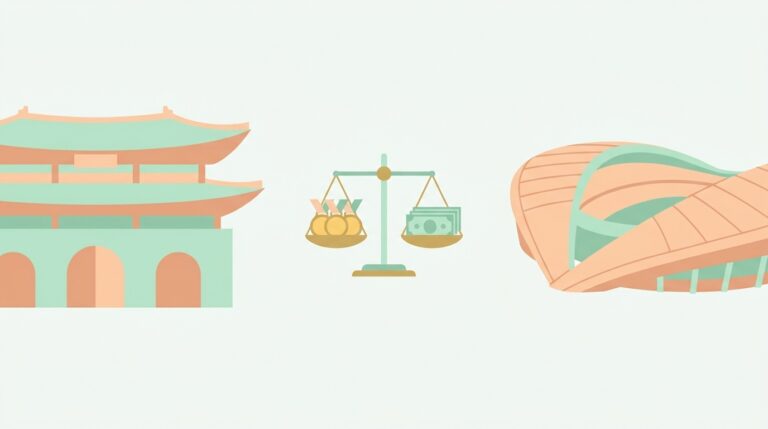
Hosting the Olympics: Economic Triumph or Financial Mirage?
안녕하세요! Welcome back to another edition of Daily Hangul, your premium space for mastering authentic Korean. I’m your head editor and local culture navigator.
Have you ever sat down with Korean friends at a cozy chimaek (치맥 – chicken and beer) spot, cheering for the national team during the Olympics, only for the conversation to shift toward a heavy debate?
“Sure, winning medals is great, but did you see how much we spent on building those stadiums? They are just sitting there empty now!”
If you wanted to jump into this fascinating debate but found yourself stuck using basic phrases like “좋아요” (It’s good) or “나빠요” (It’s bad), you are in the right place. Today, we are diving deep into the pros and cons of hosting the Olympics (올림픽 개최의 득과 실) at a sophisticated C1 level.
By the end of this guide, you’ll not only sound incredibly articulate, but you’ll also understand the deep-seated cultural psyche of collective pride and economic anxiety that shapes modern Korea.
Phase 2: Deep Dive into 3 Elite Idioms
To debate like a policy analyst or a native intellectual, you need idioms that pack a punch. Here are three advanced expressions indispensable for this topic.
1. 배보다 배꼽이 더 크다 (Bae-boda baekkobi deo keuda)
- Pronunciation: [Bae-bo-da baek-kkob-i deo keu-da] / Sound-alike: “Pay-bo-dah peck-cope-ee duh coo-dah”
- Meaning: The belly button is bigger than the belly (The collateral costs outweigh the main project; a classic “white elephant” scenario).
- K-Culture Moment: You will hear this constantly on Korean financial news when discussing the astronomical maintenance costs of local Olympic facilities after the games end.
- Editor’s Insight: It is the perfect idiom to criticize short-sighted public projects. It highlights the Korean societal value of practical efficiency over mere vanity.
- Situation Spectrum:
- Friends & Casual: ✅ (Perfect for complaining about overpriced add-ons)
- Semi-formal Business: ✅ (Very common in project evaluation meetings)
- Formal Debates: ✅
- 🤔 Think About It: Why does Korean culture emphasize the physical proportion of a body parts (belly vs. belly button) to describe economic inefficiency? What is the equivalent in your native language?
2. 빛 좋은 개살구 (Bit joeun gaesalgu)
- Pronunciation: [Bit jo-eun gae-sal-gu] / Sound-alike: “Beet-jo-eun gay-sal-goo”
- Meaning: A wild apricot with a nice color (All glitz and no substance; fool’s gold).
- K-Culture Moment: In K-Dramas featuring political satire, politicians often use this to mock rivals’ flashy but empty urban development promises.
- Editor’s Insight: Use this when an event looks incredibly prestigious on the outside, but actually leaves the host city in deep municipal debt.
- Situation Spectrum:
- Friends & Casual: ✅
- Semi-formal Business: ✅
- Formal Debates: ✅
- 🤔 Think About It: Koreans highly value naesil (내실 – inner substance/stability) over geotgire (겉치레 – superficial display). How does this idiom reflect that cultural value?
3. 국위선양 (Gugwiseonyang)
- Pronunciation: [Guk-wi-seon-yang] / Sound-alike: “Gook-we-sun-yahng”
- Meaning: Enhancing national prestige / Promoting the nation’s glory on the global stage.
- K-Culture Moment: This term is frequently used when discussing military service exemptions for Olympic gold medalists or global icons like BTS.
- Editor’s Insight: While slightly formal, it is the ultimate “pro-Olympics” argument. For decades, South Korea used mega-sports events to announce its post-war recovery to the world.
- Situation Spectrum:
- Friends & Casual: ⚠️ (Can sound a bit too serious, but often used jokingly to praise a friend’s achievement)
- Semi-formal Business: ✅
- Formal Debates: ✅
Phase 3: Textbook Korean vs. Real-World Korean
Let’s bridge the gap between classroom sterile sentences and the vibrant, high-impact language used by actual Koreans.
Scenario 1: Discussing extreme financial burden
- 📖 Textbook Korean: 올림픽을 개최하면 재정적 손실이 매우 큽니다. (Hosting the Olympics brings severe financial losses.)
- 🗣️ Real-World Korean: 올림픽 한 번 치르고 나면 적자 때문에 등골이 휘어요. (After hosting the Olympics just once, your spine literally bends from the massive deficit.)
- 💡 Why the difference? 등골이 휘다 (deung-gol-i hwida) is a visceral idiom meaning to work one’s spine to the point of bending under an immense burden. It perfectly conveys the crushing weight of public debt.
Scenario 2: Expressing skepticism over empty promises
- 📖 Textbook Korean: 올림픽의 장기적인 효과는 확실하지 않습니다. (The long-term effects of the Olympics are uncertain.)
- 🗣️ Real-World Korean: 사후 활용 방안이 없으면 결국 돈 낭비일 뿐이죠. (Without a proper post-event utilization plan, it’s just a massive money dump.)
- 💡 Why the difference? Advanced speakers don’t just say “unclear”; they pinpoint the exact policy issue—사후 활용 방안 (post-event facility utilization)—showing a mature grasp of public debate terms.
Phase 4: K-Culture Deep Dive & Non-Verbal Manners
4-1. The Art of Assertive Humility (눈치 & Body Language)
When debating political or economic topics in Korean, physical delivery is just as important as vocabulary.
* The Nod-and-Counter: Before expressing a dissenting opinion, always nod slightly and say “물론 그 말씀도 일리가 있습니다만…” (Of course, your point also has merit, but…).
* Tone Control: Keep your tone calm, rhythmic, and slightly lower-pitched. Raising your voice in a Korean debate is often perceived as losing emotional control, which immediately weakens your logical standing.
4-2. The Cultural Trajectory of Pride
For South Korea, the 1988 Seoul Summer Olympics and the 2018 PyeongChang Winter Olympics were not just sports events; they were psychological milestones. The 1988 Games signaled Korea’s emergence from the ashes of war into an industrial powerhouse. However, by 2018, public sentiment had shifted. Younger generations began asking: “Why should our tax dollars pay for national prestige when we face individual housing and employment crises?” This transition from collective nationalism to individual well-being is key to understanding modern Korean social discourse.
Phase 5: Interactive Roleplay Scenario
Setting: You are at a trendy modern Hanok bar in Ikseon-dong. Your Korean friend, Minjun (민준), who majors in Urban Planning, is passionately arguing that hosting mega-events is a relic of the past.
Cast:
- Minjun (민준): A practical, analytical thinker who hates wasteful public spending.
- You (C1 Learner): A thoughtful, articulate debater exploring both sides.
Dialogue
- 민준: (막걸리 잔을 내려놓으며) 솔직히 요즘 세상에 올림픽 유치하는 건 세금 낭비예요. 평창 때 지은 시설들 지금 다 애물단지잖아요.
- [Sol-jik-hi yo-jeum se-sang-e ol-lim-pik yu-chi-ha-neun geon se-geum nang-bi-yeo-yo. Pyeong-chang ttae ji-eun si-seol-deul ji-geum da ae-mul-dan-ji-ja-na-yo.]
- “Honestly, hosting the Olympics these days is a waste of taxes. All those facilities built for PyeongChang are just white elephants now.”
- You: (고개를 끄덕이며) 물론 사후 활용이 안 되면 빛 좋은 개살구가 될 수 있죠. 하지만 국가 브랜드 가치가 올라가는 무형의 이익도 무시할 수 없잖아요.
- [Mul-ron sa-hu hwal-yong-i an doe-myeon bit joeun gae-sal-gu-ga doel su it-jyo. Ha-ji-man guk-ga beu-raen-deu ga-chi-ga ol-reo-ga-neun mu-hyeong-ui i-ik-do mu-si-hal su eop-ja-na-yo.]
- “Of course, if there is no post-event utilization, it can become a flashy wild apricot (all show). But we can’t ignore the intangible benefits of elevating national brand value.”
- 민준: (한숨을 쉬며) 브랜드 가치요? 당장 지자체 재정이 파탄 나는데 국위선양이 밥 먹여 주나요?
- [Beu-raen-deu ga-chi-yo? Dang-jang ji-ja-che jae-jeong-i pa-tan na-neun-de guk-wi-seon-yang-i bap meog-yeo ju-na-yo?]
- “Brand value? Local government finances are going bankrupt right now—does national prestige feed us?”
- You: (미소를 지으며) 하하, 그렇게 보면 확실히 배보다 배꼽이 더 큰 상황이 생길 수도 있겠네요. 그래도 올림픽 덕분에 지역 인프라가 빠르게 발전하는 장점도 있죠.
- [Haha, geu-reoh-ge bo-myeon hwak-sil-hi bae-bo-da baek-kkob-i deo keun sang-hwang-i saeng-gil su-do it-get-nae-yo. Geu-rae-do ol-lim-pik deok-bu-ne ji-yeok in-peu-ra-ga ppa-reu-ge bal-jeon-ha-neun jang-jeom-do it-jyo.]
- “Haha, looking at it that way, there could certainly be situations where the belly button is bigger than the belly. Still, there is the advantage that regional infrastructure develops rapidly thanks to the Olympics.”
🔀 Decision Point: How will you steer the debate?
- Choice A (Focus on youth sentiment): “요즘 젊은 세대는 국가의 명예보다 개인의 실익을 더 중요하게 생각하는 것 같아요.”
- Choice B (Focus on environmental sustainability): “환경 파괴 문제도 커요. 스키장 만들려고 수백 년 된 숲을 벴잖아요.”
- Choice C (Focus on sports diplomacy): “그래도 남북 단일팀처럼 평화의 계기를 만드는 외교적 성과도 있어요.”
💡 Best Choice Analysis:
- Choice A is brilliant for a C1 speaker because it shifts the economic debate into a sociological analysis of generational change. It will deeply impress Minjun!
- Choice B targets contemporary eco-political issues, showing you have a wide range of analytical vocabulary.
- Choice C brings in geopolitical contexts, perfect for high-level political discussions.
Phase 6: 10-Second Emotion Shadowing Drill
To sound native, you must master the rhythm and pauses. Practice these sentences with emotional conviction.
- [😤 Disappointed & Firm]
적자만 남는 올림픽이라면 / 굳이 치를 필요가 / 없다고 봅니다.
(Jeok-ja-man nam-neun ol-lim-pik-i-ra-myeon / gu-ji chi-reul pil-yo-ga / eop-da-go bom-ni-da.)
“If the Olympics only leave us with deficits, I see no reason to host them.” -
[🥺 Warm & Nostalgic]
그래도 온 국민이 / 하나 되어 응원하던 / 그 뜨거운 분위기가 / 그리워요.
(Geu-rae-do on guk-min-i / ha-na doe-eo eung-won-ha-don / geu tteu-geo-un bun-wi-gi-ga / geu-ri-wo-yo.)
“Still, I miss that passionate atmosphere when the whole nation cheered as one.”
Phase 7: K-Culture Mini Dictionary
- 애물단지 (Aemuldanji): A white elephant; a beloved but troublesome possession or project that costs too much to maintain.
- 유치하다 (Yuchihada): To host/attract an international event (e.g., 올림픽을 유치하다).
- 적자 (Jeokja): Financial deficit (Antonym: 흑자 [heukja] – surplus).
- 국격 (Gukgyeok): National dignity or global standing.
Phase 8: Traveler’s Survival Kit
Even in sports debates, you might need practical physical survival tips while traveling through Olympic host cities like Pyeongchang or Seoul.
Survival Cards
- Expression 1: “이 근처에 경기장 기념관이 어디에 있나요?” (Where is the stadium memorial hall nearby?)
- Expression 2: “ktx 표는 미리 예매해야 하나요?” (Do I need to book KTX train tickets in advance?)
- Expression 3: “셔틀버스는 몇 분 간격으로 운행해요?” (How often does the shuttle bus run?)
📌 Editor’s Note: When traveling to historic host cities, avoid using generic global maps. Download the Naver Map App Download Page for Android or KakaoMap for highly accurate local transit times and schedules.
Phase 9: Deep Reflection — “One Step Further”
The changing attitude of South Koreans toward hosting the Olympics mirrors a wider global trend, but with a unique twist. In the 20th century, collective success was prioritized over individual sacrifice. Today’s Korea is undergoing a seismic cultural shift toward personal happiness and structural fairness. The debate over Olympic budgets is, at its heart, a debate over what constitutes a truly successful society.
💬 Your Turn: How is hosting major sports events viewed in your home country? Is it seen as a glorious economic boost, or a financial burden? Let us know in the comments below!
Phase 10: FAQ & Mitigating Misunderstandings
Q: Is talking about Olympic deficits considered unpatriotic in Korea?
A: Not at all. Modern South Koreans are highly realistic and analytical about public spending. Critiquing government expenditure on mega-events is seen as civic awareness, not lack of patriotism.
Q: What is the difference between ‘국위선양’ and ‘애국심’?
A: 애국심 (patriotism) is the inner emotion of loving one’s country. 국위선양 is the active, external result of raising the nation’s reputation abroad through outstanding achievements.
🚨 Common Mistakes Alert:
- Saying “올림픽을 만들다”: Incorrect. To host, always use 올림픽을 개최하다 or 올림픽을 유치하다.
- Confusing ‘적자’ (Deficit) with ‘적색’ (Red): While red ink represents deficits, always use the correct financial term 적자 in debates.
Phase 11: Action Missions
- 🥉 Bronze: Record yourself reading the Shadowing Drill sentences, focusing on emotional delivery.
- 🥈 Silver: Write a 3-sentence opinion on your social media about Olympic hosting using the word 배보다 배꼽이 더 크다.
- 🥇 Gold: Find a Korean news video on YouTube about “올림픽 사후 활용” (Post-Olympic facility usage) and try to spot at least two words learned today.
Phase 12: Interactive Quiz Challenge
1. Match the idiom to its definition: (Click to expand)
- Q: Which idiom refers to a situation where the secondary costs of a project exceed the initial value?
- A: 배보다 배꼽이 더 크다 (The belly button is bigger than the belly).
2. Fill in the blank: (Click to expand)
- Q: 올림픽 개최가 겉만 화려하고 실속이 없을 때 “빛 좋은 ______”라고 비판합니다.
- A: 개살구 (gaesalgu)






