

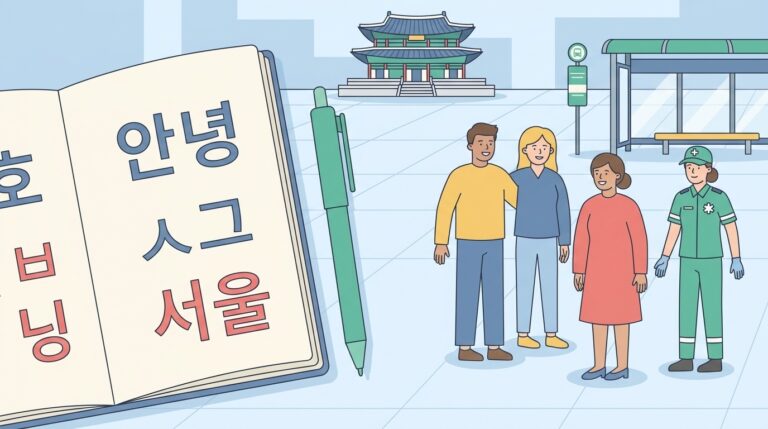
Emergency at the Han River! Master Lifesaving Korean CPR Phrases (A1 Beginner Guide)
Phase 1: The Heart-Stopping Moment at the Han River
안녕하세요! (An-nyeong-ha-se-yo! – Hello!) Your friendly editor from Daily Hangul is here.
Imagine this: You are enjoying a breezy sunset walk along the beautiful Han River (한강공원). Couples are laughing, people are eating delicious instant ramyeon, and street musicians are playing acoustic K-pop hits. It feels exactly like a scene from your favorite medical K-drama, Hospital Playlist (슬기로운 의사생활).
Suddenly, the peaceful mood shatters. An elderly man walking ahead of you suddenly clutches his chest and collapses onto the grass. People crowd around, panic rising. You know basic CPR (심폐소생술) from your safety training back home, but your mind goes completely blank:
“How do I call for help in Korean?”
“What is the emergency number here? It’s not 911!”
In emergency situations, every second counts. Knowing how to shout for help and direct bystanders in the local language can literally save a life. This guide is crafted based on real-world experiences of expats and travelers who found themselves in urgent situations. Let’s learn these vital, easy, beginner-level Korean phrases so you can be the hero when it matters most!
Phase 2: Core Survival Expressions — Deep Dive
Here are the three most critical Korean phrases you need to memorize. Even at the A1 level, these simple words carry immense power.
1. 도와주세요! (Do-wa-ju-se-yo!)
- Pronunciation: Doh-wah-joo-seh-yo! (Sounds like “Do-wah” + the English name “Ju” + “say-yo”)
- Meaning: Please help me! / Help!
- K-Culture Moment: You have likely heard this in almost every thrilling K-drama when a character is in danger. It is the universal cry for assistance.
- Editor’s Insight: This is a polite yet highly urgent phrase. In Korean, adding “-주세요” (ju-se-yo) makes a request polite. In an emergency, it ensures that locals immediately notice your distress without sounding rude.
- Situation Spectrum:
- Friends / Casual: ✅
- Coworkers / Semi-formal: ✅
- Superiors / Formal: ✅ (This phrase works perfectly in 100% of situations!)
- 🤔 Think About It: Notice how “도와주세요” doesn’t include the word “I” or “you”? Korean is a deeply context-dependent language. In an emergency, omitting the subject makes the sentence faster to speak and easier to understand!
2. 119에 전화해 주세요! (Il-il-gu-e jeon-hwa-hae-ju-se-yo!)
- Pronunciation: Eel-eel-goo-eh juhn-hwah-hae-joo-seh-yo!
- Meaning: Please call 119!
- K-Culture Moment: In Korea, the emergency number for medical crises and fires is 119 (일일구 – il-il-gu), not 911.
- Editor’s Insight: When calling out for help, don’t just shout into the void. Look directly at someone, point to them, and say this phrase clearly.
-
Situation Spectrum:
- Friends / Casual: ✅
- Coworkers / Semi-formal: ✅
- Superiors / Formal: ✅
- 🤔 Think About It: Why is the number 119? Historically, Korea adopted 119 for fire and rescue services, while 112 is used for police. Repeating the simple vowel sound “Eel” (1) makes it easy to remember even when panicking.
3. 심폐소생술 해 주세요! (Sim-pye-so-saeng-sul hae-ju-se-yo!)
- Pronunciation: Sheem-pyeh-soh-saeng-sool hae-joo-seh-yo!
- Meaning: Please do CPR!
- K-Culture Moment: Korea has high public safety standards, and CPR training is widely taught in schools, military service, and companies.
- Editor’s Insight: If you cannot perform CPR yourself but realize someone needs it, shouting this will alert trained nearby citizens who can step in immediately.
-
Situation Spectrum:
- Friends / Casual: ✅
- Coworkers / Semi-formal: ✅
- Superiors / Formal: ✅
- 🤔 Think About It: “심폐소생술” (Sim-pye-so-saeng-sul) is a Sino-Korean word. “심” (Sim) means heart, “폐” (Pye) means lungs, “소생” (Sosaeng) means revival, and “술” (Sul) means technique. It literally translates to “Heart-Lung Revival Technique!”
Phase 3: Textbook Korean vs. Real-World Korean
When emergencies happen, textbook Korean can sound too slow, stiff, or robotic. Let’s look at how textbooks teach emergency phrases versus what Koreans actually yell in real life.
Scenario 1: Requesting Emergency Services
- 📖 Textbook Korean: “경찰관이나 구급대원을 불러주십시오.” (Please summon a police officer or paramedic.) – Too long, formal, and difficult to pronounce under stress!
- 🗣️ Real Korean: “119(일일구) 좀 불러주세요!” (Please call 119!) or just “119! 119!”
- 💡 Why the difference? In a crisis, brevity saves lives. Adding “좀” (jom – please/just) softens the command while keeping the action fast.
Scenario 2: Asking for an AED (Automated External Defibrillator)
- 📖 Textbook Korean: “자동심장충격기를 지참하여 주시기 바랍니다.” (Please bring the automated external defibrillator.) – Sounds like a written safety manual! Use this, and people might stare in confusion.
- 🗣️ Real Korean: “AED(에이이디) 좀 가져다주세요!” (Please bring the AED!)
- 💡 Why the difference? While “자동심장충격기” is the official Korean name, almost every Korean—especially younger generations—understands the English acronym “AED” pronounced as “A-E-Dee.”
Phase 4: K-Culture Safety Protocol & The Power of “Nunchi”
4-1. Nunchi (눈치) in an Emergency
In Korea, there is a cultural concept called Nunchi (눈치)—the art of sensing other people’s feelings and the vibe of a situation. However, in an emergency, bystander hesitation can occur because people are afraid of overstepping boundaries or causing a scene.
To break this hesitation, you must use targeted communication. Instead of shouting “Anybody help!”, look a specific person in the eye, point directly at them, and identify them by their clothing:
* “저기 검은색 티셔츠 입은 분, 119에 전화해 주세요!” (You there in the black t-shirt, please call 119!)
This direct eye contact and pointing is considered polite and necessary in emergency survival contexts in Korea.
4-2. The “Good Samaritan” Reality in Korea
You might worry: “Will I get sued if I perform CPR in Korea?”
Korea has active Good Samaritan laws (응급의료에 관한 법률). This law protects bystanders who perform emergency CPR in good faith from civil or criminal liability if things go wrong. Feel confident to act and assist!
Phase 5: Han River Hero — Live Interactive Roleplay
Put yourself in the shoes of our hero! Read the scene below and choose your actions.
[The Setting]
7:45 PM. Mapo Han River Park. The sun has set, leaving a neon pink glow over the water. A sudden commotion occurs near the bicycle path. An elderly man collapses onto the concrete. You run over. A jogger named Min-woo (민우) stops to help, but looks panicked.
[The Cast]
* You: A caring foreign traveler who knows CPR.
* Min-woo (민우): A local Korean jogger who is shocked and frozen.
The Script
- You: 🎭 (Rushing over, kneeling by the collapsed man)
“저기요! 괜찮으세요?”
(Jeo-gi-yo! Gwan-chan-eu-se-yo? / Hey! Are you okay?) -
Min-woo: 🎭 (Stuttering, checking the man’s pulse)
“어떡해요… 숨을 안 쉬는 것 같아요!”
(Eo-tteok-hae-yo… sum-eul an swi-neun geot gat-a-yo! / Oh no… I don’t think he’s breathing!) -
You: 🎭 (Looking firmly at Min-woo to snap him out of shock)
(Choose your line below!)
🔀 Decision Point: What do you say to Min-woo?
- Option A: “도와줘!” (Do-wa-jwo!)
- Option B: “119에 전화해 주세요!” (Il-il-gu-e jeon-hwa-hae-ju-se-yo!)
- Option C: “심폐소생술을 하십시오!” (Sim-pye-so-saeng-sul-eul ha-sip-si-o!)
🔍 Choice Analysis:
- Best Choice: Option B! Asking Min-woo politely but urgently to call 119 is the best action while you prepare to perform chest compressions.
- Option A (Risk): “도와줘!” is highly informal (Banmal). Even in an emergency, using informal language with a stranger might sound shockingly aggressive to native speakers.
- Option C (Awkward): “하십시오” is excessively formal and textbook-style. It sounds like a military command and wastes precious seconds.
Phase 6: 10-Second Emotional Shadowing Drill
When calling for help, your tone must be sharp, clear, and loud. Practice these drills by emphasizing the breaks (/) and channeling the recommended emotions!
- [🥺 Desperate & Pleading for Help]
“도 / 와 / 주 / 세 / 요!”
(Doh / wah / joo / seh / yo!) -
[😤 Loud, Clear, and Commanding]
“일 / 일 / 구 / 에 / 전 / 화 / 해 / 주 / 세 / 요!”
(Eel / eel / goo / eh / juhn / hwah / hae / joo / seh / yo!)
Phase 7: K-Culture Safety Mini-Dictionary
Keep these four essential safety terms in your pocket when traveling through Korea:
- 구급차 (Gu-geup-cha) – Ambulance
- Emergency sirens in Korea make a distinct “Pee-po-pee-po” sound. If you hear this, make sure to step aside on public roads.
- 소방서 (So-bang-seo) – Fire Station
- In Korea, 119 connects you directly to the fire station, which manages both fire emergencies and ambulance dispatches.
- 골든타임 (Gol-deun-ta-im) – Golden Time
- This Konglish (Korean-English) term refers to the critical first 4 minutes of cardiac arrest where CPR must be performed to prevent brain damage.
- 편의점 약국 (Pyeon-ui-jeom Yak-guk) – Convenience Store Medicine
- In emergency situations requiring basic medical supplies (bandages, pain relievers) late at night, 24-hour convenience stores carry basic emergency medicines.
Phase 8: Emergency Survival Kit for Travelers
If you find yourself in a medical jam while visiting Korea, keep these lifelines handy:
Top 3 Survival Phrases for Travelers
| Korean (한글) | Romanization | English Translation | Pro Tip |
|---|---|---|---|
| 아파요! | A-pa-yo! | It hurts! / I am sick! | Point to where it hurts while saying this. |
| 병원에 가 주세요. | Byeong-won-e ga ju-se-yo. | Please take me to a hospital. | Say this to a taxi driver in an emergency. |
| 영어 하시는 분 계세요? | Yeong-eo ha-si-neun bun gye-se-yo? | Is there anyone who speaks English? | Useful in public places or small clinics. |
📌 Editor’s Travel Note
Before stepping foot out of Incheon Airport, make sure to download the Naver Map App on Google Play Store or the Apple App Store. Unlike foreign maps, Naver Map shows live locations of nearby AEDs, pharmacies (약국), and emergency rooms across Korea.
Phase 9: Think Deeper — Civic Duty and “Jeong” (정)
Korea is known as one of the safest countries in the world. This safety doesn’t just come from high-tech CCTV cameras; it stems from a deep-rooted cultural value called Jeong (정)—a feeling of warm affection, mutual care, and communal responsibility. When someone collapses on the street, it is very common to see multiple strangers rush over to help, hold the person’s hand, or shield them from the sun with umbrellas.
💬 Your Turn: How does your home country handle public medical emergencies? Are people quick to assist, or do they tend to wait for professional paramedics? Let us know in the comments below!
Phase 10: FAQ & Avoiding Critical Mistakes (FAQ Schema Optimized)
Q: Can I dial 119 even if my phone service is disconnected or if I am using an international SIM?
A: Yes! Even without an active local plan, emergency calls to 119 are always free and accessible on any mobile phone in Korea.
Q: Will the 119 operator understand English?
A: Yes! Korea’s emergency centers have translation services. If you speak English, they will immediately connect you with an English-speaking interpreter.
Q: Where are AEDs usually located in Korea?
A: You can easily find them inside subway stations (near the ticket gates), apartment guard offices, public libraries, and government buildings.
🚨 Common Mistakes Warning Board
- Shouting “911!”: Locals might understand, but calling 911 on your phone won’t connect as instantly as dialing 119.
- Using “Banmal” (Informal Korean): Avoid saying “도와줘!” (Do-wa-jwo) to elderly citizens or strangers; always default to “도와주세요!” (Do-wa-ju-se-yo).
- Not specifying your location: If you don’t know the address, look around for street signs, subway exit numbers, or large buildings to tell the 119 operator.
Phase 11: Your Lifesaving Action Missions
Let’s put your new knowledge into practice with these fun safety missions!
- 🥉 Bronze Mission (Mirror Practice): Stand in front of a mirror, look yourself in the eye, and yell “도와주세요!” (Do-wa-ju-se-yo!) three times with confidence.
- 🥈 Silver Mission (Share the Safety): Take a screenshot of our traveler survival kit and share it on your social media. Tag #DailyHangul to show your friends how to stay safe in Korea!
- 🥇 Gold Mission (Map Hunt): Open your map app on your phone, search for the nearest 구급차 (Ambulance station) or hospital around your accommodation, and write down its address in Korean.
Phase 12: Interactive Emergency Quiz Challenge
Test your survival instincts! Click the toggles below to reveal the answers.
Q1. Which of the following is the correct number to call for a medical emergency in Korea?
Answer: 119 (일일구).
Explanation: 112 is for the police, and 911 is not the primary emergency number in Korea.







