

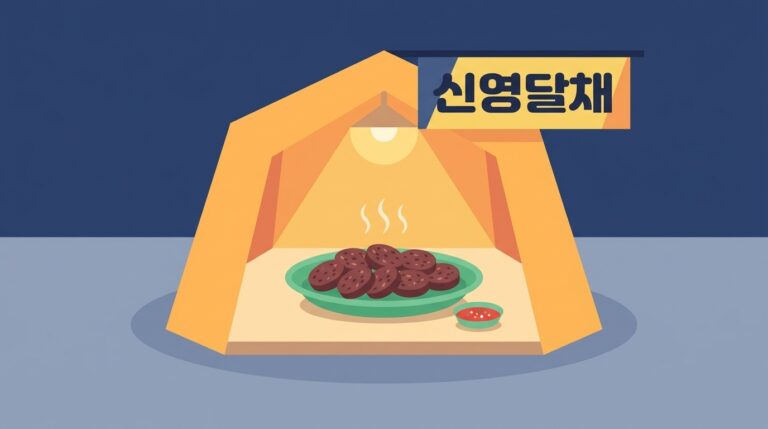
Eat Like a Local: The Golden Rule of Dipping Korean Sundae in Salt!
안녕하세요! (An-nyeong-ha-se-yo!) Hello there, beautiful souls! It’s your favorite Daily Hangul editor, your go-to Korean tutor and local culture navigator.
Imagine this: You are walking down a cozy alley in Seoul on a breezy autumn evening. The warm, glowing lights of a 포장마차 (Po-jang-ma-cha / street food tent) catch your eye. You sit down, smelling the delicious steam of hot soup. You decide to order 순대 (Sun-dae / Korean blood sausage), a beloved national street food. But when the friendly owner hands you the plate, there is a tiny dish of pinkish-orange salt next to it.
“Wait, salt on sausage? Is this how they eat it?” you wonder. Yes! Today, we are diving deep into the wonderful, savory world of eating Sundae with salt. By the end of this guide, you will order and eat like a true Seoulite, earning instant respect from your Korean friends!
1. Core Expressions: Master the Street Stall Talk
Let’s learn three simple but powerful expressions you can use at any street stall. These are perfect for beginner (A2) learners!
① 순대 소금에 찍어 드세요 (Sun-dae so-geum-e jji-geo deuseyo)
- Pronunciation: Soon-dae so-gum-eh jjee-goh deu-seh-yo (Sounds like: Soon-dae, sew-gum-eh, G-go, do-say-yo!)
- Meaning: “Please dip the sundae in salt.”
- K-Culture Moment: You will hear this phrase from a sweet 이모님 (I-mo-nim / stall auntie) when she serves your food. She wants to make sure you enjoy the perfect taste balance!
- Editor’s Insight: This is a warm, caring suggestion. The salt isn’t just plain salt; it is usually mixed with a bit of chili powder and sesame seeds for a savory kick.
- Situation Spectrum:
- Friends/Casual: ✅
- Coworkers/Semi-formal: ✅
- Boss/Elderly/Formal: ✅
- 🤔 Think About It: Why do you think Koreans prefer simple salt over heavy dipping sauces for traditional sausage? What do you usually dip savory food into in your country?
② 소금 좀 더 주세요 (So-geum jom deo ju-se-yo)
- Pronunciation: So-gum jom duh ju-seh-yo (Sounds like: So-gum jom duh ju-say-yo)
- Meaning: “Please give me a little more salt.”
- K-Culture Moment: If you accidentally drop your salt dish or simply love that savory, spicy kick, you can use this phrase politely.
- Editor’s Insight: Adding the word 좀 (jom / a little) is a magic trick in Korean. It makes any request sound soft, natural, and polite!
- Situation Spectrum:
- Friends/Casual: ✅
- Coworkers/Semi-formal: ✅
- Boss/Elderly/Formal: ✅
③ 순대 내장도 섞어 주세요 (Sun-dae nae-jang-do seok-keo ju-se-yo)
- Pronunciation: Soon-dae nae-jang-do suk-uh ju-seh-yo (Sounds like: Soon-dae nae-jang-do suck-uh ju-say-yo)
- Meaning: “Please mix in the innards (organs) too.”
- K-Culture Moment: Real locals do not just eat the sausage. They love the chewy steam-cooked liver and lung slices that come with it!
- Editor’s Insight: If you only want the sausage, you can say “순대만 주세요” (Soon-dae-man ju-se-yo / Just sundae, please). But trying the mixed plate (내장) makes you look like a food adventurer!
- Situation Spectrum:
- Friends/Casual: ✅
- Coworkers/Semi-formal: ✅
- Boss/Elderly/Formal: ✅
2. Textbook Korean vs. Real Korean
When you study with standard textbooks, the language can sometimes sound a bit too formal or unnatural for a bustling street market. Let’s look at the difference!
Situation 1: Ordering Sundae with Organs
- 📖 Textbook Korean: “순대와 내장을 같이 주십시오.” (Please give me sundae and organs together.)
- 🗣️ Real Korean: “내장 섞어 주세요!” (Mix the organs in, please!)
- 💡 Why is it different? Street stalls are fast-paced. Using the short verb 섞다 (seok-da / to mix) is highly efficient and sounds like you eat street food every day!
Situation 2: Asking for dipping salt
- 📖 Textbook Korean: “소금을 저에게 주시면 고맙겠습니다.” (I would be grateful if you gave me salt.)
- 🗣️ Real Korean: “소금 좀 주세요.” (Salt, please.)
- 💡 Why is it different? Street stall dining is cozy and informal. Using overly long honorifics can create an awkward distance between you and the friendly owner.
3. K-Culture Deep Dive & Non-verbal Manners
3-1. The “No Double-Dipping” Rule (Nunchi Manners)
Street stalls usually serve salt in a tiny, shared plastic cup or a small paper dish for each group.
* The Tip: Never dip your half-eaten sundae back into the shared salt!
* The Correct Gesture: Use the wooden toothpick provided to take a slice of sundae, tap it gently on the edge of the salt dish to get just a tiny pinch of salt, and eat it in one bite.
3-2. The Great Regional Dipping Sauce War!
Did you know that dipping sundae in salt is mostly a Seoul and Gyeonggi province style? Korea has a hilarious regional battle over this!
* Seoul & Incheon: Dipped in Salt + Chili powder (소금).
* Busan & Gyeongsang-do: Dipped in Ssamjang (쌈장 / sweet savory soybean paste).
* Gwangju & Jeolla-do: Dipped in Chojang (초장 / sweet and sour chili sauce).
* Jeju Island: Dipped in Soy Sauce (간장).
If you travel outside Seoul, try asking for their local sauce to show off your deep knowledge of K-Food culture!
4. Let’s Play: Pojangmacha Roleplay!
The Setting: You are sitting inside a warm red plastic tent in Mapo, Seoul. The steam is rising from the large metal food trays. The owner (Imo-nim) is smiling warmly at you.
- 이모님 (Imo-nim): 어서 오세요! 뭐 드릴까요? (Uh-suh oh-seh-yo! Mwo deu-ril-kka-yo?)
- 🎭 (Welcoming you warmly with a big smile)
- 나 (You): 저… 순대 1인분 주세요. (Juh… soon-dae il-in-bun ju-seh-yo.)
- 🎭 (Politely pointing at the steaming sundae container)
- 이모님 (Imo-nim): 내장도 섞어 드릴까요? (Nae-jang-do suk-uh deu-ril-kka-yo?)
- 🎭 (Holding a big knife, ready to slice the delicious sausage)
- 나 (You): 네, 같이 섞어 주세요! (Ne, ga-chi suk-uh ju-seh-yo!)
- 🎭 (Nodding happily)
- 이모님 (Imo-nim): 여기 있습니다. 소금에 찍어 드세요. (Yuh-gi is-seum-ni-da. So-gum-eh jjee-goh deu-seh-yo.)
- 🎭 (Handing you a warm plate of food and a tiny pink salt dish)
- 나 (You): 우와, 감사합니다! 잘 먹겠습니다! (Woo-wa, gam-sa-ham-ni-da! Jal muk-get-seum-ni-da!)
- 🎭 (Clapping hands lightly with excitement)
- 이모님 (Imo-nim): 맛이 어때요? (Mat-ee uh-ttae-yo?)
- 🎭 (Watching you take your very first bite)
🔀 Your Decision Point! What do you say next?
- Choice A: “소금이 너무 매워요!” (This salt is too spicy!)
- Choice B: “음! 진짜 고소하고 맛있어요!” (Mmm! It’s so savory and delicious!)
- Choice C: “부산 스타일 쌈장 주세요!” (Give me Busan style ssamjang!)
💡 The Editor’s Feedback:
- Best Choice: Choice B! Complimenting the food with 고소하다 (go-so-ha-da / savory, nutty) will instantly melt Imo-nim’s heart. You might even get some free hot fish cake soup (서비스)!
- Risk Choice: Choice C. While funny, a small street stall in Seoul might not have Busan-style ssamjang ready. Keep it local first!
5. 10-Second Emotional Shadowing Drill
Let’s practice speaking with real Korean feelings! Pay attention to the pauses (/) and try to mimic the emotions in the brackets.
- [😊 Super excited & hungry]
- “와! / 순대 진짜 / 맛있겠어요!”
- Wa! / Soon-dae jin-jja / ma-sit-get-suh-yo!
- (Wow! / The sundae / looks so delicious!)
- [🥺 Polite and sweet asking]
- “이모님, / 소금 좀 / 더 주세요~”
- I-mo-nim, / so-gum jom / duh ju-seh-yo~
- (Auntie, / can I have / a little more salt, please?)
6. K-Culture Mini Dictionary
| Word (Hangul) | Romanization | Meaning & Local Context |
|---|---|---|
| 순대 | Sundae | Korean blood sausage made by stuffing glass noodles and vegetables. |
| 내장 | Naejang | Steam-cooked organs (liver, lung) served alongside sundae. |
| 이모님 | Imonim | Literally “Aunt.” Used affectionately for middle-aged female restaurant owners. |
| 포장마차 | Pojangmacha | Street food tents selling delicious snacks, especially popular in winter nights. |
7. Traveler’s Survival Kit
Top 3 Street Food Phrases
- “이거 얼마예요?” (I-guhl uhl-ma-yeh-yo?)
- ➔ “How much is this?” (Perfect when there is no written menu).
- “포장해 주세요.” (Po-jang-hae ju-seh-yo.)
- ➔ “Please pack it to go.” (Take it back to your hotel or park!).
- “오뎅 국물 좀 주세요.” (Oh-deng guk-mul jom ju-seh-yo.)
- ➔ “Please give me some fish cake broth.” (It’s free, warm, and unlimited!).
📌 Editor’s Travel Note:
To find the absolute best local street food stalls, do not rely on Google Maps inside Korea! Instead, download the Naver Map App which is the lifesaver navigation app used by 99% of locals.
8. Deep Think: “One Step Deeper”
In Western cultures, dining can be a highly individual experience. But in Korea, street food like Sundae is a symbol of 정 (Jeong / warm social affection). People squeeze together on tiny plastic stools, rubbing shoulders, sharing a small plate, and dipping food in the same salt dish. This shared eating culture shows how much Koreans value community and closeness.
💬 Your Turn: How does your hometown view sharing food from the same plate? Do you have a similar cozy street food culture? Tell us in the comments below!
9. FAQ & Avoiding Common Mistakes
Q: Is Sundae very spicy?
A: No! Sundae itself is not spicy at all. It is very mild, savory, and chewy. The dipping salt has a tiny bit of red pepper, but it only adds flavor, not heavy heat.
Q: Can I ask for salt if I am in Busan?
A: Yes, of course! While ssamjang is the local favorite there, every stall has salt ready in their kitchen. Just ask: “소금 좀 주세요!”
Q: What if I do not want the organs?
A: Just say “순대만 주세요” (Soon-dae-man ju-se-yo). This tells the seller to fill your entire plate with delicious glass-noodle sausage only.
🚨 Common Mistake Board!
- Mistake 1: Calling the female stall owner “아줌마” (A-jum-ma / middle-aged woman). This can sound slightly rude.
- Correct Action: Always call her 이모님 (I-mo-nim / Auntie)! It sounds much sweeter and friendly.
- Mistake 2: Pouring too much salt directly onto the sundae slice.
- Correct Action: Just tap the tip of the slice onto the salt. A little goes a long way!
10. Daily Hangul Action Missions!
- 🥉 Bronze Mission: Practice saying “소금 좀 더 주세요” in front of your mirror 3 times using your sweetest voice!
- 🥈 Silver Mission: Take a screenshot of this guide’s “Regional Sauce War” section and share it on Instagram. Tag us @DailyHangul!
- 🥇 Gold Mission: Find a local Korean market (like Gwangjang Market in Seoul) and order a plate of sundae using only Korean!
11. Interactive Quiz Challenge
Q1. Which dipping sauce is the most popular style in Busan?
- A) Salt (소금)
- B) Ssamjang (쌈장)
- C) Chojang (초장)
Q2. Fill in the blank: “이모님, 소금
💡 Click to see the Answers & Explanations!
- Q1 Answer: B) Ssamjang (쌈장). People in Busan love the savory, slightly sweet kick of ssamjang on their chewy sundae!
- Q2 Answer: 좀 더 주세요 (jom deo ju-se-yo / Please give me a little more). Remember, ‘좀’ makes you sound polite and local!







