

The Art of Eating Hotteok: Master Seoul’s Winter Snack Without the Mess
안녕하세요! (Annyeonghaseyo!) Welcome back to Daily Hangul. I’m your senior editor and your trusted Korean cultural guide.
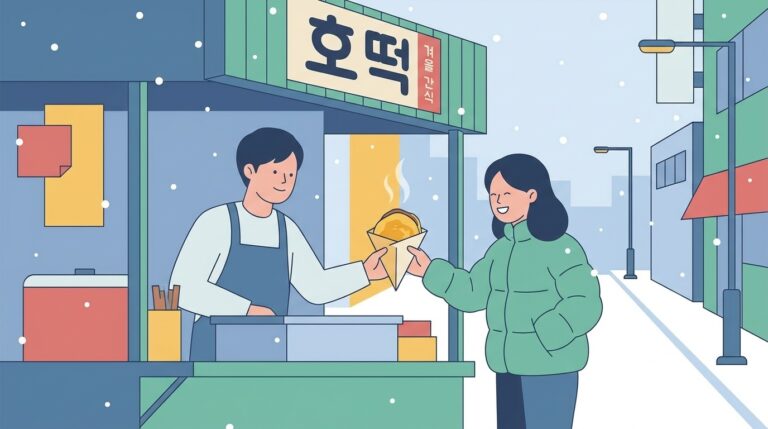
Picture this: It’s a freezing Tuesday evening in December. You’re walking through the glowing alleys of Euljiro, the scent of caramelized sugar and yeast dough filling the crisp winter air. You spot a small street cart surrounded by a warm cloud of steam. Behind the griddle stands a friendly local vendor, pressing golden, pillowy discs of Hotteok (ᘸ태ᄀ – sweet pancake filled with brown sugar, cinnamon, and nuts).
Unable to resist, you order one. It’s handed to you burning hot in a folded paper cup. You take a triumphant first bite. Splat! A stream of boiling, molten brown sugar syrup shoots out the back, landing directly on your favorite cream-colored puffer jacket.
If this nightmare has happened to you—or if you live in constant fear of it—you are not alone. Eating Hotteok without spilling is a legendary rite of passage in Korea. Today, we’re going to master not just the vocabulary you need to order like a local, but the physical science behind eating this delicious winter snack mess-free!
1. Core Expressions for Your Winter Snack Run
Here are three essential expressions you need to survive and thrive at any winter snack cart in Korea.
① — 뜨거우니까 섐심하세요
- Pronunciation: [Tteu-geo-u-ni-kka jo-sim-ha-se-yo] / Sound-alike: “Tteu-go-uni-kka jo-seem-ha-say-yo”
- Meaning: “Be careful because it is hot!”
- K-Culture Moment: You’ll hear this constantly from vendors as they hand you fresh street foods like Hotteok or Eomuk (어묵 – fishcake soup).
- Editor’s Insight: The word “섐심” (Jo-sim) means caution. Adding “~으니까” (uni-kka) creates a friendly logical link (“because of X, do Y”). It’s a warm, caring phrase that shows Korean affection (Jeong, 정).
- Situation Spectrum:
- Friends/Casual: ✅ (뜨거우니까 섐심해)
- Semi-formal/Business: ✅ (뜨거우니까 섐심하세요)
- Formal/Elders: ✅ (뜨거우니 조심하십시오)
- 🤔 Think About It: Why does Korean grammar heavily rely on causatives like “~으니까” in daily caretaking phrases? How does your culture issue soft warnings?
② — 솅이컵에 끼워 쇼세요
- Pronunciation: [Jong-i-keop-e kki-wo ju-se-yo] / Sound-alike: “Jong-ee-cup-ay kkee-wo joo-say-yo”
- Meaning: “Please slide/insert it into a paper cup.”
- K-Culture Moment: The classic way to eat street food. Rather than plates, vendors fold a standard paper cup and slide the hot pancake inside to protect your fingers.
- Editor’s Insight: The verb “끼우다” (kki-u-da) means to insert, squeeze, or wedge something. Using “아/어 쇼세요” (주세요) keeps your request polite yet natural.
- Situation Spectrum:
- Friends/Casual: ✅ (종이컵에 끼워젘)
- Semi-formal/Street Vendors: ✅ (종이컵에 끼워 쇼세요)
- Formal: ⚠️ (Slightly awkward to ask in high-formal settings as paper cups are inherently casual)
③ — 냝이 됤로 흣러내려요
- Pronunciation: [Kkul-i dwi-ro heul-leo-nae-ryeo-yo] / Sound-alike: “Kkool-ee dwee-ro huel-lor-nay-ryo-yo”
- Meaning: “The honey (syrup) is leaking out the back!”
- K-Culture Moment: You scream this as you realize gravity has betrayed you, and the syrup is pouring onto your shoes.
- Editor’s Insight: Though we call it “냝” (kkul – honey), the filling of a Hotteok is actually melted brown sugar syrup. “흣러내뢬다” (heul-leo-nae-ri-da) perfectly captures the dripping downward motion.
- Situation Spectrum:
- Friends/Casual: ✅ (냝 됤로 흣러!)
- Semi-formal/Descriptive: ✅ (냝이 됤로 흣러내려요)
- Formal: ⚠️ (Hardly used in formal speaking, but grammatically fine: 김이 됤로 흣리고 쟈습니다)
2. Textbook Korean vs. Real Street Korean
Street food carts are bustling environments. If you speak like a textbook, you’ll sound like an undercover robot!
Ordering Hotteok
- 📖 Textbook: “호떡을 하나 구매하고 싶습니다.” (I would like to purchase one hotteok.)
- 🗣️ Real Korean: “사장님, 호떡 하나만 쇼세요!” (Boss, just one hotteok please!)
- 💡 Why it’s different: “사장님” (Sajangnim – CEO/Boss) is the universal warm term of address for street vendors. Adding “만” (man – only) softens the request beautifully.
Warning Someone of Hot Syrup
- 📖 Textbook: “시럽이 매우 뜨검습니다. 피하세요.” (The syrup is very hot. Avoid it.)
- 🗣️ Real Korean: “와, 이거 진짜 뜨거워요! 입천장 다 까질 셕에요.” (Wow, this is crazy hot! You’re going to peel the roof of your mouth!)
- 💡 Why it’s different: “입천장이 까지다” (peeling the roof of the mouth) is a highly idiomatic way Koreans describe eating boiling hot foods like Hotteok, stews, or baked sweet potatoes.
3. K-Culture Deep Dive: The Physics of the “Hotteok Cup”
To eat Hotteok without ruining your clothes, you must understand Nunchi (눈치)—situational awareness—and a little physical technique.
The “Hotteok Tilt” & Cup Trick
- The Gravity Check: When you hold a hot Hotteok, the sugar inside remains liquid. If you bite the middle, the syrup pool is squeezed toward the bottom-back.
- The Fold Technique: Gently pinch the paper cup’s rim to fold the top of the Hotteok inward. This forces the liquid to pool back towards your bite, rather than leaking out the side.
- The Bow: Tilt your upper body slightly forward (about 15 degrees) over the street. If a drop falls, it lands on the cold asphalt, not your white winter fleece.
Cash & Connectivity in Winter Carts
While Korea is almost completely cashless, old-school street food carts sometimes prefer cash or bank transfers. If you see a bank account number taped to the griddle, don’t panic! You can use your mobile banking app to send money on the spot. It’s a completely normal part of Korean street culture.
4. Real-life Roleplay: The Windy Euljiro Street Cart
Test your skills in this immersive street dialogue! You are standing in front of a bustling cart.
Characters:
* You (Hungry, cold traveler)
* Imo (이먘) (The legendary street vendor Auntie, fast-moving and warm-hearted)
- Imo: “어서세요! 추우시지요? 오늘 호떡 맛이쟈어요.”
(Eoseo-oseyo! Chu-u-si-ji-yo? Oneul hotteok mas-iss-eoyo.)
(Welcome! Cold, aren’t you? Today’s hotteok is really good.) -
You: “네, 진짜 추워요! 사장님, 호떡 하나만 쇼세요.”
(Ne, jinjja chu-wo-yo! Sajangnim, hotteok hana-man juseyo.)
(Yes, it’s really cold! Boss, just one hotteok, please.) -
Imo: “씨앗 호떡으로 드릴까, 그냥 꼴 호떡으로 드릴까?”
(Ssi-at hotteok-euro deurilkka, geunyang kkul hotteok-euro deurilkka?)
(Shall I give you seed hotteok, or just regular honey hotteok?) -
You: “씨앗 호떡으로 쇼세요!”
(Ssi-at hotteok-euro juseyo!)
(Please give me the seed hotteok!) -
Imo: (Pressing the dough on the sizzling griddle) “자, 솅이컵에 끼워서 드립니다. 뜨거우니까 섐심하세요!”
(Ja, jong-i-keop-e kki-wo-seo deurimnida. Deugeo-u-ni-kka jo-sim-ha-se-yo!)
(Here, I’m sliding it into a paper cup for you. Careful, it’s hot!) -
You: “와, 감사합니다! 하… 진짜 맛있겠다.”
(Wa, gamsahamnida! Ha… jinjja mas-issgetda.)
(Wow, thank you! Ha… it looks so delicious.) -
You: (Bites into the sizzling hotteok) “아짓! 뜨거웍!”
(Ah-tteu! Deu-geop!)
(Ouch, hot! Hot!) -
Imo: “아이구, 긴찠아요? 착차히 불어서 드세요. 냝 흣림다!”
(Aigu, gwaenchanh-ayo? Chanchanhi bureo-seo deuseyo. Kkul heulnimnida!)
(Oh dear, are you okay? Blow on it slowly before eating. The honey will drip!) -
You: “네! 종이컵에서 살짝 눌러서 먹을게요.”
(Ne! Jong-i-keop-eseo saljjak nulleoseo meog-eulgeoyo.)
(Yes! I will press it down slightly in the paper cup to eat it.) -
Imo: “그렇지! 그렇게 먹어얼 손에 안 묻어요.”
(Geureotji! Geureohge meogeoya sone an mudeoyo.)
(Exactly! That’s how you eat it without getting it on your hands.)
🔀 Decision Point: The Syrup Starts to Leak!
Suddenly, a thick glob of warm brown sugar syrup is sliding towards the rim. What do you do?
- A. “사장님, 휴지 좀 쇼세요!” (Boss, please give me some tissues!)
- B. Suck it directly off the corner of the pancake.
- C. Throw the paper cup into the trash can immediately.
🏆 Best Choice Analysis:
A is excellent! It’s polite, immediate, and saves your clothes. Most street carts have a roll of toilet paper hanging nearby for exactly this reason. B is a high-risk gamble; if the syrup is too hot, you’ll burn your tongue instantly! C is wasteful and ruins the experience.
5. 10-Second Emotion Shadowing Drill
Let’s practice speaking like a native by injecting actual human feelings. Pay attention to the pauses (/).
- [😊 Excited & Warm]
- “사장님! / 진짜 맛있어요! / 또 올게요!”
- [Sajangnim! / Jinjja mas-iss-eoyo! / Tteo olgeoyo!]
- “Boss! It’s so delicious! I’ll come back!”
- [🥺 Soft Warning & Worried]
- “아… / 이거 냝 흣러내려요. / 조심해!”
- [Ah… / Igeo kkul heul-leo-nae-ryeo-yo. / Josimhae!]
- “Ah… this syrup is dripping out. Watch out!”
6. K-Culture Mini Dictionary
| Word (Hangul / Romanization) | English Meaning | Cultural Context |
|---|---|---|
| 붕어뵵 (Bungeoppang) | Carp-shaped bread with red bean filling | The ultimate rival of Hotteok. It represents sweet nostagia for every generation. |
| 군고구마 (Gungoguma) | Roasted sweet potato | Once sold by youths in winter beanies, now a classic convenience store treat. |
| 포장마차 (Pojangmacha) | Tented street food cart | A place of shared warmth where busy citizens stop for quick eats on their way home. |
| 겉바속촉 (Geotbasokchok) | Crispy outside, soft inside | The golden rule for street fried foods, especially a perfect Hotteok. |
7. Traveler’s Survival Kit
Top 3 Street Cart Survival Phrases
- “계짜이체 되나요?” [Gye-jwa-i-che doe-na-yo?]
- 💡 Pro Tip: “Can I do a bank transfer?” Use this if you don’t have cash on hand.
- “휴지 좀 쓰면 안 될카요?” [Hyu-ji jom sseu-myeon an doel-ka-yo?]
- 💡 Pro Tip: “May I use some tissue?” Perfect for wiping sticky hands.
- “섞어서 쇼세요.” [Sseok-eoseo juseyo.]
- 💡 Pro Tip: “Please mix them.” (If ordering mixed snacks like various flavored rice cakes).
📌 Editor’s Travel Note: To locate the best-hidden street food stalls in winter, download the Naver Map app download page which has crowdsourced tags for historic Hotteok carts in old markets.
8. Deep Reflection: Why Street Food Binds Us
In modern, hyper-digital South Korea, where robots make coffees and deliveries arrive in under an hour, the street food stall remains a rare, analog haven. Food like Hotteok isn’t just food; it is a shared sensory memory of childhood. When you eat street foods huddled around a warm griddle with strangers, the rigid social hierarchies of Korea dissolve for a few sweet, messy minutes.
Your Turn: Does your culture have a cozy street food that requires “special physical skills” to eat? Let us know in the comments below!
9. FAQ & Avoiding Common Mistakes
Q: Can I sit down and eat at a Hotteok stand?
A: Depends. If it’s a simple cart, most people stand nearby, eat quickly, and leave. If it’s a larger tent (Pojangmacha) with plastic stools, you are expected to sit down, but usually, you should order something like fishcake soup or tteokbokki if you plan to stay long.
Q: What is the difference between regular Hotteok and Ssiat Hotteok?
A: Regular Hotteok has plain melted sugar. Ssiat Hotteok (famous in Busan) is sliced open after cooking and stuffed with various nuts and seeds, which reduces the mess since the liquid is absorbed by the crunchy seeds!
🚨 Common Mistakes to Avoid:
- Mistake 1: Biting the very bottom of the Hotteok. (The syrup will burst from the top!)
- Mistake 2: Expecting card payments at small, independent grandmother-run sidewalk stands. (Always carry a 1,000 to 5,000 KRW bill in your coat pocket).
10. Interactive Quiz Challenge
Let’s test your street snack IQ!
1. What is the best phrase to warn your friend that their Hotteok is extremely hot?
- A) 뜨거우니까 섐심하세요!
- B) 이거것은 온도가 높습니다.
- C) 냝이 흣러내려요.
2. True or False: You should always keep the hotteok perfectly horizontal to prevent spilling.
- True / False
👀 Reveal the Answers & Explanations!
- Answer: A. It’s natural and friendly. B is way too clinical (like a thermometer speaking), and C means “the syrup is already leaking.”
- Answer: False! You should tilt it slightly forward and use the cup-pinching technique so the syrup flows safely toward your bite.
Enjoy your winter adventure in Korea, and stay warm and clean! See you in the next lesson! 감사합니다!







