

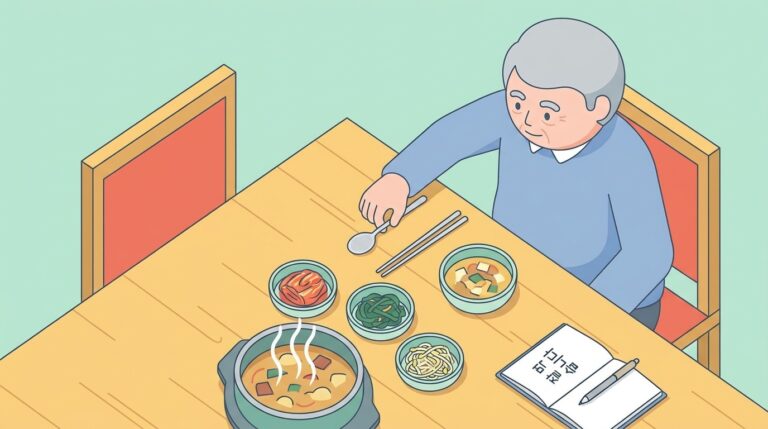
Don’t Pick Up Your Spoon Yet! The Ultimate Guide to Korean Dining Etiquette with Elders
Phase 1: Annyeonghaseyo! Let’s Talk Table Manners
Annyeonghaseyo! (안녕하세요!) Your favorite friendly neighborhood Korean tutor and local guide here.
Imagine this: You are sitting at a beautiful wooden table in Seoul. The air is thick with the mouth-watering aroma of sizzling Bulgogi (불고기) and bubbling Doenjang-jjigae (된장찌개 – soybean paste stew). Your stomach is growling loudly. The host places a steaming bowl of rice right in front of you. Naturally, you grab your spoon, eager to dive in.
Suddenly, you feel a heavy, awkward silence fall over the table. Your Korean friend gives you a gentle but frantic nudge under the table. What just happened?
You committed one of Korea’s most common dining cultural slip-ups: eating before the eldest person at the table.
In many Western cultures, once the food is served, you are encouraged to eat while it’s hot. But in Korea, dining is a synchronized cultural dance of respect. Master this one rule—waiting for the elders to eat first—and you will instantly transform from a clueless tourist into an incredibly polite, culturally aware guest whom any Korean family would love to invite back! This guide is built on real-world feedback from hundreds of my B1-level students who survived (and nailed!) their first formal Korean dinners.
Phase 2: The Core 3 Expressions You Need to Know
Let’s arm you with three powerful phrases that will save you at any Korean dinner table.
1. 먼저 드세요 (Meonjeo deuseyo)
- Pronunciation: [Meon-jeo deu-se-yo] / Sound-alike: “Mun-juh deu-say-yo”
- Meaning: “Please eat first.”
- K-Culture Moment: You will see this constantly in family-themed K-Dramas like Reply 1988. A younger son-in-law sits rigidly at the table, hands on his lap, smiling warmly at his father-in-law while saying this exact phrase.
- Editor’s Insight: This is the ultimate politeness shield. Even if the elder hesitates, offering this phrase shows you understand Korean social hierarchy and value their presence.
- Situation Spectrum:
- Friends & Casual: 🚫 (Sounds too stiff/formal)
- Coworkers & Semi-formal: ⚠️ (Only if they are significantly older)
- Bosses & Elders: ✅ (Perfect and highly recommended)
- 🤔 Think About It: Why does Korean have a completely different verb for “to eat” when talking to elders? (Meokda 먹다 for peers vs. Deusida 드시다 for elders). How does your native language show respect to older generations at the dinner table?
2. 맛있게 드세요 (Masitge deuseyo)
- Pronunciation: [Ma-sit-ge deu-se-yo] / Sound-alike: “Mah-sheet-gay deu-say-yo”
- Meaning: “Enjoy your meal!” (Literally: “Eat deliciously.”)
- K-Culture Moment: Think of your favorite K-Food mukbang or a scene in a local restaurant where the kind owner (Imo 이모 – auntie) places down the side dishes with a warm smile.
- Editor’s Insight: This is a versatile phrase, but remember: you should only say this to an elder after they have already picked up their spoon or if you are serving them.
- Situation Spectrum:
- Friends & Casual: ⚠️ (Use “맛있게 먹어” [Masitge meogeo] instead)
- Coworkers & Semi-formal: ✅
- Bosses & Elders: ✅
3. 잘 먹겠습니다 (Jal meokgetseumnida)
- Pronunciation: [Jal meok-get-seum-ni-da] / Sound-alike: “Jahl muk-get-soom-nee-dah”
- Meaning: “I will eat well!” (Equivalent to “Bon appétit” or “Thank you for this meal.”)
- K-Culture Moment: In almost every K-Pop reality show, before the group digs into their late-night chicken, they shout this together in unison like a battle cry.
- Editor’s Insight: Say this right after the eldest person at the table picks up their spoon and takes their first bite. It signals that you are ready to enjoy the feast respectfully.
- Situation Spectrum:
- Friends & Casual: ✅ (You can use the casual “잘 먹을게” [Jal meogeolge])
- Coworkers & Semi-formal: ✅
- Bosses & Elders: ✅
Phase 3: Textbook Korean vs. Real-World Korean
What you learn in textbooks can sometimes sound like a robot wrote it. Let’s look at how to sound like a real human.
Situation 1: Letting your boss/elder know you are waiting for them
- 📖 Textbook Korean: 저는 어른이 식사를 시작할 때까지 기다리겠습니다. (Jeoneun eoreuni siksarul sijakal ttaekkaji gidarigetseumnida. / “I will wait until the elder begins the meal.”)
- 🗣️ Real-World Korean: 부장님, 먼저 드세요! (Bujangnim, meonjeo deuseyo! / “Director, please eat first!”)
- 💡 Why it’s different: Koreans value direct, warm proactive communication over stating passive rules. Simply telling them to go first is polite and natural.
Situation 2: When an elder tells you to start eating first because you look hungry
- 📖 Textbook Korean: 아닙니다. 저는 먼저 먹을 수 없습니다. (Animnida. Jeoneun meonjeo meogul su eopseumnida. / “No. I cannot eat first.”)
- 🗣️ Real-World Korean: 아닙니다, 부장님 먼저 드세요! (Animnida, bujangnim meonjeo deuseyo! / “No, please go ahead first, Director!”) followed by a bright smile.
- 💡 Why it’s different: Refusing with rigid textbook grammar sounds cold and confrontational. Keeping it gentle and repetitive shows warm humility.
⚠️ Bottom Note: Since you are at a B1 level, avoid using overly slangy shortcuts with elders. Stick to “드세요” (deuseyo) to remain safe, polite, and polished.
Phase 4: K-Culture Deep Dive & Non-Verbal Manners
4-1. Nunchi (눈치) and Body Language
Dining in Korea is a high-level game of Nunchi (situational awareness).
* The Spoon Rule: Keep your hands rested gently on your lap or on the table. Do not clutch your chopsticks like weapons while waiting.
* The First Bite: Watch the eldest person out of the corner of your eye. The moment their spoon touches their rice bowl or they take a sip of soup, the green light is on!
* Passing Dishes: If an elder passes you a dish, always receive it with two hands. This is a non-verbal way of saying, “I respect you.”
4-2. The Cultural Code: “We” over “Me”
Why are Korean meals so structured? Korean food culture is deeply rooted in Confucianism and community. Unlike Western dining where everyone gets an individual plate, Korean dining centers around sharing a single Jjigae (찌개 – stew) and multiple Banchan (반찬 – side dishes). Because we share the same food, the table acts as a mini-society. Honoring the elder first is a way of maintaining harmony (Hwa 화) in that micro-society.
Phase 5: Interactive Roleplay: Dinner with the Boss
The Setting: A cozy, authentic Hanok (traditional Korean house) restaurant in Insadong, Seoul. The floor is heated, the lighting is warm, and a massive plate of steaming beef Bulgogi sits in the center.
Cast:
* You (A foreign colleague eager to make a good impression)
* Minho (Your friendly, supportive Korean coworker)
* Mr. Kim (The traditional but kind Department Head / Bujangnim 부장님)
The Dialogue
- Minho: (🎭 Whispering quietly while setting up the spoons) “Hey, remember what our Daily Hangul tutor taught us. Keep your hands down for a second.”
- You: (🎭 Nodding nervously) “Got it. No touching the chopsticks yet.”
- Mr. Kim: (🎭 Sighing happily as the hot rice arrives) “아이고, 배고프다. (Aigo, baegopeuda. / Oh, I’m hungry.)”
- You: (🎭 Keeping eye contact, smiling politely) “It smells absolutely amazing, Mr. Kim!”
- Mr. Kim: (🎭 Adjusting his glasses, looking at you) “You worked hard today. Eat up!”
- You: (🎭 Now you have a decision to make…)
🔀 Decision Point!
What do you do next?
* Choice A: Say “Thank you!” and immediately scoop up a big piece of meat.
* Choice B: Keep your hands on your lap, smile, and say: “먼저 드세요, 부장님!” (Meonjeo deuseyo, Bujangnim!)
* Choice C: Point at the food and ask, “Why aren’t you eating yet, Mr. Kim?”
The Verdict
- If you chose A: 🚫 Oh no! Even though Mr. Kim told you to eat, doing so before he actually touches his spoon can look impatient. Always let the elder take the literal first bite.
- If you chose B: ✅ Perfect! Mr. Kim will smile, pick up his spoon, take a bite, and say, “자, 맛있게 먹어요!” (Now, eat deliciously!). You just gained major respect points!
- If you chose C: 🚫 Awkward silence! Asking an elder directly why they aren’t eating can sound confrontational and slightly rude in Korean cultural context.
Phase 6: 10-Second Emotional Shadowing Drill
To speak like a native, you need the right rhythm and emotion. Try saying these out loud!
- [😊 Warmly and politely with a slight bow]
먼저 / 드세요, / 아버님!
(Meon-jeo / deu-se-yo, / a-beo-nim!)
“Please / eat first, / Father!” -
[😋 Excitedly yet respectfully before digging in]
잘 / 먹겠습니다!
(Jal / meok-get-seum-ni-da!)
“I will / eat well!”
Phase 7: K-Culture Mini Dictionary
- 어른 (Eoreun): An elder, senior, or adult. In Korea, this status is respected deeply, regardless of whether you are in a formal business meeting or a casual family dinner.
- 반찬 (Banchan): Small side dishes served along with cooked rice. They are communal, meaning everyone at the table shares them.
- 눈치 (Nunchi): The Korean art of reading the room and sensing others’ feelings. At the dinner table, your Nunchi tells you when to drink, pour, and eat.
- 식사 (Siksa): A formal or polite term for “meal.” You use this word when talking to elders instead of the casual Bap (밥).
Phase 8: Traveler’s Survival Kit
Top 3 Restaurant Survival Expressions
- 여기요! (Yeogiyo!):
- Pronunciation: [Yeo-gi-yo!]
- Pro Tip: Use this to politely get the server’s attention. Don’t whisper; say it clearly!
- 물 좀 주세요. (Mul jom juseyo.):
- Pronunciation: [Mul jom ju-se-yo.]
- Pro Tip: “Please give me some water.” Most Korean restaurants provide water for free, but sometimes you have to grab it yourself (물은 셀프입니다 – Water is self-service).
- 계산해 주세요. (Gyesanhae juseyo.):
- Pronunciation: [Gye-san-hae ju-se-yo.]
- Pro Tip: “Please bring the bill / I’d like to pay.”
📌 Editor’s Travel Note
When traveling around Seoul to try amazing food, don’t rely on Google Maps—it doesn’t update well in Korea. Instead, download the Naver Map App Download Page for real-time walking and transit directions. Also, remember: there is absolutely no tipping culture in Korea! Attempting to tip might actually confuse the staff.
Phase 9: Deep Think —
Frequently Asked Questions (FAQ)
Q: What does "먼저 드세요 (Meonjeo deuseyo)" mean in Korean and how do you pronounce it?
A: In Korean, "먼저 드세요 (Meonjeo deuseyo)" is pronounced [Meon-jeo deu-se-yo] and means: "Please eat first."
Q: What does "맛있게 드세요 (Masitge deuseyo)" mean in Korean and how do you pronounce it?
A: In Korean, "맛있게 드세요 (Masitge deuseyo)" is pronounced [Ma-sit-ge deu-se-yo] and means: "Enjoy your meal!" (Literally: "Eat deliciously.")
Q: What does "잘 먹겠습니다 (Jal meokgetseumnida)" mean in Korean and how do you pronounce it?
A: In Korean, "잘 먹겠습니다 (Jal meokgetseumnida)" is pronounced [Jal meok-get-seum-ni-da] and means: "I will eat well!" (Equivalent to "Bon appétit" or "Thank you for this meal.")







