

Beyond the Silk: Decoding the Soul, Lines, and Modern Rebirth of Hanbok (한복)
안녕하세요! (An-nyeong-ha-se-yo!) Your favorite premium Korean editor and cultural guide from Daily Hangul is back!
Have you ever stood in the middle of Gyeongbokgung Palace (경복궁), surrounded by tourists wearing bright, rented Hanbok (한복), but felt a tiny bit of hesitation? Or perhaps you were watching BLACKPINK dance in those jaw-dropping modernized Hanbok in their How You Like That music video, or Agust D (Suga of BTS) blending Joseon-era royal military robes with raw hip-hop beats in Daechwita, and wondered: “How do I express this breathtaking harmony of old and new in sophisticated Korean?”
Many intermediate and advanced learners (B2-C1) can easily say “한복이 예뻐요” (Hanbok is pretty). But as a C1 learner, you want to discuss the philosophy of Hanbok—its flowing lines, its spatial aesthetics, and how modern designers are breathing new life into this ancient heritage.
Today, we aren’t just learning words. We are stepping into the atelier of Korea’s top modern designers to bridge history and haute couture. Let’s dive deep!
Phase 1: The Soul of the Thread (A Composite Tutoring Story)
Last month, one of my advanced students, Julian (a fashion curation assistant from London), went to a high-end Hanbok exhibition in Samcheong-dong. He told me, “Teacher, I wanted to tell the designer that the curves of the sleeves looked like the eaves of a Hanok temple, but I ended up just saying ‘옷 모양이 진짜 신기해요’ (The clothing shape is really amazing). I felt like a child!”
Julian’s frustration is incredibly common. To talk about traditional heritage, we need to move past simple adjectives and tap into Korean aesthetic terminology. This guide is crafted directly from lessons with curators, designers, and stylists to help you speak with artistic authority. By the end of this post, you’ll be able to hold your own in any Korean art gallery or design studio!
Phase 2: Deep Dive: 3 Essential Aesthetic Expressions
To discuss Hanbok’s elegance, you must master these three sophisticated expressions. Notice how they capture the Korean relationship between space, nature, and the human body.
1. 선이 곱다 (seon-i gopda)
- Pronunciation: [Seon-ee gop-dah] / Sound-alike: “Sun-ee cope-dah” with a soft ‘p’
- Meaning: “The lines are exquisite and gracefully curved.”
- K-Culture Moment: You will hear this phrase constantly in historical dramas (Sageuk – 사극) like The Red Sleeve (옷소매 붉은 끝동) or The King’s Affection (연모), when characters admire the silhouette of a royal gown moving in the wind.
- Editor’s Insight: Gopda (곱다) is an elegant, literary precursor to yeppuda (예쁘다 – pretty). While yeppuda is casual and modern, gopda implies a refined, gentle, and high-quality beauty. We use it specifically for the organic, flowing lines of Hanbok sleeves (Baerae – 배래) and the collar (Git – 깃).
- Situation Spectrum:
- Casual settings (with friends): ✅ (Adds a poetic touch)
- Semi-formal (at a museum/gallery): ✅
- Formal (with elders/artisans): ✅
- 🤔 Think About It: Unlike Western tailoring which fits tightly to the body, Hanbok is structured to create space between the fabric and the skin. Why do you think Korean tradition values this “flowing space” over body-hugging contours? How does this reflect the traditional relationship with nature?
2. 전통과 현대의 조화 (jeontong-gwa hyeondae-ui johwa)
- Pronunciation: [Jeon-tong-gwa hyun-dae-ui jo-hwa] / Sound-alike: “Jun-tong-gwa hyun-dae-we jo-wha”
- Meaning: “The harmony of tradition and modernity.”
- K-Culture Moment: This is the ultimate buzzword in contemporary K-Design, frequently used by journalists describing modern lifestyle Hanbok (생활한복) worn by K-Pop groups or displayed at Seoul Fashion Week.
- Editor’s Insight: This isn’t just a textbook phrase; it represents Korea’s modern identity. Use this when criticizing or praising how a modern item (like a Hanbok jacket paired with jeans) retains its historical dignity while remaining wearable in the 21st century.
- Situation Spectrum:
- Casual settings: ⚠️ (Slightly formal, but great for deep conversations)
- Semi-formal: ✅
- Formal: ✅
- 🤔 Think About It: Is it better to preserve traditional clothing exactly as it was, or is adaptation necessary for cultural survival? How does your native culture handle traditional wear?
3. 멋을 살리다 (meos-eul sallida)
- Pronunciation: [Meos-eul sal-li-dah] / Sound-alike: “Mut-eul sal-lee-dah”
- Meaning: “To bring out the style/vibe; to highlight the aesthetic charm.”
- K-Culture Moment: Stylists on fashion YouTube channels use this constantly when showing how to style Jeogori (저고리 – Hanbok jacket) with crop tops or combat boots.
- Editor’s Insight: Meot (멋) is a profound Korean concept. It goes beyond simple “coolness” or “fashion”; it represents an effortless, soulful charisma. To sallida (살리다) means “to bring to life.” Therefore, this phrase means to unlock the latent, soulful charm of a design.
- Situation Spectrum:
- Casual settings: ✅
- Semi-formal: ✅
- Formal: ⚠️
- 🤔 Think About It: Think of an item of clothing from your own culture. How would you “bring out its unique vibe” (멋을 살리다) using modern accessories?
Phase 3: Textbook Korean vs. Real-World Korean
When C1 speakers sound unnatural, it’s usually because they use rigid dictionary translations instead of the dynamic vocabulary of modern Seoul. Let’s compare the stiff textbook phrasing with the authentic language of K-fashion.
Scenario 1: Praising a Modernized Hanbok Design
- 📖 Textbook Style:
“이 현대식 한복은 정말 아름답고 가치가 있습니다.”
(I hyeondae-sik hanbog-eun jeongmal areumdapgo gachi-ga isseumnida.)
“This modern-style Hanbok is very beautiful and valuable.”
💡 Why it’s awkward: It sounds like a generic brochure or an artificial intelligence generated caption. It lacks artistic passion. - 🗣️ Real-World Style:
“전통적인 요소를 힙하게 재해석했네요!”
(Jeontong-jeogin yoso-reul hip-hage jae-haeseok-haet-ne-yo!)
“They’ve reinterpreted traditional elements so hiply!”
💡 Why it works: It uses the active, creative verb 재해석하다 (to reinterpret) and combines it with the trendy Korean loanword 힙하다 (to be hip/cool).
Scenario 2: Describing how Hanbok fits someone
- 📖 Textbook Style:
“한복을 입은 당신의 모습이 아주 보기 좋습니다.”
(Hanbog-eul ibeun dangsin-ui moseub-i aju bogi joseumnida.)
“The sight of you wearing Hanbok is very good to look at.”
💡 Why it’s awkward: It feels overly formal, detached, and slightly archaic. - 🗣️ Real-World Style:
“한복 핏이 진짜 예술이네요!”
(Hanbok pit-i jinjja yesul-i-ne-yo!)
“Your Hanbok fit is truly a work of art!”
💡 Why it works: 핏 (fit – silhouette/drape) is used daily in Korea to describe how clothing sits on the body. Calling something 예술 (art/artistic) is a natural, enthusiastic compliment for someone looking incredibly stylish.
Phase 4: K-Culture Deep-Dive & Non-Verbal Etiquette
4-1. The Body Language of Elegance
To truly appreciate and wear Hanbok, you must understand Nunchi (눈치) and the physical manners embedded in the garment:
1. The Walk (걸음걸이): Traditional Hanbok skirts (Chima – 치마) are voluminous. When walking in Hanbok, Korean women historically held the left side of the skirt slightly with their left hand to prevent it from dragging, stepping lightly from heel to toe. Avoid rushing; Hanbok is designed for a slow, dignified pace.
2. The Hand Placement (공수 – Gongsu): When standing in formal Hanbok, do not let your arms hang loosely. Instead, rest your hands gently over your lower abdomen, with the left hand over the right (for women) or right hand over the left (for men, except at funerals). This posture instantly exudes respect and poise.
4-2. The Modern Hanbok Revolution
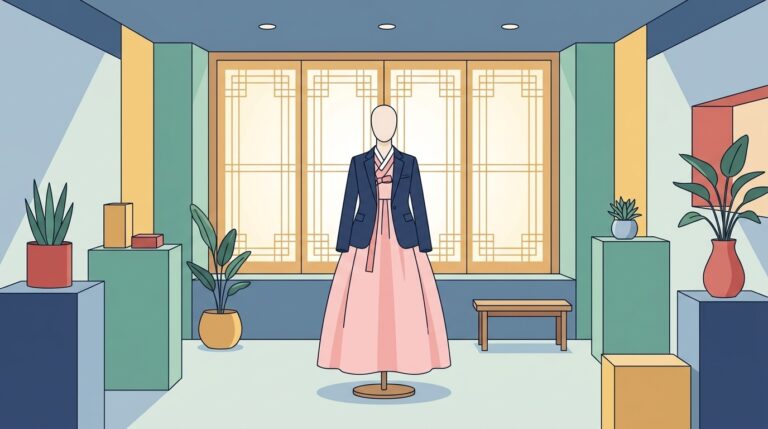
ALT: A modern minimalist interior gallery featuring a fusion Hanbok blending traditional translucent silk layers with structured modern silhouettes.

In the early 2000s, Hanbok was slowly becoming a relic—something only worn on Chuseok (추석) or weddings. However, the rise of Newtro (뉴트로 – New + Retro) culture changed everything. Brands like Danha (단하) and Leesle (리슬) pioneered “Lifestyle Hanbok” (생활한복) by replacing heavy silks with breathable cotton, adding pockets, and shortening the skirts for everyday life.
When discussing this in Korean, you can use the phrase “전통의 일상화” (jeontong-ui ilsang-hwa), which means “making tradition part of daily life.”
Phase 5: Interactive Roleplay Scenario
The Setting
You are visiting a high-end designer boutique in Samcheong-dong, Seoul. The air smells of rich cedarwood, and natural light filters through traditional Hanji (한지) paper windows, illuminating racks of stunning modern fusion Hanbok. You are speaking with Min-woo (민우), the chief designer.
The Cast
- You (지영 – Ji-young): A fashion curator looking to collaborate.
- Min-woo (민우): A passionate, modern Hanbok artisan in his late 30s.
1. 민우: (🎭 Welcoming you with a soft bow) 어서 오세요. 현대적으로 재해석한 저희 브랜드의 컬렉션입니다. 천천히 둘러보세요.
   (Welcome. This is our brand's collection, reinterpreted modernly. Please take your time looking around.)

2. 지영: (🎭 Smiling warmly, touching a pastel silk blazer) 감사합니다. 와, 이 재킷은 깃(collar) 부분이 정말 독특하네요!
   (Thank you. Wow, this jacket's collar section is truly unique!)

3. 민우: (🎭 Eyes lighting up) 알아보시는군요! 전통 한복의 '동정(white collar band)' 라인을 현대적인 테일러드 재킷에 접목해 봤습니다.
   (Ah, you recognize it! I tried grafting the traditional Hanbok's 'white collar band' line onto a modern tailored jacket.)

4. 지영: (🎭 Nodding in admiration) 정말 전통과 현대의 조화가 돋보여요. 한복 특유의 고운 선이 현대적인 실루엣 속에서도 그대로 살아 있네요.
   (The harmony of tradition and modernity really stands out. The exquisite line unique to Hanbok is preserved perfectly within the modern silhouette.)

5. 민우: (🎭 Gratefully bowing) 최고의 극찬이십니다. 요즘 젊은 세대나 외국인 고객분들도 일상에서 '힙하게' 입을 수 있도록 신경을 많이 썼거든요.
   (That is the highest praise. I put a lot of effort into making it so the younger generation and foreign clients can wear it 'hiply' in their daily lives.)

6. 지영: (🎭 Pointing to a skirt with a subtle ink-wash pattern) 이 치마의 동양적인 패턴도 아주 매력적이에요. 과하지 않으면서도 세련된 느낌이랄까요?
   (The oriental pattern of this skirt is also very charming. It's sophisticated without being overdone, if you know what I mean?)

7. 민우: (🎭 Smiling proudly) 맞습니다. 한국의 '여백의 미(beauty of empty space)'를 살리기 위해 일부러 여백을 많이 남겨두고 드로잉을 배치했습니다.
   (Exactly. To bring out the Korean 'beauty of empty space', we intentionally left a lot of blank space and arranged the drawing carefully.)

8. 지영: (🎭 Raising your chin thoughtfully) 그렇군요. 비우는 것이 오히려 시각적 깊이를 더해주는 것 같아요.
   (I see. Leaving it empty actually seems to add visual depth.)

9. 민우: (🎭 Nodding eagerly) 제 의도를 정확히 읽어주셨네요! 오늘 정말 훌륭한 안목을 가진 파트너를 만난 것 같습니다.
   (You read my intention perfectly! I feel like I've met a partner with wonderful taste today.)

10. 지영: (🎭 Handing him your business card) 저야말로요. 이 멋진 의상들을 세계 무대에 꼭 소개하고 싶습니다.
    (Likewise. I would absolutely love to introduce these wonderful outfits to the global stage.)
🔀 Decision Point
How would you respond if Min-woo asks you: “전통 한복의 가장 큰 매력은 무엇이라고 생각하시나요?” (What do you think is the greatest charm of traditional Hanbok?)
- Option A: “그냥 색깔이 화려하고 사진 찍기에 좋은 것 같아요.”
(I think the colors are just colorful and it’s good for taking photos.)
👉 Editor’s Verdict: Too superficial! While true for tourists, as a C1 speaker, this misses the artistic depth of the garment and sounds a bit dismissive. -
Option B: “몸을 조이지 않고 자연스럽게 흘러내리는 고운 선과 여백의 미가 매력적입니다.”
(The exquisite lines that flow naturally without constricting the body, and the beauty of empty space, are its charms.)
👉 Editor’s Verdict: BEST CHOICE! This uses advanced aesthetic vocabulary (고운 선, 여백의 미) and demonstrates a deep cultural understanding of Hanbok’s philosophical design. -
Option C: “서양 옷보다 훨씬 편해서 매일 입기 좋습니다.”
(It is much more comfortable than Western clothes, so it’s good to wear every day.)
👉 Editor’s Verdict: Historically inaccurate. Authentic traditional Hanbok can actually be quite complex and restrictive to wear daily, which is why modern reinterpretation was necessary! This sounds slightly naive.
Phase 6: 10-Second Emotional Shadowing Drill
Let’s practice speaking with real soul and emotion. Mimic the pauses (/) and immerse yourself in the emotional cues!
Phrase 1: Admiring the design with awe
- [😊 Filled with artistic awe]
- “전통적인 요소를 / 이렇게 힙하게 / 재해석하다니 / 진짜 감탄했어요!”
- (Jeontong-jeogin yoso-reul / ireohge hip-hage / jae-haeseok-hada-ni / jinjja gamtan-haess-eo-yo!)
- “To think they reinterpreted / traditional elements / so hiply / I’m truly amazed!”
Phrase 2: Praising the drape/fit with elegant conviction
- [✨ Poetic and confident]
- “움직일 때마다 / 한복 특유의 / 고운 선이 / 그대로 살아나요.”
- (Umjig-il ttae-mada / hanbok teugyu-ui / goun seon-i / geudaero saranayo.)
- “Every time you move, / the unique / exquisite line of Hanbok / vividly comes to life.”
Phase 7: K-Culture Mini Dictionary
| Word | Pronunciation | English Translation | Real-world Contextual Usage |
|---|---|---|---|
| 깃 | Git | Collar of Jeogori | The stiff v-neck collar of the Hanbok jacket, which acts as the framing focal point of the face. |
| 배래 | Baerae | Curved sleeve line | The belly-like gentle curve of the sleeves, inspired by the natural silhouette of a melon’s belly. |
| 여백의 미 | Yeobaek-ui mi | Beauty of empty space | The classical Korean artistic philosophy of leaving parts of a canvas (or garment) empty to allow room for imagination and breath. |
| 생활한복 | Saenghwal-hanbok | Modern lifestyle Hanbok | Casualized, highly-functional Hanbok designed for modern daily wear (often machine washable with pockets). |
Phase 8: Traveler’s Survival Kit (Buying & Styling Modern Hanbok)
TOP 3 Crucial Expressions
- “이 디자인은 데일리로 입기에 부담 없을까요?”
- (I di-ja-in-eun de-il-li-ro ib-gi-e bu-dam eobs-eul-kka-yo?)
- English: “Would this design be easy enough to wear as a daily look? (Not too overwhelming?)”
- Pro Tip: Modern Hanbok can range from ultra-casual to theatrical. Use this to ask if an item works for everyday streets.
- “물세탁이 가능한 재질인가요?”
- (Mul-se-tag-i ga-neung-han jae-jil-in-ga-yo?)
- English: “Is this material machine-washable?”
- Pro Tip: Traditional silk Hanbok requires dry cleaning. If buying modern lifestyle Hanbok, make sure it’s cotton or synthetic blend so you can wash it easily.
- “믹스매치하기 좋은 아이템을 추천해 주세요.”
- (Mik-seu-mae-chi-ha-gi jo-eun a-i-tem-eul chu-cheon-hae ju-se-yo.)
- English: “Please recommend items that are good for mixing and matching.”
- Pro Tip: Ask this to find modern outer jackets that pair perfectly with standard jeans or basic t-shirts.
📌 Editor’s Travel Note:
When shopping for modern Hanbok in Seoul, avoid tourist trap rental shops. Instead, head to the Insadong Ssamzigil Mall or look up contemporary designers on The National Institute of Korean Language Romanization Guidelines to make sure you are buying authentic, locally made designer pieces.
Phase 9: Thinking Deeper — “The Fluidity of Heritage”
Western tailoring historically restructured the human body—corsets pulled the waist in, shoulder pads built the silhouette out. However, Hanbok has always been an art of fluidity and accommodation. It wraps, drapes, and flows. It does not force the body into a pre-made mold; it adapts to the unique shape of the wearer.
When we look at modern Hanbok, we see this philosophy adapted for globalized youth. It’s not just “costume-play”—it is an elegant protest against rigid, fast-fashion structures. It asks us to slow down, look at the lines, and appreciate space.
💬 Your Turn: How does your native culture view traditional clothing? Is it preserved in a museum glass box, or is it dynamically evolving like Hanbok? Let us know in the comments below!
Phase 10: FAQ & Avoiding Misunderstandings
Q: Can foreigners wear modern Hanbok without it being “cultural appropriation”?
A: Yes, absolutely! Koreans love when foreigners show genuine appreciation for Hanbok, especially when they understand its elements. Wearing it respectfully to historical sites, galleries, or styling lifestyle Hanbok in daily life is highly welcomed and seen as a beautiful cross-cultural bridge.
Q: What is the difference between 생활한복 (Saenghwal-hanbok) and 개량한복 (Gaeryang-hanbok)?
A: Historically, Gaeryang-hanbok (reform Hanbok) emerged in the late 20th century, often associated with comfortable, rustic clothing worn by activists or teachers. Saenghwal-hanbok (lifestyle/modern Hanbok) is the younger, trendier evolution focused on high fashion, streetwear, and youth appeal.
Q: Is there a specific rule for folding the ribbon (Goreum – 고름)?
A: Yes! The chest ribbon must be tied so that the short loop is clean and the long tail falls straight down the right side of your chest. Tying it incorrectly can look messy or, in worst cases, resemble historical mourning wear. Watch a quick video tutorial before heading out!
🚨 Common Pitfalls to Avoid
- Mistake 1: Wearing the collar (Git) overlapping left-over-right.
- Correct Action: In Korea, right-over-left (right collar tucked under the left) is only for deceased spirits in traditional funeral rituals. Always cross your left side over the right side (as you look down at it).
- Mistake 2: Walking around in historical rental Hanbok with sneakers sticking out like neon lights.
- Correct Action: If wearing traditional rental wear, opt for simple black or white slip-ons. If wearing modern lifestyle Hanbok, go wild with combat boots or chunky sneakers!
- Mistake 3: Thinking all Hanbok looks the same.
- Correct Action: Train your C1 eye to distinguish between Joseon-style (high waist, full skirt) and modern variations (asymmetrical layers, utility buckles).
Phase 11: Action Missions
- 🥉 Bronze (At-Home Challenge): Find a photo of a modern Hanbok design online. Write a 3-sentence description in Korean utilizing the term 전통과 현대의 조화 and post it in your personal study notebook.
- 🥈 Silver (Network Challenge): Share a photo of your favorite K-Star (like BTS or BLACKPINK) wearing Hanbok on social media. Write a caption using “한복 핏이 진짜 예술이네요!” and tag @DailyHangul.
- 🥇 Gold (Real-World Challenge): Visit a modern Hanbok shop or exhibition. Strike up a conversation with the staff or a friend and say: “이 옷은 고운 선을 현대적인 감각으로 아주 잘 살린 것 같아요.” (I think this clothing beautifully brings out the exquisite lines with a modern sensibility.)
- 🎮 K-Culture Mission: Watch Agust D’s Daechwita music video. Spot the moments where historical royal robes are blended with streetwear, and write down how the concept of 멋을 살리다 applies here.
Phase 12: Interactive Quiz Challenge
1. Situational Judgment
You are at a trendy Hanbok pop-up shop in Hongdae. You want to praise the designer for making the traditional collar look incredibly chic on a denim jacket. Which expression is the most natural and culturally elevated?
* A) 이 옷은 아주 오래된 스타일이라 고상해요.
* B) 전통적인 ‘깃’ 디자인을 힙하게 재해석한 점이 인상 깊어요.
* C) 청바지랑 입으니까 그냥 예쁜 옷이 되었네요.
👉 See Answer & Explanation
- Correct Answer: B
- Explanation: B uses precise fashion vocabulary (‘깃’ – collar, ‘재해석한’ – reinterpreted, ‘힙하게’ – hiply), which instantly marks you as an advanced, culturally literate speaker. A is too old-fashioned, and C is too simplistic.
2. Fill in the Blanks
Fill in the blank with the appropriate aesthetic expression from today’s lesson:
“바람이 불 때마다 흩날리는 한복 치마의 __________________ 정말 눈부시게 아름답네요.”
(The ________ of the Hanbok skirt fluttering every time the wind blows is truly dazzlingly beautiful.)
👉 See Answer & Explanation
- Correct Answer: 고운 선이 (or 선이 곱다 / 고운 선을)
- Explanation: In Korean aesthetics, the lines made by flowing silk are traditionally described as ‘곱다’ (exquisite/elegant).
3. True or False
- Q: Modern Hanbok should never have pockets or zippers because it ruins the traditional spirit. (T / F)
👉 See Answer & Explanation
- Correct Answer: False
- Explanation: Today’s movement is focused on 전통의 일상화 (making tradition part of daily life). Adding pockets, zippers, and belt loops is highly celebrated in modern Korea as it makes traditional styles practical for daily life!







