

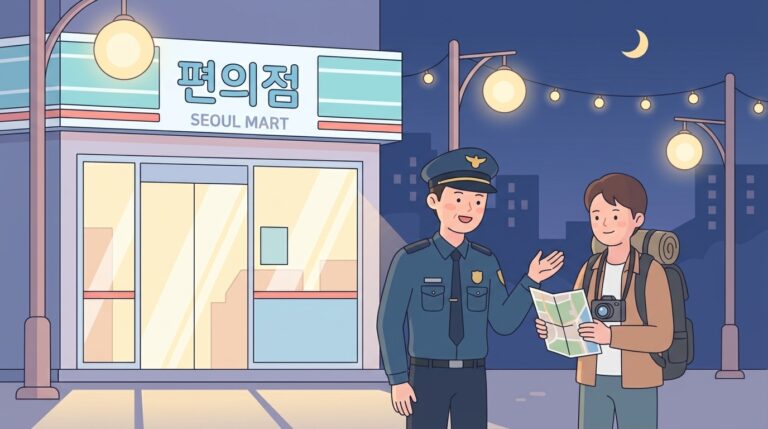
Don’t Panic in Korea! How to Call 112 and Get Help Instantly
Phase 1: Keep Calm and Speak Korean! (Your Safety First)
안녕하세요! (An-nyeong-ha-se-yo!) It is your friendly Korean editor from Daily Hangul.
Imagine this: You are walking down a beautifully lit alleyway in Seoul, enjoying the cool night breeze after eating some delicious Tteokbokki (떡볶이). Suddenly, you realize your backpack is gone, or you witness a sudden safety hazard. Your heart races. In K-Dramas like Voice or Signal, we always see the cool dispatch officers tracking down locations in seconds. But in real life, as a foreigner, how do you call for help without panicking?
Many of my students tell me, “I am so scared of dialing 112 because my Korean is not perfect yet!”
Don’t worry! Today, we are going to learn super simple, life-saving Korean phrases that even absolute beginners (A1) can use instantly. Knowing these phrases won’t just keep you safe; it will give you the ultimate confidence to explore every corner of South Korea like a local. Let’s learn how to protect yourself and others!
Phase 2: Top 3 Emergency Phrases You Must Know
1. 도와주세요! (Do-wa-ju-se-yo!)
- Pronunciation: Doh-wah-joo-seh-yo! (Sounds like “Door-wah” + “Jew” + “Say yo”)
- Meaning: Please help me!
- K-Culture Moment: You hear this in almost every action K-Drama when characters are in trouble. It is the most universal cry for help in Korea.
- Editor’s Insight: This is a polite but urgent request. Never hesitate to scream this if you feel you are in immediate danger. People nearby will instantly look at you to help.
- Situation Spectrum:
- Friends/Casual: ⚠️ Too formal for a casual joke, but use it in real danger!
- Strangers/Public: ✅ Perfect and highly effective.
- Formal/Emergency: ✅ The gold standard.
- 🤔 Think About It: Unlike English which just uses “Help!”, Korean adds “-주세요” (-ju-se-yo) which means “please give/do for me.” Why do you think Korean grammar keeps politeness even in urgent moments?
2. 경찰을 불러주세요. (Gyeong-chal-eul bul-leo-ju-se-yo.)
- Pronunciation: Gyung-chahl-eul bool-luh-joo-seh-yo.
- Meaning: Please call the police.
- K-Culture Moment: Think of classic movies where a store owner quickly dials the police under the counter when something suspicious happens.
- Editor’s Insight: If your phone is dead or you cannot dial, point to a passerby or a convenience store clerk and say this clearly.
- Situation Spectrum:
- Friends/Casual: 🚫 Too heavy for casual talk.
- Strangers/Public: ✅ Very clear and direct.
- Formal/Emergency: ✅ Extremely useful.
- 🤔 Think About It: “경찰” (Gyeong-chal) means police. By adding “~을 불러주세요” (please call ~), you can ask for any emergency service. What other services might you need?
3. 여기가 [장소]예요. (Yeo-gi-ga [Place]-yeo-yo.)
- Pronunciation: Yuh-gi-gah [Place] yeh-yo.
- Meaning: This place is [Place] / I am at [Place].
- K-Culture Moment: When ordering late-night Han River ramen delivery, or when calling a taxi in a drama, characters always start with “여기가…” (Yeogiga…).
- Editor’s Insight: 112 operators need your location first. If you don’t know the exact address, just say the name of a nearby subway station, cafe, or store. For example: “여기가 홍대역이에요” (Yeo-gi-ga Hong-dae-yeok-i-e-yo – This is Hongdae Station).
- Situation Spectrum:
- Friends/Casual: ✅ Great for telling friends where you are.
- Strangers/Public: ✅ Clear orientation.
- Formal/Emergency: ✅ Crucial for police tracking.
- 🤔 Think About It: In Korean, the subject often comes first, marked by “가” (ga). “여기” (yeo-gi) means “here”. Why is locating yourself the first step to safety?
Phase 3: Textbook Korean vs. Real-World Korean
Sometimes, textbooks teach you phrases that are too long or stiff for a real emergency. Let’s look at the difference!
Scenario 1: Requesting Police Intervention
- 📖 Textbook Korean: 저를 위해 경찰관에게 즉시 연락을 취해 주시겠습니까? (Jeo-reul wi-hae gyeong-chal-gwan-e-ge jeuk-si yeol-lak-eul chwi-hae ju-si-get-seup-ni-ka? – Would you please contact a police officer immediately on my behalf?)
- 🗣️ Real Korean: 경찰 불러주세요! (Gyeong-chal bul-leo-ju-se-yo! – Call the police!)
- 💡 Why is it different? In a panic, no one uses 15-syllable honorific grammar. The short, punchy “경찰 불러주세요” gets the message across in one second.
Scenario 2: Showing Your Location via Nearby Store
- 📖 Textbook Korean: 현재 저의 위치는 편의점 근처에 도달해 있습니다. (Hyeon-jae jeo-ui wi-chi-neun pyeon-ui-jeom geun-cheo-e do-dal-hae it-seup-ni-da. – My current location has arrived near a convenience store.)
- 🗣️ Real Korean: 편의점 앞이에요! (Pyeon-ui-jeom ap-i-e-yo! – I am in front of the convenience store!)
- 💡 Why is it different? Koreans value extreme speed and efficiency. Saying “[Noun] 앞이에요” (In front of [Noun]) is how locals naturally communicate location.
Phase 4: K-Culture Deep Dive & Safety Manners
4-1. “Nunchi” (눈치) in Emergency Situations
In Korea, Nunchi (the art of reading the room/situation) is highly valued. If you need to make a 112 call, keep your eyes open for these visual clues to feed to the operator:
1. Convenience Stores (편의점): Almost every 24-hour convenience store in Korea is designated as a “Safe House” for people in danger. If you feel followed, walk inside and ask the clerk for help.
2. Streetlight Numbers: Many streetlights in Seoul have yellow ID numbers. Read those numbers to the 112 operator, and they can pinpoint your location instantly!
4-2. The Real 112 Dispatch System
Unlike some K-Dramas where police take hours to arrive, Korea’s police dispatch is incredibly fast due to GPS tracking and high CCTV density.
Foreign Language Support: Did you know that 112 has a built-in translation service? If you call 112 and speak English, they will connect you to a three-way translation call with an interpreter! So, don’t worry about perfect grammar.
Phase 5: Interactive Roleplay: The Lost Phone Mystery
Let’s practice! Imagine you are at Hangang Park (한강공원). Your phone was left on a bench, and someone walked away with it. You run to a nearby park office and meet Officer Kim (김 순경).
- Setting: A busy, windy evening at Yeouido Hangang Park. Bicycle bells are ringing in the background.
- Cast: You (A1 learner) & Officer Kim (Helpful local police officer).
- Turn 1 (Officer Kim):
🎭 (Approaching you with a worried look)
“무슨 일 있으세요? 괜찮으세요?”
(Mu-seun il is-seu-se-yo? Gwaen-chan-eu-se-yo? – What’s wrong? Are you okay?) -
Turn 2 (You):
🎭 (Breathing heavily, pointing to your pocket)
“도와주세요! 스마트폰… 없어요!”
(Do-wa-ju-se-yo! Seu-ma-teu-pon… eop-seo-yo! – Help! My smartphone… is gone!) -
Turn 3 (Officer Kim):
🎭 (Nodding quickly, taking out his notepad)
“아, 핸드폰을 잃어버리셨군요. 여기가 어디예요? 정확한 위치를 아세요?”
(Ah, haen-deu-pon-eul il-eo-beo-ri-syeot-gun-yo. Yeo-gi-ga eo-di-yeo-yo? Jeong-hwak-han wi-chi-reul a-se-yo? – Ah, you lost your phone. Where is this? Do you know the exact location?) -
Turn 4 (You):
🎭 (Looking around, pointing at a bright convenience store)
“여기가… 한강 GS25 편의점 앞이에요!”
(Yeo-gi-ga… Han-gang GS-i-sip-o pyeon-ui-jeom ap-i-e-yo! – This is… in front of the Han River GS25 convenience store!) -
Turn 5 (Officer Kim):
🎭 (Typing on his radio)
“확인했습니다. 언제 잃어버렸어요?”
(Hwak-in-haet-seup-ni-da. Eon-je il-eo-beo-ryeo-sseo-yo? – Confirmed. When did you lose it?) -
Turn 6 (You):
🎭 (Showing 5 fingers)
“오 분 전에요! 저기 벤치에서요!”
(O bun jeon-e-yo! Jeo-gi ben-chi-e-seo-yo! – Five minutes ago! Over there on the bench!) -
Turn 7 (Officer Kim):
🎭 (Looking toward the benches)
“알겠습니다. 지금 바로 112에 연락해서 같이 확인해 드릴게요.”
(Al-get-seup-ni-da. Ji-geum ba-ro baek-sip-i-beon-e yeon-rak-hae-seo gat-i hwak-in-hae deu-ril-ge-yo. – Understood. I will call 112 right now and check it with you.) -
Turn 8 (You):
🎭 (Sighing with relief, bowing slightly)
“감사합니다! 정말 감사합니다.”
(Gam-sa-ham-ni-da! Jeong-mal gam-sa-ham-ni-da. – Thank you! Thank you so much.)
🔀 Decision Point!
Officer Kim asks you if you saw the person who took it. What do you say?
- A) “몰라요! 그냥 도와주세요!” (Mol-la-yo! Geu-nyang do-wa-ju-se-yo! – I don’t know! Just help me!)
- B) “검은색 티셔츠 입은 사람이에요!” (Geom-eun-saek ti-syeo-tsu ib-eun sa-ram-i-e-yo! – It is a person wearing a black t-shirt!)
- C) “아무것도 아닙니다.” (A-mu-geot-do a-nim-ni-da. – It’s nothing.)
Best Choice Analysis:
- Choosing B is the Best! Providing visual details like color (“검은색” – black) and item (“티셔츠” – t-shirt) helps the police check CCTV quickly.
- If you chose A: It’s okay because you are panicked, but try to give simple descriptions if possible!
- If you chose C: Don’t say it’s nothing! Korean police are happy to help you find your lost items.
Phase 6: 10-Second Emotion Shadowing Drill
Practice saying these with the correct feeling. The / slash shows where to take a tiny breath.
- [🥺 Urgently calling for help]
“도와주세요! / 핸드폰 / 없어요!”
(Do-wa-ju-se-yo! / Haen-deu-pon / eop-seo-yo!)
“Help me! / My phone / is gone!” -
[😤 Direct and loud to get attention]
“여기 / 경찰을 / 불러주세요!”
(Yeo-gi / gyeong-chal-eul / bul-leo-ju-se-yo!)
“Here, / please call / the police!”
Phase 7: K-Culture Mini Dictionary
| Word (Hangul) | Romanization | English | Cultural Context |
|---|---|---|---|
| 경찰 | Gyeong-chal | Police | You will see “지구대” (neighborhood police boxes) all over Seoul. Feel free to walk in if you need directions or help. |
| 신고 | Sin-go | Report | Used for reporting crimes (112) or fires/medical emergencies (119). |
| CCTV | Ssi-si-ti-bi | Security Camera | South Korea has one of the highest densities of security cameras in the world, keeping streets highly safe. |
| 편의점 | Pyeon-ui-jeom | Convenience Store | Open 24/7. They have direct emergency buttons to the police under their desks. |
Phase 8: Traveler’s Survival Kit
Top 3 Survival Phrases
- “지갑 잃어버렸어요.” (Ji-gap il-eo-beo-ryeo-sseo-yo.)
- 👉 I lost my wallet.
- “여권이 없어요.” (Yeo-gwon-i eop-seo-yo.)
- 👉 I don’t have my passport.
- “다쳤어요.” (Da-chyeo-sseo-yo.)
- 👉 I am hurt.
📌 Editor’s Travel Note:
When traveling, download the Naver Map Application for Navigation immediately. Unlike Google Maps which has limited functionality in Korea, Naver Map shows your exact 5-digit postal address and nearby landmark building names instantly, which you can read to a 112 operator.
Note: Emergency calls to 112 are completely free from any active mobile phone, even without a local SIM card. (Current policy as of 2024).
Phase 9: Deep Reflection — “One Step Deeper”
Have you ever wondered why South Korea is widely ranked as one of the safest countries in the world? Part of it is the modern technology like CCTV, but a huge part is the community culture of Jeong (정)—a deep feeling of attachment and mutual care. Koreans naturally watch out for each other, and returning lost wallets filled with cash to the police station is a very common daily occurrence.
💬 Your Turn: How does the emergency service in your country compare? Is there a special number you call? Let us know in the comments below!
Phase 10: FAQ & Mistakes (Optimized for Search)
Q: Can I call 112 if I don’t speak any Korean?
A: Yes! When you call 112, simply say “English, please” or “영어 (Yeong-eo).” The police system will instantly route you to a translation service officer who will translate between you and the dispatcher.
Q: What is the difference between 112 and 119 in Korea?
A: 112 is for crime and security, while 119 is for fire, rescue, and medical emergencies. If you need an ambulance, dial 119.
Q: Can I text 112 if I cannot speak on the phone?
A: Yes! You can send a text message to the number 112 with your location, photos, or video of the emergency.
🚨 Common Mistakes to Avoid:
- Saying “Help” in English: Locals in non-tourist areas might freeze up if you scream in English. Always use “도와주세요!” (Do-wa-ju-se-yo!).
- Not checking your location: Don’t start a call without knowing at least one landmark around you.
- Being afraid to call: Some tourists fear getting fined for calling the police. If you are in genuine danger or have lost important documents, calling 112 is the right and legal thing to do.
Phase 11: Action Missions
- 🥉 Bronze (At Home): Look in the mirror and shout “도와주세요!” with a serious face three times. Get comfortable with the sounds!
- 🥈 Silver (Social Media): Take a screenshot of our Mini Dictionary and share it on Instagram with the tag #DailyHangul to help your fellow travelers stay safe.
- 🥇 Gold (Real Life): Next time you walk around Seoul, spot three yellow numbers on streetlights or find the nearest 편의점 (convenience store) just in case!
Phase 12: Interactive Quiz Challenge
Test your survival Korean skills!
1. What should you scream if someone grabs your bag in Seoul?
- A) 비싸요! (Bi-ssa-yo!)
- B) 도와주세요! (Do-wa-ju-se-yo!)
- C) 맛있어요! (Ma-si-sseo-yo!)
2. Match the Emergency Number:
- 1) 112
- 2) 119
- A) Ambulance / Fire
- B) Police
👉 Click to reveal the Answers & Explanations!
Answers:
1. B) 도와주세요! (A means ‘It is expensive!’, C means ‘It is delicious!’ – definitely don’t say those to a thief!)
2. 1-B, 2-A (112 is Police, 119 is Fire/Medical).







