

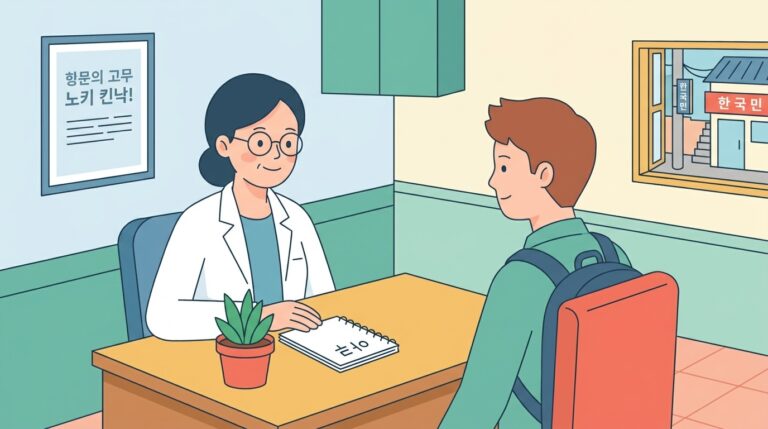
Don’t Panic at the Korean Clinic! How to Explain Your Symptoms Like a Local
Phase 1: Empathy — Losing Your Voice in Seoul?
Annyeonghaseyo! (안녕하세요!) It’s your favorite Korean tutor and local guide from Daily Hangul.
Imagine this: You’ve had the absolute best weekend in Seoul. You sang your heart out at a Noraebang (노래방 – karaoke) in Hongdae, ate delicious, spicy Tteokbokki (떡볶이) from a street cart, and walked along the Han River under the cool night breeze. But Monday morning arrives, and you wake up with a burning throat, a pounding headache, and a voice that sounds like a broken cello.
You need to go to a local clinic (내과 – nae-gwa), but your mind goes blank. How do you tell the doctor what’s wrong without relying on frantic hand gestures? If you’ve watched K-Dramas like Hospital Playlist, you know Korean doctors are incredibly caring, but explaining physical pain in a foreign language can still feel terrifying.
Don’t worry! Today, we are going to learn how to express exactly how you feel with absolute confidence. By the end of this guide, you will be able to walk into any Korean clinic and get the right treatment, just like a true Seoulite.
Phase 2: The Big Three — Core Symptom Expressions
Let’s master the three most common phrases you will need at a doctor’s office. These are simple, highly effective, and natural.
1. 머리가 아파요 (Meo-ri-ga a-pa-yo)
- Pronunciation: [meo-ri-ga a-pa-yo] / Sound-alike: “Maw-ree-gah ah-pah-yo”
- Meaning: My head hurts / I have a headache.
- K-Culture Moment: You see this in almost every K-Drama when a character gets stressed out by drama in their family or company. They hold their forehead and groan, “어휴, 머리야…” (Uh-hyu, meo-ri-ya… / Oh, my head…).
- Editor’s Insight: “아파요” (a-pa-yo) comes from the verb “아프다” (a-peu-da – to be sick/painful). You can attach this to almost any body part! Just add the subject marker 이/가 (i/ga) after the body part: [Body Part] + 이/가 아파요. For example: 배가 아파요 (Bae-ga a-pa-yo – My stomach hurts).
- Situation Spectrum:
- Friends/Casual: 머리 아파 (Meo-ri a-pa) — ✅
- Colleagues/Semi-formal: 머리가 아파요 (Meo-ri-ga a-pa-yo) — ✅
- Doctor/Formal: 머리가 아픕니다 (Meo-ri-ga a-peum-ni-da) — ✅ (Though “아파요” is perfectly polite for a doctor!)
- 🤔 Think About It: In English, we say “I have a headache” (possession). In Korean, we say “The head is hurting” (state of the subject). Why do you think Korean focuses more on the location of the pain rather than owning the illness?
2. 목이 부었어요 (Mog-i bu-eot-seo-yo)
- Pronunciation: [mog-i bu-eot-seo-yo] / Sound-alike: “Mawk-ee boo-ut-suh-yo”
- Meaning: My throat is swollen / sore.
- K-Culture Moment: Essential for K-Pop fans who screamed too loudly at a concert, or after eating extra-spicy Buldak noodles.
- Editor’s Insight: “목” (mok) can mean both “neck” and “throat” in Korean. “부었어요” comes from “붓다” (but-da – to swell). If you have a sore throat from a cold, this is the perfect line to use.
- Situation Spectrum:
- Friends/Casual: 목 부었어 (Mok bu-eot-seo) — ✅
- Colleagues/Semi-formal: 목이 부었어요 (Mog-i bu-eot-seo-yo) — ✅
- Doctor/Formal: 목이 부었습니다 (Mog-i bu-eot-seum-ni-da) — ✅
3. 콧물이 나요 (Kot-mul-i na-yo)
- Pronunciation: [kot-mul-i na-yo] / Sound-alike: “Kote-mool-ee nah-yo”
- Meaning: I have a runny nose (Literally: Nose-water is coming out).
- K-Culture Moment: Often used in chilly autumn or winter scenes when characters walk through the beautiful fallen leaves in Gyeongbokgung Palace but forget their scarves.
- Editor’s Insight: “콧물” (kot-mul) is a compound word: “코” (ko – nose) + “물” (mul – water). The small “ㅅ” in the middle is a phonetic bridge! It literally means “nose water”. Koreans use the verb “나다” (na-da – to exit/come out) for bodily fluids like sweat (땀이 나요) and tears (눈물이 나요).
- Situation Spectrum:
- Friends/Casual: 콧물 나 (Kot-mul na) — ✅
- Colleagues/Semi-formal: 콧물이 나요 (Kot-mul-i na-yo) — ✅
- Doctor/Formal: 콧물이 납니다 (Kot-mul-i nam-ni-da) — ✅
Phase 3: Textbook Korean vs. Real Korean
Textbooks teach you to sound like a robot. Let’s look at how real Koreans talk when they are feeling under the weather.
Case 1: Feeling Exhausted & Achy
- 📖 Textbook: “저는 감기에 걸렸습니다.” (Jeo-neun gam-gi-e geol-lyeot-seum-ni-da. – I caught a cold.)
- 🗣️ Real Korean: “몸살 기운이 있어요.” (Mom-sal gi-un-i it-seo-yo. – I feel body aches/fatigue starting.)
- 💡 Why is it different? Koreans have a unique word: 몸살 (Momsal). It refers to that specific, heavy body ache you get from fatigue, overwork, or just before a severe cold hits. Saying you have “몸살 기운” (momsal gi-un) immediately tells the doctor you need rest and recovery.
Case 2: Indigestion after eating too fast
- 📖 Textbook: “배가 아픕니다.” (Bae-ga a-peum-ni-da. – My stomach hurts.)
- 🗣️ Real Korean: “체한 것 같아요.” (Che-han geot gat-ah-yo. – I think I have indigestion.)
- 💡 Why is it different? 체하다 (Che-hada) is a cultural physical phenomenon in Korea. It means food is “stuck” in your digestive system due to stress or eating too quickly. It’s much more specific than a simple stomachache!
Phase 4: K-Culture Deep Dive & Non-Verbal Manners
4-1. Clinic Etiquette in Korea (The Body Language)
- The Two-Handed Hand-off: When you register at the front desk or hand over your health insurance card/passport, always use two hands. It shows immense respect.
- The Doctor’s Title: Always address the doctor as 의사 선생님 (ui-sa seon-saeng-nim – Doctor Teacher) or simply 선생님 (seon-saeng-nim). Never call them by their name.
4-2. The “Ringer” (링거) Phenomenon
If you watch K-Dramas, you’ve definitely seen characters lying in a hospital bed with an IV drip (called “링거” – ring-ger) for just a common cold or fatigue. In Korea, getting an IV nutrient drip is highly common and socially accepted as a quick way to “recharge” your energy. If you are extremely tired, don’t be surprised if the doctor asks: “수액 맞으시겠어요?” (Su-aek ma-jeu-si-get-eo-yo? – Would you like an IV fluid drip?)
Phase 5: Interactive Clinic Roleplay
Setting: A warm, clean local clinic (내과) in Sinchon, Seoul. The smell of light sanitizer is in the air. You are sitting across from Dr. Kim, a gentle doctor wearing round glasses.
The Cast:
- Dr. Kim (의사 선생님): A kind, attentive doctor.
- You (환자 – Patient): Feeling slightly feverish and congested.
Dialogue:
- Dr. Kim: 🎭 (Smiling warmly) 어서 오세요. 어디가 안 좋으세요?
(Eo-seo o-se-yo. Eo-di-ga an jo-eu-se-yo? / Welcome. Where does it feel bad?) -
You: 🎭 (Holding your throat slightly) 안녕하세요, 선생님. 목이 많이 아파요.
(An-nyeong-ha-se-yo, seon-saeng-nim. Mog-i man-i a-pa-yo. / Hello, doctor. My throat hurts a lot.) -
Dr. Kim: 🎭 (Nodding and typing on his computer) 아, 목이 아프시군요. 언제부터 아팠어요?
(Ah, mog-i a-peu-si-gun-yo. Eon-je-bu-teo a-pat-seo-yo? / Oh, your throat hurts. Since when has it been hurting?) -
You: 🎭 (Thinking) 어제 저녁부터 아팠어요. 열도 조금 나는 것 같아요.
(Eo-je jeo-nyeok-bu-teo a-pat-seo-yo. Yeol-do jo-geum na-neun geot gat-ah-yo. / It started hurting since yesterday evening. I think I have a bit of a fever too.) -
Dr. Kim: 🎭 (Picking up a small flashlight) 자, 아~ 해보세요.
(Ja, ah~ hae-bo-se-yo. / Now, say ‘Ah’.) -
You: 🎭 (Opening mouth wide) 아~~
(Ah~~) -
Dr. Kim: 🎭 (Examining your throat) 목이 많이 부었네요. 콧물이나 기침도 나나요?
(Mog-i man-i bu-eot-ne-yo. Kot-mul-i-na gi-chim-do na-na-yo? / Your throat is very swollen. Do you have a runny nose or a cough too?) -
You: 🎭 (Sniffling) 네, 콧물도 조금 나고 기침도 해요.
(Ne, kot-mul-do jo-geum na-go gi-chim-do hae-yo. / Yes, I have a bit of a runny nose and a cough too.) -
Dr. Kim: 🎭 (Writing down prescription) 감기 몸살이네요. 주사 맞고 약 먹으면 금방 나을 거예요. 밥 잘 챙겨 드세요.
(Gam-gi mom-sal-i-ne-yo. Ju-sa mat-go yak meog-eu-myeon geum-bang na-eul geo-yeo-yo. Bap jal chaeng-gye deu-se-yo. / It’s a cold with body aches. If you get a shot and take medicine, you will get better soon. Make sure to eat your meals well.) -
You: 🎭 (Bowing slightly) 감사합니다, 선생님. 안녕히 계세요.
(Gam-sa-ham-ni-da, seon-saeng-nim. An-nyeong-hi gye-se-yo. / Thank you, doctor. Goodbye.)
🔀 Decision Point:
At step 9, Dr. Kim says you should get a shot (주사 – ju-sa). What do you do?
- Option A: “주사는 싫어요! 약만 주세요.” (Ju-sa-neun sil-heo-yo! Yak-man ju-se-yo. / I don’t like shots! Just give me medicine.)
- Editor’s Insight (Best for needle phobias): Perfectly fine! Korean doctors are used to patients preferring oral medicine over quick-acting injections.
- Option B: “네, 주사 맞을게요.” (Ne, ju-sa maj-eul-ge-yo. / Yes, I’ll get the shot.)
- Editor’s Insight (Fastest recovery): Highly Recommended. Korean clinic shots (usually administered on the hip/buttock area) are incredibly fast-acting and will make you feel 100% better by the next morning!
- Option C: “주사 아파요?” (Ju-sa a-pa-yo? / Does the shot hurt?)
- Editor’s Insight (Cute but slightly childish): It’s okay to ask, but at A2 level, it might sound a bit like a child asking, though the doctor will find it endearing!
Phase 6: 10-Second Emotion Shadowing Drill
Let’s practice saying how we feel with real emotion. Pause at the slashes / and mimic the feeling!
- [🥺 Feeling tired and pitiful]
- “몸살 기운이 / 있어서 / 너무 / 힘들어요.”
- (Mom-sal gi-un-i / it-seo-seo / neo-mu / him-deul-eo-yo.)
- Translation: I feel body aches… and it’s… so… tough.
- **[😤 Determined to get better]
- “의사 선생님, / 빨리 / 낫고 싶어요!”
- (Ui-sa seon-saeng-nim, / ppal-li / nat-go sip-eo-yo!)
- Translation: Doctor, / I want to / get well quickly!
Phase 7: K-Culture Mini Dictionary
| Word (Korean + Romanization) | English Meaning | Cultural Context |
|---|---|---|
| 내과 (Nae-gwa) | Internal Medicine | The absolute first place you go in Korea for colds, stomach aches, or general physical fatigue. |
| 처방전 (Cheo-bang-jeon) | Prescription | The paper the doctor hands you. You must take this to the local pharmacy (약국) nearby to get your meds. |
| 약국 (Yak-guk) | Pharmacy | Located right outside almost every clinic. Look for the big red sign that says 약 (Yak)! |
| 몸살 (Mom-sal) | Fatigue-induced Body Ache | A deeply Korean physical concept. It’s when your body protests because you’ve worked too hard. |
Phase 8: Traveler’s Survival Kit
If you are traveling in Korea, keep these three golden phrases in your back pocket:
Survival Card
- “근처에 약국이 어디에 있나요?”
- Pronunciation: Geun-cheo-e yak-guk-i eo-di-e it-na-yo?
- Tip: Ask any local on the street if you need to find a pharmacy fast.
- “감기약 주세요.”
- Pronunciation: Gam-gi-yak ju-se-yo.
- Tip: Use this at the pharmacy to get over-the-counter cold medicine without a prescription.
- “진통제 있어요?”
- Pronunciation: Jin-tong-je it-seo-yo?
- Tip: Use this to buy painkillers (like ibuprofen or acetaminophen) at the pharmacy or even at a convenience store (편의점).
📌 Editor’s Travel Note: To locate the nearest clinic or pharmacy, do not use Google Maps (which has limited functionality in Korea). Instead, download the Naver Map App Download Page or Kakao Maps for real-time locations, hours, and directions.
Phase 9: Think Deeper — The Power of “Bap” (밥)
In the roleplay, you noticed Dr. Kim said, “밥 잘 챙겨 드세요” (Eat your meals well). Why do Korean doctors always talk about food when you are sick?
In Korea, food is considered the ultimate medicine. There is a famous saying: “밥이 보약이다” (Bap-i bo-yak-i-da – Food is the best herbal medicine). Taking medicine on an empty stomach is highly discouraged. Thus, the concept of eating a warm bowl of porridge (죽 – juk) before taking your pills is deeply ingrained in the culture.
💬 Your Turn: Does your country have a similar concept where food is treated as medicine? What is your go-to comfort food when you are sick? Let us know in the comments below!
Phase 10: FAQ & Common Mistakes (FAQ Schema Optimized)
Q: Can I go to a Korean clinic without national health insurance?
A: Yes! You can walk into any local clinic (내과) as a tourist. Without Korean insurance, a standard doctor’s consultation usually costs around 15,000 to 25,000 KRW ($12–$20 USD), which is remarkably affordable compared to many Western countries.
Q: Why did the doctor tell me to go to a separate pharmacy for my medicine?
A: Korea has a strict separation of prescribing and dispensing drugs (의약분업). Doctors only diagnose and print the 처방전 (prescription), while the 약국 (pharmacy) next door prepares the physical pills.
Q: What is the most common mistake foreigners make at a clinic?
A: Using “아파요” without specifying where it hurts, or using “배” (bae) incorrectly. “배” can mean stomach, pear, or boat! Make sure you point to your tummy so they know you don’t mean a fruit!
🚨 Common Mistakes Alert:
- Mistake 1: Saying “I have a cold” as “나 감기 있어” (Na gam-gi it-seo).
- Correct Action: Say “감기 걸렸어요” (Gam-gi geol-lyeot-seo-yo).
- Mistake 2: Bowing with hands in your pockets.
- Correct Action: Keep your hands respectfully at your sides or folded in front of you.
Phase 11: Action Missions
- 🥉 Bronze (At-home Challenge): Practice saying “머리가 아파요” and “목이 부었어요” in front of the mirror 3 times with a dramatic pout.
- 🥈 Silver (Social Challenge): Write a post on your social media or language exchange app using the phrase: “오늘 몸살 기운이 있어요 😭” and see how your Korean friends respond!
- 🥇 Gold (Real-world Challenge): If you are in Korea, walk into a local pharmacy (약국) and confidently ask for “대역 감기약 주세요” (Sore throat cold medicine, please) or simply buy a box of vitamins!
Phase 12: Interactive Quiz Challenge
Test your clinic skills below!
1. Which body part hurts if you say “배가 아파요”?
- A) Head
- B) Throat
- C) Stomach
- D) Foot
2. Fill in the blank:
- Doctor: “어디가 아프세요?”
- Patient: “어제부터 코에서 물이 나와요. _________ 나요.”
🎉 Click here to reveal the Answers & Explanations!
- Answer: C) Stomach. “배” (bae) means stomach. (Meo-ri = Head, Mok = Throat/Neck).
- Answer: 콧물이 (Kot-mul-i). The patient is describing a runny nose (“water coming from the nose”), so the correct word is “콧물이 나요”.







