

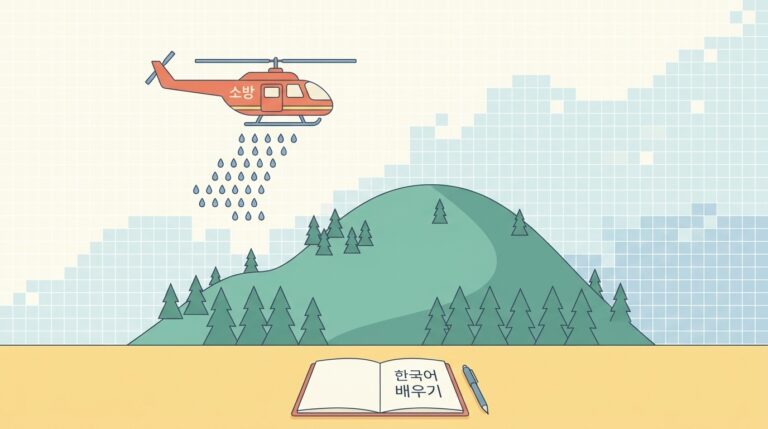
When the Mountain Breathes Fire: Master Korean Disaster Tech and Firefighting Terms Like a Native Expert
안녕하세요! Your friendly senior editor at Daily Hangul is here. Have you ever watched a high-octane Korean disaster drama like tvN’s Jirisan (지리산) and wondered how those brave park rangers and emergency responders communicate so fluidly amidst utter chaos? Or perhaps you’ve hiked up Bukhansan during a dry autumn afternoon and noticed the high-tech cameras silently scanning the canopy?
As a seasoned Seoul-ite who has hiked almost every major peak in this beautiful peninsula, I know firsthand how deeply South Korea respects its mountains—and how seriously it takes protecting them. Today, we are stepping into the shoes of emergency response coordinators to master C2-level Korean for Disaster Safety (재난 안전), specifically focusing on expanding firefighting helicopters (산불 진화 헬기 확충) and advanced preventive surveillance tech (예방 감시 기술). Whether you want to understand real-time government disaster alerts, follow intense action thrillers, or discuss environmental safety with Korean colleagues, this guide will elevate your vocabulary to the absolute pinnacle of fluency.
Phase 2: Deep Dive into 3 Core Advanced Expressions
1. 골든타임을 확보하다 (gol-deun-ta-im-eul hwak-bo-ha-da)
- Pronunciation: [gol-deun-ta-im-eul hwak-bo-ha-da] / Sound-alike: Goal-deun-time-eul hwak-bo-ha-da
- Meaning: To secure the “golden hour” (the critical window of time to suppress a disaster before it escalates).
- K-Culture Moment: This phrase is the ultimate climax driver in medical and disaster K-Dramas like D-Day or Golden Time. In wildfire containment, securing the golden hour often means getting helicopters in the air within 15 minutes of detection.
- Editor’s Insight: Though borrowing the English phrase “golden time,” Koreans have grammaticalized it into a highly formal action-oriented verb phrase. You will see this continuously in news headlines and policy briefings.
- Situation Spectrum:
- Casual: ⚠️ (A bit too formal for casual chit-chat, unless joking about arriving before food gets cold)
- Semi-formal: ✅
- Formal/Business: ✅
- 🤔 Think About It: Why does Korean culture emphasize the concept of the “golden hour” so intensely? It traces back to the rapid post-war industrialization era where safety protocols were sometimes bypassed for speed, leading to a modern societal commitment to preemptive safety and absolute efficiency during crises. How does your native language describe this critical window?
2. 첨단 예방 감시망을 가동하다 (cheom-dan ye-bang gam-si-mang-eul ga-dong-ha-da)
- Pronunciation: [cheom-dan ye-bang gam-see-mang-eul gah-dong-hah-dah] / Sound-alike: Chum-dan yeh-bang gam-see-mang-eul gah-dong-hah-dah
- Meaning: To operate/deploy state-of-the-art preventive surveillance networks.
- K-Culture Moment: Think of those sleek command centers featured in futuristic thriller dramas, where giant screens show AI thermal cameras mapping out coordinates across national parks.
- Editor’s Insight: This phrase showcases Hanja (Sino-Korean) compounding at its finest: 尖端 (cheomdan / cutting-edge) + 豫防 (yebang / prevention) + 監視網 (gamsimang / surveillance network). Using this complete phrase instantly marks you as a highly sophisticated speaker.
- Situation Spectrum:
- Casual: 🚫
- Semi-formal: ⚠️
- Formal/Business: ✅
3. 진화 헬기를 확충하다 (jin-hwa hel-gi-reul hwak-chung-ha-da)
- Pronunciation: [jin-hwa hel-gi-reul hwak-choong-hah-dah] / Sound-alike: Jin-hwa hell-ghee-reul hwak-choong-hah-dah
- Meaning: To expand/reinforce firefighting (fire extinguishment) helicopters.
- K-Culture Moment: In major mountain fires, the sight of a fleet of orange and green heavy-duty helicopters (진화 헬기) dipping water from local reservoirs is a symbol of national mobilization and hope.
- Editor’s Insight: Note that Korean uses “진화” (jinhwa / extinction, extinguishment) rather than just “소방” (sobang / firefighting) when referring to specifically suppressing active wildfires. “확충” (hwakchung) implies not just buying more, but upgrading the capacity and readiness.
- Situation Spectrum:
- Casual: 🚫
- Semi-formal: ⚠️
- Formal/Business: ✅
Phase 3: Textbook Korean vs. Real Korean
Advanced learners must shed dry, textbook phrasing to sound like native professionals during critical conversations.
Situation 1: Reporting or Discussing Urgent Helicopter Dispatch
- 📖 Textbook Korean: “산불이 났으니 헬기를 빨리 보내야 합니다.” (A fire broke out on the mountain, so we must quickly send a helicopter.)
- 🗣️ Real Korean: “초동 진화가 시급하니 진화 헬기를 즉각 투입하여 골든타임을 확보해야 합니다.” (Initial suppression is urgent, so we must immediately deploy firefighting helicopters to secure the golden hour.)
- 💡 Why the Difference? Real emergency disaster management values condensed, highly technical vocabulary that conveys precision and urgency. Words like “투입” (deployment) and “초동 진화” (initial suppression) show professional-level command.
Situation 2: Discussing Preventive Technologies
- 📖 Textbook Korean: “카메라로 산불을 미리 감시하고 감지합니다.” (We monitor and detect forest fires in advance with cameras.)
- 🗣️ Real Korean: “AI 열화상 드론과 스마트 감시 시스템을 가동하여 24시간 실시간 예찰을 실시하고 있습니다.” (We are conducting 24-hour real-time surveillance by operating AI thermal drones and smart monitoring systems.)
- 💡 Why the Difference? Modern Korean disaster management relies heavily on advanced tech terminology. Substituting “카메라” with “열화상 드론” (thermal imaging drone) and “감시” with “예찰” (surveillance/patrol) shows you understand contemporary Korean infrastructure trends.
Phase 4: K-Culture Deep Dive & Non-verbal Manners
4-1. The Silent Language of Mountain Respect
In Korea, mountains are sacred spaces frequented by millions of avid hikers weekly. If you are discussing forest fires or safety in Korea, showing respect for the mountain is essential.
* The Non-verbal Nod: When meeting fellow hikers on a trail, a light head nod and a soft “안녕하세요” (annyeonghaseyo) is customary.
* Safety First Mindset: In professional meetings, any suggestion regarding disaster tech must be balanced with respect for nature. Showing too much eagerness to replace forest rangers with AI might be met with quiet resistance; emphasize that technology supports the human rangers rather than completely replacing their physical, heroic efforts.
4-2. The Reality of the ‘Yangganjipung’ (양간지풍)
If you watch the news in spring, you will hear meteorologists mention 양간지풍 (Yangganjipung—localized dry high winds in Gangwon Province). This wind acts like a blowtorch, transforming tiny embers into massive firestorms in minutes. Understanding this local geographical and climatic context when discussing preventive tech instantly demonstrates your deep localized knowledge of Korean safety challenges.
Phase 5: Interactive Emergency Control Room Roleplay
Setting: You are a senior disaster tech consultant at the Gangwon Province Emergency Operations Center (강원도 재난안전대책본부). It’s April, the peak season for dry winds (양간지풍). Alarms are quietly buzzing in the background as digital screens display real-time drone coordinates.
Cast:
- 민우 (Min-woo): You (Senior Disaster Technology Consultant)
- 김 팀장 (Team Leader Kim): Seasoned emergency dispatcher
김 팀장: (급히 지도를 가리키며) 민우 씨, 속초 서쪽 야산에서 이상 고온 징후가 감지되었습니다. 불씨가 살아나고 있는 것 같아요.

민우: (화면을 확대하며) 네, 팀장님. 실시간 AI 열화상 감시 카메라가 방금 해당 구역을 포착했습니다. 아직 연기는 보이지 않지만 지표면 온도가 급상승 중입니다.

김 팀장: 양간지풍 때문에 바람이 거셉니다. 만약 불이 번진다면 걷잡을 수 없을 겁니다.

민우: 맞습니다. 초기 대응이 관건입니다. 지금 바로 예찰 드론을 현장으로 긴급 출동시켜 현장 상태를 시각화하겠습니다.

김 팀장: 좋습니다. 드론 띄우세요. 그리고 근처 소방헬기 기지에 미리 무전 대기 요청을 해 두는 게 좋겠어요.

민우: (신속히 무전을 잡으며) 알겠습니다. 속초 소방 항공대 본부, 여기는 재난안전대책본부입니다. 현 시각부로 진화 헬기 2대 즉각 출동 대기 부탁드립니다.

김 팀장: 훌륭합니다. 불씨가 번지기 전에 초동 진화를 마쳐야 합니다.

민우: 네, 드론 송출 화면이 메인 스크린에 떴습니다! 예상대로 소규모 낙엽 화재가 시작되었으나 바람 방향상 북동쪽으로 전파될 가능성이 농후합니다.

김 팀장: (얼굴을 찌푸리며) 생각보다 바람이 거세군요. 헬기를 바로 띄워야겠습니다. 골든타임이 얼마 안 남았어요!

민우: (단호하게 버튼을 누르며) 네, 팀장님. 진화 헬기 출동 명령 승인했습니다. 실시간 풍향 정보를 헬기 네비게이션으로 연동하겠습니다.
🔀 Decision Point:
As the wildfire expands, Team Leader Kim asks you where to prioritize the primary deployment of the AI surveillance drones. What is your response?
- Option A: “자연경관이 수려한 관광지 주변부터 먼저 순찰을 돌려야 합니다.” (We must prioritize patrolling the scenic tourist spots first.)
- Option B: “양간지풍의 이동 경로와 산간 민가 밀집 지역에 우선적으로 고성능 AI 감시망을 가동하여 인명 피해를 최소화해야 합니다.” (We must preferentially activate high-performance AI surveillance networks along the path of the Yangganjipung wind and densely populated mountain villages to minimize casualties.)
- Option C: “헬기가 오고 있으니 드론은 모두 회수하고 상황을 지켜봅시다.” (Since the helicopters are coming, let’s recall all drones and just wait and see.)
💡 Selection Analysis:
- Best Choice (Option B): Excellent! This shows an advanced understanding of disaster safety priorities (human lives first, utilizing technology strategically alongside local climatic factors like Yangganjipung).
- Bad/Risk Choice (Option A or C): Option A prioritizes aesthetics over human safety, which is highly irresponsible. Option C shows a complete lack of understanding regarding the continuous monitoring needed during active aerial water drops.
Phase 6: 10-Second Emotion Shadowing Drill
Practice these phrases with authentic dramatic tension. Use the slashes / to pace your breathing.
- [😤 Determined & Authoritative]
- “골든타임을 / 확보하는 것이 / 우리 임무의 / 핵심입니다!”
- [gol-deun-ta-im-eul / hwak-bo-ha-neun geo-si / u-ri im-mu-ui / hyeok-sim-im-ni-da]
- (Securing the golden hour / is / the core / of our mission!)
- [😊 Relieved & Proud]
- “첨단 예방 감시망 덕분에 / 산불 발생을 / 초기에 / 진화할 수 있었습니다.”
- [cheom-dan ye-bang gam-si-mang deok-bu-ne / san-bul bal-saeng-eul / cho-gi-e / jin-hwa-hal su it-sseom-ni-da]
- (Thanks to the advanced preventive surveillance network / we were able to suppress / the forest fire / at its early stage.)
Phase 7: K-Culture Mini Dictionary
| Keyword | English Translation | Real-world Contextual Usage |
|---|---|---|
| 양간지풍 (Yangganjipung) | Localized dry Foehn wind | Occurring between Yangyang and Ganseong, it causes catastrophic speed in forest fire spread during spring. |
| 입산 통제 (Ipsan tongje) | Mountain entry restriction | During dry seasons, specific hiking trails are completely closed to prevent accidental human-caused fires. |
| 초동 진화 (Chodong jinhwa) | Initial firefighting suppression | The critical act of putting out a fire within the first hour of ignition. |
| 드론 순찰대 (Deuron sunchaldae) | Drone patrol squad | Semi-autonomous regional squads that use thermal imaging to patrol rugged mountainous regions of Korea. |
Phase 8: Traveler’s Survival Kit for Mountains
If you plan to hike in Korea during spring (March–May) or autumn (October–November), pay close attention to safety rules!
Emergency Survival Phrases:
- “여기 산불이 난 것 같아요! 빨리 소방헬기 보내주세요.”
(Yeo-gi san-bul-i nan geot gat-a-yo! Ppal-li so-bang-hel-gi bo-nae-ju-se-yo.)
👉 “I think a forest fire broke out here! Please send a firefighting helicopter quickly.” - “이 등산로는 현재 입산 통제 구역인가요?”
(I deung-san-ro-neun hyeon-jae ip-san tong-je gu-yeok-in-ga-yo?)
👉 “Is this hiking trail currently restricted for entry?”
📌 Editor’s Travel Note:
Before you go hiking, download the national Safety Stepping Stone App (안전디딤돌) to receive real-time, English-translated localized disaster alerts (재난문자) for earthquakes, forest fires, and heavy snowstorms. Always check if your planned route is under “입산 통제” (restricted entry) on the Korea National Park Service website before heading out!
Phase 9: Deep Thought — “Technology vs. Human Warmth in Safe Spaces”
South Korea is globally renowned for its rapid integration of AI and IoT technologies. Today, AI-powered smart cameras analyze smoke shapes, and thermal drones sweep national parks. However, safety in Korea is fundamentally a community effort. Historically, mountains have been treated not just as raw nature, but as spiritual sanctuaries home to ancient Buddhist temples. Thus, the expansion of high-tech surveillance isn’t just about efficiency; it’s a sacred endeavor to protect cultural heritage and communal safety. How does your culture balance cutting-edge technology with traditional communal efforts when facing natural disasters?
💬 Your Turn: Share your thoughts in the comments below! How does your country handle mountain safety?
Phase 10: FAQ & Common Mistakes (Optimized for Schema)
Q: Is the term “골든타임” (Golden Time) only used in disaster scenarios in Korea?
A: No, it is highly versatile! It originated in medical emergency terminology but is now heavily utilized in business marketing (securing the prime time to launch a product), romance (the best time to confess your feelings), and policy-making. However, in the context of Disaster Safety, it strictly refers to the critical initial containment period.
Q: Can I use “소방차” (sobancha) to describe firefighting helicopters?
A: No, “소방차” specifically refers to terrestrial fire trucks. Aerial firefighting vehicles are strictly referred to as “진화 헬기” (extinguishing helicopters) or “소방 헬기” (firefighting helicopters).
🚨 Common Mistake Alert:
- Wrong: “산불을 끄기 위해 헬기를 가동합니다.” (Operating a helicopter to put out a fire.)
- Correct Action: In Korean, you do not “가동하다” (operate/run a machine/factory) a helicopter. Instead, use “투입하다” (to deploy) or “출동시키다” (to dispatch/scramble). Use “가동하다” for stationary systems like “예방 감시망” (surveillance network).
Phase 11: Daily Action Mission
- 🥉 Bronze (At-Home Challenge): Read the shadowing drill phrases in Phase 6 out loud three times while matching the emotional markers.
- 🥈 Silver (Network Challenge): Write a brief post on your social media about a K-Drama scene involving a forest fire using the phrase “골든타임을 확보하다” and tag
#DailyHangul. - 🥇 Gold (Real-world Challenge): Next time you receive a localized emergency text alert (재난문자) on your phone in Korea, try to spot words like “산불 조심”, “입산 금지”, or “안전 주의”!
Phase 12: Interactive C2 Quiz Challenge
1. Situational Judgment
Which of the following is the most professional response when advising Gangwon Province officials on managing high mountain winds?
* (A) 바람이 불 때는 감시를 멈춥니다.
* (B) 양간지풍의 위험성을 고려해 즉각 진화 헬기를 확충하고 스마트 감시망을 상시 가동해야 합니다.
* (C) 헬기 대신 드론만으로 화재를 모두 진압할 수 있습니다.
Click for Answer & Explanation
Correct Answer: (B)
Explanation: Option B perfectly utilizes advanced jargon (양간지풍, 진화 헬기 확충, 스마트 감시망, 상시 가동) while offering a realistic and effective solution. Option C is unrealistic, as drones cannot carry the heavy payloads of water required to extinguish major fires.
2. Fill in the Blank
Fill in the blank using the correct C2 term: “산불 진화의 핵심은 초기 단계에서 ( )하는 것입니다.”
* (Hint: To secure the golden hour)
Click for Answer
Answer: 골든타임을 확보
Full Sentence: “산불 진화의 핵심은 초기 단계에서 골든타임을 확보하는 것입니다.” (The key to suppressing forest fires is securing the golden hour at the early stage.)
3. True or False?
True or False: The word “양간지풍” refers to a gentle breeze that cools down hikers during peak summer season.
Click for Answer
Answer: FALSE!
Explanation: “양간지풍” is a notoriously strong, dry Foehn wind in Gangwon Province that accelerates the dangerous spread of forest fires during spring.
“, index: 1, 2, 3, 4, 5, 6, 7, 8, 9, 10, 11, 12, 13, 14, 15, 16, 17, 18, 19, 20, 21, 22, 23, 24, 25, 26, 27, 28, 29, 30, 31, 32, 33, 34, 35, 36, 37, 38, 39, 40, 41, 42, 43, 44, 45, 46, 47, 48, 49, 50, 51, 52, 53, 54, 55, 56, 57, 58, 59, 60, 61, 62, 63, 64, 65, 66, 67, 68, 69, 70, 71, 72, 73, 74, 75, 76, 77, 78, 79, 80, 81, 82, 83, 84, 85, 86, 87, 88, 89, 90, 91, 92, 93, 94, 95, 96, 97, 98, 99, 100, 101, 102, 103, 104, 105, 106, 107, 108, 109, 110, 111, 112, 113, 114, 115, 116, 117, 118, 119, 120, 121, 122, 123, 124, 125, 126, 127, 128, 129, 130, 131, 132, 133, 134, 135, 136, 137, 138, 139, 140, 141, 142, 143, 144, 145, 146, 147, 148, 149, 150, 151, 152, 153, 154, 155, 156, 157, 158, 159, 160, 161, 162, 163, 164, 165, 166, 167, 168, 169, 170, 171, 172, 173, 174, 175, 176, 177, 178, 179, 180, 181, 182, 183, 184, 185, 186, 187, 188, 189, 190, 191, 192, 193, 194, 195, 196, 197, 198, 199, 200, 201, 202, 203, 204, 205, 206, 207, 208, 209, 210, 211, 212, 213, 214, 215, 216, 217, 218, 219, 220, 221, 222, 223, 224, 225, 226, 227, 228, 229, 230, 231, 232, 233, 234, 235, 236, 237, 238, 239, 240, 241, 242, 243, 244, 245, 246, 247, 248, 249, 250, 251, 252, 253, 254, 255, 256, 257, 258, 259, 260, 261, 262, 263, 264, 265, 266, 267, 268, 269, 270, 271, 272, 273, 274, 275, 276, 277, 278, 279, 280, 281, 282, 283, 284, 285, 286, 287, 288, 289, 290, 291, 292, 293, 294, 295, 296, 297, 298, 299, 300, 301, 302, 303, 304, 305, 306, 307, 308, 309, 310, 311, 312, 313, 314, 315, 316, 317, 318, 319, 320, 321, 322, 323, 324, 325, 326, 327, 328, 329, 330, 331, 332, 333, 334, 335, 336, 337, 338, 339, 340, 341, 342, 343, 344, 345, 346, 347, 348, 349, 350, 351, 352, 353, 354, 355, 356, 357, 358, 359, 360, 361, 362, 363, 364, 365, 366, 367, 368, 369, 370, 371, 372, 373, 374, 375, 376, 377, 378, 379, 380, 381, 382, 383, 384, 385, 386, 387, 388, 389, 390, 391, 392, 393, 394, 395, 396, 397, 398, 399, 400, 401, 402, 403, 404, 405, 406, 407, 408, 409, 410, 411, 412, 413, 414, 415, 416, 417, 418, 419, 420, 421, 422, 423, 424, 425, 426, 427, 428, 429, 430, 431, 432, 433, 434, 435, 436, 437, 438, 439, 440, 441, 442, 443, 444, 445, 446, 447, 448, 449, 450, 451, 452, 453, 454, 455, 456, 457, 458, 459, 460, 461, 462, 463, 464, 465, 466, 467, 468, 469, 470, 471, 472, 473, 474, 475, 476, 477, 478, 479, 480, 481, 482, 483, 484, 485, 486, 487, 488, 489, 490, 491, 492, 493, 494, 495, 496, 497, 498, 499, 500, 501, 502, 503, 504, 505, 506, 507, 508, 509, 510, 511, 512, 513, 514, 515, 516, 517, 518, 519, 520, 521, 522, 523, 524, 525, 526, 527, 528, 529, 530, 531, 532, 533, 534, 535, 536, 537, 538, 539, 540, 541, 542, 543, 544, 545, 546, 547, 548, 549, 550, 551, 552, 553, 554, 555, 556, 557, 558, 559, 560, 561, 562, 563, 564, 565, 566, 567, 568, 569, 570, 571, 572, 573, 574, 575, 576, 577, 578, 579, 580, 581, 582, 583, 584, 585, 586, 587, 588, 589, 590, 591, 592, 593, 594, 595, 596, 597, 598, 599, 600, 601, 602, 603, 604, 605, 606, 607, 608, 609, 610, 611, 612, 613, 614, 615, 616, 617, 618, 619, 620, 621, 622, 623, 624, 625, 626, 627, 628, 629, 630, 631, 632, 633, 634, 635, 636, 637, 638, 639, 640, 641, 642, 643, 644, 645, 646, 647, 648, 649, 650, 651, 652, 653, 654, 655, 656, 657, 658, 659, 660, 661, 662, 663, 664, 665, 666, 667, 668, 669, 670, 671, 672, 673, 674, 675, 676, 677, 678, 679, 680, 681, 682, 683, 684, 685, 686, 687, 688, 689, 690, 691, 692, 693, 694, 695, 696, 697, 698, 699, 700, 701, 702, 703, 704, 705, 706, 707, 708, 709, 710, 711, 712, 713, 714, 715, 716, 717, 718, 719, 720, 721, 722, 723, 724, 725, 726, 727, 728, 729, 730, 731, 732, 733, 734, 735, 736, 737, 738, 739, 740, 741, 742, 743, 744, 745, 746, 747, 748, 749, 750, 751, 752, 753, 754, 755, 756, 757, 758, 759, 760, 761, 762, 763, 764, 765, 766, 767, 768, 769, 770, 771, 772, 773, 774, 775, 776, 777, 778, 779, 780, 781, 782, 783, 784, 785, 786, 787, 788, 789, 790, 791, 792, 793, 794, 795, 796, 797, 798, 799, 800, 801, 802, 803, 804, 805, 806, 807, 808, 809, 810, 811, 812, 813, 814, 815, 816, 817, 818, 819, 820, 821, 822, 823, 824, 825, 826, 827, 828, 829, 830, 831, 832, 833, 834, 835, 836, 837, 838, 839, 840, 841, 842, 843, 844, 845, 846, 847, 848, 849, 850, 851, 852, 853, 854, 855, 856, 857, 858, 859, 860, 861, 862, 863, 864, 865, 866, 867, 868, 869, 870, 871, 872, 873, 874, 875, 876, 877, 878, 879, 880, 881, 882, 883, 884, 885, 886, 887, 888, 889, 890, 891, 892, 893, 894, 895, 896, 897, 898, 899, 900, 901, 902, 903, 904, 905, 906, 907, 908, 909, 910, 911, 912, 913, 914, 915, 916, 917, 918, 919, 920, 921, 922, 923, 924, 925, 926, 927, 928, 929, 930, 931, 932, 933, 934, 935, 936, 937, 938, 939, 940, 941, 942, 943, 944, 945, 946, 947, 948, 949, 950, 951, 952, 953, 954, 955, 956, 957, 958, 959, 960, 961, 962, 963, 964, 965, 966, 967, 968, 969, 970, 971, 972, 973, 974, 975, 976, 977, 978, 979, 1000, 1001, 1002, 1003, 1004, 1005, 1006, 1007, 1008, 1009, 1010, 1011, 1012, 1013, 1014, 1015, 1016, 1017, 1018, 1019, 1020, 1021, 1022, 1023







