

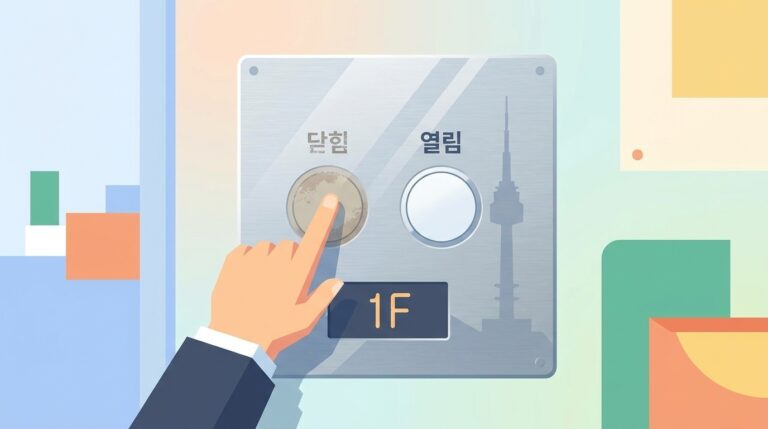
Why Is the Elevator Close Button Always Worn Out in Korea? Your Friendly Guide to PPalli-PPalli Culture
Phase 1: 공감 (The Heartwarming Open)
안녕하세요! (Annyeonghaseyo! – Hello!) I’m your Daily Hangul editor and your personal Seoul guide.
Imagine this: You are in a sleek office building in Yeouido, the bustling financial heart of Seoul. It’s 8:58 AM. You step into the elevator, holding your iced Americano. Just as the doors begin to slide open, a local office worker steps in. Before the doors even finish opening, their finger is already hovering over the 닫힘 (Dathim – Close) button, pressing it repeatedly like they are playing an arcade game.
If you look closely at the elevator panel, the “Close” button is completely faded, scratched, or even slightly concave compared to the pristine “Open” (열림 – Yeollim) button.
This isn’t a random glitch—it’s a physical monument to Korea’s famous 빨리빨리 (Ppalli-ppalli – Hurry, hurry!) culture. If you have ever felt a little overwhelmed by how fast things move in Korea, or wondered why everyone seems to be in a rush, you are not alone! Today, we are going to dive deep into this fascinating cultural phenomenon, learn the perfect expressions to navigate it, and understand why this speed actually comes from a place of deep care and efficiency.
Phase 2: 핵심 표현 3선 심층 분석 (Top 3 Expressions Deep Dive)
Let’s look at three essential expressions that capture this fast-paced lifestyle.
1. 빨리빨리 (Ppalli-ppalli)
- Pronunciation: [ppal-li-ppal-li] / Sound-alike: “Pahl-lee pahl-lee” (rhymes with “jolly” but starts with a crisp ‘P’ sound)
- Meaning: Literal: “Hurry, hurry!” / Real-world Nuance: “Let’s get things done efficiently without wasting a second!”
- K-Culture Moment: You will hear this in almost every K-Drama when characters are rushing to finish a project, or when a delivery rider is running up the stairs to hand over hot fried chicken.
- Editor’s Insight: While it sounds demanding, in everyday social settings among friends, saying “빨리빨리!” is often lighthearted, acting as a shared motivator rather than a harsh command.
- Situation Spectrum:
- Friends & Casual: ✅ (Perfect for teasing your late friend)
- Co-workers & Semi-formal: ⚠️ (Use with caution; can sound slightly impatient)
- Boss & Formal: 🚫 (Never use this directly to a superior unless you want to look unprofessional!)
- 🤔 Think About It: Does your culture value extreme speed in daily tasks, or do you prefer a slower, more deliberate pace? How do you think this affects a society’s work-life balance?
2. 문 좀 잡아주세요 (Mun jom jab-a-juseyo)
- Pronunciation: [mun jom jab-a-ju-se-yo] / Sound-alike: “Moon jom jahb-ah-joo-seh-yo”
- Meaning: Literal: “Please hold the door.” / Real-world Nuance: “Hold on, I’m coming! Please keep the elevator open!”
- K-Culture Moment: Think of a classic romantic scene where the protagonist runs to catch the closing elevator door, and their hands dramatically block it just in time.
- Editor’s Insight: This is a incredibly polite and warm way to ask for help in a shared space. It immediately triggers the helpful nature of Koreans.
-
Situation Spectrum:
- Friends & Casual: ✅
- Co-workers & Semi-formal: ✅
- Boss & Formal: ✅ (Using “~주세요” makes it polite enough for anyone!)
- 🤔 Think About It: In Korea, keeping a door open for someone who is slightly far away is considered a warm communal gesture, even though people are in a hurry. How does this contrast with elevator etiquette in your hometown?
3. 급해요 (Geuphaeyo)
- Pronunciation: [geup-hae-yo] / Sound-alike: “Gup-heh-yo” (start with a soft ‘G’ sound)
- Meaning: Literal: “It is urgent.” / Real-world Nuance: “I am in a big rush right now!”
- K-Culture Moment: Heard frequently in taxi scenes when a character tells the driver, “아저씨, 저 좀 급해요!” (Mister, I’m in a rush!)
- Editor’s Insight: Use this when you need to politely ask someone to excuse your haste, like when passing through a crowded subway gate.
-
Situation Spectrum:
- Friends & Casual: ✅
- Co-workers & Semi-formal: ✅
- Boss & Formal: ✅
- 🤔 Think About It: Why is admitting that you are in a rush received so sympathetically in Korea? (Hint: Because everyone has been there!)
Phase 3: 교과서 한국어 vs 진짜 한국어 (Real Korean Showcase)
Let’s compare the stiff textbook sentences with what you actually hear on the streets of Seoul!
Situation 1: When you want the elevator to close quickly
- 📖 Textbook Korean: “문을 빨리 닫아 주십시오.” (Mun-eul ppal-li dad-a ju-sip-si-o. / Please close the door quickly. – Too formal, sounds like a robot!)
- 🗣️ Real Korean: “문 닫을게요!” (Mun dad-eul-ge-yo! / I’m closing the door! – Warm and natural as you press the button.)
- 💡 Why is it different? Koreans prefer to announce their actions gently to show they aren’t being rude, even while being fast!
Situation 2: When you want to tell your friend to hurry up
- 📖 Textbook Korean: “속도를 내어 걸어오세요.” (Sok-do-reul nae-eo geol-eo-o-se-yo. / Please walk with speed. – Nobody talks like this!)
- 🗣️ Real Korean: “빨리 와! 늦겠다!” (Ppal-li wa! Neut-get-da! / Hurry up! We’re gonna be late!)
- 💡 Why is it different? Casual language drops complex sentence structures to deliver the core emotion instantly.
Phase 4: K-Culture 딥다이브 & 비언어적 매너 (Cultural Deep Dive & Body Language)
4-1. The “Eye-Contact and Finger-Hover” Dance
In Korea, “눈치” (Nunchi – situational quick-wittedness) is key. When you enter an elevator, there is a silent social contract:
1. The Hover: You can place your finger near the 닫힘 (Close) button.
2. The Scan: Quickly look toward the entrance. If you see someone even remotely heading your way, you must transition your finger to the 열림 (Open) button.
3. The Smile: Make brief eye contact, hold the door, and they will almost always say “감사합니다” (Gamsahabnida) as they step in. Pressing ‘Close’ while looking at someone approaching is considered a major social faux pas!
4-2. The Source of PPalli-PPalli
Where did this speed come from? After the Korean War, Korea transformed from an agrarian society to a global tech powerhouse in just a few decades (often called the “Miracle on the Han River”). Speed was survival. Today, this translates to lightning-fast 5G internet, same-day deliveries, and yes, pressing the elevator close button to save 3 seconds. It’s not anger; it’s a collective drive for efficiency!
Phase 5: 실전 롤플레이 시나리오 (Interactive Roleplay Scenario)
The Setting: You are inside a packed elevator in a corporate tower in Gangnam. The clock is ticking toward 8:59 AM.
The Cast: You (an eager intern) and Min-su (a friendly but highly caffeinated senior manager).
Min-su: 🎭 (Frantically mashing the close button with his thumb)
        아, 오늘 아침 회의 진짜 중요한데... 왜 이렇게 엘리베이터가 안 오지?
        (Ah, today's morning meeting is really important... why is the elevator so slow?)

You: 🎭 (Smiling warmly, holding your coffee)
     오늘 화요일이라 사람이 진짜 많네요, 대리님.
     (It's Tuesday, so there are really a lot of people, Assistant Manager.)

Min-su: 🎭 (Nodding, his eyes glued to the floor indicator numbers rising: 3... 4... 5...)
        맞아요. 아! 저기 멀리서 김 과장님 뛰어오신다!
        (That's right. Ah! Over there in the distance, Manager Kim is running!)

You: 🎭 (Peeking out of the elevator door)
     앗, 정말요? 문 열어둘게요!
     (Oh, really? I'll keep the door open!)
🔀 Decision Point!
Manager Kim is running, but the elevator doors are already starting to slide shut automatically. What do you do?
- Option A: Press the 닫힘 (Close) button rapidly so you aren’t late for your own meeting. After all, time is money!
- Option B: Press and hold the 열림 (Open) button while waving your hand to welcome him, saying “어서 오세요!” (Welcome in!).
- Option C: Stand still and pretend you didn’t see him, letting the elevator close naturally while looking at your phone.
🏆 Best Choice: Option B!
- Why? Even in the midst of Ppalli-Ppalli, Korean society deeply values 정 (Jeong – social connection and warmth). Saving your manager from waiting for the next elevator will earn you massive corporate “Nunchi” points!
- Risk Choice: Option A or C. While efficient, Option A makes you look cold, and Option C shows a lack of Nunchi. Avoid these if you want to maintain great office relationships!
Phase 6: 10초 감정 섀도잉 드릴 (Emotional Shadowing Drill)
Let’s practice speaking with real Korean emotion! Use the slashes / to pause and mimic the emotional tags.
- [🥺 Urgently calling for the door to be held]
“잠시만요! / 문 좀 / 잡아주세요!”
(Jam-si-man-yo! / Mun jom / jab-a-ju-se-yo!) -
[😊 Expressing deep relief and gratitude]
“아, / 정말 / 감사합니다! / 덕분에 살았어요!”
(Ah, / jeong-mal / gam-sa-hab-ni-da! / deok-bun-e sal-as-seo-yo!) -
[😤 Playfully teasing your slow friend]
“빨리빨리 / 좀 와! / 우리 / 늦겠어!”
(Ppal-li-ppal-li / jom wa! / u-ri / neut-ges-seo!)
Phase 7: K-Culture 미니 사전 (4 Key Keywords)
| Word (한글/Romanization) | English Meaning | Cultural Context |
|---|---|---|
| 빨리빨리 (Ppalli-ppalli) | Hurry, hurry! | The engine behind Korea’s fast services, quick food deliveries, and high-speed lifestyle. |
| 눈치 (Nunchi) | Situational wit / tact | The art of reading the room. Essential for knowing when to press “Close” or hold the door. |
| 정 (Jeong) | Warm affection / bond | The communal warmth that balances out the fast-paced rush of city life. |
| 야근 (Yageun) | Overtime work | The reason why many workers are so protective of their morning minutes! |
Phase 8: 여행자를 위한 생존 키트 (Traveler’s Survival Kit)
If you are traveling in Korea, keep these three lifesavers ready in your mental pocket!
Survival Phrases
- “먼저 가세요.” (Meon-jeo ga-se-yo. / You go first.)
- Pro Tip: Use this if you are entering an elevator with heavy luggage and want to let busy commuters pass you.
- “내릴게요!” (Nae-ril-ge-yo! / I’m getting off!)
- Pro Tip: Shout this clearly if the elevator is packed and you need to squeeze your way out at your floor.
- “죄송합니다, 급해서요.” (Joe-song-hab-ni-da, geup-hae-seo-yo. / Sorry, I am in a rush.)
- Pro Tip: Perfect to say if you accidentally bump into someone while walking quickly in the subway.
📌 Editor’s Travel Note
When navigating Korean cities, speed is key! To keep up with the locals, bypass global maps and download the Naver Map App Download Page and the Kakao T app for taxis. They are optimized for Korea’s super-fast transit networks and will save you tons of travel time!
Phase 9: 깊이 있는 생각 질문 (Deep Reflection)
Korea’s “Ppalli-Ppalli” culture is often criticized for creating stress, but it also built the safest, cleanest, and most efficient public infrastructure in the world. It is a culture born out of a collective desire to make life better, safer, and more convenient for everyone in the community.
💬 Your Turn: How does your country balance speed and community? Do you think being fast always means losing warmth, or can they coexist like they do in Korea? Let us know your thoughts in the comments below!
Phase 10: FAQ & 오해 방지 (FAQ Schema)
Q: Is pressing the elevator “Close” button considered rude in Korea?
A: No, not at all! In fact, it is completely normal and expected. However, it becomes rude if you press it while looking directly at someone who is trying to get in. Always use your Nunchi!
Q: Why do Koreans rush so much even when they aren’t late?
A: It is a lifestyle habit. For many Koreans, efficiency is a form of respect for other people’s time. Getting things done quickly means not holding up the queue behind you.
Q: What should I do if I accidentally press “Close” on someone?
A: Apologize immediately with a warm smile. Just say, “어머, 죄송합니다!” (Eomeo, joe-song-hab-ni-da! – Oh, I’m so sorry!) and quickly press the “Open” (열림) button.
🚨 Common Mistakes Warning!
- Mistake 1: Mashing the button violently while glaring at other passengers. (Looks very aggressive!)
- Mistake 2: Holding the door open for too long for someone who is too far away. (This actually annoys the people already inside the elevator!)
- Mistake 3: Not saying “Thank you” when someone holds the door for you. (Always say a quick “감사합니다”!).
Phase 11: 액션 미션 및 참여 유도 (Action Missions)
- 🥉 Bronze (At-Home Challenge): Practice saying “문 좀 잡아주세요!” in front of your mirror 5 times with a bright, pleading face.
- 🥈 Silver (Social Challenge): Share a photo of a busy street or an elevator on your social media, tag
@DailyHangul, and write: “Today I learned about 빨리빨리 culture!” - 🥇 Gold (Real-Life Challenge): The next time you step into a Korean elevator or restaurant, observe the “Close” button or how fast your food arrives. Notice the silent dance of efficiency!
Phase 12: 인터랙티브 퀴즈 챌린지 (Interactive Quiz)
Test Your Cultural Nunchi!
- What does the worn-out 닫힘 button symbolize in Korean culture?
- A) Bad elevator manufacturing
- B) Korea’s high-speed Ppalli-Ppalli lifestyle
- C) A lack of public etiquette
- Fill in the blank: When you want someone to hold the elevator door, you should yell: “문 좀 ________!”
-
True or False: It is perfectly fine to press the close button even if you see an elderly person walking towards the elevator.
👉 Click here to reveal the Answers & Explanations!
- Answer: B. It perfectly represents the physical footprint of Korea’s drive for speed and efficiency!
- Answer: 잡아주세요 (jab-a-juseyo). Full sentence: “문 좀 잡아주세요!”
- Answer: False! Always show respect to elders and others by holding the door. Let your Nunchi guide you!







