

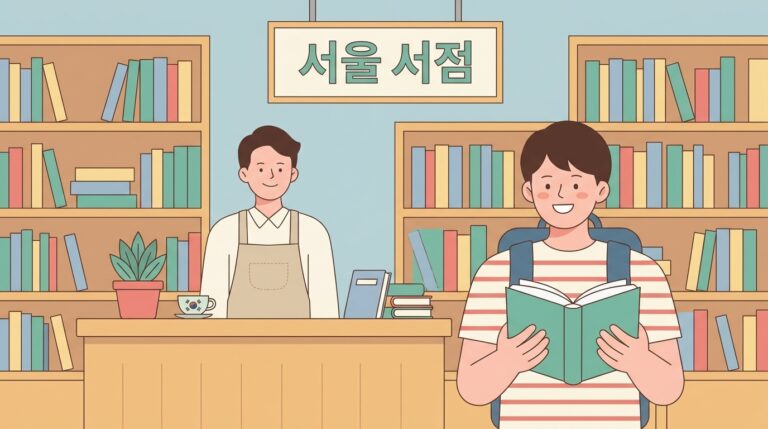
Don’t Panic at the Korean Bookstore! How to Ask for Exchanges and Refunds Like a Local
Phase 1: Empathy (Your Cozy Bookstore Moment)
안녕하세요! (An-nyeong-ha-se-yo!) Hello there, my dear language learner and fellow book lover! It’s your friendly chief editor from Daily Hangul here.
Imagine this: You are walking through the beautiful, bustling streets of Gwanghwamun in Seoul. The smell of fresh coffee and old paper draws you into Kyobo Bookstore (교보문고). Excitedly, you pick up a gorgeous, illustrated Korean novel or a limited-edition K-pop photo essay book. You head back to your guesthouse, open the cover, and… oh no! You realize you accidentally bought the wrong volume, or perhaps there is a misprint on page 42.
Suddenly, anxiety hits. “How do I say ‘Can I exchange this?’ in Korean? Will I sound rude? What if they don’t understand me?”
If you’ve ever felt your heart race at the thought of returning or exchanging an item in Korea, take a deep breath. You are not alone! Many of my students at the A2 level have stood in those exact shoes, gripping their shopping bags tightly.
Today, we are going to transform that anxiety into complete confidence. Learning how to ask for an exchange (교환 – Gyo-hwan) or a refund (환불 – Hwan-bul) politely is an absolute superpower. Not only will you save your wallet, but when you use these natural, polite phrases, Korean store staff will look at you with deep respect and give you their warmest smiles!
This guide is packed with real, practical tips gathered from actual foreign learners who conquered their fears in Seoul’s best bookshops. Let’s dive in!
Phase 2: Deep Dive into 3 Core Expressions
Let’s learn the three most important sentences you need. These are sweet, simple, and perfectly polite for an A2 learner.
1. 이거 교환할 수 있어요? (I-geo gyo-hwan-hal su is-seo-yo?)
- Pronunciation: “Ee-geo gyoh-hwan-hal soo eet-suh-yo?” (Tip: Blend “gyo” and “hwan” quickly, like “gyo-whan”)
- Meaning: Can I exchange this?
- K-Culture Moment: You will hear this phrase in almost every realistic K-drama when characters go shopping in trendy spots like Hongdae or Gangnam. It’s the ultimate go-to sentence for swapping sizes, colors, or books!
- Editor’s Insight: The word 이거 (I-geo) means “this.” Adding ~할 수 있어요? (~hal su is-seo-yo?) is the easiest way to ask “Can I…?” in Korean. It sounds very friendly and natural.
- Situation Spectrum:
- Friends/Casual: ⚠️ Too polite for close friends (you would say “이거 바꿀 수 있어?”)
- Retail/Staff (Semi-formal): ✅ Perfect! Standard polite form.
- Formal/Business: ✅ Fully respectful and polite.
- 🤔 Think About It: In Korean, we rarely say “I” or “you” when speaking to store clerks. We just say “Can exchange this?” rather than “Can you exchange this for me?” Why do you think Korean drops pronouns so often?
2. 환불하고 싶은데, 어떻게 해요? (Hwan-bul-ha-go sip-eun-de, eo-tteok-hae-yo?)
- Pronunciation: “Hwan-bool-ha-goh sheep-eun-deh, uh-ttuk-hae-yo?”
- Meaning: I’d like a refund, what should I do?
- K-Culture Moment: Think of a scene where a character returns a gift from an ex-partner. Instead of throwing it away, they practically head to the store and ask for a clean return!
- Editor’s Insight: Ending a sentence with ~ㄴ데 (~nde) soft-pedals your request. It translates to “I want to do this, so…” which gives the listener a polite cue to help you. It sounds much gentler than just demanding a refund.
- Situation Spectrum:
- Friends/Casual: ⚠️ A bit too formal for casual friends.
- Retail/Staff (Semi-formal): ✅ Highly recommended! It shows great manners.
- Formal/Business: ✅ Excellent and respectful.
3. 영수증이 없는데 괜찮아요? (Yeong-su-jeung-i eop-neun-de gwaen-chan-a-yo?)
- Pronunciation: “Yung-soo-jeung-ee up-noon-deh gwen-chan-ah-yo?”
- Meaning: I don’t have the receipt, is that okay?
- K-Culture Moment: The moment of panic! You searched your pockets and backpack, but the little paper slip is gone.
- Editor’s Insight: 영수증 (Yeong-su-jeung) is receipt. Asking “Is it okay?” (괜찮아요?) with a slightly apologetic tone is the magic key to getting the clerk to search for your transaction in their computer system using your card details!
- Situation Spectrum:
- Friends/Casual: ⚠️
- Retail/Staff (Semi-formal): ✅ Crucial survival phrase!
- Formal/Business: ✅
Phase 3: Textbook Korean vs. Real Korean
Many textbooks teach sentences that are grammatically perfect but sound like they were written in 1950. Let’s see how native Koreans actually talk in stores!
Situation 1: Swapping one book for another
- 📖 Textbook Korean: “저는 이 책을 다른 책과 교환하기를 원합니다.” (Jeo-neun i chaeg-eul da-reun chaeg-gwa gyo-hwan-ha-gi-reul won-ham-ni-da.)
- Why it’s awkward: It sounds like a formal declaration: “I desire to swap this volume with a different literature piece.” Nobody talks like this!
- 🗣️ Real Korean: “이걸로 교환해 주세요.” (Ee-geol-lo gyo-hwan-hae ju-se-yo.)
- Why it works: Short, punchy, and sweet. “Please exchange it for this one.” It uses 주세요 (ju-se-yo) which is the ultimate polite request.
Situation 2: Asking for a refund back to your card
- 📖 Textbook Korean: “지불한 카드로 환불해 주십시오.” (Ji-bul-han ka-deu-ro hwan-bul-hae ju-sip-si-o.)
- Why it’s awkward: Extremely stiff. Sounds like an instruction manual or a robotic voice at an ATM.
- 🗣️ Real Korean: “카드 취소해 주세요.” (Ka-deu chwi-so-hae ju-se-yo.)
- Why it works: Literally translates to “Please cancel the card [payment].” This is the exact phrase 99% of Koreans use at the counter for card refunds!
Phase 4: K-Culture Deep Dive & Non-verbal Manners
4-1. Nunchi (눈치) and Body Language
In Korea, communication is only 30% words—the other 70% is 눈치 (Nunchi – situational wit/vibe) and non-verbal etiquette. When asking for a return or exchange:
* The Two-Handed Hand-off: Always hand over the book and your receipt with both hands. Using one hand can seem dismissive. Placing both hands on the item shows respect.
* The Soft Head Tilt: When explaining that you made a mistake or that the book has a defect, tilt your head slightly and speak with a softer, slightly apologetic voice. Store staff will instantly feel your sincerity and go out of their way to help you.
4-2. Korean Bookstore Culture & Refund Rules
Did you know that Korean mega-bookstores like Kyobo (교보문고) and Bandi & Luni’s have some of the most comfortable reading lounges in the world? They encourage people to sit and read for hours.
Because of this cozy culture, refund rules are quite clear to prevent abuse:
1. The 7-Day Rule: Most major bookstores allow exchanges or refunds within 7 days of purchase.
2. Perfect Condition: The book must be in pristine condition. No folded page corners or cracked spines!
3. Indie Bookstores (독립서점): If you visit a cute indie bookshop in Yeonnam-dong or Ikseon-dong, keep in mind they might not offer refunds easily unless the book is physically damaged. Supporting local indie authors is highly appreciated!
Phase 5: Gamer-style Real Roleplay Scenario
The Setting: You are inside a beautifully lit, indie bookstore called “Book Cafe Forest” in Hongdae. Jazz is playing softly, and the store smells of lavender.
The Cast:
* You (A foreign book lover, holding a book with a small dent on the corner)
* Min-woo (A friendly clerk wearing a green linen apron and a warm smile)
Let’s play out the scenario! Follow the stage directions to master the mood.
Min-woo: 어서 오세요! 찾으시는 책 있으세요?
          (Eor-seo o-se-yo! Chat-eu-si-neun chaek is-seo-yo?)
          (🎭 Smiling warmly, welcoming you to the store)
          "Welcome! Are you looking for any specific book?"

You: 안녕하세요. 저... 이 책 교환할 수 있어요?
     (An-nyeong-ha-se-yo. Jeo... i chaek gyo-hwan-hal su is-seo-yo?)
     (🎭 Holding the book gently with both hands, looking a bit shy)
     "Hello. Um... can I exchange this book?"

Min-woo: 아, 네! 가능합니다. 책에 문제가 있나요?
          (Ah, ne! Ga-neung-ham-ni-da. Chaeg-e mun-jae-ga in-na-yo?)
          (🎭 Tilting his head politely with a curious expression)
          "Ah, yes! It's possible. Is there a problem with the book?"

You: 네, 여기 책 모서리가 조금 찢어졌어요.
     (Ne, yeo-gi chaek mo-seo-ri-ga jo-geum jji-jeo-jyeos-seo-yo.)
     (🎭 Pointing gently to the torn corner with your index finger)
     "Yes, the corner of the book is torn a little here."

Min-woo: 아, 죄송합니다! 제가 확인해 드릴게요. 영수증 있으세요?
          (Ah, joe-song-ham-ni-da! Je-ga hwag-in-hae deul-il-ge-yo. Yeong-su-jeung is-seo-yo?)
          (🎭 Looking apologetic, extending his hands to receive the book)
          "Oh, I'm sorry! Let me check that for you. Do you have the receipt?"

You: 네, 여기 있어요.
     (Ne, yeo-gi is-seo-yo.)
     (🎭 Taking the receipt out of your bag and handing it over with both hands)
     "Yes, here it is."

Min-woo: 감사합니다. 혹시 똑같은 책 새 걸로 교환해 드릴까요?
          (Gam-sa-ham-ni-da. Hok-si ttok-gat-eun chaek sa geol-lo gyo-hwan-hae deul-il-ka-yo?)
          (🎭 Typing quickly on the computer register)
          "Thank you. Shall I exchange it for a brand new copy of the same book?"
🔀 Decision Point!
What should you say next? Choose your path!
- Choice A: “아니요, 그냥 환불해 주세요.” (An-i-yo, geu-nyang hwan-bul-hae ju-se-yo.)
- Choice B: “네, 똑같은 책으로 주세요.” (Ne, ttok-gat-eun chaeg-eu-ro ju-se-yo.)
- Choice C: “이거 돈으로 다시 주시면 안 돼요?” (I-geo don-eu-ro da-si ju-si-myeon an dwae-yo?)
💡 Choices Analysis:
- Best Choice (Choice B): “Yes, please give me the same book.” This is smooth, polite, and solves your problem instantly. The clerk will gladly fetch a perfect, undamaged copy for you.
- Polite Alternative (Choice A): “No, please just refund it.” If you’ve changed your mind, this is perfectly polite.
- Risky/Awkward (Choice C): “Can’t you give me this back in cash?” If you paid with a credit card, stores cannot legally refund you in cash. Asking this might create a confusing situation! Stick to Choice A or B.
Phase 6: 10-Second Shadowing Drill
Let’s practice speaking with real emotion! Read these out loud, pausing at the slashes (/) and channeling your inner K-drama star.
- Sentence 1: [🥺 Polite & Apologetic]
“저기요… / 이거 / 환불하고 싶은데 / 괜찮아요?”
(Jeo-gi-yo… / i-geo / hwan-bul-ha-go sip-eun-de / gwaen-chan-a-yo?)
“Excuse me… / this / I’d like to refund / is it okay?” -
Sentence 2: [😊 Bright & Appreciative]
“네! / 이걸로 / 교환해 주세요. / 감사합니다!”
(Ne! / ee-geol-lo / gyo-hwan-hae ju-se-yo. / gam-sa-ham-ni-da!)
“Yes! / for this one / please exchange it. / Thank you!”
Phase 7: K-Culture Mini Dictionary
| Word (Korean + Romanization) | English Translation | Real-world Context Insight |
|---|---|---|
| 영수증 (Yeong-su-jeung) | Receipt | In Korea, clerks will always ask: “영수증 드릴까요?” (Would you like a receipt?). Always say “네” (Yes) if you might change your mind later! |
| 교환 (Gyo-hwan) | Exchange | Swapping an item for another. In many apparel and book shops, this is much faster to process than a full refund. |
| 환불 (Hwan-bul) | Refund | Getting your money back. Most refunds go back to the original payment method (card to card, cash to cash). |
| 득템 (Deuk-tem) | Lucky Find / Great Buy | A fun slang word combining Korean and English (득 = gain, 템 = item). Used when you find a rare book or cute goods in a shop! |
Phase 8: Traveler’s Survival Kit
Top 3 Quick Phrases for Your Pocket:
- 교환증 주세요. (Gyo-hwan-jeung ju-se-yo.)
- Meaning: Please give me an exchange voucher. (Useful if you are buying a book as a gift for a Korean friend!)
- 이거 결제 취소해 주세요. (I-geo gyeol-je chwi-so-hae ju-se-yo.)
- Meaning: Please cancel this payment. (Useful if the clerk made a mistake on your bill.)
- 새 제품 있어요? (Sae je-pum is-seo-yo?)
- Meaning: Do you have a brand-new, unopened copy in stock?
📌 Editor’s Travel Note:
When traveling through Seoul, standard Google Maps might not give you accurate walking paths. Make sure to download the Naver Map App to find hidden cozy indie bookstores in alleys. Also, keep in mind that most retail stores in Korea are completely cashless, so keep your credit card or tourist transit card (like T-Money) ready for quick digital card cancellations!
Phase 9: Deep Thoughts — “One Step Deeper”
In Western cultures, returning an item is often viewed as a cold, administrative right of the consumer. However, in Korea, asking for a refund or exchange involves a subtle exchange of Jeong (정 – social warmth) and consideration.
When you go back to a store, the clerk might feel a sense of regret that they sold you a damaged or incorrect book. By using gentle, indirect language like “~하고 싶은데…” (I would like to do this, but…), you are politely softening the situation, making sure nobody feels uncomfortable. This is the beauty of Korean harmony in daily interaction.
💬 Your Turn: How do people handle refunds in your country? Is it direct and quick, or do people use polite, soft expressions like in Korea? Let me know in the comments below!
Phase 10: FAQ & Common Mistakes (FAQ Schema)
Q: Can I get a refund if I bought a book with a tourist discount or tax refund?
A: Yes, but you must bring your passport and the original receipt to the same store branch. The tax refund process will need to be canceled and recalculated at the tax-free register.
Q: I lost my physical receipt! Can I still exchange my book at Kyobo Bookstore?
A: Yes, in most cases! If you paid with a credit card, you can show them your card and tell them the exact date and time of purchase. They can track your transaction in their database.
Q: Is there any item that can never be exchanged or refunded?
A: Books that come with special sealed packaging, online code access, or scratchable lottery cards cannot be refunded once opened.
🚨 Common Mistakes Warning Board
- Saying “돈 돌려주세요” (Don dol-ryeo-ju-se-yo): This literally means “Give me my money back!” and can sound extremely aggressive or demanding. Always use “환불해 주세요” instead.
- Handing things with one hand: Avoid sliding your card or receipt across the counter with one finger. It’s a major etiquette faux pas in Korea.
- Waiting too long: Trying to refund a book after 2 weeks. The system will lock the transaction, and the staff won’t be able to help you even if they want to!
Phase 11: Action Missions
Are you ready to practice? Here is your daily mission!
- 🥉 Bronze Mission (Mirror Challenge): Stand in front of a mirror, hold your favorite book with both hands, look apologetic, and say out loud: “이거 교환할 수 있어요?” 5 times!
- 🥈 Silver Mission (Social Challenge): Take a picture of your favorite Korean book or notebook, post it on your Instagram Story, tag @DailyHangul, and write the caption: “오늘의 득템!” (Today’s lucky find!)
- 🥇 Gold Mission (Real World Challenge): Next time you buy something in Korea, even at a convenience store, keep your receipt and say: “영수증 주세요!” (Receipt, please!) with a bright smile.
Phase 12: Interactive Quiz Challenge
Test your skills before you head out to the bookstore!
1. Which phrase is the most natural way to ask for a card payment cancellation/refund?
- A) 카드 버려주세요 (Ka-deu beo-ryeo-ju-se-yo)
- B) 카드 취소해 주세요 (Ka-deu chwi-so-hae ju-se-yo)
- C) 카드 없어요 (Ka-deu eop-seo-yo)
2. True or False: You should always give your receipt to the bookstore clerk using both hands.
- A) True
- B) False
🎉 Click here to reveal the Answers & Explanations!
- Correct Answer: B
- Explanation: “카드 취소해 주세요” is the standard real-world phrase for card refunds. Option A means “Please throw away my card” (yikes!) and Option C means “I don’t have a card.”
- Correct Answer: A (True)
- Explanation: In Korean etiquette, using both hands shows respect and builds a warm, positive connection with the store staff! Keep it up!
Great job today! You are officially ready to visit any bookstore in Korea with absolute confidence. Keep reading, keep practicing, and see you in the next lesson! 다음에 또 만나요! (See you again next time!)







