

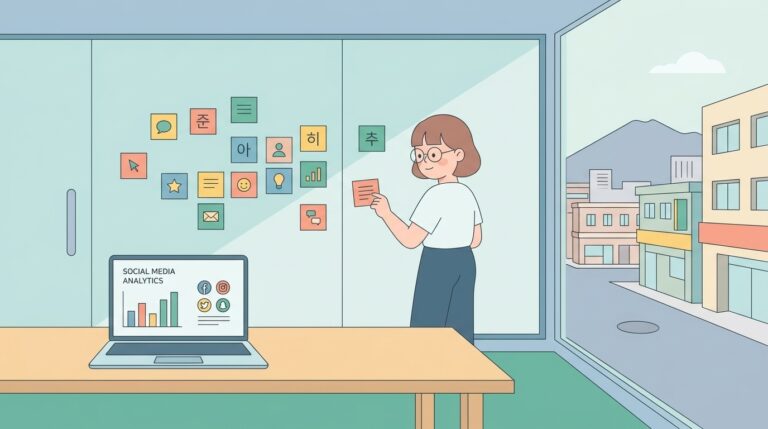
Slaying the Seongsu-dong Trend: How to Analyze Korean Viral Marketing Like a Local
안녕하세요! Welcome back to another premium edition of Daily Hangul. I’m your Lead Editor and your ultimate cultural navigator.
Imagine this: You are sitting in a sleek, glass-walled office in Seongsu-dong (성수동)—the Brooklyn of Seoul. Across the table, your brand manager is frantically tapping her iPad, pointing at a social media post showing a mountain of whipped cream bursting from a sliced pastry. “This has gone completely viral,” she says. “We need to analyze why this happened and recreate this buzz for our next launch!”
To pitch, survive, and thrive in Korea’s hyper-accelerated corporate landscape, you can’t rely on textbook business vocabulary anymore. Standard Korean terms won’t cut it when the board of directors wants to know about the latest algorithmic trend on TikTok or Instagram. Today, we are diving deep into the sophisticated world of Korean Viral Marketing (바이럴 마케팅) to equip you with the exact vocabulary and cultural nuances needed to analyze trend waves like a true Seoul native.
Phase 2: Core Expressions Deep-Dive
To master C1-level business discussions in Korea’s trend-driven sectors, these three terms are absolutely non-negotiable.
1. 반갈샷 (Ban-gal-syat)
- Pronunciation: [ban-gal-syat] / Sound-alike: “Bahn-gahl-shat” (Rhymes with ‘shot’)
- Meaning: Literally “Half-split shot.” It describes the viral social media trend of slicing a food item (usually a heavily stuffed pastry, cream bread, or cheese pocket) cleanly down the middle to photograph the indulgent, overflowing filling.
- K-Culture Moment: This trend catapulted the convenience store chain CU’s Yonsei University Cream Bread (연세우유 생크림빵) into legendary status. Millions of young Koreans posted their own “반갈샷” on Instagram, turning a simple convenience store snack into a scarce, highly coveted status symbol.
- Editor’s Insight: This isn’t just a silly internet trend; it’s a highly calculated visual hook. In Korean marketing, sensory appeal must be immediate and highly shareable (“인스타그래머블” – Instagrammable).
- Situation Spectrum:
- Friends & Casual: ✅ (Perfect for casual food talk)
- Colleagues & Semi-formal: ✅ (Highly relevant in modern marketing brainstorms)
- Executive & Formal: ⚠️ (Use ‘단면 시각 효과’ – cross-section visual effect – for highly conservative formal presentations, but 반갈샷 is accepted in creative agencies)
- 🤔 Think About It: Why does visual gratification play such a disproportionate role in modern food marketing? Does your country have a similar equivalent to “반갈샷”?
2. 내돈내산 (Nae-don-nae-san)
- Pronunciation: [nae-don-nae-san] / Sound-alike: “Nay-don-nay-sahn”
- Meaning: An acronym for “내 돈 주고 내가 산” (I bought it with my own money). It denotes authentic, unsponsored content generated by real consumers, completely free of corporate sponsorship.
- K-Culture Moment: Following massive public backlashes against popular YouTubers who engaged in 뒷광고 (hidden sponsorships), Korean consumers became intensely skeptical of influencer ads. Saying “이거 진짜 내돈내산이에요!” (This is a genuine, bought-with-my-own-money review!) became the ultimate badge of trust.
- Editor’s Insight: This phrase represents the pinnacle of peer-to-peer marketing. If your brand can trigger natural 내돈내산 reviews, you have won the Korean market. It implies unvarnished truth.
- Situation Spectrum:
- Friends & Casual: ✅
- Colleagues & Semi-formal: ✅
- Executive & Formal: ⚠️ (In formal reports, replace with ‘자발적 소비자 생성 콘텐츠’ – user-generated organic content)
- 🤔 Think About It: How does the intense skepticism toward hidden sponsorships shape consumer trust in your country versus the highly digitalized Korean market?
3. 대란 (Dae-ran)
- Pronunciation: [dae-ran] / Sound-alike: “Day-rahn”
- Meaning: Literally “Great Turmoil” or “Crisis.” In modern marketing, it is used dramatically to describe a massive viral craze that leads to nationwide product shortages (e.g., 품절 대란 – sold-out crisis).
- K-Culture Moment: Think of the historic Honey Butter Chip craze, or the more recent 먹태깡 (dried pollack potato chips) phenomenon, where people lined up at convenience store loading docks just to secure one bag.
- Editor’s Insight: While “대란” sounds alarmist, it carries a highly positive connotation for brands. It signifies that your product has reached an almost cult-like desirability.
- Situation Spectrum:
- Friends & Casual: ✅
- Colleagues & Semi-formal: ✅
- Executive & Formal: ✅ (Used universally in media headlines and corporate retail performance reports)
- 🤔 Think About It: Why do you think Korean consumers are so highly receptive to collective trends, turning simple snacks into national “crises” of supply and demand?
Phase 3: Textbook Korean vs. Real Korean Showcase
When pitching strategies in Seoul, using sterile textbook phrasing will make you sound like an outdated manual. Here is how to upgrade your language to match the real-world pace.
Situation 1: Describing a massive product sell-out
- 📖 Textbook Korean: “이 제품은 현재 소비자들의 많은 관심으로 인해 재고가 모두 소진되었습니다.”
(This product is currently out of stock due to much consumer interest.) - 🗣️ Real Korean: “지금 이거 완전 품절 대란이라, 오픈런 안 하면 절대 못 구해요.”
(This is currently a total sold-out crisis, so if you don’t do an open run, you’ll absolutely never get one.) - 💡 Why it matters: Korean consumer culture is heavily driven by real-time scarcity. Terms like 오픈런 (open run – sprinting to a store the moment it opens) and 품절 대란 paint a vivid picture of extreme demand that captures the executive board’s attention immediately.
Situation 2: Highlighting the organic nature of a social media trend
- 📖 Textbook Korean: “소비자들이 자발적으로 홍보 게시물을 올리고 있어 긍정적인 효과가 기대됩니다.”
(It is expected to have a positive effect as consumers are voluntarily posting promotional content.) - 🗣️ Real Korean: “소비자들이 직접 내돈내산 인증을 하면서 바이럴이 알아서 터지고 있어요.”
(Consumers are uploading their own “bought-with-my-own-money” proofs, and the virality is just exploding on its own.) - 💡 Why it matters: In modern marketing agencies, speed is everything. Using snappy terms like 바이럴이 터지다 (virality exploding) and 내돈내산 인증 shows you understand the mechanics of organic reach far better than stiff academic phrases do.
Phase 4: K-Culture Deep-Dive & Non-Verbal Manners
4-1. Reading the Room: The Nuance of Nunchi (눈치) in Marketing Pitches
When presenting viral trends to senior executives in Korea, you must balance enthusiasm with deep cultural awareness.
* The Non-Verbal Balance: Avoid overly aggressive gestures or dismissing traditional marketing outright. If you suggest leaning into a viral meme or an internet trend, couch it in respect. Use a slight head tilt and a lower tone to pitch bold ideas: “대표님, 요즘 젊은 세대에서는 이런 코드가 다소 낯설게 보일 수 있지만, 실제 구매 전환율은 상당합니다.” (CEO, while this code might look a bit unfamiliar to some, the actual conversion rate is substantial.) This displays excellent 눈치 (nunchi)—showing respect for their experience while guiding them toward modern trends.
4-2. The Cultural Engine: The Rise of “Deok-hu” (덕후)
Korean viral marketing is heavily propelled by “Deok-hu” (덕후 – derived from the Japanese ‘Otaku’, but completely redefined as a positive term for highly passionate enthusiasts or geeks). Whether it is a 디저트 덕후 (dessert geek) or a 뷰티 덕후 (beauty obsessive), these micro-communities are the primary nodes for modern viral campaigns. When a product satisfies a 덕후‘s rigorous standards, they create high-quality organic content that triggers the wider 대란.
Phase 5: The Seongsu-dong Brainstorming Room (Interactive Roleplay)
Setting: A hip, glass-enclosed meeting room overlooking the bustling streets of Seongsu-dong. Sticky notes in neon pink and green cover the walls.
Cast:
* You (Global Marketing Strategist)
* Ji-won (이지원 대리 – A brilliant, fast-talking Senior Brand Manager who survived three successful viral product launches)
Ji-won: (💡 Clicking her multi-colored pen repeatedly)
"이번 신제품 크림 도넛 말이에요. 어떻게 해야 MZ세대 마음을 확 사로잡을 수 있을까요? 예산이 넉넉하지 않아서 고민이에요."

You: (🧐 Leaning forward and tapping your tablet screen)
"우선 비주얼로 쇼부를 봐야 해요. 요즘 인스타에서 유행하는 '반갈샷'을 무조건 유도하는 비주얼로 패키징을 짜야 합니다."

Ji-won: (✨ Her eyes widening as she scribbles on her pad)
"아! 반갈샷! 도넛 속에 형형색색 크림을 가득 채워서 가르면 쏟아져 나오게 만들면 대박이겠네요!"

You: (☝️ Raising a finger to emphasize a crucial point)
"네, 그리고 대놓고 광고하는 느낌을 주면 요즘 소비자들은 바로 스크롤을 넘겨버려요. 철저히 '내돈내산'처럼 보이게 바이럴을 태워야 합니다."

Ji-won: (🤔 Stroking her chin thoughtfully)
"맞아요, 요즘 애들은 광고 냄새 나면 절대 안 사죠. 그럼 마이크로 인플루언서 위주로 시딩을 먼저 돌릴까요?"

You: (📝 Drawing a flow chart on the glass wall)
"그렇죠. 그들이 진짜 감동해서 올리는 '찐템' 후기처럼 포지셔닝해야 해요. 초기 트랙션만 생기면 바로 품절 대란으로 몰고 갈 수 있어요."

Ji-won: (👏 Clapping her hands in excitement)
"완벽해요! 품절 대란 소문 돌기 시작하면 편의점 앞에서 오픈런 인증샷이 알아서 올라오기 시작할 거예요."

You: (😏 Smiling confidently)
"그게 바로 우리가 노리는 바이럴 루프죠. 일단 소셜 피드를 우리 도넛 반갈샷으로 도배시키는 겁니다."

Ji-won: (☕ Taking a quick sip of her iced Americano)
"좋아요! 그런데 이거 대표님한테 결재받을 때 전통 TV 광고 안 하냐고 물어보시면 뭐라고 답변해야 설득이 될까요?"
🔀 Decision Point: How do you pitch this to the traditional CEO?
- Option A: “대표님, 요즘 누가 TV 광고를 보나요? 인스타 감성 없으면 회사는 망합니다!” (Aggressive & disrespectful. Disregards traditional business hierarchy.)
- Option B: “기존의 공중파 매체 대비, 이번 바이럴 전략은 비용 대비 전환 효율(ROI)이 최소 300% 이상 높은 타사 성공 데이터를 바탕으로 기획되었습니다.” (Best Choice. Highly professional, backed by quantitative data, yet progressive.)
- Option C: “인터넷 바이럴은 원래 운에 맡기는 겁니다. 일단 던져보고 터지길 기도해야죠!” (Unprofessional. Lacks strategic depth and corporate reliability.)
💡 Best Choice Analysis (Option B):
Opting for Option B demonstrates C1-level business acumen. It translates trendy social media slang into professional, data-backed metric comparisons that appeal directly to conservative Korean executives who favor concrete ROI over nebulous “vibes.”
Phase 6: 10-Second Emotional Shadowing Drill
Practice speaking like a native marketing executive by injecting genuine emotion and correct rhythm. The / marks indicate brief natural pauses.
- [😤 Urgently & Excitedly – Explaining a viral sell-out]
“지금 이거 / 완전 품절 대란이라 / 오픈런 안 하면 / 절대 못 구해요!”
(Ji-geum i-geo / wan-jeon pum-jeol dae-ran-i-ra / o-peun-reon an ha-myeon / jeol-dae mot gu-hae-yo!) -
[🥺 Earnestly & Honestly – Vouching for authenticity]
“광고 절대 아니고요, / 진짜 제 돈 주고 제가 산 / 찐 내돈내산 후기예요!”
(Gwang-go jeol-dae a-ni-go-yo, / jin-jja je don ju-go jae-ga san / jjin nae-don-nae-san hu-gi-yeo!) -
[😊 Proudly & Giggly – Celebrating a successful post]
“어제 올린 반갈샷 / 좋아요 수가 / 진짜 대박 터졌어요!”
(Eo-je ol-rin ban-gal-syat / jo-a-yo su-ga / jin-jja dae-bak teo-jyeos-seo-yo!)
Phase 7: K-Culture Mini Dictionary
| Word (한글/Romanization) | Target Meaning | Cultural Context & Usage |
|---|---|---|
| 품절대란 (Pum-jeol-dae-ran) | Sold-out Crisis | Used when a product becomes so phenomenally popular that it is impossible to find on shelves. |
| 오픈런 (O-peun-reon) | Open Run | Originally meant running to luxury brand boutiques when doors opened, now applied to any viral bakery or pop-up store in Seoul. |
| 바이럴 (Ba-i-reol) | Viral / Buzz | Used as a noun or a verb (바이럴을 태우다 – to ignite viral buzz) to describe digital word-of-mouth strategies. |
| 찐템 (Jjin-tem) | Genuine Item | A portmanteau of 찐 (real/genuine) and 아이템 (item). Refers to a product that someone genuinely loves and uses daily. |
Phase 8: Traveler’s Survival Kit (Seoul Trend Edition)
Even if you’re not in a marketing meeting, you’ll need these phrases to track down viral sensations during your stay in Seoul!
Survival Phrases
- Phrase 1: “이거 요즘 SNS에서 제일 핫한 제품 맞나요?” (Is this the product that is currently hottest on social media?)
- Phrase 2: “혹시 이 제품 들어오는 입고 시간대가 언제인가요?” (Could you tell me what time this product gets restocked?)
- Phrase 3: “품절이라고 적혀 있는데, 예약 주문도 안 되나요?” (It says sold out, but is it possible to pre-order?)
📌 Editor’s Travel Note
When hunting down viral products in Seoul (like limited-edition convenience store snacks or rare beauty items), do not use Google Maps. It is highly outdated in Korea. Download the Naver Map App to search for real-time convenience store stock statuses and read authentic user reviews to avoid wasting your time on overhyped traps.
Phase 9: Deep Thoughts — “한 발 더 깊이”
Korea’s marketing environment moves faster than almost any other in the world due to the unique convergence of dense urban populations, near-universal digital connectivity, and a socio-cultural phenomenon known as 집단주의 (collectivism) balanced by competitive self-expression.
This rapid velocity can feel dizzying. One week, a certain cream bread dominates every single social feed; the next, it is completely forgotten for a new matcha cookie. This relentless cycle forces marketers to think not just about sustainable longevity, but about capturing short, intense waves of attention. It forces us to ask: Is this collective pursuit of the “next big thing” a form of cultural bonding, or does it contribute to a culture of constant consumerist anxiety?
💬 Your Turn: How do viral trends behave in your country? Do people line up for hours for a trending snack, or do they prefer long-standing local classics? Let’s discuss in the comments below!
Phase 10: FAQ & Common Mistakes
Q: Is “바이럴” (viral) always a positive word in Korean business?
A: Depends. While “바이럴 마케팅” is a standard business term, using the word “바이럴” too casually in front of consumers can trigger suspicion. Consumers often say “이거 바이럴이네” (This is just an orchestrated viral ad) to dismiss a product as fake hype. Always emphasize 진정성 (authenticity) when building your campaigns.
Q: What is the difference between “내돈내산” and “솔직후기”?
A: “내돈내산” specifically proves that no financial transaction or free sponsorship occurred between the brand and the poster. “솔직후기” (honest review) means the review is candid, but the reviewer might have received the product for free in exchange for their honest feedback.
Q: Can I use “반갈샷” in an email to a conservative business partner?
A: No. Keep it to informal brainstorming sessions, Slack channels, or creative presentations. In formal email correspondence, use “단면 연출 이미지” (cross-section presentation image) or “비주얼 마케팅 요소” (visual marketing element).
🚨 Common Mistakes Alert!
- Using “대란” for minor popularity: Don’t say 대란 for a product that is just slightly popular. It must be genuinely hard to find, or you will sound like you are exaggerating.
- Confusing “뒷광고” with “PPL”: PPL (Product Placement) is a legitimate, legally disclosed broadcast placement. 뒷광고 (back-door advertising) is illegal and unethical hidden sponsorship.
- Pronouncing “내돈내산” as separate words: Run the syllables together naturally like a single word [내돈내산] without pauses.
Phase 11: Action Missions
- 🥉 Bronze (At-Home Challenge): Record a 10-second voice note using the Phrase 6 Shadowing Drill. Focus on the sharp delivery of the word “내돈내산”!
- 🥈 Silver (Social Media Challenge): The next time you buy a delicious pastry or a beautiful product, post a photo of it on Instagram and tag it with
#내돈내산or#반갈샷to practice your localized marketing vocabulary! - 🥇 Gold (Real-World Challenge): Go to a trendy cafe or convenience store in Seoul and ask the clerk: “이거 요즘 품절 대란이라는데, 재고 남아있나요?” (I heard this is a massive viral sensation right now; do you have any stock left?)
Phase 12: Interactive Quiz
Test your knowledge of high-level Korean marketing trends!
1. Which term describes the act of rushing to a store the second it opens to buy a viral product?
- A) 반갈샷
- B) 오픈런
- C) 내돈내산
2. Fill in the blank:
“이 리뷰는 협찬이 아니라 제 돈 주고 산 100% ________ 후기입니다.”
3. True or False: “대란” originally meant a nationwide national crisis, but is now used to describe product stock shortages.
- True / False
🔍 Click here to reveal the Answers & Explanations!
- Answer: B) 오픈런 (Open Run). 반갈샷 is the half-cut photo, and 내돈내산 is buying with your own money.
- Answer: 내돈내산. This fits perfectly to emphasize an unsponsored, authentic purchase.
- Answer: True. This dramatic evolution of vocabulary perfectly highlights how seriously Koreans take consumer trends and cultural waves!







