

Master the Art of Korean Trash: The Ultimate Guide to “음식물 쓰레기” (Food Waste)
Phase 1: Empathy (An Existential Crisis in Front of the Trash Bins)
안녕하세요! (Annyeonghaseyo!) It’s your friendly neighborhood tutor and local Seoul guide from Daily Hangul.
Imagine this: You’ve just finished a delicious meal of spicy, comforting Kimchi-jjigae (김치찌개) at your new Airbnb in Mapo. You have some leftover pork bones, onion skins, and a bit of leftover broth. You walk down to the building’s trash disposal area, armed with a plastic bag. Suddenly, you freeze.
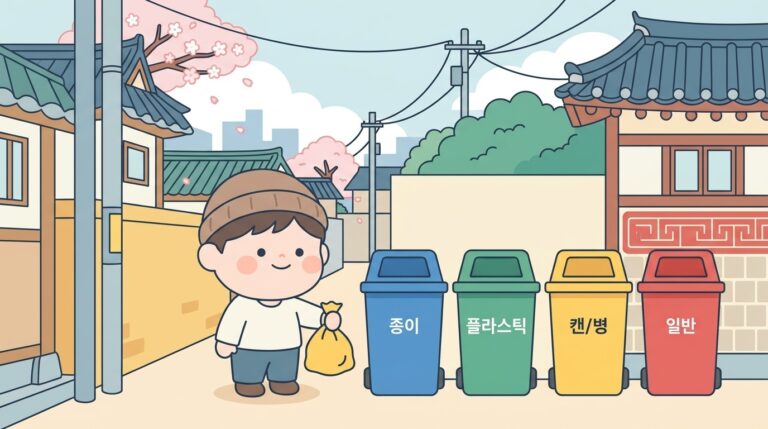
Before you stands a row of color-coded bins with various signs: 일반 쓰레기 (Ilban sseuregi – General Waste), 음식물 쓰레기 (Eomsseu / Eomsikmul sseuregi – Food Waste), and 재활용 (Jaehwalyong – Recycling). You see a neighbor giving you a polite but watchful look. Is an onion skin food waste? What about the bones? If I mess this up, will my landlord write me an angry KakaoTalk message?
Don’t panic! Almost every foreigner—and honestly, many Koreans who just moved out on their own—has faced this exact “trash-sorting paralysis.” In Korea, waste disposal is not just a chore; it is a highly organized, civic duty backed by law.
By mastering how to say “음식물 쓰레기는 종량제 봉투에 넣다” (Put food waste in the designated volume-rate bag) and understanding the culture behind it, you won’t just avoid hefty fines. You will earn the ultimate respect of your Korean neighbors and show that you truly respect their clean, green lifestyle. Let’s dive into this essential B1-level guide!
Phase 2: Core Expressions Deep Dive
1. 음식물 쓰레기는 종량제 봉투에 넣으세요. (Eomsikmul sseuregi-neun jongryangje bongtu-e neouseyo.)
- Pronunciation: [Eum-sik-mul sseu-re-gi-neun jong-ryang-je bong-tu-e neo-eusaeyo] / Sound-alike: Um-seek-mool ssuh-reh-gee-neun jong-ryahng-jeh bong-too-eh nuh-ooh-seh-yo.
- Meaning: Please put food waste in the designated volume-rate garbage bag.
- K-Culture Moment: You will hear this friendly but firm advice from your Korean landlord (집주인 아주머니 – Jipjuin ajumoni) on your first day of moving into an officetel or villa.
- Editor’s Insight: 종량제 봉투 (Jongryangje bongtu) is a system where you pay for waste processing by buying specific government-approved bags at local convenience stores or marts. Using a regular plastic bag for food waste is illegal and can lead to a fine of up to 100,000 KRW!
- Situation Spectrum:
- Friends/Casual: ⚠️ Too formal. Use “음쓰는 종량제에 넣어” (Eomsseu-neun jongryangje-e neo).
- Colleagues/Semi-formal: ✅
- Superiors/Formal: ✅
- 🤔 Think About It: In many Western countries, waste management fees are included in property taxes. Why do you think Korea charges directly per bag? How does this “pay-as-you-throw” system affect people’s daily consumption and waste habits?
2. 이거 음식물 쓰레기예요, 일반 쓰레기예요? (Igeo eomsikmul sseuregi-yeyo, ilban sseuregi-yeyo?)
- Pronunciation: [Ee-geo eum-sik-mul sseu-re-gi-ye-yo, eel-ban sseu-re-gi-ye-yo] / Sound-alike: Ee-guh um-seek-mool ssuh-reh-gee-yeh-yo, eel-bahn ssuh-reh-gee-yeh-yo.
- Meaning: Is this food waste, or is it general waste?
- K-Culture Moment: This is the ultimate “survival question” you’ll ask your Korean roommate while cleaning up after a late-night delivery chicken feast.
- Editor’s Insight: The golden rule of thumb in Korea: “Can an animal eat this?” In Korea, recycled food waste is processed into animal feed (사료 – saryo) or fertilizer. Therefore, hard shells (egg shells, clam shells), bones (chicken, pork, beef), and fibrous skins (onion skins, garlic skins) are considered 일반 쓰레기 (general waste) because animals cannot digest them.
- Situation Spectrum:
- Friends/Casual: ✅ Adjust to “이거 음쓰야, 일쓰야?” (Igeo eomsseu-ya, ilsseu-ya?)
- Colleagues/Semi-formal: ✅
- Superiors/Formal: ✅
- 🤔 Think About It: Categorizing waste by “animal edibility” shows a highly systematic approach to ecology. How does your home country distinguish between organic and inorganic waste?
3. 물기를 꼭 짜서 버려야 해요. (Mulgireun kkok jjaseo beoryeoya haeyo.)
- Pronunciation: [Mul-gi-reun kkok jja-seo beo-ryeo-ya hae-yo] / Sound-alike: Mool-ghee-reun jjah-suh buh-ryuh-yah hae-yo.
- Meaning: You must squeeze out the water (moisture) before throwing it away.
- K-Culture Moment: You will see this written on posters in the shared kitchens of guesthouses or public trash collection areas.
- Editor’s Insight: Wet food waste smells worse, weighs more, and is harder to process. Squeezing out the liquid is considered basic civic etiquette (예의 – yeyi) in Korea.
- Situation Spectrum:
- Friends/Casual: ✅ (Change “해요” to “해”)
- Colleagues/Semi-formal: ✅
- Superiors/Formal: ✅
Phase 3: Textbook Korean vs. Real Korean
When you open a standard Korean textbook, the vocabulary is often overly formal and suited for official public announcements. Let’s look at how Koreans actually talk in daily life.
Situation 1: Telling someone to separate the trash
- 📖 Textbook Korean: 음식물 쓰레기를 수거함에 배출하십시오. (Please discharge the food waste into the collection bin.)
- 🗣️ Real Korean: 음쓰는 여기 따로 모아두세요. (Keep the food waste separate over here.)
- 💡 Why the difference? No one uses the word “배출하십시오” (discharge) in normal conversation unless they are a pre-recorded robotic voice or a government document. Koreans heavily use the abbreviation 음쓰 (Eomsseu) for food waste because it’s fast and friendly.
Situation 2: Asking where to buy the trash bags
- 📖 Textbook Korean: 쓰레기 규격 봉투는 어디에서 판매합니까? (Where do they sell standard-sized trash bags?)
- 🗣️ 혹시 쓰레기 봉투 어디서 팔아요? (By the way, where do they sell trash bags?)
- 💡 Why the difference? “규격 봉투” (standard-sized bag) is the legal term, but locals simply call it 쓰레기 봉투 (trash bag) or 종량제 봉투 (jongryangje bag). Asking “혹시… 어디서 팔아요?” is the natural, polite way to inquire in a store or neighborhood.
Phase 4: K-Culture Deep Dive & Non-Verbal Manners
4-1. “Nunchi” (눈치) at the Trash Bin
In Korea, trash sorting is a highly visible social activity. When you go down to throw away your trash, you might encounter elderly neighbors (especially the apartment security guard, 경비아저씨 – Gyeongbi-ajeossi).
- The Polite Greeting: Always bow slightly and say “안녕하세요” (Annyeonghaseyo) when you see the security guard.
- The Apologetic Body Language: If you are unsure about sorting, don’t just dump your bag and run. Hold the bag with both hands, look slightly apologetic, and ask: “혹시 이거 어떻게 버려야 해요?” (How should I throw this away?). They will appreciate your effort to learn and will gladly show you the ropes.
4-2. The Korean Food Culture Connection
Why is food waste recycling such a big deal in Korea? It links back to K-Food culture. Korean meals are famous for Banchan (반찬 – side dishes). Because traditional tables feature many small dishes, leftover food waste has historically been very high. To combat this, the government introduced the strict Jongryangje system in 1995. Today, Korea recycles nearly 95% of its food waste—making it a global environmental leader!
Phase 5: Interactive Roleplay Scenario
Setting: You are renting a room in a beautiful shared house in Hongdae. It is Sunday evening, and you just finished making tteokbokki with your housemate, Ji-a.
Cast:
- You (유): An exchange student trying to be a perfect housemate.
- Ji-a (지아): Your sweet but eco-conscious Korean roommate.
1. 지아: (🎭 smiling while wiping the table) 오늘 떡볶이 진짜 맛있었어요! 배부르다~
          (Oneul tteokbokki jinja masisseosseoyo! Baebureuda~)
          "The tteokbokki today was so delicious! I'm so full~"

2. 유: (🎭 holding a plate of leftovers) 저도요! 근데 남은 어묵이랑 양배추는 어떻게 버려요?
          (Jeodoyo! Geunde nameun eomug-irang yangbaechu-neun eotteoke beoryeoyo?)
          "Me too! But how do I throw away the leftover fishcakes and cabbage?"

3. 지아: (🎭 pointing to the sink) 아, 그건 음식물 쓰레기예요. 물기를 꼭 짜서 노란색 봉투에 넣어주세요.
          (Ah, geugeon eomsikmul sseuregi-yeyo. Mulgireun kkok jjaseo noransaek bongtu-e neoeojuseyo.)
          "Ah, that's food waste. Please squeeze out the moisture and put it in the yellow bag."

4. 유: (🎭 looking at the yellow bag) 아! 이게 '종량제 봉투'군요? 마트에서 산 거 맞죠?
          (Ah! Ige 'jongryangje bongtu'gunyo? Mateu-eseo san geo matjyo?)
          "Ah! This is the 'jongryangje bag', right? The one bought at the mart?"

5. 지아: (🎭 nodding) 맞아요. 우리 마포구는 음식물 쓰레기 봉투가 노란색이에요. 구마다 색깔이 달라요!
          (Majayo. Uri Mapo-gu-neun eomsikmul sseuregi bongtuga noransaek-ieyo. Gu-mada saekkkari dallayo!)
          "Exactly. In Mapo-gu, our food waste bags are yellow. The colors are different for each district!"

6. 유: (🎭 holding up a chicken bone from yesterday) 그럼 이 치킨 뼈도 노란 봉투에 넣으면 되나요?
          (Geureom i chikin pyeodo noran bongtu-e neoumeun doenayo?)
          "Then should I put this chicken bone from yesterday into the yellow bag too?"

7. 지아: (🎭 waving her hands) 아, 안 돼요! 치킨 뼈는 동물이 못 먹으니까 일반 쓰레기 봉투에 버려야 해요.
          (Ah, an dwaeyo! Chikin pyeoneun dongmuri mot meogeunikka ilban sseuregi bongtu-e beoryeoya haeyo.)
          "Ah, no! Animals can't eat chicken bones, so you have to throw them in the general trash bag."

8. 유: (🎭 nodding in realization) 아하! '동물이 먹을 수 있는가'가 기준이군요!
          (Aha! 'Dongmuri meogeul su inneunga'ga gijun-igunyo!)
          "Aha! So 'whether an animal can eat it' is the standard!"

9. 지아: (🎭 smiling) 정답이에요! 참, 계란 껍데기랑 양파 껍질도 일반 쓰레기예요.
          (Jeongdab-ieyo! Cham, gyeran kkeopdeg-irang yangpa kkeopjildo ilban sseuregi-yeyo.)
          "Correct! Oh, and eggshells and onion skins are also general trash."

10. 유: (🎭 proud) 와, 이제 확실히 알겠어요! 제가 쓰레기 버리고 올게요!
          (Wa, ije hwaksilhi algesseoyo! Jega sseuregi beorigo olgeyo!)
          "Wow, now I get it perfectly! I'll go throw away the trash!"
🔀 Decision Point: What do you say to the security guard downstairs?
- Option A: (Quietly drop the bag and walk away without making eye contact.)
- Option B: “아저씨, 이거 음쓰 노란 봉투에 잘 넣었어요! 맞죠?” (Ajossi, this food waste, I put it in the yellow bag well! Right?)
- Option C: “안녕하세요! 혹시 이거 일반 쓰레기 봉투에 넣는 거 맞나요?” (Annyeonghaseyo! By any chance, is it correct to put this in the general trash bag? – while showing the bag of chicken bones)
💡 Feedback:
- Best Choice: Option C! Asking for confirmation politely with a friendly greeting establishes you as a respectful, lovely resident. Option B is a bit too informal/boastful for an older security guard, and Option A might make you look suspicious!
Phase 6: 10-Second Emotional Shadowing Drill
Let’s practice speaking with real Korean emotions! Pay attention to the pauses (/) and intonation.
- [🥺 Confused & Asking for Help]
- “저기요, / 이거 / 음식물 쓰레기예요?”
- (Jeogiyo, / igeo / eum-sik-mul sseu-re-gi-ye-yo?)
- “Excuse me… is this food waste?”
- [😊 Bright & Friendly]
- “음쓰 봉투는 / 편의점에서 / 팔아요!”
- (Eomsseu bongtu-neun / pyeoni-jeom-eseo / parayo!)
- “You can buy food waste bags at the convenience store!”
- [😤 Determined & Responsible]
- “물기를 / 꼭 / 짜서 버릴게요!”
- (Mul-gi-reun / kkok / jja-seo beo-ril-ge-yo!)
- “I will make sure to squeeze out the water before throwing it away!”
Phase 7: K-Culture Mini Dictionary
| Word (Hangul) | Romanization | English Translation | Cultural Context & Usage |
|---|---|---|---|
| 음쓰 | Eomsseu | Food waste (Abbreviation) | Used daily among roommates, families, and friends. Very casual. |
| 종량제 봉투 | Jongryangje bongtu | Volume-rate garbage bag | Government-mandated plastic bags. You must buy the ones specific to your local district (Gu – 구). |
| 분리수거 | Bunrisugeo | Separate trash recycling | The act of sorting plastic, paper, glass, and cans. Usually done on designated days. |
| 일반 쓰레기 | Ilban sseuregi | General waste | Anything that cannot be recycled or eaten by animals. Often put in white or blue Jongryangje bags. |
Phase 8: Traveler’s Survival Kit
Survival Phrases TOP 3
- “음식물 쓰레기 봉투 주세요.” (Eomsikmul sseuregi bongtu juseyo.)
- Meaning: Please give me food waste bags. (Say this at any cashier desk at a convenience store like GS25 or CU).
- “몇 리터짜리 있어요?” (Myeot riter-jjari isseoyo?)
- Meaning: What liter sizes do you have? (Food waste bags come in small sizes like 1L, 2L, which are perfect for travelers).
- “이거 어디에 버려요?” (Igeo eodie beoryeoyo?)
- Meaning: Where do I throw this away?
📌 Editor’s Travel Note:
If you are staying in Seoul, make sure to check Seoul Metropolitan Government’s Official Guide or search for your neighborhood office website (e.g., “Mapo-gu Office”) to check local garbage schedules. Note that you must pay for these bags in cash or local debit cards at small neighborhood supermarkets, so keep a few 1,000 KRW bills handy!
Phase 9: One Step Deeper — “Why Korea Cares So Much”
In Western countries, individual convenience is often prioritized. In Korea, however, the concept of 우리의 공간 (uri-ui gonggan – “our shared space”) is deeply ingrained. Because Korea is a densely populated country, unmanaged trash would quickly become an ecological disaster.
Sorting trash is a daily ritual where everyone participates in maintaining the clean beauty of the community. It’s a reflection of Jeong (정 – community warmth and affection)—taking care of the earth so the next person can enjoy a clean environment.
💬 Your Turn: How does your home country handle food waste? Do you compost, or does everything go into one big bin? Let’s discuss in the comments below!
Phase 10: FAQ & Common Mistakes (FAQ Schema)
Q: Can I use a yellow Mapo-gu food waste bag if I live in Gangnam-gu?
A: No. You cannot use trash bags from other districts. Waste management is handled by local district offices (Gu). If you move to a new district, you must buy new bags from that specific area, or visit your new community center (Dong 주민센터) to get sticker transfers for your old bags.
Q: Are banana peels and apple cores food waste or general waste?
A: Food waste. Soft fruit peels (bananas, apples, oranges, watermelons) can be easily eaten by livestock, so they belong in the food waste bag. However, hard fruit stones (peach pits, avocado seeds) are general waste.
Q: What happens if I get caught throwing food waste in a normal bag?
A: Yes, you will get fined. Many residential areas have CCTV cameras near trash piles, and local offices inspect bags for personal mail or receipts to find the culprit. Fines start at 100,000 KRW.
🚨 Common Mistakes Alert!
- Mistake 1: Throwing animal bones in food waste. (Bones are too hard for recycling machines; always throw them in general waste).
- Mistake 2: Leaving too much water in the bag. (Always squeeze out the excess liquid to keep the streets smelling fresh).
- Mistake 3: Buying the wrong size. (Don’t buy a giant 20L food waste bag if you live alone; it will take weeks to fill and smell terrible. Buy 1L or 2L bags!).
Phase 11: Action Missions
- 🥉 Bronze (At-Home Challenge): Go to your kitchen right now and identify 3 items that would be classified as “general waste” in Korea (e.g., eggshells, coffee grounds, tea bags).
- 🥈 Silver (Social Challenge): Take a photo of a clean park or street in a K-drama and post it on your Instagram Story with the caption: “Keeping Korea clean! #음쓰 #DailyHangul”
- 🥇 Gold (Real-Life Challenge): Go to a Korean convenience store, walk up to the counter, and confidently ask: “음식물 쓰레기 봉투 있어요?” (Do you have food waste bags?). Buy a pack of 2L bags!
Phase 12: Interactive Quiz Challenge
Test your new “Korean Resident” status!
1. Which of the following is considered FOOD waste (음식물 쓰레기) in Korea?
- A) Chicken bones
- B) Onion skins
- C) Soft banana peels
- D) Clam shells
2. Fill in the blank:
- “물기를 꼭
버려야 해요.”
3. True or False?
- You can use any plastic grocery bag to throw away food waste as long as it is tied tightly.
👉 Click to reveal the Answers & Explanations!
- Answer: C (Soft banana peels)
- Explanation: Animals can easily digest soft fruit peels! Bones, onion skins, and hard shells will damage recycling machinery, so they go to general waste.
- Answer: 짜서 (jjaseo – squeeze)
- Explanation: The full sentence is “물기를 꼭 짜서 버려야 해요” (You must squeeze out the moisture and throw it away).
- Answer: False
- Explanation: You must use the official government-issued volume-rate bags (종량제 봉투) specific to your district!
- Explanation: You must use the official government-issued volume-rate bags (종량제 봉투) specific to your district!







