

Glowing in Seoul: How to Ace Your K-Beauty Clinic Consultation Like a Local
안녕하세요! (Annyeonghaseyo!) I am your lead editor and your friendly neighborhood Korean tutor from Daily Hangul. If you have ever watched a K-Drama and wondered how the actors get that impossibly radiant, glowing skin, you are not alone. Seoul is the undisputed world capital of skincare and aesthetic treatments.
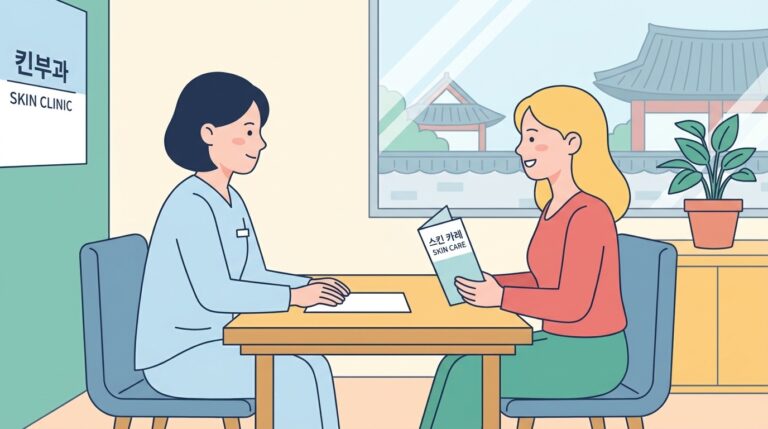
But let us paint a picture: You walk into a stunning, marble-floored clinic in the heart of Gangnam. The scent of calming lavender fills the air, and a beautifully polished consultant welcomes you. Suddenly, your mind goes blank. How do you explain that you want a fresh, glowing look without sounding like a robotic textbook?
Do not worry! Today, we are going to learn the exact Korean phrases that will transform you from a nervous tourist into a savvy, respected local beauty insider. Let us dive in!
Phase 2: 3 Core Expressions for Your Consultation
To make your clinic visit seamless, here are the three most important phrases you need to know.
1. 자연스럽게 해 주세요. (Jayeonseoreopge hae juseyo.)
- Pronunciation: [Ja-yuhn-suh-ruhp-geh hae ju-seh-yo] / Sound-alike: “Jah-yuhn-suh-ruhp-geh” sounds a bit like “natural-ly” in a smooth flow.
- Meaning: Please make it look natural.
- K-Culture Moment: This is the ultimate phrase used by actors in dramas who want to look effortlessly handsome or beautiful—what Koreans call “Kku-An-Kku” (꾸안꾸), which means “looking stylish but like you didn’t try too hard.”
- Editor’s Insight: Korean beauty philosophy values subtle enhancements. Telling your consultant this phrase ensures they will focus on bringing out your best features rather than overdoing any treatment.
- Situation Spectrum:
- Friends & Casual: ⚠️ (Sounds too formal for close friends, but okay)
- Clinic Consultants: ✅ (Perfect, polite, and clear)
- Doctors & Elders: ✅ (Very respectful)
- 🤔 Think About It: Why do you think Korean beauty trends focus so heavily on a “natural, dewy glow” rather than heavy, dramatic transformations? How does this reflect the cultural value of harmony and subtle elegance?
2. 요즘 어떤 시술을 많이 해요? (Yojeum eotteon sisureul mani haeyo?)
- Pronunciation: [Yo-jeum uh-ttuhn she-sul-eul mah-nee hae-yo]
- Meaning: What treatments are popular these days?
- K-Culture Moment: You will hear beauty vloggers ask this as soon as they sit in the consultation chair to find out the secret behind the latest “glass skin” trends.
- Editor’s Insight: Instead of guessing from a long, confusing treatment menu, use this phrase! It lets the consultant guide you to the safest, most popular, and modern skin treatments currently trending in Seoul.
- Situation Spectrum:
- Friends & Casual: ✅ (Just drop the “yo” at the end: “요즘 어떤 시술 많이 해?”)
- Clinic Consultants: ✅ (Very natural and proactive)
- Doctors & Elders: ✅ (Polite and inquisitive)
- 🤔 Think About It: Korea is famous for fast-evolving trends (called “Ppalli-Ppalli” culture). How does this affect the variety and technology of skincare treatments available compared to your country?
3. 부작용은 없나요? (Bujagyongeun eomnayo?)
- Pronunciation: [Bu-jah-gyong-eun uhm-nah-yo] / Sound-alike: “Bu-jah-gyong” rhymes with “song” and means side effects.
- Meaning: Are there any side effects?
- K-Culture Moment: The smart, cautious main character in a daily drama always asks this before agreeing to any sudden cosmetic change.
- Editor’s Insight: It is completely natural to feel a bit nervous. Asking this question shows you are responsible, and it prompts the consultant to give you important aftercare instructions.
- Situation Spectrum:
- Friends & Casual: 🚫 (Too formal/clinical for casual chat)
- Clinic Consultants: ✅ (Essential for safety)
- Doctors & Elders: ✅ (Highly appropriate)
- 🤔 Think About It: How does asking about safety in a soft, polite way using “-요” (-yo) create a stronger trust relationship between you and your Korean practitioner?
Phase 3: Textbook Korean vs. Real Korean
Sometimes, textbooks teach phrases that sound too stiff or outdated. Let us look at what to actually say!
Situation 1: Asking for discounts or promotions
- 📖 Textbook Korean: 할인을 해 줄 수 있습니까? (Harineul hae jul su itseumnika? – “Are you able to provide a discount?”)
- 🗣️ Real Korean: 이벤트나 패키지 할인이 있나요? (Ibeonteuna paekiji harini innayo? – “Are there any events or package discounts?”)
- 💡 Why is it different?: Asking directly to “cut the price” can sound a bit too aggressive in a professional clinic. Korean clinics love hosting “seasonal events” (이벤트) or bundle packages (패키지). Asking about these makes you sound like a smart shopper!
Situation 2: Expressing your fear of pain
- 📖 Textbook Korean: 고통이 심합니까? (Gotongi simhamnika? – “Is the pain severe?”)
- 🗣️ Real Korean: 많이 아파요? (Mani apayo? – “Does it hurt a lot?”)
- 💡 Why is it different?: “고통” (gotong) is a very heavy, dramatic word for pain (like deep emotional agony). Simply asking “많이 아파요?” with a slightly worried face is how local Koreans express their cute, relatable fear of needles or lasers!
⚠️ Bottom Note: Since you are at an A2 level, stick to clean, polite ending forms like “-요” (-yo). It keeps you safe, respectful, and perfectly understood without sounding overly stiff!
Phase 4: K-Culture Deep-Dive & Non-Verbal Manners
4-1. “Nunchi” (눈치) and Body Language in the Clinic
When you sit down for a consultation, showing good “Nunchi” (tact/social situational awareness) goes a long way.
* The Gentle Point: When pointing to areas of your face you want to improve (like dark circles or acne), do not point aggressively. Instead, tilt your head slightly, look in the hand mirror they provide, and gently tap the area with one or two fingers while speaking.
* Active Listening: Nod your head gently and say “아~ 네…” (Ah~ ne… / “Ah, yes…”) while the consultant explains. This shows you respect their expertise.
4-2. The Real K-Beauty Travel Scene
If you visit clinics in Gangnam or Myeongdong, you will find they are highly efficient. However, trying to speak even a tiny bit of Korean will instantly warm up the staff. Consultants are often so delighted by your effort that they might sneak in a free soothing mask or some extra premium skincare samples!
Phase 5: Your Interactive Clinic Roleplay
Imagine you are playing an interactive visual novel. You are at the clinic, and your consultant, Min, is ready to guide you.
- Setting: A bright, gorgeous consulting room with soft lighting. A small, clean mirror sits on the table between you and Min.
Min (Consultant): 🎭 (Smiles warmly and bows slightly)
                  "안녕하세요! 오늘 어떤 고민으로 오셨나요?"
                  [An-nyeong-ha-se-yo! Oh-neul eo-tteon go-min-eu-ro o-syeot-na-yo?]
                  "Hello! What skin concerns bring you here today?"

You: 🎭 (Smile back gently and point to your cheeks)
     "안녕하세요. 요즘 피부가 많이 건조해요."
     [An-nyeong-ha-se-yo. Yo-jeum pi-bu-ga ma-ni geon-jo-hae-yo.]
     "Hello. My skin is very dry these days."

Min: 🎭 (Nods sympathetically and looks closely at your skin)
     "아, 그러시군요. 물광 주사나 리쥬란 시술을 추천해 드려요."
     [Ah, geu-reo-si-gun-yo. Mul-gwang ju-sa-na Re-ju-ran si-sul-eul chu-cheon-hae deu-ryeo-yo.]
     "Ah, I see. I recommend our Aqua Shine injection or Rejuran healer treatment."

You: 🎭 (Tilt your head curiously)
     "요즘 어떤 시술을 많이 해요?"
     [Yo-jeum eo-tteon si-sul-eul ma-ni hae-yo?]
     "What treatments are popular these days?"

Min: 🎭 (Points to a brochure with glowing skin photos)
     "리쥬란이 제일 인기 많아요. 피부 속부터 촉촉해져요!"
     [Re-ju-ran-i je-il in-ki man-a-yo. Pi-bu sok-bu-teo chok-chok-hae-jyeo-yo!]
     "Rejuran is the most popular. It makes your skin hydrated from the inside!"

You: 🎭 (Look at the brochure, then look slightly worried)
     "많이 아파요?"
     [Ma-ni a-pa-yo?]
     "Does it hurt a lot?"

Min: 🎭 (Reassuringly waves her hand)
     "마취크림을 발라서 많이 안 아파요. 걱정 마세요!"
     [Ma-chwi-kreem-eul bal-la-seo ma-ni an a-pa-yo. Geok-jeong ma-se-yo!]
     "We apply numbing cream, so it doesn't hurt much. Don't worry!"

You: 🎭 (Sigh with relief)
     "다행이네요. 부작용은 없나요?"
     [Da-haeng-i-ne-yo. Bu-ja-gyong-eun eomp-na-yo?]
     "That is a relief. Are there any side effects?"

Min: 🎭 (Explains clearly)
     "시술 후에 약간 빨갛게 될 수 있지만, 하루 만에 가라앉아요."
     [Si-sul hu-e yak-gan ppal-gat-ge doel su it-ji-man, ha-ru man-e ga-ra-an-ja-yo.]
     "It might get a little red after the treatment, but it goes down in just one day."
🔀 Decision Point: What will you say next?
- Option A: “그럼, 자연스럽게 해 주세요!” [Geu-reom, ja-yeon-seo-reop-ge hae ju-se-yo!] (“Then, please make it look natural!”)
- Option B: “돈 깎아주세요!” [Don kkak-a-ju-se-yo!] (“Give me a discount!”)
- Option C: “안 해요. 갈게요.” [An hae-yo. Gal-ge-yo.] (“I won’t do it. I’m leaving.”)
💡 Feedback on Your Choice:
- Best Choice (Option A): Excellent! This shows you trust their advice and establishes a friendly, co-operative tone. You will likely get amazing service.
- Risky Choice (Option B): Too blunt! Asking to “cut the price” directly sounds a bit impolite in a clinic setting. Better to ask about packages instead!
- Cold Choice (Option C): Oh no! This sounds very abrupt and might leave a cold impression. If you need time to think, say: “더 생각해 볼게요.” (I will think about it more.)
Phase 6: 10-Second Emotion Shadowing Drill
Let us practice speaking with true Korean emotion! Mimic the tone and pause at the slashes (/).
- [🥺 Worried but hopeful]
- 자연스럽게 / 해 주세요.
- [Ja-yeon-seo-reop-ge / hae ju-se-yo.]
- Tip: Soften your voice at the end to sound polite and trusting.
- [🥺 Cute and slightly scared]
- 많이 / 아파요?
- [Ma-ni / a-pa-yo?]
- Tip: Raise the pitch slightly on “파요?” to show you are asking a gentle question.
Phase 7: K-Culture Mini Dictionary
| Word (Korean/Romanization) | English Meaning | Cultural Context |
|---|---|---|
| 시술 (Sisul) | Minor Treatment | Non-invasive procedures like lasers, fillers, or botox. Unlike major surgery (수술 – Susul), there is almost no downtime! |
| 마취크림 (Machwi-keurim) | Numbing Cream | The magic cream applied before treatments to ensure you do not feel any pain. |
| 원장님 (Wonjangnim) | Head Doctor / Director | How you should address the doctor performing your treatment. It is highly respectful! |
| 꿀피부 (Kkul-pibu) | Honey Skin | The ultimate skin goal in Korea—skin so hydrated and smooth it looks like glistening honey. |
| 실장님 (Siljangnim) | Consultation Manager | The highly professional manager who discusses prices and packages with you before you meet the doctor. |
Phase 8: Traveler’s Survival Kit
Survival Phrases TOP 3
- 예약했어요. (Ye-yak-haes-seo-yo.)
- Meaning: I made a reservation.
- Pro Tip: Say this at the front desk when you first arrive.
- 추천해 주세요. (Chu-cheon-hae ju-se-yo.)
- Meaning: Please recommend something.
- Pro Tip: Perfect if you do not know which skin treatment is best for your skin type.
- 텍스프리 돼요? (Tek-seu-peu-ri dwae-yo?)
- Meaning: Is Tax-Free available?
- Pro Tip: Many certified skin clinics offer tax refunds for tourists! Always bring your passport.
📌 Editor’s Travel Note
Before heading to Seoul, make sure to download the Babitalk official cosmetic review app or use the Naver Map App navigation service to find highly-rated aesthetic clinics in Gangnam. Keep your physical passport with you to easily claim tax refunds immediately at the clinic counter!
Phase 9: Deep Thoughts — “Self-Management” (자기관리)
In many Western cultures, cosmetic treatments can sometimes carry a small social stigma. However, in Korea, taking care of your skin and appearance is widely referred to as 자기관리 (Jagi-gwanri), which translates to “Self-Management.” It is viewed as a highly positive form of self-discipline, respect for others, and healthy self-care, much like going to the gym or eating well.
💬 Your Turn: How is skincare or cosmetic enhancement viewed in your home country? Is it seen as a luxury, a secret, or a normal part of life? Let us know in the comments below!
Phase 10: FAQ & Avoiding Mistakes
Q: Do I need to speak fluent Korean at the clinic?
A: Not at all! While many clinics in Seoul have English or Chinese translators, learning basic phrases like “자연스럽게 해 주세요” shows deep respect and immediately builds great rapport with your consultant.
Q: What is the difference between “시술” (Sisul) and “수술” (Susul)?
A: This is a crucial distinction! 시술 (Sisul) refers to quick, non-surgical beauty procedures (like skin lasers or injections) with little to no recovery time. 수술 (Susul) refers to actual invasive plastic surgery. Make sure you do not mix them up during your consultation!
Q: Can I negotiate the price at Korean clinics?
A: Generally, medical and aesthetic prices are fixed. However, always ask politely about “이벤트” (events) or “패키지” (packages) to see if you can get special promotional pricing or free post-treatment care!
🚨 Common Mistakes Alert!
- Mistake 1: Calling the doctor “의사 선생님” (Uisa seon-saeng-nim).
- Correct Action: Address them as 원장님 (Won-jang-nim) for a much more professional and local touch.
- Mistake 2: Demanding discounts aggressively.
- Correct Action: Ask “이벤트 할인 있어요?” (Are there any event discounts?) with a gentle smile.
- Mistake 3: Not telling them you are a tourist before payment.
- Correct Action: Ask “텍스프리 돼요?” (Is Tax-Free available?) to save up to 7-10% of your money!
Phase 11: Action Missions
- 🥉 Bronze Mission: Stand in front of your mirror, look at yourself, and practice saying “자연스럽게 해 주세요!” three times with a confident smile.
- 🥈 Silver Mission: Write down your favorite Korean skincare step or product on your social media, and use the hashtag #KkulPibu (#꿀피부)!
- 🥇 Gold Mission: The next time you visit a cosmetics store or a beauty clinic, ask the staff: “요즘 어떤 제품/시술을 많이 해요?”
- 🎮 K-Culture Mission: Watch a popular K-Drama (like True Beauty or My ID is Gangnam Beauty) and try to spot a scene where characters talk about their skin concerns or visit a clinic!
Phase 12: Interactive Quiz
Test your new K-Beauty Korean skills!
1. Which phrase should you use to ask for popular treatments?
- A) 비싼 거 주세요. (Give me the expensive one.)
- B) 요즘 어떤 시술을 많이 해요? (What treatments are popular these days?)
- C) 이거 진짜 아파요? (Does this really hurt?)
2. True or False?
- “시술” (Sisul) means a major, invasive surgical procedure.
🎉 Click here to see the answers and explanations!
- Correct Answer: B
- Explanation: Asking what is popular (“요즘 어떤 시술을 많이 해요?”) helps you discover the best and most trusted trends in the clinic!
- Correct Answer: False
- Explanation: “시술” (Sisul) is a light, quick aesthetic treatment. Major invasive surgery is called “수술” (Susul)!
- Explanation: “시술” (Sisul) is a light, quick aesthetic treatment. Major invasive surgery is called “수술” (Susul)!







