

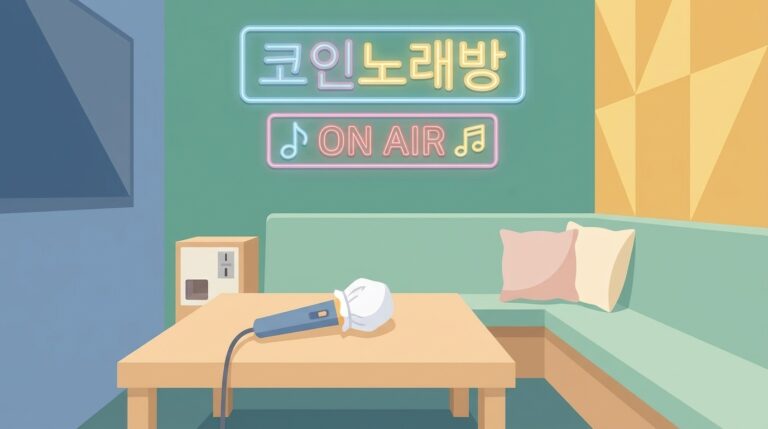
Mastering the Korean Noraebang: The Unwritten Mic Cover Rule
Phase 1: Empathy (The Noraebang Dilemma)
안녕하세요! (Annyeonghaseyo!) It’s your favorite Korean culture navigator and senior editor at Daily Hangul.
Imagine this: You’re out in Hongdae with your new Korean friends. After delicious K-BBQ, someone yells, “Let’s go to Noraebang! (노래방)” Your heart races with excitement. You step into a neon-lit room, ready to belt out your favorite K-pop anthem or K-drama OST. But before you can grab the microphone, your Korean friend hands you a tiny, sealed plastic pouch containing two black, circular sponge-like sheets.
Everyone is looking at you, expecting you to know what to do. You freeze. Is it a coaster? A make-up sponge? A complimentary snack wrapper?
Actually, it’s a microphone hygiene cover (마이크 위생 커버). In Korea, putting this cover on before you sing is the ultimate unwritten social rule. Slipping up on this minor detail won’t ruin your night, but mastering it instantly marks you as an “insider” (인싸 – in-ssa) who respects local manners. Let’s dive into how to handle this gracefully and what to say while doing it!
Phase 2: Core Expressions Deep Dive
Here are the three essential phrases you need to survive this moment like a pro.
1. 마이크 커버 좀 씌워 주세요 (Ma-i-keu keo-beo jom ssi-wo ju-se-yo)
- Pronunciation: My-keu kuh-buh jom shee-wo joo-seh-yo (Sound Analogy: Think of saying “she-wore” really fast for ssi-wo)
- Meaning: “Please put the mic cover on for me” or “Can you help me put this cover on?”
- K-Culture Moment: This is what you say when you are holding a tambourine in one hand and struggling to open the tight cover with the other. In K-dramas, this is a classic subtle way to flirt or show care—helping someone cover their mic before a duet!
- Editor’s Insight: The verb 씌우다 (ssi-u-da) means “to cover” or “to put a cap/hat on something.” Using 좀 (jom) makes your request sound soft, polite, and natural rather than demanding.
- Situation Spectrum:
- Friends & Casual: ⚠️ (Slightly formal, but okay)
- Co-workers & Semi-formal: ✅ (Perfect, polite balance)
- Bosses & Elders (Formal): ✅ (Safe and respectful)
- 🤔 Think About It: Why does Korean use a specific verb like ssi-u-da (to put a cap on) instead of just buda (to attach) or kkuda (to insert)? It shows how Koreans visually categorize actions based on the shape of the object being handled!
2. 이거 어디에 있어요? (I-geo eo-di-e isseo-yo?)
- Pronunciation: Ee-guh uh-dee-eh eet-suh-yo?
- Meaning: “Where is this?” / “Where can I find these?”
- K-Culture Moment: You walk into a Coin Noraebang (코노), but the mic covers aren’t in your room. You head to the front desk or the vending machine to ask the staff.
- Editor’s Insight: This is a survival phrase! In small coin karaoke rooms, covers are often placed in a small basket near the change machine or given at the counter.
- Situation Spectrum:
- Friends & Casual: ✅
- Co-workers: ✅
- Staff/Elders: ✅
3. 위생이 중요하죠! (Wi-saeng-i jung-yo-ha-jyo!)
- Pronunciation: Wee-saeng-ee joong-yo-ha-jyo!
- Meaning: “Hygiene is important, of course!”
- K-Culture Moment: When your Korean host appreciates that you covered your mic before singing, you can drop this line with a warm smile to show you care about shared spaces.
- Editor’s Insight: 위생 (wi-saeng) means hygiene/sanitation, and -죠 (-jyo) is a friendly ending that means “isn’t it?” or “indeed!” It builds immediate rapport.
- Situation Spectrum:
- Friends & Casual: ✅
- Co-workers: ✅
- Bosses & Elders: ✅
Phase 3: Textbook Korean vs. Real Korean
When you study from standard textbooks, the instructions can sound like a scientific manual. Let’s look at the difference between what the book says and what actual Koreans say in the heat of a karaoke night.
Situation 1: Telling someone to put the cover on
- 📖 Textbook Korean: “마이크 위생 덮개를 마이크 머리에 씌우십시오.” (Please place the microphone sanitary cover on the microphone head.)
- 🗣️ Real Korean: “마이크 커버 끼우자!” (Let’s pop the mic cover on! / Ma-i-keu keo-beo kki-u-ja!)
- 💡 Why the difference? Koreans value speed and casual connection. Nobody says “위생 덮개” (sanitary cover) in real life; they just call it a “커버” (cover) and use the casual verb “끼우다” (to insert/fit onto).
Situation 2: Asking if there are more covers
- 📖 Textbook Korean: “여분의 마이크 위생 커버가 더 있습니까?” (Are there additional microphone sanitary covers?)
- 🗣️ Real Korean: “커버 더 있어요?” (Are there more covers? / Keo-beo deo isseo-yo?)
- 💡 Why the difference? Dropping unnecessary pronouns and particles makes your Korean flow like a native speaker. The shorter, the more natural!
Phase 4: K-Culture Deep Dive & Non-verbal Manners
4-1. Nunchi (눈치) and Non-verbal Etiquette
In Korea, shared hygiene is a sign of respect for the community. Here are two vital non-verbal manners for Noraebang:
1. The Double-Hand Handover: When passing a microphone to someone older or a colleague, hold the microphone body with your right hand, and gently rest your left hand under your right forearm or on your chest.
2. The Cover Stretch: Mic covers are made of elastic fabric but can be surprisingly tight. To avoid looking like you’re struggling, gently stretch the opening of the cover with your thumbs before sliding it onto the mic head.
4-2. The Cultural Mindset: ‘Uri’ (우리가) over ‘I’ (내가)
Why is the mic cover so essential? It stems from Korea’s deep-rooted collective culture (우리 – Uri / We, Our). Because the Noraebang room and the microphones are shared by hundreds of people daily, taking care of the microphone isn’t just about keeping your hands clean—it’s a protective gesture for the next person who steps into that room.
Phase 5: Real-life Roleplay Scenario
Setting: You are at a trendy Coin Noraebang in Sinchon with your Korean classmate, Minji (민지). Neon pink lights glow, and the room smells faintly of sweet butter popcorn. The bass from the room next door vibrates through your feet.
- Minji: 🎭 (Hands you a small plastic pouch with high energy) “자, 마이크 커버 여기 있어! 얼른 씌워!”
(Ja, ma-i-keu keo-beo yeo-gi isseo! Eol-leun ssi-wo! / Here, here’s the mic cover! Put it on quickly!) - You: 🎭 (Looking at the tight cover, struggling to open it) “어… 이거 어떻게 열어? 잘 안 돼.”
(Eo… i-geo eo-tteoh-ge yeo-reo? Jal an dwae. / Uh… how do I open this? It’s not working well.) - Minji: 🎭 (Laughs warmly and grabs the pouch) “내가 도와줄게! 끝을 잡고 찢으면 돼.”
(Nae-ga do-wa-jul-ge! Kkeut-eul jap-go jji-jeu-myeon dwae. / I’ll help you! Just hold the edge and rip it.) - You: 🎭 (Gratefully watching her open it) “오, 고마워! 마이크에 이렇게 씌우면 돼?”
(O, go-ma-wo! Ma-i-keu-e i-reoh-ge ssi-u-myeon dwae? / Oh, thanks! Do I just put it on the mic like this?) - Minji: 🎭 (Nodding dynamically) “응! 마이크 머리 부분을 완전히 덮어야 돼.”
(Eung! Ma-i-keu meo-ri bu-bun-eul wan-jeon-hi deop-eo-ya dwae. / Yes! You have to cover the head of the mic completely.) - You: 🎭 (Stretching the cover and popping it onto the mic) “됐어! 이제 우리 노래 시작할까?”
(Dwaes-seo! I-je u-ri no-rae si-jak-hal-kka? / Done! Shall we start singing now?) - Minji: 🎭 (Passing you the song selection remote) “좋아! 네가 첫 곡 예약해!”
(Jo-ah! Ne-ga cheot gok ye-yak-hae! / Great! You reserve the first song!)
🔀 Decision Point: Minji hands you the microphone with no cover on it yet, but the song intro is already starting!
- A) Just sing anyway. Stopping to put on a cover ruins the hype!
- B) Calmly say “잠깐만! (Wait a second!)”, put the cover on quickly, and then sing.
- C) Throw the cover away and tell Minji you don’t care about germs.
-
Best Choice: B
Why? Koreans will highly appreciate your social manners (Nunchi) even in a rushed moment. Skipping the cover can make your friends feel slightly uncomfortable sharing the mic later! - Risk Choice: C
Why? This can feel blunt and dismissive of local cultural hygiene expectations.
Phase 6: 10-Second Emotion Shadowing Drill
Practice saying these with the right emotion to sound natural!
- [😊 Bright & Friendly]
“마이크 커버 / 여기 있어요!”
(Ma-i-keu keo-beo / yeo-gi isseo-yo!)
-> “The mic cover is over here!” -
[🥺 Cute & Helpless]
“이거 좀 / 씌워 주시면 안 돼요?”
(I-geo jom / ssi-wo ju-si-myeon an dwae-yo?)
-> “Could you please help me put this on?” -
[😤 Confident & Proud]
“위생이 / 제일 중요하죠!”
(Wi-saeng-i / je-il jung-yo-ha-jyo!)
-> “Hygiene is the most important thing!”
Phase 7: K-Culture Mini Dictionary
- 코노 (Kono): Short for 코인노래방 (Coin Noraebang). Highly popular, budget-friendly mini karaoke booths where you pay per song rather than per hour.
- 서비스 (Seo-bi-seu): “Service” or free bonus time added to your clock by friendly Noraebang owners when you book a room by the hour.
- 탬버린 (Taem-beo-rin): Tambourine. A staple instrument in Korean karaoke rooms used to keep the rhythm and hyping up your friends.
- 애창곡 (Ae-chang-gok): One’s go-to, favorite song to sing at karaoke.
Phase 8: Traveler’s Survival Kit
Top 3 Survival Phrases
- “방 안내해 주세요.” (Bang an-nae-hae ju-se-yo.) -> “Please guide us to our room.”
- “서비스 더 주세요!” (Seo-bi-seu deo ju-se-yo!) -> “Please give us more free bonus time!” (Say this with a cute smile to the owner!)
- “물 두 병 주세요.” (Mul du byeong ju-se-yo.) -> “Two bottles of water, please.” (Essential for dry throats!)
📌 Editor’s Travel Note: To locate the cleanest, highly rated Coin Noraebangs nearby, do not rely on standard global map apps. Instead, search “코인노래방” directly on the Naver Map App Download Page to find real-time reviews and operating hours.
Phase 9: Think Deeper — “One Step Further”
In Western cultures, karaoke is often seen as a performance where one person takes the stage and others watch. In Korea, Noraebang is a highly collaborative, communal bonding experience. The microphone hygiene cover is a physical manifestation of this “communal bubble.” By putting on the cover, you are signaling, “I respect this room, I respect your health, and I am ready to be part of ‘us’ (우리).”
💬 Your Turn: How does your culture handle shared items in social settings? Do you have similar unwritten rules? Let us know in the comments below!
Phase 10: FAQ & Common Mistakes
Q: Do I need to buy the mic covers separately?
A: No. In standard hourly Noraebangs, they are almost always provided for free at the front desk or placed inside the room. In Coin Noraebangs (코노), they are usually sitting in a basket next to the coin exchange machine for you to take.
Q: Can one cover be reused for multiple people?
A: Generally, yes, within your own group. If you are sharing a microphone with friends, you usually keep the same cover on for the session. However, if someone else is highly sensitive about germs, they might put a fresh one on when it’s their turn.
Q: Where do I throw the cover away when finished?
A: In the trash bin inside your room. Never leave used covers on the table or floor when you leave. Leaving a clean room is part of excellent Noraebang manners.
🚨 Common Mistakes Alert!
- Mistake 1: Tearing the cover while trying to force it onto the mic. Fix: Gently stretch the rim with your fingers first.
- Mistake 2: Singing into the microphone bare. Fix: Always look around for the cover pouch first!
- Mistake 3: Taking the cover home. Fix: Toss it in the trash bin inside the room before leaving.
Phase 11: Action Missions
- 🥉 Bronze (At-Home Challenge): Practice stretching a clean sock or small cup over a water bottle while saying: “마이크 커버 씌우자!”
- 🥈 Silver (Social Challenge): Share a picture of your favorite K-pop song on your social media with the hashtag
#DailyHanguland write: “Noraebang night!” - 🥇 Gold (Real-world Challenge): Next time you visit a Korean Coin Noraebang, ask the counter staff: “마이크 커버 어디에 있어요?” without looking at your notes!
Phase 12: Interactive Quiz
Q1. What is the correct casual verb to use when putting a cover on a microphone?
Answer: 씌우다 (ssi-u-da) or 끼우다 (kki-u-da).
Explanation: These verbs specifically denote covering or fitting something snugly onto an object.
Q2. True or False: In a Coin Noraebang (코노), you must always pay extra for the mic covers.
Answer: False.
Explanation: They are almost always free and placed in a basket near the kiosk or entrance.
Q3. What is the short, trendy Korean word for ‘Coin Karaoke’?
Answer: 코노 (Kono).
Explanation: It’s a portmanteau of 코인 (Coin) and 노래방 (Noraebang).







