

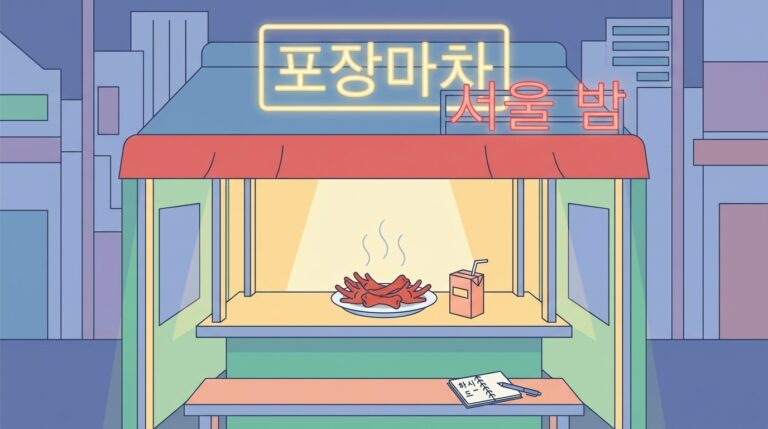
Conquer the Fire: How Eating Spicy Chicken Feet Became Korea’s Ultimate Stress Buster
안녕하세요! (Annyeonghaseyo!) It’s your favorite Seoul-insider tutor and cultural navigator from Daily Hangul!
Have you ever had one of those days? Your boss dumped a mountain of paperwork on your desk at 5:59 PM, your transit card refused to scan, and you missed the subway by a hair. In many cultures, the remedy is a pint of ice cream or a warm bath. But in Korea? We head straight to a neon-lit alleyway, slide onto a plastic chair, put on a disposable plastic glove, and chew on fiery, tongue-numbing chicken feet.
If you have watched K-Dramas like Work Later, Drink Now or Crash Landing on You, you have probably seen characters sweating, crying, and laughing over a bright red plate of 닭발 (Dakbal – Chicken Feet). It looks intimidating, but there is a beautiful, therapeutic logic behind this culinary madness. Today, we are going to dive deep into the heart of Korean late-night food culture (야식 – Yasik) and learn the exact expressions you need to survive, thrive, and show off your spicy pride!
This guide is based on real-world tutoring sessions with intermediate students who started out terrified of Dakbal but ended up ordering it like seasoned Seoulites. Let’s get started!
Phase 2: Deep Dive into 3 Key Expressions
1. 스트레스(를) 풀다 (Seutoureseu-reul pulda)
- Pronunciation: [seu-teu-re-seu-reul pool-dah] / Sound-alike: “soo-treh-suh-reul pool-dah”
- Meaning: To relieve stress (Literally: “to untie/unwind stress”)
- K-Culture Moment: This is the ultimate anthem of Korean office workers. After a long day under hierarchical pressure, coworkers gather at a local tent restaurant (Pojangmacha) and sigh, “아, 스트레스 풀러 가자!” (Ah, let’s go untie our stress!).
- Editor’s Insight: In Korean psychology, stress is conceptualized as a tight, tangled knot inside your chest. You don’t just “reduce” it; you physically untie (풀다) it. Eating extremely spicy food acts as a biological scissor to cut that knot!
- Situation Spectrum:
- Friends/Casual: ✅ (스트레스 풀어야 돼)
- Coworkers/Semi-formal: ✅ (스트레스 풀어야 해요)
- Boss/Formal: ✅ (스트레스를 풀어야 합니다)
- 🤔 Think About It: In English, we “relieve” or “manage” stress. In Korean, we “untie” it. How does this physical metaphor of “untying” change the way you think about mental fatigue?
2. 맵부심 (Maepbusim)
- Pronunciation: [maep-boo-seem] / Sound-alike: “map-boo-seem”
- Meaning: Pride in one’s ability to eat spicy food (Portmanteau of 매운 것 – Maeun geot [spicy food] + 자부심 – Jabusim [pride])
- K-Culture Moment: You will see this word constantly on Korean mukbang YouTube channels and variety shows. When idols challenge each other to eat spicy noodles without drinking water, they are putting their Maepbusim on the line.
- Editor’s Insight: Eating spicy food in Korea is practically a social sport. Having Maepbusim means you can handle the heat without flinching, tearing up, or reaching for water. It’s a badge of honor!
- Situation Spectrum:
- Friends/Casual: ✅ (나 맵부심 있어!)
- Coworkers/Semi-formal: ⚠️ (저 맵부심 있어요 – slightly slangy, but totally fine in casual company)
- Boss/Formal: 🚫 (Avoid using slang with conservative superiors)
- 🤔 Think About It: Why do you think food tolerance became connected to personal pride and identity in modern Korean youth culture?
3. 스트레스가 확 날아가다 (Seutoureseuga hwak naragada)
- Pronunciation: [seu-teu-re-seu-ga hwak nah-rah-gah-dah] / Sound-alike: “soo-treh-suh-gah hwak nah-rah-gah-dah”
- Meaning: For stress to fly away instantly/completely
- K-Culture Moment: The moment you take that first bite of fiery Dakbal, your forehead sweats, your heart races, and suddenly—you forget all your worries. That is when you gasp, “와, 스트레스가 확 날아간다!”
- Editor’s Insight: The word 확 (hwak) is an onomatopoeia for a sudden, powerful gust of wind or a swift, decisive action. It adds an exciting sensory drama to the verb “to fly away” (날아가다).
- Situation Spectrum:
- Friends/Casual: ✅ (스트레스가 확 날아가네!)
- Coworkers/Semi-formal: ✅ (스트레스가 확 날아가요!)
- Boss/Formal: ⚠️ (A bit too casual; use ‘스트레스가 해소됩니다’ instead)
- 🤔 Think About It: Onomatopoeias like ‘확’ are the secret sauce of natural Korean speech. Can you think of similar words in your language that describe a feeling disappearing in a flash?
Phase 3: Textbook Korean vs. Real Korean
When you study with standard textbooks, you learn grammatically perfect but sometimes robotic sentences. Let’s see how locals actually speak when the heat is on!
Situation 1: Ordering your food extra, extra spicy
- 📖 Textbook Korean: 아주 매운 맛으로 요리해 주세요. (Please cook it with a very spicy flavor.)
- 🗣️ Real Korean: 진짜 눈물 나게 맵게 해주세요! (Please make it so spicy that tears run down my face!)
- 💡 Why the difference? Koreans love sensory and emotional exaggeration. Asking for “tear-inducing” spice communicates your desperation for a true emotional release.
Situation 2: Admitting you can’t handle the heat
- 📖 Textbook Korean: 저는 매운 음식을 잘 먹지 못합니다. (I do not eat spicy food well.)
- 🗣️ Real Korean: 저 완전 맵찔이에요! (I am a total spice-wimp!)
- 💡 Why the difference? 맵찔이 (Maepjjiri) is a super-popular, cute, self-deprecating slang combining 맵다 (Spicy) and 찌질이 (Wimp). Using this instantly breaks the ice and makes Koreans feel protective of your stomach!
Phase 4: K-Culture Deep Dive & Non-verbal Manners
4-1. The Art of the Plastic Glove (Nunchi on the Table)
Eating Dakbal is not about elegance; it’s about raw, unpretentious survival. When you enter a chicken feet restaurant, you will notice a box of disposable plastic gloves (위생장갑 – Wisaeng-janggap) on every table.
* The Non-verbal Rule: Put the glove on your dominant hand. Use your gloved hand to pick up the chicken feet, bite off the meat, and politely spit the tiny bones into the small paper cup provided. Keep your other hand clean and gloved-free to hold your drink or side dishes. It is a shared bonding experience—seeing each other sweat and eat messy food with plastic gloves breaks down all professional barriers!
4-2. The Chemistry of Spicy Yasik (K-Food Sync)
In Korea, pain is therapeutic. When you eat capsaicin-heavy food, your brain releases endorphins to combat the pain, giving you a natural “high” that relieves tension. But you need the right sidekicks to survive the ordeal:
1. 주먹밥 (Jumeokbap): Hand-rolled rice balls seasoned with seaweed and sesame oil. Eating these coats your stomach.
2. 쿨피스 (Coolpis): A sweet, milky peach-flavored drink. This is the ultimate Korean fire extinguisher! Water won’t wash away spicy oil, but the casein in dairy-adjacent Coolpis will.
Phase 5: The Mapo Alleyway Roleplay
Setting: It is 11:30 PM. You and your coworker, Minho, are sitting at a round metal table in a packed indoor street-food tent (실내포차) in Mapo, Seoul. The sound of sizzling grills and clinking glasses surrounds you. Minho looks exhausted after a brutal day at work.
Cast:
* You (An expat working in Seoul)
* Minho (민호) (Your friendly but stressed-out Korean coworker)
- Minho: (🎭 Loosening his tie with a heavy sigh) 아… 오늘 김 부장님 잔소리 진짜 심하네. 머리 아프다.
(Ah… Manager Kim’s nagging today was really something else. My head hurts.) -
You: (🎭 Nodding sympathetically) 맞아요. 오늘 진짜 힘든 하루였어요. 우리 맛있는 거 먹고 스트레스 풀어요!
(Right. Today was a really tough day. Let’s eat something delicious and untie our stress!) -
Minho: (🎭 Eyes lighting up) 오, 좋아요! 스트레스 풀 때는 역시 매운 게 최고지. 저기요! 여기 뼈 없는 닭발 아주 매운맛으로 하나 주세요!
(Oh, sounds good! When relieving stress, spicy food is the absolute best. Excuse me! One boneless chicken feet, extra spicy, please!) -
You: (🎭 Gasping playfully) 와, 민호 씨 맵부심 대단하네요! 아주 매운맛 괜찮겠어요?
(Wow, Minho, your spicy pride is awesome! Will you be okay with the extra spicy level?) -
Minho: (🎭 Smirking proudly) 에이, 나 이래봬도 대한민국 대표 맵짱이야! 매운 거 먹으면 스트레스가 확 날아가거든.
(Hey, despite how I look, I’m Korea’s representative spice-king! When I eat spicy food, my stress completely flies away.) -
You: (🎭 Smiling, putting on the plastic glove) 그럼 저도 도전해 볼게요! 오늘 제대로 한판 붙어봐요.
(Then I will challenge it too! Let’s have a real battle today.) -
Minho: (🎭 The steaming red plate of Dakbal arrives. Minho picks one up and eats it) 으하! 바로 이 맛이야! 자, 얼른 먹어봐요!
(Uha! This is the exact taste! Here, hurry up and try it!) -
You: (🎭 Takes a bite. Immediately, your tongue catches fire. You start fanning your mouth) 헉! 진짜… 진짜 매워요! 입에서 불이 나요!
(Heck! It is really… really spicy! My mouth is on fire!) -
Minho: (🎭 Laughing while sweating) 하하하! 괜찮아요? 여기 쿨피스랑 주먹밥 좀 먹어요!
(Hahaha! Are you okay? Eat some Coolpis and rice balls here!)
🔀 Decision Point!
Minho hands you a cup of sweet peach Coolpis. How do you respond?
- Option A: “아니요, 괜찮아요! 저도 맵부심 있어요! 하나 더 먹을래요.”
(No, I’m fine! I have spicy pride too! I’ll eat one more.) - Option B: “살려주세요… 저 완전 맵찔이인가 봐요. 쿨피스 다 마실래요!”
(Save me… I guess I’m a total spice-wimp. I’m going to drink all of this Coolpis!) - Option C: “이렇게 매운 걸 도대체 왜 돈 주고 먹어요?”
(Why on earth do people pay money to eat something this spicy?)
💡 Action Analysis:
- Best Choice: Option B! Self-deprecating humor like calling yourself a Maepjjiri is extremely endearing to Koreans. It builds instant warmth, and Minho will happily coach you through eating it.
- Runner Up: Option A! This is highly entertaining. Koreans love it when foreigners show playful competitive spirit over local spicy food.
- Avoid: Option C! Even if you are joking, criticizing a core comfort food culture can instantly kill the fun, supportive atmosphere of the dinner.
Phase 6: 10-Second Emotional Shadowing Drill
To speak natural Korean, you need the right emotions and natural pauses. Practice these aloud, mimicking the emotional cues:
- [😊 Feeling incredibly relieved and happy]
- “매운 거 먹으니까 / 스트레스가 / 확 풀린다!”
- Pronunciation: Maeun geo meogeunikka / seutoureseuga / hwak pullinda!
- Translation: Since I’m eating spicy food, my stress is totally untied!
- [🥺 Pouting and desperately pleading for mercy]
- “나 진짜 / 맵찔이인가 봐… / 물 좀… 물 좀 주세요…”
- Pronunciation: Na jinjja / maepjjiri-inga bwa… / mul jom… mul jom juseyo…
- Translation: I guess I’m really a spice-wimp… water please… please give me some water…
Phase 7: K-Culture Mini Dictionary
| Word (Hangul/Romanization) | Meaning | Real-World Context |
|---|---|---|
| 야식 (Yasik) | Late-night snack | Eating after 10 PM. Korea’s dense cities and 24/7 delivery infrastructure make Yasik a lifestyle, not just a meal. |
| 맵찔이 (Maepjjiri) | Spice-wimp | A cute, slangy word for someone who can’t tolerate spicy food. Used to politely excuse oneself from fiery dishes. |
| 포장마차 (Pojangmacha) | Street food tent | Often shortened to ‘Pocha’. The orange/red tents with plastic chairs where people share drinks and emotional conversations. |
| 치맥 (Chimaek) | Chicken + Beer | The golden standard of Korean Yasik, popular worldwide but born in the hearts of working-class Koreans. |
Phase 8: Traveler’s Survival Kit
If you find yourself in the back alleys of Hongdae or Gangnam tonight, keep these three phrases in your back pocket:
1. “덜 맵게 해주세요.”
- Romanization: [deol maep-ge hae-juseyo]
- Meaning: Please make it less spicy.
- Pro Tip: Use this if you want to try authentic dishes but are afraid of the default heat level.
2. “뼈 없는 걸로 주세요.”
- Romanization: [pyeo eom-neun geol-lo juseyo]
- Meaning: Please give me the boneless version.
- Pro Tip: Eating chicken feet with bones requires skilled mouth coordination. If you are a beginner, bone-free (뼈 없는 닭발) is highly recommended!
3. “여기 위생장갑 더 주세요.”
- Romanization: [yeogi wisaeng-janggap deo juseyo]
- Meaning: Please give me more plastic gloves here.
- Pro Tip: Your gloves might rip while handling hot food, or you might want a fresh one.
📌 Editor’s Travel Note: Don’t rely on Google Maps in Korea—it doesn’t navigate well! Download the Naver Map App (네이버 지도) to easily find highly-rated “닭발 맛집” (Dakbal hotspots) near you. Most local spots do not expect tips, so feel free to enjoy the incredible service without extra calculations!
Phase 9: Deep Thoughts — “One Step Deeper”
Why are Koreans so obsessed with eating food that hurts?
Modern South Korea is a hyper-fast, highly competitive society (빨리빨리 – Ppalli-ppalli culture). From school to the corporate world, Koreans carry immense pressure to perform. In a culture where expressing negative emotions openly is often discouraged to maintain social harmony (인화 – Inhwa), people need a private, safe outlet to let go.
Eating fiery Dakbal or Buldak ramen causes actual physical pain, triggering the body to release a rush of dopamine and endorphins. In a way, sweating over a spicy plate of chicken feet with close friends is a form of collective, physical catharsis. It is a delicious coping mechanism for a stressful world.
💬 Your Turn: What is the go-to food in your country when you’ve had an incredibly stressful day? Do you prefer something sweet, salty, or spicy? Let us know in the comments below!
Phase 10: FAQ & Avoiding Misunderstandings
Q: Is Dakbal really made of real chicken feet?
A: Yes, absolutely! It is the actual paw of a chicken, cleaned, marinated in a heavy red chili sauce, and usually grilled over charcoal or boiled. If you find the visual too shocking, always ask for 뼈 없는 닭발 (Boneless chicken feet), which looks like small, chewy red strips of meat!
Q: Can I find non-spicy Dakbal?
A: Honestly? No. The dish’s entire identity is built on spice. Even the “mild” (순한맛 – Sunhan-mat) version at a specialized restaurant will still be quite spicy for a standard Western palate. If you absolutely cannot do spice, try ordering 계란찜 (Gyeran-jjim – Steamed egg pot) as your main side to soothe your mouth.
Q: Why do Koreans drink sweet drinks like Coolpis instead of cold water?
A: Capsaicin (the spicy chemical) is hydrophobic, meaning it doesn’t dissolve in water. Drinking water just spreads the fire around your mouth! Milk-based or highly sugary drinks like Coolpis contain fats and sugars that bind to capsaicin and wash it away.
🚨 Common Mistakes Warning Board
- Saying “이것은 너무 아파요” (This hurts): While technically true, Koreans don’t say food “hurts.” Instead, say “진짜 매워요!” (It’s really spicy!).
- Not wearing the glove: Trying to eat bone-in chicken feet with chopsticks is a recipe for disaster and food splattering on your shirt. Wear the plastic glove proudly!
- Refusing to eat side dishes: Rice and steamed egg aren’t just extra calories; they are functional tools designed to protect your stomach lining. Eat them strategically!
Phase 11: Action Missions
Are you ready to take your Korean out of the classroom and into the streets? Complete these three missions!
- 🥉 Bronze (The Mirror Challenge): Stand in front of a mirror, put on your most dramatic face, and practice saying: “스트레스가 확 날아간다!” three times.
- 🥈 Silver (The Social Challenge): Post a picture of your favorite comfort food on Instagram or Twitter, write: “오늘 스트레스 받아서 [Food Name] 먹었어요!” (I ate [Food Name] because I was stressed today!), and tag us at #DailyHangul.
- 🥇 Gold (The Real-world Challenge): Go to your nearest Korean restaurant (or order online) and confidently ask the staff: “이거 많이 매워요? 저 맵찔이에요.” (Is this very spicy? I’m a spice-wimp.) and see how they smile and help you!
Phase 12: Interactive Quiz Challenge
Let’s test your new cultural and linguistic superpowers!
1. Which word is a combination of ‘Spicy’ and ‘Pride’?
- A) 맵찔이 (Maepjjiri)
- B) 맵부심 (Maepbusim)
- C) 스트레스 (Seutoureseu)
Reveal Answer & Explanation
Correct Answer: B) 맵부심
Excellent! 맵부심 (Maepbusim) combines 매운 것 (Spicy) and 자부심 (Pride). If you answered A, remember that 맵찔이 (Maepjjiri) is a spice-wimp!
2. Fill in the blank:
“오늘 매운 닭발을 먹어서 스트레스가 _______ 날아갔어요!”
(Today I ate spicy chicken feet and my stress flew away _______!)
* A) 확 (Hwak)
* B) 천천히 (Cheoncheonhi)
* C) 아주 (Aju)
Reveal Answer & Explanation
Correct Answer: A) 확 (Hwak)
확 (Hwak) is the perfect onomatopoeia to express a sudden, clean, and satisfying clearance of stress!
3. True or False: Drinking water is the best way to cool your mouth down after eating spicy Korean food.
- True
- False
Reveal Answer & Explanation
Correct Answer: False!
Water does not dissolve capsaicin! Go for dairy-like drinks like Coolpis (쿨피스), milk, or starch-heavy foods like 주먹밥 (Rice balls) instead.







