

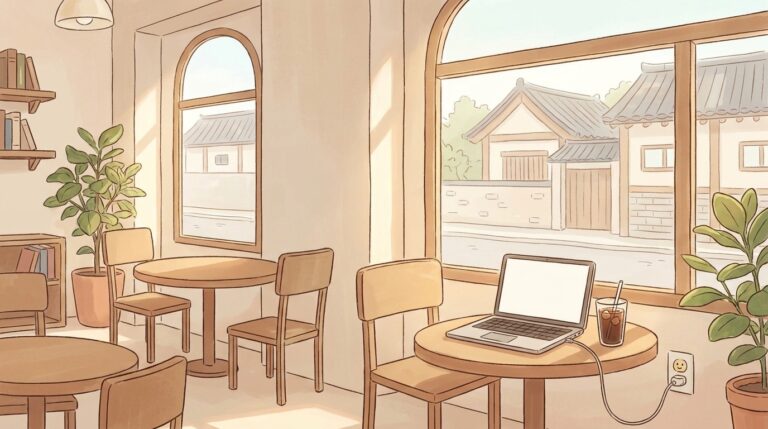
Lost in a Korean Cafe with 1% Battery? How to Find and Ask for a Power Outlet Like a Local
안녕하세요! (An-nyeong-ha-se-yo!) Hello, my lovely language learners! It is your favorite senior editor and local Seoul navigator from Daily Hangul here.
Imagine this: You are sitting in a stunning, minimalist cafe in the trendy neighborhood of Hongdae. The aesthetic is perfect, your strawberry latte looks amazing, and you are ready to upload a video to your social media. Suddenly, you look at your phone. 1% battery.
Your heart drops. You need to check your maps, translate signs, and find your way back to your guesthouse. You look around, but all the power outlets seem hidden. You want to ask the barista for help, but your mind goes blank.
Don’t panic! In Korea’s world-famous cafe culture, finding a charger plug is a daily survival skill. Today, we will learn the exact, natural phrases to secure that precious electricity. By the end of this guide, you will sound so natural that the barista might even offer you a free cookie!
This guide is packed with real-life insights based on dozens of questions from my actual A2-level students who survived (and thrived!) in Seoul’s cafes. Let’s dive in!
Phase 2: 3 Key Expressions to Save Your Battery’s Life
Here are the three most important phrases you need. We have tailored these specifically for your level so they are easy to remember but incredibly natural.
1. 콘센트 있는 자리 있어요? (Is there a seat with an outlet?)
- Pronunciation: kon-sen-teu in-neun ja-ri is-seo-yo?
- Sound-alike guide: “cone-sent” (like an ice cream cone) + “in-noon” + “jah-ree” + “it’s-up-yo?”
- Meaning:
- Literal: “Is there a seat that has a concentric plug?”
- Real-world Nuance: “Excuse me, is there a seat available near a power outlet?”
- K-Culture Moment: You will hear this phrase whispered by university students or remote workers entering a busy cafe in Sinchon, searching for a spot to plug in their laptops.
- Editor’s Insight: Notice the word 콘센트 (kon-sen-teu). This is a classic example of Konglish (Korean-style English), derived from “concentric plug.” If you ask for an “outlet” or “socket,” local baristas might look confused. Stick to “콘센트”!
- Situation Spectrum:
- Casual (Friends): ✅
- Semi-formal (Barista/Staff): ✅
- Formal (Business Meeting): ⚠️
- 🤔 Think About It: Why do you think Korean adopted the word “consent” instead of “outlet”? This linguistic adaptation shows how Korea imported modern technology and customized the language for daily speed!
2. 저기 충전 좀 해 주실 수 있나요? (Could you charge this for me over there?)
- Pronunciation: jeo-gi chung-jeon jom hae ju-sil su in-na-yo?
- Sound-alike guide: “juh-gee” + “choong-juhn” + “jom” + “heh-joo-shil-soo” + “inn-nah-yo?”
- Meaning:
- Literal: “Over there, can you do charging a little bit?”
- Real-world Nuance: “Could you possibly charge my phone behind the counter?”
- K-Culture Moment: In cozy local cafes where outlets are rare, baristas are often happy to plug your phone in behind the cash register. It is a warm, community-focused service!
- Editor’s Insight: The tiny word 좀 (jom) means “a little bit,” but it acts like a magic politeness wand. It softens your request, making you sound extremely polite and respectful.
- Situation Spectrum:
- Casual: ✅
- Semi-formal: ✅
- Formal: ✅
3. 혹시 이 자리 콘센트 나와요? (Does the outlet at this seat work?)
- Pronunciation: hok-shi i ja-ri kon-sen-teu na-wa-yo?
- Sound-alike guide: “hoke-shee” + “ee” + “jah-ree” + “cone-sent-teu” + “nah-wah-yo?”
- Meaning:
- Literal: “By any chance, does the outlet come out at this seat?”
- Real-world Nuance: “Is this power outlet working? (Does it have power?)”
- K-Culture Moment: Sometimes you find an outlet under a wooden bench, but it is switched off. This phrase helps you verify if electricity is actually flowing!
- Editor’s Insight: Koreans use the verb 나오다 (na-o-da – to come out) for resources like electricity, water, and Wi-Fi. It’s like asking, “Is the power flowing out?”
- Situation Spectrum:
- Casual: ✅
- Semi-formal: ✅
- Formal: ⚠️
Phase 3: Textbook Korean vs. Real Korean Showcase
When you open a traditional textbook, you might learn sentences that sound like a robot wrote them. Let’s compare those with what real humans actually say!
Situation 1: Asking the barista for a seat near a plug
- 📖 Textbook Korean: “전력 공급용 콘센트가 설치된 좌석이 존재합니까?” (Jeon-ryeok gong-geub-yong kon-sen-teu-ga seol-chi-doen jwa-seok-i jon-jae-hab-ni-ka? – “Does a seating unit installed with a power supply concentric plug exist?”)
- 🗣️ Real Korean: “콘센트 자리 있어요?” (kon-sen-teu ja-ri is-seo-yo? – “Is there an outlet seat?”)
- 💡 Why is it different? Koreans value speed and efficiency (the famous “Pali-Pali” culture). Drop the heavy grammatical particles and get straight to the point with polite intonation!
Situation 2: Asking to borrow a charger
- 📖 Textbook Korean: “저에게 핸드폰 충전 기기를 대여해 주실 수 있겠습니까?” (Jeo-e-ge haen-deu-pon chung-jeon gi-gi-reul dae-yeo-hae ju-sil su it-get-seub-ni-ka? – “Would you be able to lease a mobile phone charging device to me?”)
- 🗣️ Real Korean: “혹시 충전기 빌릴 수 있어요?” (hok-shi chung-jeon-gi bil-ril su is-seo-yo? – “By any chance, can I borrow a charger?”)
- 💡 Why is it different? “대여” (leasing) is too corporate. Use “빌리다” (to borrow) with “혹시” (by any chance) to sound warm and natural.
Phase 4: K-Culture Deep Dive & Non-verbal Manners
4-1. The Art of Nunchi (눈치) and Body Language
In Korea, 눈치 (Nunchi – situational quick-wittedness) is everything. Before you even speak, look around the cafe.
* The Visual Scan: Do not point your finger directly at an outlet. Instead, use an open palm gesture to indicate the area you are asking about.
* The Nod: When asking a barista to charge your phone, bow your head slightly (about 15 degrees) as you hand over your phone. It shows deep gratitude for their extra service.
4-2. The “Cagong-jok” (카공족) Phenomenon
Have you heard of 카공족 (Ka-gong-jok)? This is a compound word: 카페 (Cafe) + 공부 (Study) + 족 (Tribe). It refers to the massive tribe of students and freelancers who study in cafes.
Because of this culture, almost all modern Korean cafes are heavily equipped with outlets. However, there is an unwritten rule: if you occupy an outlet seat for more than 2-3 hours, you should order a second drink or a dessert out of respect for the business owner!
Phase 5: Interactive Roleplay – The Hapjeong Cafe Mission
The Setting: It is 3:00 PM on a rainy Tuesday. You are inside a cozy, wooden cafe in Hapjeong, Seoul. The smell of fresh coffee bean roast fills the air. Your laptop is at 4% battery. You walk up to a friendly barista named Minho.
- Minho (Barista): 🎭 (Smiling warmly behind the register) 어서 오세요! 주문 도와드릴까요?
(Eo-seo o-se-yo! Ju-mun do-wa-deu-ril-ka-yo?)
“Welcome! Can I help you order?” - You: 🎭 (Politely bowing) 안녕하세요. 따뜻한 아메리카노 한 잔 주세요.
(An-nyeong-ha-se-yo. Tta-tteut-han a-me-ri-ka-no han jan ju-se-yo.)
“Hello. One warm Americano, please.” - Minho: 🎭 (Tapping the screen) 네, 사천오백 원입니다. 드시고 가시나요?
(Ne, sa-cheon-o-baek won-im-ni-da. Deu-si-go ga-si-na-yo?)
“Okay, that is 4,500 won. Are you having it here?” - You: 🎭 (Nodding) 네, 먹고 갈게요. 혹시… 콘센트 자리 있어요?
(Ne, meok-go gal-ge-yo. Hok-shi… kon-sen-teu ja-ri is-seo-yo?)
“Yes, I will drink it here. By any chance… is there a seat with an outlet?” - Minho: 🎭 (Looking around the busy seating area) 아, 지금 안쪽 구석 자리만 콘센트가 있어요.
(Ah, ji-geum an-jjok gu-seok ja-ri-man kon-sen-teu-ga is-seo-yo.)
“Ah, right now only the seat in the inner corner has an outlet.” - You: 🎭 (Looking towards the corner) 아, 저기 말씀이시죠? 감사합니다! 혹시 저기 콘센트 잘 나와요?
(Ah, jeo-gi mal-sseum-i-si-jyo? Gam-sa-ham-ni-da! Hok-shi jeo-gi kon-sen-teu jal na-wa-yo?)
“Ah, you mean over there? Thank you! By any chance, does that outlet work well?” - Minho: 🎭 (Laughing gently) 네, 아주 잘 나와요.
(Ne, a-ju jal na-wa-yo.)
“Yes, it works very well.” - You: 🎭 (Handing over your card) 다행이네요. 감사합니다!
(Da-haeng-i-ne-yo. Gam-sa-ham-ni-da!)
“What a relief. Thank you!”
🔀 Decision Point: What if all outlet seats are taken?
If Minho said: “죄송해요, 지금 콘센트 자리가 다 찼어요.” (I am sorry, all outlet seats are full right now.)
- Choice A: “아… 그럼 그냥 나갈게요.” (Ah… geu-reom geu-nyang na-gal-ge-yo. – “Ah… then I will just leave.”)
- Tutor’s Review: A bit cold, but okay if you really need power. However, you might miss out on delicious coffee!
- Choice B (Best Choice): “혹시 카운터에서 핸드폰 충전 좀 해 주실 수 있나요?” (Hok-shi ka-un-teo-e-seo haen-deu-pon chung-jeon jom hae ju-sil su in-na-yo? – “Could you by any chance charge my phone at the counter?”)
- Tutor’s Review: Perfect! This is super common and polite. Minho will almost certainly say yes.
- Choice C (Risky Choice): “저 사람 언제 가요?” (Jeo sa-ram eon-je ga-yo? – “When is that person leaving?”)
- Tutor’s Review: Oh no! 🚨 Extremely rude and lacks Nunchi. Avoid asking when other customers are leaving!
Phase 6: 10-Second Shadowing Drill
Let’s train your tongue! Say this out loud with the correct emotion in one breath. The slashes / represent natural pauses.
[🥺 Hopeful and Polite]
“혹시 / 콘센트 있는 자리 / 있어요?”
(Hok-shi / kon-sen-teu in-neun ja-ri / is-seo-yo?)
[😊 Deeply Grateful]
“우와, / 정말 / 감사합니다!”
(U-wa, / jeong-mal / gam-sa-ham-ni-da!)
Phase 7: K-Culture Mini Dictionary
| Word | Pronunciation | English Meaning | Cultural Insight |
|---|---|---|---|
| 콘센트 | Kon-sen-teu | Power Outlet | Korea’s universal word for wall plugs, adapted from concentric plug. |
| 카공족 | Ka-gong-jok | Cafe-Study Tribe | The modern generation that turns cafes into beautiful personal offices. |
| 충전기 | Chung-jeon-gi | Charger Cable | Often borrowed or rented at major cafes. |
| 보조 배터리 | Bo-jo bae-teo-ri | Portable Power Bank | An absolute travel essential in tech-heavy Korea. |
Phase 8: Traveler’s Survival Kit
Top 3 Quick Survival Phrases
- “와이파이 비밀번호가 뭐예요?” (Wa-i-pa-i bi-mil-beon-ho-ga mwo-yeo-yo?)
- 👉 Pro Tip: “What is the Wi-Fi password?” Usually, it is printed at the bottom of your paper receipt!
- “충전기 빌릴 수 있어요?” (Chung-jeon-gi bil-ril su is-seo-yo?)
- 👉 Pro Tip: “Can I borrow a charger?” Many franchise cafes keep multi-cables behind the counter.
- “여기 자리 있어요?” (Yeo-gi ja-ri is-seo-yo?)
- 👉 Pro Tip: “Is this seat taken?” Use this to ask another customer if you can sit next to them.
📌 Editor’s Travel Note
When navigating Seoul, standard Google Maps won’t show walking paths accurately. Make sure to download the Naver Map App Store Page for absolute precision. Also, if you run out of juice, look for “Chunjeon 돼지” (Charging Pig) kiosks in convenience stores—they offer cheap portable battery rentals!
Phase 9: Think Deeply — “A Safe Haven”
Have you ever noticed something shocking in Korean cafes? People leave their expensive MacBooks, iPhones, and wallets on tables while they go to the restroom for 15 minutes. In many cultures, this is unthinkable.
This high level of social trust stems from Korea’s community-oriented safety and the widespread presence of CCTV cameras. However, it also reflects the deep comfort people feel inside a cafe—it is treated as a safe extension of home.
💬 Your Turn: Would you dare to leave your laptop unattended in a cafe in your hometown? Let me know in the comments below!
Phase 10: FAQ & Avoiding Mistakes
Q: Can I charge my phone using any wall outlet I see in a restaurant or cafe?
A: Generally, Yes. In standard cafes, outlets are placed for customer use. However, if an outlet is hidden behind a heavy vending machine or computer, always ask the staff first to avoid accidentally unplugging important business equipment!
Q: What voltage does South Korea use?
A: Korea uses 220V at 60Hz, with plug types C and F (two round pins). Always carry a travel adapter!
Q: Is it okay to buy one coffee and stay for five hours?
A: Depends. If the cafe is empty, it is usually tolerated. But if people are waiting in line, it is best to buy another small drink or vacate the table after two hours.
🚨 Common Mistakes Warning Board
- Saying “Outlet” directly: Local staff won’t understand. Always use the word 콘센트 (Kon-sen-teu)!
- Unplugging cafe equipment: Never unplug a lamp or POS terminal to plug in your phone. This is a major tourist faux pas.
- Shouting across the room: Avoid yelling for the staff. Walk directly to the counter or raise a hand politely with a soft “저기요” (jeo-gi-yo – “excuse me”).
Phase 11: Action Mission!
- 🥉 Bronze (Mirror Practice): Look in the mirror and practice saying: “콘센트 자리 있어요?” three times with a bright smile.
- 🥈 Silver (Social Challenge): Share this blog post on your social feed with the Korean word you found most surprising today!
- 🥇 Gold (Real-world Quest): Next time you enter a Korean-run cafe in your city, order your drink and politely ask the barista: “혹시 콘센트 자리 있어요?” and see their eyes light up!
Phase 12: Interactive Quiz Challenge
Test your cafe survival intelligence!
Question 1: What is the most natural way to say ‘power outlet’ in Korea? (Click to reveal)
Answer: 콘센트 (Kon-sen-teu). Saying ‘outlet’ might result in blank stares!
Question 2: What does the mini-word ‘좀 (jom)’ do in a request? (Click to reveal)
Answer: It softens your sentence, making your request sound polite and natural instead of demanding.
Question 3: True or False: It is perfectly polite to stay in a tiny, crowded cafe for 6 hours on a single Espresso. (Click to reveal)
Answer: False! To practice good Nunchi, buy an extra snack or head out after 2-3 hours to let other customers sit.
See you in the next lesson, where we learn how to order custom K-beauty products! 다음에 또 만나요! (See you next time!)







