

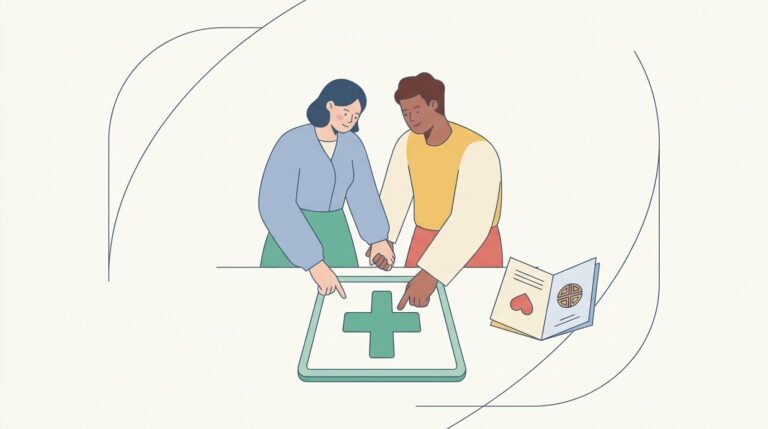
Phase 1: Empathy — The “Real” K-Drama Moments
Hello! I’m your Daily Hangul Editor.
Picture this: You’re watching a classic K-Drama. The couple has overcome disapproving parents, dramatic misunderstandings, and maybe even a surprise amnesia plot. They are finally planning their wedding. But then, the mother-in-law slides a suspicious brown envelope across the cafe table. It’s not a bribe—it’s a demand for a comprehensive medical report.
While real-life Korea is much less dramatic (and definitely less toxic), a modern, highly practical trend has emerged among millennial and Gen Z couples: the 웨딩 검진 (Wedding Checkup).
When preparing for marriage in Korea, it’s no longer just about booking the perfect wedding hall or getting the best Seu-de-me (Studio, Dress, Makeup) package. With couples marrying later in life, pre-marital health checkups and prenatal tests (산전 검사) have become essential steps to ensure a healthy future.
At a C2 (Advanced) level, you aren’t just learning how to say “I am sick.” You need to navigate highly sensitive, nuanced conversations about fertility, genetic history, and family planning with your partner and future in-laws, all while understanding the cultural pragmatism behind it. Let’s dive in!
Phase 2: Core Expressions Deep Dive
1. 웨딩 검진을 받다
- Pronunciation: weding geomjineul batda [Sounds like: wed-ding gum-jin-eul baht-da]
- Meaning: (Literal) To receive a wedding examination. / (Real nuance) To undergo a comprehensive pre-marital health screening.
- K-Culture Moment: You’ll often see ads for these specific “packages” in women’s clinics or urology departments. In a mature relationship, one partner might gently bring this up over a nice dinner after the proposal.
- Editor’s Insight: The word “웨딩” (wedding) softens the clinical coldness of “건강 검진” (health checkup). It frames the medical tests as a romantic, responsible step toward building a life together rather than a suspicious probe into someone’s medical history.
- Situation Spectrum:
- Partner (Intimate): ✅
- Close Friends (Casual sharing): ✅
- Coworkers/Acquaintances: ⚠️ (A bit too personal unless you’re very close)
- 🤔 Think About It: Why do Koreans love packaging things, even medical tests, with English loanwords like “Wedding”? How does this alter the psychological barrier to medical procedures?
2. 2세 계획
- Pronunciation: ise gyehoek [Sounds like: ee-seh gyeh-hwek]
- Meaning: (Literal) Second generation plan. / (Real nuance) Family planning / Plans to have children.
- K-Culture Moment: When meeting the future in-laws for the first time, an elder might delicately ask, “두 사람, 2세 계획은 어떻게 되니?” (What are your plans for children?).
- Editor’s Insight: Unlike the blunt “아기 낳을 거야?” (Are you going to have a baby?), “2세 계획” is highly respectful and intellectual. It acknowledges that having children is a shared, structured plan rather than just a biological event.
- Situation Spectrum:
- In-laws/Elders (Formal): ✅
- Doctors (Professional): ✅
- Friends (Casual): ⚠️ (Usually, friends just say “애기 언제 가질 거야?”)
- 🤔 Think About It: The term “2세” implies a continuation of lineage. Does your native language have an equally formal, lineage-focused term for having kids, or is it more individually focused?
3. 산전 검사
- Pronunciation: sanjeon geomsa [Sounds like: sahn-jeon gum-sah]
- Meaning: (Literal) Pre-birth examination. / (Real nuance) Prenatal screening / Pre-pregnancy checkup.
- K-Culture Moment: Many newlywed couples visit the local 보건소 (Public Health Center) because the Korean government provides free or highly subsidized sanjeon geomsa to encourage childbirth.
- Editor’s Insight: This isn’t just for women. Modern Korean culture heavily emphasizes that men must also undergo this checkup. It’s a sign of a progressive, supportive husband.
- Situation Spectrum:
- Partner/Doctor: ✅
- In-laws: ✅
- Boss/Coworkers: 🚫 (Too invasive)
Phase 3: Textbook vs. Real Korean
[Suggesting a checkup to your partner]
* 📖 Textbook Korean: 우리 결혼 전에 건강 검진을 하러 병원에 갑시다. (Let’s go to the hospital for a health checkup before we marry.)
* 🗣️ Real Korean: 우리 슬슬 웨딩 검진 예약할까? 보건소 혜택도 알아보고. (Shall we slowly book our wedding checkup? And look into the health center benefits too.)
* 💡 Why the difference?: The word “슬슬” (slowly/leisurely) is a magic word in Korean. It removes the pressure and makes a serious suggestion feel natural and unforced.
[Discussing fertility / having kids]
* 📖 Textbook Korean: 우리는 아이를 가질 계획이 당분간 없습니다. (We do not have plans to have a child for the time being.)
* 🗣️ Real Korean: 2세 계획은 천천히 생각하려고요. 일단은 저희 생활에 집중하고 싶어요. (We’re planning to think about a second generation slowly. For now, we want to focus on our life together.)
* 💡 Why the difference?: Direct refusal or definitive negative statements can sound harsh to older Koreans. Using “천천히 생각하다” (think about it slowly) is the polite, culturally accepted way to say “Not right now.”
Phase 4: Cultural Context — K-Culture Deep Dive
4-1. Non-Verbal Nuances: The Art of “Nunchi” in Medical Talk
Bringing up medical history or fertility is a minefield. You must use high-level 눈치 (Nunchi). Do not bring this up when your partner is stressed from work or during an argument. It should be brought up collaboratively. A great physical gesture is looking at a shared screen (like a tablet showing a clinic’s website) rather than intense, interrogative eye contact. Sit beside them, not across from them.
4-2. The K-Drama vs. Real-Life Disconnect
In K-Dramas, medical issues are weaponized for plot twists. A chaebol heir’s hidden illness, or a mother-in-law throwing a glass of water because the bride is infertile.
However, in real, modern Korea, the “웨딩 검진” is viewed as the ultimate act of romance and responsibility. It says, “I love you enough to ensure we are physically prepared for our future, and I am transparent with you.” Furthermore, due to Korea’s highly efficient and accessible healthcare system, booking a comprehensive screening (which includes blood work, ultrasounds, and genetic testing) can be done on a smartphone in minutes, and the couple often makes a “clinic date” out of it, followed by a nice brunch.
Phase 5: Real-Life Roleplay Scenario
Setting: A quiet, minimalist cafe in Cheongdam-dong. It’s Sunday afternoon. You and your Korean fiancé, Ji-hoon, have just finished a grueling 2-hour meeting with your wedding planner. You are sipping iced Americanos. It’s time to bring up the practical matters.
Characters:
– YOU: An expat professional living in Seoul, engaged to Ji-hoon. You want to ensure everything is transparent before the big day.
– Ji-hoon (32): Your fiancé. Practical, loving, but sometimes a bit shy about medical topics.
Dialogue:
YOU: 지훈아, 오늘 스드메(Studio/Dress/Makeup) 예약 끝내니까 진짜 실감 난다, 그치? 💍
(Ji-hun-a, oneul seudeume yeyak kkeunnaenikka jinjja silgam nanda, geuchi?)
[Ji-hoon, now that we’ve finished booking the studio, dress, and makeup, it really feels real, right?]
Ji-hoon: 내 말이. 나 벌써 기 빨려… 근데 자기야, 우리 식장 들어가기 전에 하나 더 남았잖아.
(Nae mari. Na beolsseo gi ppallyeo… Geunde jagiya, uri sikjang deureogagi jeone hana deo namatjana.)
[Tell me about it. My energy is already drained… But honey, we have one more thing left before we walk down the aisle.]
YOU: 응? 신혼여행 티켓팅?
(Eung? Sinhonnyeohaeng tiketting?)
[Huh? Ticketing for the honeymoon?]
Ji-hoon: 아니, 우리 웨딩 검진.
(Ani, uri weding geomjin.)
[No, our wedding checkup.]
YOU: 아, 맞다! 산전 검사도 같이 받을 수 있는 데로 알아볼까?
(A, matda! Sanjeon geomsado gachi badeul su inneun dero arabolkka?)
[Ah, right! Should we look into a place where we can get the prenatal tests together too?]
Ji-hoon: 응, 보건소에서도 기본 검사는 무료로 해준대. 근데 2세 계획 생각하면, 전문 병원 가서 꼼꼼하게 받는 게 낫지 않을까?
(Eung, bogeonsoeseodo gibon geomsaneun muryoro haejundae. Geunde ise gyehoek saenggakamyeon, jeonmun byeongwon gaseo kkomkkomhage banneun ge natji aneulkka?)
[Yeah, I heard the public health center does basic tests for free. But considering our family plans, wouldn’t it be better to go to a specialized clinic and get checked thoroughly?]
🔀 Your Turn! How do you respond to Ji-hoon?
– A) “아니, 난 건강해서 안 받아도 돼! 너나 받아.” (No, I’m healthy so I don’t need it! You get it.)
– B) “그래, 우리 미래를 위해서 같이 가서 싹 다 검사받자! 예약은 내가 알아볼게.”
– C) “나 무서워… 병원 꼭 가야 돼?”✅ Best Choice: B — Reason: It shows mutual responsibility and partnership. Using “싹 다” (all of it / entirely) adds a native, comfortable vibe to taking care of everything efficiently.
⚠️ Choice A Analysis: This is a major red flag in Korean wedding prep! Refusing the test can imply you are hiding something, and saying “너나 받아” (You do it) is incredibly rude.
Phase 6: 10-Second Shadowing Drill
Practice this sentence to sound incredibly natural and thoughtful when bringing up the topic with your partner.
😊 우리 / 이번 주말에 / 보건소 가서 / 웨딩 검진 알아볼까?
(uri / ibeon jumare / bogeonso gaseo / weding geomjin arabolkka?)
Emotion: Gentle, supportive, and collaborative.
Tip: Pause slightly at the slashes (/). The tone should go UP slightly at the end to make it a soft suggestion, not a command.
Phase 7: K-Culture Mini Dictionary
1. 스드메 (Seu-de-me)
* Romanization: seudeume
* English: Studio, Dress, Makeup
* Context: The Holy Trinity of Korean wedding prep. Couples usually buy these as a bundled package through a wedding planner.
2. 보건소 (Bogeonso)
* Romanization: bogeonso
* English: Public Health Center
* Context: Government-run health clinics in every district in Korea. They offer incredible benefits for residents, including free prenatal vitamins and subsidized pre-marital tests to boost the birth rate.
3. 눈치 (Nunchi)
* Romanization: nunchi
* English: Emotional intelligence / reading the room
* Context: Crucial when discussing sensitive topics like medical history or when fielding intrusive questions from extended family about your “2세 계획”.
4. 상견례 (Sanggyeollye)
* Romanization: sanggyeollye
* English: The formal meeting between the two families.
* Context: The official kick-off to wedding prep in Korea. This is usually where formal terms like “2세 계획” might subtly be dropped by the parents.
Phase 8: Traveler’s Survival Kit
Even if you aren’t getting married, if you live in or travel to Korea, navigating the highly efficient hospital system is a must. Here are top expressions for medical clinics:
🆘 Survival Expressions for Korean Clinics
– 🇰🇷 “종합 건강 검진을 예약하고 싶어요.” (jonghap geongang geomjineul yeyakago sipeoyo.)
– 🗣️ English: I would like to book a comprehensive health checkup.
– 📍 Where to use: Large hospitals or specialized checkup centers.
– 💡 Pro Tip: Korean “jonghap” (comprehensive) checkups are famous globally for being fast, affordable, and incredibly detailed, often completed in just 3-4 hours!
- 🇰🇷 “결과 지는 언제 나오나요?” (gyeolgwajineun eonje naonayo?)
- 🗣️ English: When will the results come out?
🇰🇷 “외국인 등록증 여기 있습니다.” (oegugin deungnokjeung yeogi itseumnida.)
- 🗣️ English: Here is my Alien Registration Card (ARC).
- 💡 Pro Tip: You need your ARC to get National Health Insurance benefits!
📌 Editor’s Travel Note
– Useful App: ‘똑닥’ (Ttokddak) allows you to book clinic appointments and check wait times from your phone.
– Speed: In Korea,
Frequently Asked Questions (FAQ)
Q: What does "웨딩 검진을 받다" mean in Korean and how do you pronounce it?
A: In Korean, "웨딩 검진을 받다" is pronounced [weding geomjineul batda [Sounds like: wed-ding gum-jin-eul baht-da] and means: (Literal) To receive a wedding examination. / (Real nuance) To undergo a comprehensive pre-marital health screening.
Q: What does "2세 계획" mean in Korean and how do you pronounce it?
A: In Korean, "2세 계획" is pronounced [ise gyehoek [Sounds like: ee-seh gyeh-hwek] and means: (Literal) Second generation plan. / (Real nuance) Family planning / Plans to have children.
Q: What does "산전 검사" mean in Korean and how do you pronounce it?
A: In Korean, "산전 검사" is pronounced [sanjeon geomsa [Sounds like: sahn-jeon gum-sah] and means: (Literal) Pre-birth examination. / (Real nuance) Prenatal screening / Pre-pregnancy checkup.







