

Phase 1: Empathy
Greeting: Hello! I’m your Daily Hangul Editor.
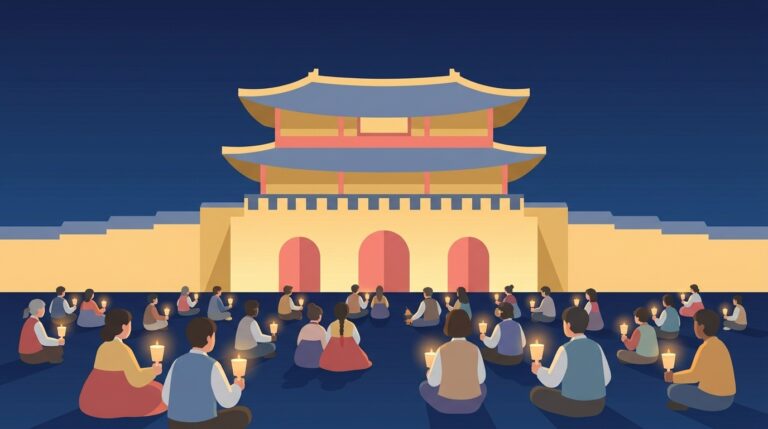
Imagine this: You’re watching a K-Drama like Vincenzo or Itaewon Class, and the underdog protagonists finally rally the citizens together to take down a corrupt mega-corporation. Or perhaps you were visiting Seoul on a chilly Saturday evening in recent years, stepping out of Gwanghwamun Station only to be met with a sea of millions of people holding paper cups with flickering candles. There’s no rioting, no violence—just a massive crowd singing iconic K-Pop and folk songs, sharing hot packs, and later, meticulously picking up their own trash.
At a C1 level, you already know the basic words for ‘politics’ or ‘society.’ But to truly understand the modern Korean soul, you need to understand the language of the ‘Square’ (광장). Why are Koreans so passionate about peaceful protests? How did a simple candle become the ultimate symbol of democracy?
If you want to move beyond textbook Korean and discuss social issues with your Korean friends like a true insider, you need the right vocabulary. This guide is crafted from real questions asked by expats who were baffled—and then deeply moved—by Korea’s unique protest culture.
Phase 2: Core Expression Deep Dive
Let’s explore the sophisticated vocabulary used to discuss civic consciousness in Korea.
1. 촛불을 들다
- Pronunciation: [chotbureul deulda] + [chot-boo-reul deul-da]
- Meaning: Literal: To hold a candle. Real nuance: To participate in a peaceful protest or demand democratic change.
- K-Culture Moment: You’ll hear this in news broadcasts or serious K-Dramas when citizens are mobilizing. “결국 시민들이 촛불을 들었습니다” (In the end, the citizens held up candles).
- Editor’s Insight: This isn’t just a physical action; it’s a profound metaphor for peaceful resistance. The candle represents a small, fragile light that, when gathered together, can dispel overwhelming darkness.
- Situation Spectrum:
- Casual discussions with friends: ✅
- Debates with colleagues (Semi-formal): ✅
- Professional news/Academic settings (Formal): ✅
- 🤔 Think About It: Fire is often seen as destructive, but in Korea, a candle (촛불) signifies peace and unity. How are protests symbolized in your home country?
2. 목소리를 보태다
- Pronunciation: [moksorireul botaeda] + [mok-so-ri-reul bo-tae-da]
- Meaning: Literal: To add one’s voice. Real nuance: To lend one’s support to a cause or movement.
- K-Culture Moment: When K-Pop idols or actors subtly show support for a social campaign on Instagram, netizens might say, “선한 영향력으로 목소리를 보탰다” (They added their voice through positive influence).
- Editor’s Insight: Koreans value collective action. You aren’t just ‘speaking out’ as an individual; you are ‘adding’ (보태다) your voice to a larger, unified chorus.
- Situation Spectrum:
- Casual: ✅
- Semi-formal: ✅
- Formal: ✅
- 🤔 Think About It: The verb 보태다 (to add/supplement) implies that a movement is incomplete without collective participation. How does this reflect the Korean concept of Uri (우리/We)?
3. 성숙한 시민 의식
- Pronunciation: [seongsukan simin uisik] + [seong-soo-kan shi-min eui-shik]
- Meaning: Literal: Mature civic consciousness. Real nuance: Advanced, responsible behavior by citizens (e.g., maintaining order, cleaning up after a massive rally).
- K-Culture Moment: If a massive K-Pop concert ends and fans clean up the stadium flawlessly, reporters will praise the fandom’s “성숙한 시민 의식.”
- Editor’s Insight: This is the ultimate compliment for a group in Korea. It shows that people are not just demanding rights, but also fulfilling their social duties with respect and order.
- Situation Spectrum:
- Casual: ⚠️ (A bit too formal for a pub chat)
- Semi-formal: ✅
- Formal: ✅
- 🤔 Think About It: Why is ‘maturity’ (성숙함) the adjective used to describe good civic behavior in Korea?
Phase 3: Textbook vs. Real Korean
As an advanced learner, it’s time to swap out rigid vocabulary for nuanced, native-like expressions.
[Describing Social Participation]
* 📖 Textbook Korean: 저는 그 시위를 지지합니다. (I support that protest.)
* 🗣️ Real Korean: 저도 뜻을 함께하고 있어요. (I am also sharing their will/joining forces.)
* 💡 Why the difference?: “뜻을 함께하다” is a sophisticated, emotionally resonant way to express solidarity without sounding overly militant or political.
[Describing a Massive Gathering]
* 📖 Textbook Korean: 광장에 사람들이 아주 많습니다. (There are very many people in the square.)
* 🗣️ Real Korean: 광장에 촛불의 물결이 일었습니다. (A wave of candles has risen in the square.)
* 💡 Why the difference?: Korean news and literature love poetic imagery. Describing millions of candles as a “wave” (물결) captures the overwhelming, moving nature of the event.
Phase 4: Cultural Context — K-Culture Deep Dive
4-1. Non-verbal Cues: The Art of the ‘Cultural Festival’ (문화제)
In Korea, candlelight protests are rarely chaotic. Because of strict assembly laws, many large protests are legally registered as ‘Cultural Festivals’ (문화제). Thus, the non-verbal atmosphere is incredibly unique. People sit neatly on padded mats, hold their candles (or smartphone flashlights) in both hands, and wave them to the rhythm of acoustic folk songs. The Nunchi (눈치) here involves matching the solemn yet hopeful vibe—it’s not about angry screaming, but about showing unified, undeniable presence.
4-2. The K-Drama Connection: The Power of the Collective
Have you noticed how Korean dramas often resolve their plots? In Western media, a lone superhero usually saves the day. In K-Dramas (think The Fiery Priest or Chief Kim), the climax almost always involves ordinary citizens, office workers, or neighborhood shop owners banding together to form an unstoppable force. This trope is a direct reflection of Korea’s modern history, where democratization was achieved not by a single savior, but by the relentless, collective candlelight of the masses.
Phase 5: Real-Life Roleplay Scenario
Let’s put you in the scene.
Setting: Saturday evening, 7:00 PM. You and your Korean coworkers just stepped out of a restaurant near Gwanghwamun. The main roads are completely blocked off by police buses. Ahead of you, hundreds of thousands of people are sitting in the streets, holding LED candles, listening to a speaker on a massive stage.
Characters:
– YOU: An expat professional living in Seoul, familiar with Korean culture but witnessing a mega-rally for the first time.
– Min-su (34): Your passionate, slightly dramatic Korean colleague.
Dialogue:
Min-su: 와, 오늘 인파 장난 아니네요. 촛불 집회 규모가 역대급인데요?
(Wa, oneul inpa jangnan anineyo. Chotbul jiphoe gyumoga yeokdaegeubindeyo?)
(Wow, the crowd today is no joke. The scale of this candlelight rally is record-breaking, isn’t it?)
YOU: 그러게요. 저는 이렇게 큰 시위는 처음 봐요. 그런데 생각보다 되게 평화롭네요?
(Geureogeyo. Jeoneun ireoke keun siwineun cheoeum bwayo. Geureonde saenggakboda doege pyeonghwaromneyo?)
(I know, right? I’ve never seen a protest this big. But it’s much more peaceful than I expected?)
Min-su: 한국에서는 이걸 단순한 시위가 아니라 ‘축제’나 ‘문화제’처럼 생각하거든요. 다들 자발적으로 나온 거예요.
(Hangugeseoneun igeol dansunhan siwiga anira ‘chukje’na ‘munhwaje’cheoreom saenggakageodeunyo. Dadeul jabaljeogeuro naon geoyeyo.)
(In Korea, we don’t just consider this a protest, but more like a ‘festival’ or ‘cultural event’. Everyone came out voluntarily.)
YOU: 아, 그래서 저기 무대에서 노래도 부르고 있는 거군요.
(A, geuraeseo jeogi mudaeseo noraedo bureugo inneun geogunyo.)
(Ah, so that’s why they are singing on that stage over there.)
Min-su: 맞아요. 이따가 집회 끝나면 사람들이 쓰레기도 다 치우고 갈 걸요? 시민 의식이 진짜 많이 성숙해졌어요.
(Majayo. Ittaga jiphoe kkeunnamyeon saramdeuri sseuregido da chiugo gal geollyo? Simin uisigi jinjja mani seongsukaejyeosseoyo.)
(Exactly. Later when the rally is over, people will probably clean up all the trash before they leave. Our civic consciousness has truly matured a lot.)
🔀 Your Turn! How do you respond?
– A) “아, 쓰레기를 치우다니 대단하네요.” (Ah, cleaning up the trash is amazing.)
– B) “진짜 멋지네요. 작은 촛불이 모여서 큰 힘을 만드는 것 같아요.” (That’s truly cool. It seems like small candles gathering together create a great power.)
– C) “저도 당장 가서 촛불을 들어야겠어요!” (I should go grab a candle right now!)✅ Best Choice: B — This option beautifully incorporates the metaphor of the candlelight, showing your deep, C1-level understanding of the cultural nuance. Min-su will be incredibly impressed.
⚠️ Choice C Analysis: While enthusiastic, if you are on a certain visa in Korea (like E-2 or D-2), participating in political protests is technically illegal. It’s safer for expats to observe and appreciate the culture from a slight distance!
Phase 6: 10-Second Shadowing Drill
Master the intonation and emotional weight of this beautiful C1 expression.
😌 작은 촛불이 / 모여서 / 🥺 큰 기적을 / 만들었어요.
(jageun chotburi / moyeoseo / keun gijeogeul / mandeureosseoyo.)
(Small candles gathered to create a great miracle.)
Phase 7: K-Culture Mini Dictionary
1. 촛불 집회
* Romanization: chotbul jiphoe
* English: Candlelight rally
* Context: The hallmark of modern Korean protests. It represents peaceful, democratic resistance by ordinary citizens.
2. 광장 민주주의
* Romanization: gwangjang minjujuui
* English: Square democracy
* Context: A political science term used often in Korean news. It refers to direct democratic action taking place in public squares (like Gwanghwamun) when representative institutions fail.
3. 시민 의식
* Romanization: simin uisik
* English: Civic consciousness / Civic pride
* Context: Used to describe public etiquette, collective responsibility, and the moral compass of the general public.
4. 떼창
* Romanization: ttechang
* English: Sing-along
* Context: Usually associated with K-Pop concerts, this phenomenon also happens at rallies where hundreds of thousands sing protest anthems or folk songs in perfect unison.
Phase 8: Traveler’s Survival Kit
If you are traveling in Seoul, particularly on weekends near City Hall, Gwanghwamun, or Jongno, you will encounter massive rallies. Here’s how to navigate them.
🆘 Survival Expressions for Detours
– 🇰🇷 “기사님, 오늘 시위 때문에 이쪽 길이 통제됐나요?” (gisanim, oneul siwi ttaemune ijjok giri tongjedaennayo?)
– 🗣️ English: “Driver, is this road blocked off today due to the protests?”
– 📍 Where to use: In a taxi when traffic is at a standstill.
– 💡 Pro Tip: Look out for signs at bus stops that say 우회 운행 (Detour operation). During weekend rallies, buses completely bypass the Gwanghwamun area.
📌 Editor’s Travel Note
– Navigation Apps: KakaoMap and Naver Map provide real-time traffic updates and will show you if roads are marked red (blocked) due to 집회 (rallies).
– Subway is King: On Saturday afternoons in central Seoul, abandon buses and taxis. The subway is your only reliable option.
– Safety: These rallies are incredibly safe and highly policed for crowd control. You don’t need to feel threatened, but be prepared for loud noises and massive crowds.
Phase 9: Critical Thinking Corner — “One Step Deeper”
🧠 Think Deeper: Language & Power (The Evolution of ‘Uri’)
You probably learned early on that Koreans use “우리” (Uri / We) instead of “내” (My)—like “우리 엄마” (our mom) or “우리 나라” (our country). This deep-seated collectivism is often stereotyped as just conforming to the group. However, the candlelight protests show the incredible, democratic power of Uri. In the political sphere, this collective mindset mobilizes millions to protect shared values. They don’t protest as angry individuals demanding personal rights; they protest as “우리 시민” (we citizens) protecting “우리 사회” (our society). The peaceful nature of the protests is rooted in the belief that even the police and the opposing side are part of Uri.💬 Your Turn: Does your home country have a culture of massive, peaceful protests? How does individualistic vs. collectivistic language affect how people demand political change? Let us know in the comments!
Phase 10: FAQ & Preventing Misunderstandings
Q: Can foreigners participate in candlelight rallies?
A: Legally, be very careful. According to Korean immigration law, foreigners on certain visas (like E-2 English teachers, D-2 students) are prohibited from engaging in political activities. While observing from the sidelines is fine, actively holding a sign or marching could jeopardize your visa status.
Q: Is it safe to wear politically colored clothing around City Hall?
A: In Korea, political parties are heavily associated with colors (e.g., Red for conservatives, Blue for liberals). During election seasons or massive rallies, wearing a bright red or bright blue jacket in protest zones might make people assume you are part of a specific group!
❌ Common Mistake #1: Calling it a ‘폭동’ (Riot).
✅ Do this instead: Always use ‘시위’ (Protest) or ‘집회’ (Rally). Using the word riot for peaceful protests is highly offensive to Koreans who take pride in their non-violent democratic achievements.
Phase 11: Summary & Action Items
One-Liner Summary: Korea’s candlelight protests (촛불 집회) are the ultimate manifestation of the nation’s mature civic consciousness (성숙한 시민 의식) and collective solidarity.
Action Mission 3 Steps:
– 🥉 Bronze (Solo): Practice saying “성숙한 시민 의식” three times out loud, focusing on the sophisticated nuance.
– 🥈 Silver (Online): Find a Korean news clip on YouTube about a recent ‘촛불 집회’ and leave a supportive comment in Korean.
– 🥇 Gold (Real World): The next time a Korean friend mentions social issues, try saying, “작은 촛불이 모여서 큰 기적을 만드는 것 같아요” (Small candles gather to make a big miracle).
🎬 K-Culture Mission:
To truly understand the blood, sweat, and tears that led up to today’s peaceful candlelight rallies, watch the Korean movies “1987: When the Day Comes” or “A Taxi Driver”. You’ll realize why modern Koreans cherish their right to protest peacefully in the square!
Engagement: Which K-Drama scene involving a massive citizen rally gave you the most goosebumps? Drop the title below!
Phase 12: Quiz — Interactive Challenge
1. Situational Judgment: You are watching a news report about thousands of citizens gathering peacefully in Gwanghwamun to demand change. Which C1-level phrase best describes this?
* A) 시민들이 폭동을 일으켰습니다.
* B) 시민들이 촛불을 들었습니다.
* C) 시민들이 불만을 표현했습니다.
2. True or False – K-Culture Edition:
Foreigners on any visa can freely join political marches and hold protest signs in Korea without legal repercussions. (T/F)
3. Fill in the Blank:
어제 콘서트 끝나고 팬들이 쓰레기를 다 치우고 갔어. 정말 대단한 [ ]이야.
(Yesterday after the concert, fans cleaned up all the trash. What an amazing ________.)
👀 Click here for Answers!
1. B (A means ‘started a riot’ which is incorrect and offensive. C is too basic. B captures the cultural nuance of peaceful protesting.)
2. False (Foreigners on non-permanent/non-marriage visas like E-2 or D-2 are generally restricted from political activities under immigration law.)
3. 시민 의식 (Civic consciousness / Civic pride)
Frequently Asked Questions (FAQ)
Q: What does "촛불을 들다" mean in Korean and how do you pronounce it?
A: In Korean, "촛불을 들다" is pronounced [chotbureul deulda] and means: Literal: To hold a candle. Real nuance: To participate in a peaceful protest or demand democratic change.
Q: What does "목소리를 보태다" mean in Korean and how do you pronounce it?
A: In Korean, "목소리를 보태다" is pronounced [moksorireul botaeda] and means: Literal: To add one's voice. Real nuance: To lend one's support to a cause or movement.
Q: What does "성숙한 시민 의식" mean in Korean and how do you pronounce it?
A: In Korean, "성숙한 시민 의식" is pronounced [seongsukan simin uisik] and means: Literal: Mature civic consciousness. Real nuance: Advanced, responsible behavior by citizens (e.g., maintaining order, cleaning up after a massive rally).







