

Phase 1: Empathy & The “Beautiful Lie”
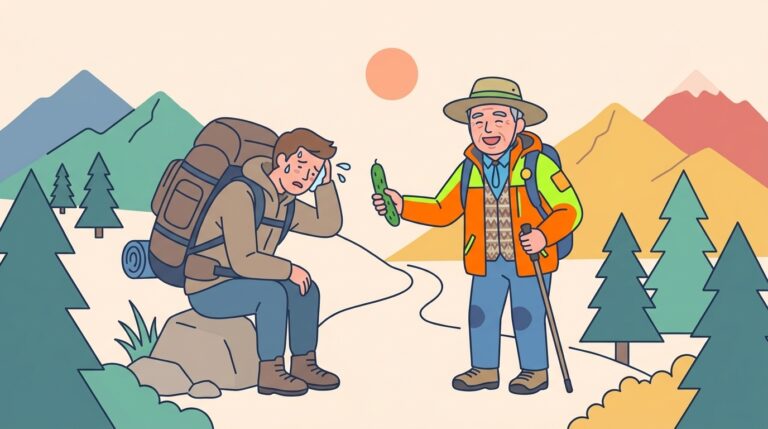
Hello! I’m your editor at Daily Hangul, your local friend and Korean tutor. Picture this: It’s a crisp Sunday morning in Seoul. You decided to hike Bukhansan Mountain because you saw it in a K-Drama and thought, “How hard can it be?” Two hours later, your legs are shaking, your water bottle is empty, and you are desperately looking for the peak.
You spot a friendly Korean man in fluorescent, high-tech hiking gear. You gather your remaining breath and ask in Korean, “How much further?” He flashes a warm smile and says, “Almost there! Just five more minutes!” You feel a rush of hope. But 30 minutes later, you are still climbing.
Welcome to the greatest, most loving lie in Korean hiking culture! If you don’t know the cultural context behind this phrase, you might feel betrayed. But once you understand it, you’ll realize it’s a beautiful piece of Korean empathy. Let’s learn the survival phrases you need for your next K-Hiking adventure!
Phase 2: Core Expressions Deep Dive
1. 정상까지 얼마나 걸려요?
- Pronunciation: [jeongsang-kkaji eolmana geollyeoyo?] (jeong-sang sounds like “jong-sang”, geol-lyeo-yo sounds like “gull-yuh-yo”)
- Meaning: How long does it take to get to the top? (Literal & Real nuance)
- K-Culture Moment: This is the ultimate survival question. Whether you are climbing Namsan Tower stairs or Seoraksan Mountain, you will hear people panting and asking this to anyone coming down the trail.
- Editor’s Insight: “얼마나 걸려요?” (How long does it take?) is a magical A1 phrase. You can use it anywhere—subways, restaurants, or waiting for a BTS concert to start!
- Situation Spectrum:
- Casual (Friends): ✅ (얼마나 걸려? – Drop the ‘요’)
- Semi-formal (Strangers on trail): ✅
- Formal (Boss): ⚠️ (Better to ask: 얼마나 걸릴까요?)
- 🤔 Think About It: Why do we ask “how much time it takes” rather than “how many kilometers”? In mountainous Korea, 1 kilometer uphill can take an hour!
2. 다 왔어요!
- Pronunciation: [da wasseoyo!] (sounds like “dah wah-ssuh-yo”)
- Meaning: Literal: “We all came.” / Real nuance: “We’re almost there!” or “You’ve arrived!”
- K-Culture Moment: You will hear this everywhere in Korea. Parents say it to crying kids in the back seat. Friends say it when they are actually 10 minutes late. And hikers say it when the peak is still 40 minutes away.
- Editor’s Insight: It’s not a malicious lie! It’s an expression of encouragement. They want to give you hope.
- Situation Spectrum:
- Casual (Friends): ✅
- Semi-formal (Strangers): ✅
- Formal (Boss): ✅
- 🤔 Think About It: Why do Koreans use the past tense (“came”) when you haven’t arrived yet? It implies the goal is so close that it’s practically already achieved!
3. 조금만 더 가면 돼요.
- Pronunciation: [jogeum-man deo gamyeon dwaeyo.] (jo-geum sounds like “joe-goom”)
- Meaning: You just need to go a little bit further.
- K-Culture Moment: The classic combo! A Korean hiker will say, “다 왔어요! 조금만 더 가면 돼요!” (Almost there! Just a little further!).
- Editor’s Insight: When a Korean hiker says “a little bit,” multiply it by 3.
Phase 3: Textbook vs. Real Korean
[Asking the Distance]
* 📖 Textbook Korean: 산의 정상까지 몇 분 남았습니까? (How many minutes remain until the mountain’s peak?)
* 🗣️ Real Korean: 정상까지 얼마나 걸려요? (How long to the top?)
* 💡 Why the difference?: The textbook version sounds like a news reporter interviewing a geologist. The real phrase is natural, versatile, and soft.
[Expressing Exhaustion]
* 📖 Textbook Korean: 저는 지금 매우 지쳤습니다. (I am very exhausted right now.)
* 🗣️ Real Korean: 아휴, 힘들어 죽겠어요! (Ah-hyu, I’m going to die from tiredness!)
* 💡 Why the difference?: Koreans love dramatic expressions! Adding “~죽겠어요” (going to die) is a fun, highly common way to express extreme emotion, even for beginners.
Bottom Note: For A1 beginners, simply saying “너무 힘들어요!” (neomu himdeureoyo! – It’s too hard!) with a cute, tired face is perfect. Strangers will instantly offer you snacks out of pity!
Phase 4: Cultural Context — K-Culture Deep Dive
4-1. Non-Verbal Communication: The Mountain Snack Offering
If you look exhausted on a Korean mountain, a middle-aged hiker (Ajusshi or Ajumma) might suddenly hand you a mini cucumber (오이), a cherry tomato, or a piece of chocolate. Do not panic! This is pure Korean Jeong (정 – warm affection/connection). Accept it with two hands, bow slightly, and say “감사합니다!” (Thank you!). Eating a hydrating cucumber on a hike is a massive part of Korean outdoor culture.
4-2. K-Drama Trope: The Dreaded Corporate Hike
Have you ever watched a K-Drama where the office workers look miserable on a weekend? That’s the notorious “주말 등산” (Weekend Company Hike). In the past (and sometimes still today), enthusiastic bosses would force their team to bond by climbing a mountain on a Saturday morning, followed by drinking Makgeolli (rice wine) and eating Pajeon (green onion pancake) at the bottom. The workers smile and say “다 왔어요, 부장님!” (We’re almost there, Boss!), but inside, they are crying.
Phase 5: Interactive Roleplay Scenario
- Setting: Sunday morning, Bukhansan Mountain. You are sweating buckets, holding onto a rock for dear life. You see a Korean local coming down the trail looking completely refreshed.
- Characters:
- YOU: A foreigner in Seoul, regretting your life choices.
- Ajusshi (Local Hiker): 55 years old, wearing a neon yellow jacket, holding hiking poles.
Ajusshi: (Smiles brightly) 안녕하세요!
(annyeonghaseyo!)
[Hello!]
YOU: (Panting) 헉헉… 안녕하세요.
(heokheok… annyeonghaseyo.)
[Pant, pant… Hello.]
YOU: 저기요… 정상까지 얼마나 걸려요?
(jeogiyo… jeongsang-kkaji eolmana geollyeoyo?)
[Excuse me… how long does it take to get to the top?]
Ajusshi: 에이~ 다 왔어요! 5분! 5분!
(ei~ da wasseoyo! obun! obun!)
[Ey~ You’re almost there! 5 minutes! 5 minutes!]
🔀 Your Turn! How do you respond to his “5 minutes”?
* A) “아, 5분요? 감사합니다!” (Ah, 5 minutes? Thank you!) – Polite and safe.
* B) “진짜요? 너무 힘들어요 ㅠㅠ” (Really? It’s so hard T_T) – Honest and invites sympathy.
* C) “거짓말! (Liar!)” – Too aggressive for a stranger!✅ Best Choice: B — If you say this, Korean Ajusshis will activate their “parent mode” and cheer you on!
(Assuming you chose B)
YOU: 진짜요? 너무 힘들어요…
(jinjja-yo? neomu himdeureoyo…)
[Really? It’s so hard…]
Ajusshi: 하하하! 조금만 더 가면 돼요. 자, 이거 먹어요.
(hahaha! jogeum-man deo gamyeon dwaeyo. ja, igeo meogeoyo.)
[Hahaha! Just go a little bit more. Here, eat this.]
(🎭 Stage Direction: He hands you a fresh cucumber from his backpack)
YOU: 우와, 오이! 감사합니다! 잘 먹겠습니다.
(uwa, oi! gamsahamnida! jal meokgetseumnida.)
[Wow, a cucumber! Thank you! I will eat it well.]
Ajusshi: 네, 파이팅!
(ne, paiting!)
[Yes, fighting! (You can do it!)]
YOU: 네! 파이팅!
(ne! paiting!)
[Yes! Fighting!]
Phase 6: 10-Second Shadowing Drill
Practice this out loud so you sound totally natural on the mountain!
- 😢 저기요… / 정상까지 / 얼마나 / 걸려요?
(jeogiyo… / jeongsang-kkaji / eolmana / geollyeoyo?)
[Tone: Exhausted, desperate for good news] - 😊 다 왔어요! / 조금만 더 / 가세요!
(da wasseoyo! / jogeum-man deo / gaseyo!)
[Tone: Cheerful, energetic, slightly lying]
Phase 7: K-Culture Mini Dictionary
1. 아저씨 / 아줌마
* Romanization: ajeossi / ajumma
* English: Middle-aged man / Middle-aged woman
* Context: The absolute rulers of Korean mountains. Often seen in groups, sharing elaborate packed lunches at the peak.
2. 등산복
* Romanization: deungsanbok
* English: Hiking clothes
* Context: Koreans take hiking gear very seriously. You will see people equipped for Mt. Everest even on a 200-meter local hill. Neon colors are highly favored!
3. 파이팅
* Romanization: paiting (Fighting)
* English: You can do it! / Cheer up!
* Context: Konglish word used universally to encourage someone. Hikers yell this to passing strangers all the time.
4. 막걸리
* Romanization: makgeolli
* English: Korean traditional rice wine
* Context: The ultimate reward after a hike. It is milky, fizzy, and usually paired with savory pancakes at restaurants located at the base of the mountain.
Phase 8: Traveler Survival Kit (Hiking & Moving Around)
These phrases are your lifeline when navigating Seoul, whether on a mountain or in the subway!
🆘 Survival Expression #1: Asking the Time
* 🇰🇷 “여기서 얼마나 걸려요?” (yeogiseo eolmana geollyeoyo?)
* 🗣️ English meaning: How long does it take from here?
* 📍 Where to use: Asking a local how far the subway station or tourist spot is.🆘 Survival Expression #2: Expressing Need
* 🇰🇷 “잠깐만 쉴게요.” (jamkkan-man swilgeyo.)
* 🗣️ English meaning: I will rest for just a moment.
* 📍 Where to use: When your friend is walking too fast in Myeongdong.🆘 Survival Expression #3: The Emergency Stop
* 🇰🇷 “화장실 어디 있어요?” (hwajangsil eodi isseoyo?)
* 🗣️ English meaning: Where is the restroom?
* 📍 Where to use: Literally everywhere. (Pro tip: Look for public restrooms at trailheads before you start climbing!)
📌 Editor’s Travel Note:
* Helpful Apps: Do NOT use Google Maps for walking/hiking in Korea. Download Naver Map or KakaoMap. They even show hiking trail paths!
* Hydration: Bring your own water. There are rarely vending machines halfway up a Korean mountain.
Phase 9: Critical Thinking — “One Step Deeper”
🧠 Think Deeper: Language & Empathy (The Beautiful Lie)
Why do Koreans knowingly “lie” about the distance to the peak? In Korean culture, this isn’t considered deception; it’s considered Nunchi (reading the room) and Jeong (affection). If a hiker is struggling, telling them “You still have 2 hours left” might break their spirit. Instead, “Almost there!” provides a psychological boost. The priority of the language here is not factual accuracy, but emotional support and community encouragement.
💬 Your Turn: Does your culture have a “beautiful lie” to encourage people? How do people cheer each other on during difficult physical tasks in your country? Let me know in the comments!
Phase 10: FAQ & Common Mistakes
- Q: Can I use “다 왔어요” when taking a taxi?
- Yes! If you are in a taxi and see your hotel, you can tell the driver, “기사님, 다 왔어요! 여기서 내려주세요.” (Driver, we are here! Please drop me off here.)
- Q: Can I accept food from strangers on the trail?
- Yes! It’s extremely common. Just make sure to say thank you. If you have a piece of candy to give back, you’ll make their day!
❌ Common Mistake #1: Asking “시간이 뭐예요?” (What is time?) instead of “얼마나 걸려요?” (How long does it take?)
✅ How to fix it: If you want to know duration, ALWAYS use “얼마나 걸려요?”
Phase 11: Summary & Action Items
- One-Liner Summary: When someone asks “얼마나 걸려요?” (How long?), Koreans use “다 왔어요” (Almost there) to give you emotional support!
🔥 Action Mission 3 Steps:
* 🥉 Bronze (Solo): Say “다 왔어요!” out loud next time you finally reach your couch after a long day.
* 🥈 Silver (Online): Post a picture of your next walk or hike on social media with the caption “정상까지 얼마나 걸려요? 🏔️”.
* 🥇 Gold (Real Life): Next time you are in Korea (or at a local Korean market), use “얼마나 걸려요?” to ask how long a wait or a walk is!
- K-Culture Mission: Watch a K-Drama this week. Try to spot a scene where coworkers are forced to go somewhere together on a weekend. Listen closely for “다 왔어요!”
Phase 12: Interactive Quiz
1. You are halfway up a mountain and you are exhausted. You see a hiker coming down. What should you ask?
* A) 화장실 어디 있어요? (Where is the bathroom?)
* B) 정상까지 얼마나 걸려요? (How long to the top?)
* C) 저는 한국을 좋아해요! (I like Korea!)
* Answer: B. (Though A is also valid if it’s a real emergency!)
2. True or False: If a Korean hiker says “다 왔어요” (Almost there), it means you are exactly 1 minute away from the top.
* Answer: False! It’s an expression of encouragement. You might still have 30 minutes left!
3. Fill in the blank: What is the magical word Koreans yell to cheer you on?
* “포기하지 마세요! _______!” (Don’t give up! _______!)
* Answer: 파이팅 (Paiting / Fighting!)
Frequently Asked Questions (FAQ)
Q: What does "정상까지 얼마나 걸려요?" mean in Korean and how do you pronounce it?
A: In Korean, "정상까지 얼마나 걸려요?" is pronounced [jeongsang-kkaji eolmana geollyeoyo?] and means: How long does it take to get to the top? (Literal & Real nuance)
Q: What does "다 왔어요!" mean in Korean and how do you pronounce it?
A: In Korean, "다 왔어요!" is pronounced [da wasseoyo!] and means: Literal: "We all came." / Real nuance: "We're almost there!" or "You've arrived!"
Q: What does "조금만 더 가면 돼요." mean in Korean and how do you pronounce it?
A: In Korean, "조금만 더 가면 돼요." is pronounced [jogeum-man deo gamyeon dwaeyo.] and means: You just need to go a little bit further.







