

Phase 1: Empathy (Immersive Opening)
Hello! This is your Daily Hangul Editor.
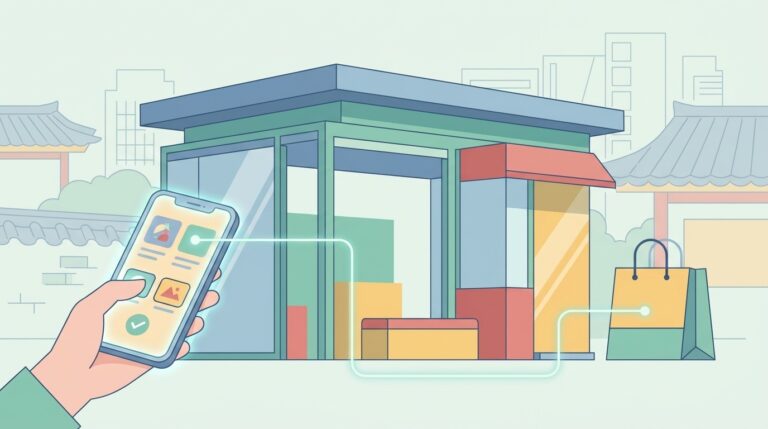
Imagine this: You are standing in the middle of Seongsu-dong, Seoul’s trendiest neighborhood. You spot a brilliant, meticulously designed pop-up store for a popular K-Beauty brand. Eager to check out their new product line, you step toward the entrance. But instead of a simple “Welcome,” the impeccably dressed staff member holding an iPad smiles and says, “고객님, 앱으로 대기 걸어주셨나요?” (Sir/Ma’am, did you put yourself on the waitlist via the app?)
Welcome to the ultra-connected, high-speed ecosystem of South Korean retail. If you are a marketer, a business professional, or an advanced language learner aiming for C2 fluency, knowing how to order a coffee isn’t enough anymore. Korea is a global testbed for Omnichannel Strategy and Customer Experience (CX) Optimization. The line between physical (offline) and digital (online) doesn’t just blur here; it completely vanishes.
Today, we aren’t just learning vocabulary. We are diving deep into the corporate jargon and consumer dialect that drives Korea’s O2O (Online-to-Offline) miracle. If you don’t know these terms, you’ll be left outside the pop-up store—literally and professionally. Let’s decode the matrix of Korean omnichannel CX, based on real experiences from expat marketers navigating Seoul’s retail jungle.
Phase 2: Core Expressions Deep Dive
1. 앱과 연동되다 (aepgwa yeondongdoeda)
- Pronunciation: [aep-gwa yeon-dong-dwe-da] (‘yeon-dong’ sounds like ‘yawn-dong’ spoken briskly)
- Meaning: Literal: To be linked with the app. Real nuance: To be seamlessly synced or integrated across digital platforms.
- K-Culture Moment: You buy a lipstick at an Olive Young physical store, and before you even walk out, your phone buzzes with a KakaoTalk notification. Your purchase history, loyalty points, and a request for a digital review are instantly synced to your CJ ONE app.
- Editor’s Insight: ‘연동 (integration/linkage)’ is the holy grail word for Korean tech and marketing. It signifies that a user’s data flows effortlessly between different touchpoints. When pitching a CX strategy in Korea, if your platforms aren’t ‘연동,’ your strategy is considered obsolete.
- Situation Spectrum:
- 친구 사이(Casual): ⚠️ (Too formal for casual chats, though tech-savvy teens use it)
- 직장 동료(Semi-formal): ✅
- 직장 상사·어른(Formal): ✅
- 🤔 Think About It: Why is ‘연동’ (syncing) so crucial in Korean business culture? It stems from the ‘빨리빨리’ (ppalli-ppalli, hurry-hurry) mindset. Consumers have zero tolerance for lag or data fragmentation. Does your culture expect instant data synchronization to the same degree?
2. 온오프라인 통합 (on-opeurain tonghap)
- Pronunciation: [on-o-peu-ra-in tong-hap]
- Meaning: Literal: Online-offline unification. Real nuance: Omnichannel integration.
- K-Culture Moment: During a boardroom meeting at a Korean fashion brand, the CMO slams her hand on the table (K-Drama style!) and demands a strategy for ‘온오프라인 통합’ because customers are complaining that online coupons can’t be used in physical flagship stores.
- Editor’s Insight: While ‘옴니채널’ (Omnichannel) is widely used, ‘통합’ (unification/consolidation) carries a heavier, more strategic weight. It shows you understand the operational backend required to make the CX smooth.
- Situation Spectrum:
- 친구 사이(Casual): 🚫
- 직장 동료(Semi-formal): ✅
- 직장 상사·어른(Formal): ✅
- 🤔 Think About It: Integrating systems requires breaking down corporate silos. How do rigid hierarchies in traditional Korean conglomerates sometimes clash with the need for this horizontal ‘통합’?
3. 심리스한 경험 (simniseuhan gyeongheom)
- Pronunciation: [sim-ni-seu-han gyeong-heom]
- Meaning: Seamless experience.
- K-Culture Moment: Pitching a new UI/UX design to a client. You explain that using Kakao Pay via biometric scan at a self-checkout kiosk creates a “심리스한 경험.”
- Editor’s Insight: Welcome to the world of Korean corporate Konglish! Instead of using a pure Korean equivalent (like 매끄러운 경험), Korean marketers frequently borrow the English word ‘seamless’ and attach the Korean adjective maker ‘하다’ to it. Using this immediately signals that you are an insider in the Korean marketing ecosystem.
- Situation Spectrum:
- 친구 사이(Casual): 🚫
- 직장 동료(Semi-formal): ✅
- 직장 상사·어른(Formal): ✅
- 🤔 Think About It: Why does Korean business jargon rely so heavily on English loanwords, even when perfectly good Korean words exist? Is it about precision, or does it project an aura of global sophistication?
Phase 3: Textbook vs. Real Korean
[Situation 1: Discussing Customer Pain Points]
* 📖 Textbook Korean: 고객들이 오프라인 매장과 웹사이트를 번갈아 사용하는 것을 불편해합니다. (Customers find it inconvenient to alternate between the physical store and the website.)
* 🗣️ Real Korean: 채널 간 전환에서 고객의 페인포인트(Pain Point)가 발생하고 있습니다. 심리스한 연동이 시급해요. (Pain points are occurring in channel transitions. Seamless syncing is urgent.)
* 💡 Why it’s different: In high-level business environments (C2 level), industry-specific loanwords (채널, 페인포인트) are preferred over descriptive, textbook sentences for efficiency and professional flair.
[Situation 2: Promoting an App in a Physical Store]
* 📖 Textbook Korean: 스마트폰 애플리케이션을 설치하시면 할인을 받을 수 있습니다. (If you install the smartphone application, you can receive a discount.)
* 🗣️ Real Korean: 고객님, 앱 다운받고 바코드 보여주시면 바로 첫 구매 혜택 연동해 드릴게요! (Customer, if you download the app and show the barcode, I’ll instantly sync your first-purchase benefits!)
* 💡 Why it’s different: Service staff use highly abbreviated, action-oriented phrases (다운받고, 연동해 드릴게요) combined with ultra-polite honorifics (고객님, ~드릴게요) to speed up the transaction without sacrificing courtesy.
Bottom Note: At the C2 level, your goal isn’t just correct grammar; it’s adopting the register of a Korean corporate professional. Embrace the strategic use of Konglish in boardrooms, but maintain flawless Korean syntax around it.
Phase 4: Cultural Context — K-Culture Deep Dive
4-1. Non-Verbal Elements of Omnichannel CX
In Korea, the physical execution of O2O is an art form. When presenting a digital barcode for scanning (for loyalty points or app payment), the silent rule is to turn your screen brightness all the way up. Furthermore, handing your phone over with one hand while lightly supporting your elbow with the other demonstrates deep cultural competence (the ‘manner hand’). It’s the intersection of ancient Confucian respect and modern tech convenience.
4-2. The K-Travel & Lifestyle Connection: The “Catch Table” Phenomenon
If you travel to Seoul today, you’ll notice an absence of physical queues outside top-tier restaurants and trendy pop-ups. Enter Catch Table (캐치테이블) or similar waitlist apps.
The ultimate omnichannel experience begins before you even arrive. You secure a virtual spot via the app, receive a KakaoTalk message when there are 3 teams ahead of you, and walk right in.
- Critical Perspective: While this creates a frictionless CX for tech-savvy locals, it creates a massive barrier for tourists or the elderly who lack a Korean phone number or app fluency. This digital divide is currently a hot-topic social issue in Korea.
Phase 5: Real-world Roleplay Scenario
Scenario A: The Pop-up Store Audit
– Setting: Wednesday afternoon, The Hyundai Seoul (a mecca for retail innovation). You are an expat CX consultant touring a newly launched K-Cosmetics pop-up store that merges VR experiences with physical product testing.
– Characters:
– YOU: A sharp, observant CX Marketer analyzing the customer journey.
– Manager Kim (35): The energetic, detail-oriented Korean Store Manager.
Manager Kim: 저희 매장 오프라인 경험 어떠셨나요? 꽤 신경 많이 썼거든요.
(Jeo-hui maejang opeurain gyeongheom eotteosyeonnayo? Kkwae singyeong mani sseotgeodeunyo.)
[Translation] How was our store’s offline experience? We put a lot of effort into it.
(🎭 Stage Direction: Manager Kim gestures toward the interactive digital kiosk.)
YOU: 네, 특히 VR 체험존이 인상적이었습니다.
(Ne, teuki VR cheheomjoni insangjeogieotseumnida.)
[Translation] Yes, the VR experience zone was particularly impressive.
Manager Kim: 다행이네요. 체험 후에 고객들이 바로 구매로 이어지게 하려고 QR 코드를 배치했는데, 전환율이 생각보다 안 나와서 고민입니다.
(Dahaeng-ineyo. Cheheom hue gogaekdeuri baro gumaero ieojige haryeogo QR kodeureul baechihaenneunde, jeonhwanyuri saenggakboda an nawaseo gominimnida.)
[Translation] That’s a relief. We placed QR codes so that customers would immediately proceed to purchase after the experience, but the conversion rate is lower than expected, which is a concern.
🔀 Your Turn! How do you diagnose the CX issue like a local pro?
– A) “QR 코드가 너무 작아서 사람들이 못 보는 것 같습니다.” (Grammatically perfect, but a bit simplistic for a consultant.)
– B) “오프라인 체험과 온라인 앱 연동 사이에 페인포인트가 있는 것 같네요. 심리스하게 넘어가질 않아요.” (Professional, uses the exact corporate jargon.)
– C) “대박! 그럼 앱을 싹 다 뜯어고쳐야겠네요!” (Way too casual and dramatic for a professional audit.)✅ Best Choice: B — Reason: It precisely utilizes the C2-level marketing vocabulary (앱 연동, 페인포인트, 심리스하다) that Korean professionals expect. It shows empathy for the business problem while offering an analytical observation.
Scenario B: The Introvert’s Omnichannel Dream (Bonus)
– Setting: A bustling Starbucks in Gangnam during the morning rush.
– Situation: You use ‘Siren Order’ (사일렌 오더) on your app. You walk in. The barista calls your nickname: “스마일 고객님!” (Customer Smile!). You nod, pick up the drink, and leave without exchanging a single word. Your app automatically deducts payment and adds a digital star. This is the pinnacle of seamless CX—efficiency maximizing personal space.
Phase 6: 10-Second Shadowing Drill
Master the confident, persuasive tone of a Korean marketing director!
😤 오프라인 매장의 / 경험이 / 온라인으로 / 심~리스하게 / 연동되어야 합니다.
(o-peu-ra-in mae-jang-ui / gyeong-heo-mi / on-na-i-neu-ro / sim~ni-seu-ha-ge / yeon-dong-doe-eo-ya ham-ni-da.)
(The offline store’s experience must be seamlessly synced online.)
Phase 7: K-Culture Mini Dictionary
1. 옴니채널 (omni-chaeneol)
* English: Omnichannel
* Context: The overarching buzzword in Korean retail. It’s not just multichannel; it’s about breaking down walls so the consumer feels no friction between swiping an app and walking down an aisle.
2. 팝업 성지 (pabeop seongji)
* English: Pop-up holy land (mecca)
* Context: Used to describe areas like Seongsu-dong or Yeouido (The Hyundai) where brands test their wildest omnichannel CX experiments. ‘성지’ means a place you must make a pilgrimage to.
3. 전환율 (jeonhwanyul)
* English: Conversion rate
* Context: A crucial metric in K-Marketing. If a brilliant offline pop-up doesn’t result in a high ‘전환율’ (getting people to buy or download), it’s considered a beautiful failure.
4. 오늘드림 / 퀵커머스 (oneul-deurim / kwik-keomeoseu)
* English: Today Dream (Olive Young’s service) / Quick Commerce
* Context: The ultimate fulfillment of omnichannel. Ordering on your commute and having the physical product waiting at your door before you finish dinner.
Phase 8: Traveler (and Expat) Survival Kit
Even as a C2 master, applying these concepts in everyday life in Korea is essential.
🆘 Survival Expressions for the Omnichannel Consumer
– 🇰🇷 “이거 온오프라인 통합 포인트 적립 되나요?” (igeo on-opeurain tonghap pointeu jeongnip doenayo?)
– 🗣️ Meaning: Can I earn integrated online/offline points for this?
– 📍 Where to use: Department stores, cosmetics shops, large franchises.
– 💡 Pro Tip: Whenever you buy something, have the brand’s app open. Cashiers assume you want to sync your purchase.📌 Editor’s Lifestyle Note
– The Phone Number Barrier: Korean omnichannel CX relies heavily on identity verification via a Korean mobile number. If you are a short-term visitor, you might hit a wall when trying to use waitlist apps or earn points.
– Digital Receipts: You will often be asked, “스마트 영수증으로 발급해 드릴까요?” (Shall I issue a smart receipt?). Say “네” (Yes), and it will automatically go to your app, saving paper.
Phase 9: Critical Thinking Corner — “One Step Deeper”
🧠 Think Deeper: Korean in the Global Era (Language & Power)
The dominance of English loanwords in Korean omnichannel marketing (옴니채널, 심리스, 페인포인트, 어질리티) reveals a fascinating cultural dynamic. On one hand, using these terms signals that a company is globally aligned, agile, and modern. It serves as an intellectual shorthand among corporate elites. On the other hand, this linguistic shift creates an undeniable barrier. For the older generation, or those outside the corporate sphere, this ‘marketer’s dialect’ is almost a foreign language. The drive for a ‘seamless’ experience in retail is ironically creating a ‘seamed’ reality in language, widening the digital and generational divide.
💬 Your Turn: Does the business sector in your culture also adopt foreign jargon to sound more “innovative”? Or do you actively invent native words for new tech concepts? Share your thoughts below!
Phase 10: FAQ & Avoiding Misunderstandings
- Q: Can I use words like “심리스하다” or “페인포인트” when talking to my older, traditional Korean boss?
- A: Maybe. It depends on the industry. In tech, marketing, or startups, absolutely—it proves you know the industry. In a highly traditional, conservative manufacturing firm, they might prefer native Korean terms or Hanja-based words (e.g., 문제점 instead of 페인포인트).
- Q: Why did the cashier stare at me when I handed them a physical loyalty card?
- A: Korea is practically cardless now. Bringing out a physical plastic loyalty card is seen as very old-fashioned. Almost all loyalty programs are ‘앱 연동’ (synced to the app) or tied to your phone number.
❌ Common Mistake #1: Translating “customer experience” literally to “손님 경험” (sonnim gyeongheom).
✅ Do this instead: In business contexts, always use “고객 경험” (gogaek gyeongheom) or simply “CX.” ‘손님’ is used by the restaurant owner addressing the patron directly; ‘고객’ is the analytical business term for consumers.
Phase 11: Summary & Action Items
- One-Liner Summary: Mastering Korean omnichannel CX means understanding not just the tech, but the fast-paced, Konglish-heavy vocabulary that bridges the digital and physical worlds.
-
Action Mission 3 Steps:
- 🥉 Bronze: Stand in front of a mirror and deliver the 10-second shadowing drill like a confident CMO pitching to a board.
- 🥈 Silver: Read a Korean marketing article (on Naver or Brunch) about “팝업 스토어” and highlight every English loanword you find.
- 🥇 Gold (Field Mission): Go to Olive Young, buy a sheet mask, and successfully navigate the “앱 적립” (app point accumulation) and “스마트 영수증” (smart receipt) process entirely in Korean.
- K-Culture Mission: Download the Catch Table app or Olive Young app. Explore the UI. Notice how they use words like ‘픽업’ (Pick-up) and ‘연동’ (Sync) to guide the customer journey.
Phase 12: Quiz — Interactive Challenge
1. Situational Judgment:
You are reviewing a recent pop-up store event with your Korean marketing team. You want to point out that the transition from the physical event to downloading the brand’s app was clumsy. What is the most C2-level professional way to express this?
– A) 오프라인 매장이 안 좋았어요. (The offline store was bad.)
– B) 오프라인과 온라인 앱 연동이 심리스하지 않았습니다. (The sync between the offline and online app was not seamless.)
– C) 스마트폰 앱을 더 많이 써야 합니다. (We need to use the smartphone app more.)
2. Fill in the Blank:
To increase the ______ from offline visitors to online app users, we need a better QR code strategy.
– 오프라인 방문객을 온라인 앱 유저로 유도하기 위해, 더 높은 __________ 가 필요합니다. (Hint: Conversion rate)
3. True or False — K-Culture Edition:
In modern Korean pop-up stores, showing a physical plastic membership card is the most common way to earn points.
– [ T / F ]
(Answers: 1. B, 2. 전환율, 3. False – Mobile apps and phone numbers are the standard.)
Did you nail the quiz? You are officially ready to conquer the Korean marketing landscape! See you in the next Daily Hangul post. 😊
Frequently Asked Questions (FAQ)
Q: What does "앱과 연동되다 (aepgwa yeondongdoeda)" mean in Korean and how do you pronounce it?
A: In Korean, "앱과 연동되다 (aepgwa yeondongdoeda)" is pronounced [aep-gwa yeon-dong-dwe-da] and means: Literal: To be linked with the app. Real nuance: To be seamlessly synced or integrated across digital platforms.
Q: What does "온오프라인 통합 (on-opeurain tonghap)" mean in Korean and how do you pronounce it?
A: In Korean, "온오프라인 통합 (on-opeurain tonghap)" is pronounced [on-o-peu-ra-in tong-hap] and means: Literal: Online-offline unification. Real nuance: Omnichannel integration.
Q: What does "심리스한 경험 (simniseuhan gyeongheom)" mean in Korean and how do you pronounce it?
A: In Korean, "심리스한 경험 (simniseuhan gyeongheom)" is pronounced [sim-ni-seu-han gyeong-heom] and means: Seamless experience.







