Hello! Daily Hangul Editor here.
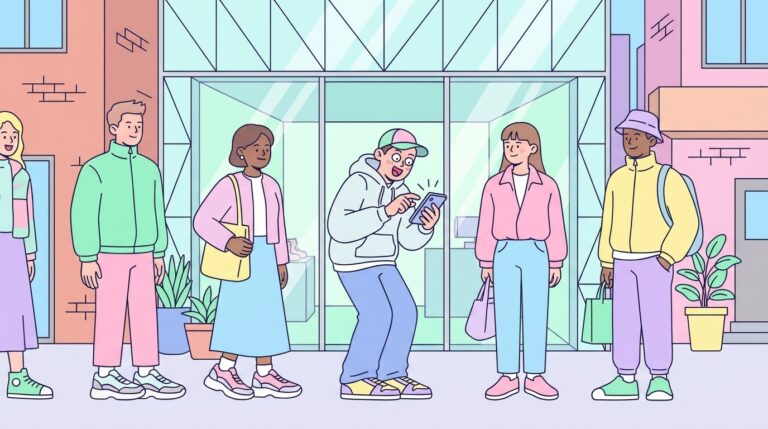
Imagine this: It’s 6:00 AM on a freezing Friday in Seongsu-dong, the Brooklyn of Seoul. You aren’t at a club, but there’s a line wrapping around the block. People are huddled in padded jackets, intensely tapping their phones. As the sun rises, you hear someone mutter, “아, P가 너무 붙었는데?” (Ah, there’s too much P attached?).
Wait, P? Attached? Are they talking about blood (Pi in Korean)?
Welcome to the hyper-competitive, adrenaline-fueled world of Korea’s “Drop” and Resell Culture. Whether it’s a limited-edition Nike x Peaceminusone sneaker, an exclusive K-Pop photocard, or a Dubai chocolate from a pop-up store, Korean consumer behavior is heavily driven by exclusivity and speed. If you want to understand modern young Koreans, you have to understand the language of the resell market.
Let’s dive into the C2-level vocabulary of hype, hustle, and “Resell-tech.”
Phase 2: Core Expressions Deep Dive
1. 오픈런 (Open Run)
- Pronunciation: [o-peun-reon] Sounds like ‘open run’ but with a sharp ‘o’ and clipped ‘n’s.
- Meaning: Literal: Open run. Real Nuance: Waiting in line for hours before a store opens to grab limited-edition items.
- K-Culture Moment: You’ll see this on the news every time Chanel raises its prices, or when a massive K-Pop group opens a temporary pop-up store in Yeouido.
- Editor’s Insight: It’s not just a physical act; it’s a cultural phenomenon. Saying “나 내일 오픈런 뛰어” (I’m running an open run tomorrow) means you are dedicating your physical and mental stamina to capitalism.
- Situation Spectrum:
- Casual: ✅
- Semi-formal: ✅ (Used in news and business)
- Formal: ⚠️
- 🤔 Think About It: Why does a country famous for Ppalli-Ppalli (hurry up) culture tolerate waiting in line for 6 hours? Does the difficulty of acquisition amplify the perceived value of the item in Korean society?
2. 피(P)를 붙이다 (To add a ‘P’)
- Pronunciation: [pi-reul bu-chi-da] ‘Pi’ sounds exactly like the English letter P. ‘Bu-chi-da’ sounds like a tiny sneeze: boo-chee-dah.
- Meaning: Literal: To attach P. Real Nuance: To add a premium to the original price for reselling.
- K-Culture Moment: Scrolling through ‘Kream’ (Korea’s StockX) or ‘Bunjang’ (Lightning Market), a sneakerhead sighs. A 150,000 KRW shoe now has 300,000 KRW of ‘P’ attached to it.
- Editor’s Insight: Interestingly, ‘피 (Pi)’ also means ‘blood’ in Korean. So “피를 흘리다” means to bleed, but “피를 붙이다” means to mark up a price. Resellers who charge absurd ‘P’ are often mockingly called “되팔이” (Doe-pa-ri, scalpers).
- Situation Spectrum:
- Casual: ✅
- Semi-formal: ⚠️ (Okay among close colleagues)
- Formal: 🚫
- 🤔 Think About It: Koreans love shortening English words and turning them into local slang. How does taking the ‘P’ from Premium and turning it into an independent Korean noun reflect the globalized nature of Korean consumerism?
3. 피켓팅 (Piketting)
- Pronunciation: [pi-ke-ting] Pee-ket-ting
- Meaning: Literal: Blood (Pi) + Ticketing. Real Nuance: A ticketing war so fierce it feels like a bloodbath.
- K-Culture Moment: It’s 7:59 PM. You have the atomic clock open on your monitor. At exactly 8:00:00, you click to buy a limited-edition drop or a BTS concert ticket. The server crashes. You have just experienced Piketting.
- Editor’s Insight: While originally for concerts, this word has bled (pun intended) into the retail sector for online limited drops. If you succeed, you say “피켓팅 성공!” (Piketting success!).
- Situation Spectrum:
- Casual: ✅
- Semi-formal: ✅
- Formal: 🚫
- 🤔 Think About It: The dramatization of everyday tasks. Why do we use words related to war and blood for consumer activities?
Phase 3: Textbook vs. Real Korean
Let’s upgrade your vocabulary from “foreign exchange student” to “local Seongsu-dong hypebeast.”
[Situation 1: Discovering an item is completely sold out]
* 📖 Textbook Korean: 전부 다 팔렸습니까? (Is it all sold out?)
* 🗣️ Real Korean: 헐, 이거 완전 순삭됐네요. (Whoa, this got completely deleted in a blink.)
* 💡 Why it’s different: 순삭 (순식간에 삭제 – deleted in an instant) originated from gaming and internet culture, perfectly capturing the digital speed at which limited drops disappear online.
[Situation 2: Reacting to a crazy resell price]
* 📖 Textbook Korean: 리셀 가격이 많이 올랐습니다. (The resell price has risen a lot.)
* 🗣️ Real Korean: 와, 리셀가 떡상했네. 완전 미쳤다. (Wow, the resell price skyrocketed. Absolutely crazy.)
* 💡 Why it’s different: 떡상 (a steep rise) comes from cryptocurrency and stock market slang. Modern Korean youth view limited items as financial assets, known as 리셀테크 (Resell-Tech), hence the financial jargon.
[Situation 3: Trying to buy something fast]
* 📖 Textbook Korean: 빨리 클릭해야 합니다. (You must click quickly.)
* 🗣️ Real Korean: 무조건 광클해야 돼! (You absolutely have to click like crazy!)
* 💡 Why it’s different: 광클 (미친듯이 클릭 – crazy clicking) is the physical manifestation of Korean impatience and high-speed internet infrastructure.
Bottom Note: At a C2 level, weaving internet-born socio-economic slang (like 떡상, 순삭) into your spoken Korean instantly signals high cultural fluency. Just don’t use them in a corporate board meeting!
Phase 4: Cultural Context — K-Culture Deep Dive
4-1. The Non-verbal ‘Nunchi’ of Reselling
In the resell culture, Nunchi (눈치 – the subtle art of gauging others’ moods and situations) is financial leverage. When a limited shoe drops, buyers play a massive game of Nunchi on the Kream app. “Should I buy now? Or will the ‘P’ drop tomorrow?” You don’t just ask about the price; you study the market sentiment.
4-2. The K-Pop Photocard Economy
While Western sneakerheads hunt for Jordans, the true kings and queens of Korea’s resell market are K-Pop fans. Album inclusions, specifically photocards (포카 – Po-ka), have their own stock market.
* Fans use Twitter and the Bunjang (번장) app to trade.
* Critical Perspective: K-Pop agencies intentionally create “random” photocards to fuel this secondary market. What seems like innocent fandom activity is actually a highly sophisticated, gamified consumer behavior system. Buying an album isn’t just supporting an artist; it’s entering a lottery.
Phase 5: Real-life Roleplay Scenario
Setting: A trendy industrial-chic cafe in Seongsu-dong. You and your hypebeast Korean colleague, Minho, are looking at your phones. You both just failed an online drop for a limited streetwear collaboration.
Characters:
– YOU: A foreign expat who loves Korean street fashion but hates overpaying.
– Minho (29): Your colleague. Sneakerhead. Spends half his salary on the Kream app.
Dialogue:
Minho: 아, 1초 만에 순삭됐어. 서버 터진 거 실화냐? 😤
(A, 1cho mane sunsakdwaesseo. Seobeo teojin geo silhwanya?)
[Ah, it got deleted in 1 second. The server crashing, is this real life?]
(🎭 Stage Direction: Minho violently tosses his phone on the table)
YOU: 저도 결제창에서 튕겼어요. 완전 피켓팅이네요. 😭
(Jeodo gyeoljechang-eseo twinggyeosseoyo. Wanjeon piketting-ineyo.)
[I got bounced at the payment window too. Total blood-ticketing.]
Minho: 이거 지금 크림(Kream)에 벌써 매물 올라왔는데?
(Igeo jigeum keurim-e beolsseo maemul ollawanneunde?)
[There are already listings for this up on Kream right now?]
YOU: 진짜요? 리셀가 얼마예요?
(Jinjjayo? Riselga eolmayeyo?)
[Really? How much is the resell price?]
Minho: 원가 20만 원인데, 지금 P가 15만 원 붙었어. 35만 원 줘야 돼.
(Wonga 20man won-inde, jigeum p-ga 15man won buteosseo. 35man won jwoya dwae.)
[Retail is 200,000 KRW, but right now there’s 150,000 KRW of ‘P’ attached. We have to pay 350,000.]
🔀 Your Turn! How do you respond?
– A) “그건 너무 비쌉니다. 안 사겠습니다.” (Too textbook, kills the vibe)
– B) “와, 되팔이들 진짜 양심 없네. 존버합시다!” (Wow, scalpers have no conscience. Let’s hold out/wait!)
– C) “대박! 그냥 지금 살까요?” (Crazy! Should we just buy it now?)✅ Best Choice: B — 존버 (Jon-beo: originally vulgar, now mainstream slang for “holding on/waiting it out” in stocks/resell). It shows high empathy and native-like frustration with the market.
⚠️ Choice A Analysis: Grammatically flawless, but entirely lacks the emotional camaraderie expected when complaining about scalpers with a friend.
Bonus K-Culture Scenario: Danggeun Market (당근마켓)
You decide to buy a less-hyped item on Karrot (Danggeun), the local community resell app. You meet the seller at Exit 3 of Hongdae Station.
Seller: 혹시… 당근이세요? (Hoksi… Danggeun-iseyo?) [By any chance… are you Karrot?]
YOU: 네! 저 쿨거래 할게요. 계좌이체 해드리겠습니다. (Ne! Jeo kul-georae halgeyo. Gyejwaiche haedeurigesseumnida.) [Yes! I’ll do a ‘cool trade’ (no haggling/quick transaction). I’ll bank transfer you.]
Phase 6: 10-Second Shadowing Drill
Time to sound like a frustrated Korean sneakerhead. Pay attention to the pauses and the dramatic sigh!
😤 하아... / 이거 완전 순삭이네. / 리셀가에 / 피가 너무 붙었어요.
(Haa… / igeo wanjeon sunsak-ine. / riselga-e / pi-ga neomu buteosseoyo.)
Sigh… / This got totally deleted in a blink. / The resell price / has way too much ‘P’ attached.
Phase 7: K-Culture Mini Dictionary
1. 당근 (Danggeun)
* Romanization: danggeun
* English: Karrot (Secondhand Market App)
* Context: Literally means “carrot.” Korea’s biggest neighborhood-based secondhand app. “당근하다” has become a verb meaning “to buy/sell secondhand.”
2. 크림 (Kream)
* Romanization: keurim
* English: Kream App
* Context: An acronym for Kicks Rule Everything Around Me. Korea’s dominant authentication and resell platform for luxury goods, streetwear, and sneakers.
3. 쿨거래 (Cool-georae)
* Romanization: kul-georae
* English: Cool transaction
* Context: A fast secondhand deal without annoying haggling, questioning, or ghosting. Sellers often write “쿨거래 시 네고 가능” (Negotiable if it’s a cool transaction).
4. 되팔이 (Doepari)
* Romanization: doe-pa-ri
* English: Scalper / Flippers
* Context: A derogatory term for people who buy limited items only to resell them at exorbitant prices.
Phase 8: Traveler Survival Kit
Even if you aren’t a hardcore sneakerhead, you will face limited-edition culture during your trip, from exclusive Kakao Friends plushies to Pop-up cafe menus.
🆘 Survival Expressions
– 🇰🇷 “이거 지금 재고 있나요?” (igeo jigeum jaego innayo?)
– 🗣️ Meaning: Do you have stock of this right now?
– 🇰🇷 “1인당 몇 개까지 살 수 있어요?” (irindang myeot gaekkaji sal su isseoyo?)
– 🗣️ Meaning: How many can I buy per person?
– 🇰🇷 “한정판이에요?” (hanjeongpan-ieyo?)
– 🗣️ Meaning: Is it limited edition?📌 Editor’s Travel Note
– Pop-up Capital: If you want to experience this drop culture, go to Seongsu-dong (성수동) or The Hyundai Seoul (더현대 서울) in Yeouido.
– Reservation Apps: Many popular pop-ups no longer do physical lines to avoid chaos. You need to use a tablet at the door via “CatchTable” (캐치테이블) to secure a digital queue ticket.
Phase 9: Critical Thinking Corner — “One Step Deeper”
Language & Power (Korean in the Global Era)
Take a look at the vocabulary of Korea’s resell culture: Drop, Open run, Resell, Premium (P), Ticketing. They are almost entirely English loanwords. However, they aren’t used the way native English speakers use them.
🧠 Think Deeper:
In hyper-capitalist modern Korea, English loanwords are often utilized to give a subculture an air of exclusivity, modernity, and global relevance. But Korean syntax bends these words to its will. “Open run” becomes a noun for a physical marathon. “Premium” is chopped down to “P” and treated like a physical sticker (“attached”). This reflects a society that absorbs global trends at lightning speed but relentlessly localizes them for maximum efficiency. Is this the destruction of pure Korean language, or a brilliant evolution of global urban slang?💬 Your Turn: Does your country have a massive “resell” culture? Do you use local slang, or have English terms taken over your market too? Let us know in the comments!
Phase 10: FAQ & Preventing Misunderstandings
- Q: Can I use “피켓팅 (Piketting)” in a business email to describe a hard project?
- A: No! It is strictly slang for consumer behavior/ticketing. In business, use “경쟁이 치열하다” (the competition is fierce).
- Q: Is it rude to ask a secondhand seller on ‘Danggeun’ to lower the price?
- A: Maybe. Haggling (네고 – Nego, from negotiation) is common, but asking for a massive discount right away is considered poor “Nunchi.” Always ask “혹시 네고 가능할까요?” (Is negotiation possible by any chance?) politely.
❌ Common Mistake:
Calling an official store clerk a “되팔이” (scalper) because the item is expensive.
✅ Do this instead: “되팔이” is an insult reserved strictly for unofficial resellers/scalpers. Never use it against official retail staff!
Phase 11: Summary & Action Items
One-Liner Summary: To survive Korea’s hyper-fast limited drop market, you need to master the art of the Open run, survive the Piketting, and know how much P to attach.
Action Mission 3 Steps:
– 🥉 Bronze (Solo): Say “아, 완전 순삭됐어” (Ah, it got completely deleted in a blink) three times next time you miss out on something.
– 🥈 Silver (Online): Look up “Kream” (크림) on the web and try to find a shoe with “P” attached.
– 🥇 Gold (Action): Visit a Pop-up store in Seoul and ask the staff, “이거 한정판이에요?” (Is this limited edition?)
👟 K-Culture Mission:
Go on YouTube and search for “더현대 팝업스토어 오픈런” (The Hyundai Pop-up Store Open Run). Watch the vlogs to truly grasp the scale of this cultural phenomenon!
Phase 12: Quiz — Interactive Challenge
1. Situational Judgment:
You finally succeeded in buying a limited K-Pop photocard online after the server crashed 5 times. You text your Korean friend. What is the most natural message?
– A) 나의 구매가 성공했습니다. (My purchase succeeded.)
– B) 드디어 피켓팅 성공! ㅠㅠ (Finally, piketting success! T_T)
– C) 오픈런 완료. (Open run complete.)
2. Fill in the Blank:
“Wow, this jacket was $100, but on Kream it’s $300. There’s way too much _______ attached!”
“와, 이 자켓 크림에서 30만 원이네. ___가 너무 붙었다!”
3. True or False:
If an item is “순삭” (Sunsak), it means it is highly unpopular and was deleted from the store. (T/F)
👀 Click here for Answers!
1. B (A is too robotic, C is for physical waiting in line, not online clicking.)
2. P (피) (Premium markup.)
3. False (It means it sold out incredibly fast because it was too popular!)
Frequently Asked Questions (FAQ)
Q: What does "오픈런 (Open Run)" mean in Korean and how do you pronounce it?
A: In Korean, "오픈런 (Open Run)" is pronounced [o-peun-reon] and means: Literal: Open run. Real Nuance: Waiting in line for hours before a store opens to grab limited-edition items.
Q: What does "피(P)를 붙이다 (To add a 'P')" mean in Korean and how do you pronounce it?
A: In Korean, "피(P)를 붙이다 (To add a 'P')" is pronounced [pi-reul bu-chi-da] and means: Literal: To attach P. Real Nuance: To add a premium to the original price for reselling.
Q: What does "피켓팅 (Piketting)" mean in Korean and how do you pronounce it?
A: In Korean, "피켓팅 (Piketting)" is pronounced [pi-ke-ting] and means: Literal: Blood (Pi) + Ticketing. Real Nuance: A ticketing war so fierce it feels like a bloodbath.