

Hello! I’m your daily navigator and Lead Editor at Daily Hangul.
Phase 1: The ‘Dakku’ Dream in Myeongdong
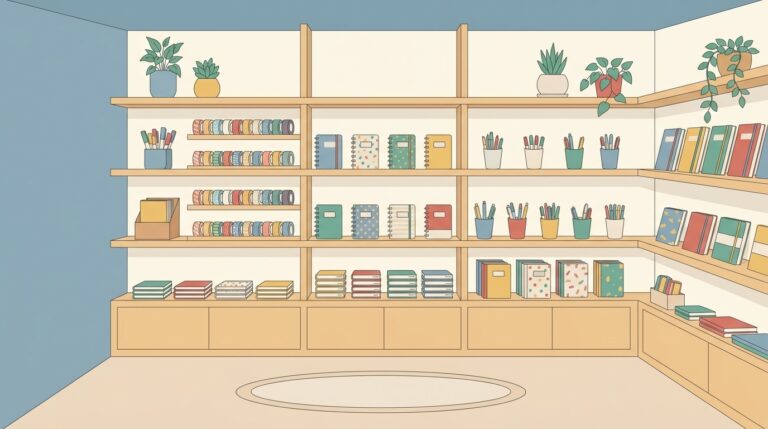
Picture this: You are in the heart of Myeongdong, stepping into a massive, 8-story Daiso, or perhaps a neon-lit Artbox in Hongdae. K-Pop is playing warmly in the background. You just bought a gorgeous photocard of your favorite idol, or maybe you want to start a travel journal for your trip to Seoul. You need to decorate it! You wander the endless aisles filled with cute stickers, plushies, and pens. But wait… where is the tape?
In Korea, stationery stores are more than just places to buy office supplies; they are playgrounds for K-Pop fans and K-Drama lovers. But standing in front of 50 different aisles, feeling lost without knowing how to ask for something as simple as ‘tape’ can be frustrating.
Don’t worry! I’ve seen countless beginner students freeze in this exact moment. Today, we’re going to learn the easiest, most magical phrases you need to survive and thrive in a Korean stationery store.
Phase 2: Core Expressions Deep Dive
Let’s look at the absolute must-know phrases for an A1 beginner.
1. 테이프 어디 있어요?
- Pronunciation: te-i-peu eo-di i-sseo-yo? [te-ee-pu uh-dee ee-sso-yo?]
(Tip: ‘eu’ sounds like the disgusted ‘ugh’ sound when you step in gum!)- Meaning: Where is the tape?
- K-Culture Moment: You’ll use this everywhere! In a massive Artbox, asking the busy clerk organizing the sticker aisle.
- Editor’s Insight: This is the ultimate “Where is X?” formula. Just put the item you want at the front, and add “어디 있어요?” (Where is it?). It’s polite, natural, and gets you exactly what you need.
- Situation Spectrum:
- Casual (Friends): ⚠️ (Friends would use ‘어디 있어?’)
- Semi-formal (Store clerks, strangers): ✅ (Perfect!)
- Formal (Bosses, elders): ✅
- 🤔 Think About It: Why does Korean use Konglish (Korean + English) for ‘tape’? Does your native language also borrow words for modern inventions?
2. 마스킹 테이프 있어요?
- Pronunciation: ma-seu-king te-i-peu i-sseo-yo? [ma-su-king te-ee-pu ee-sso-yo?]
- Meaning: Do you have masking tape (washi tape)?
- K-Culture Moment: Masking tapes with cute characters or K-Pop aesthetics are huge in Korea. You’ll see fans trading decorated polaroids using these exact tapes.
- Editor’s Insight: “있어요?” (Do you have…?) is a lifesaver. If you don’t know the Korean word, you can even point to a picture on your phone and say “이거 있어요?” (Do you have this?).
- Situation Spectrum:
- Casual: ⚠️
- Semi-formal: ✅
- Formal: ✅
- 🤔 Think About It: In Korean stores, it’s very common to ask if they “have” something rather than if they “sell” it. It feels more like asking a neighbor for a favor!
Phase 3: Textbook vs. Real Korean
Let’s see how real Koreans speak in the store!
[Asking for the Tape’s Location]
* 📖 Textbook Korean: 테이프는 어디에 있습니까? (te-i-peu-neun eo-di-e it-seum-ni-kka?)
* 🗣️ Real Korean: 테이프 어디 있어요? (te-i-peu eo-di i-sseo-yo?)
* 💡 Why the difference?: Real Koreans drop grammatical particles like ‘는’ (neun) and ‘에’ (e) in casual speaking to save time and sound much more approachable.
[Asking if they sell it]
* 📖 Textbook Korean: 테이프를 판매하시나요? (te-i-peu-reul pan-mae-ha-si-na-yo?)
* 🗣️ Real Korean: 테이프 있어요? (te-i-peu i-sseo-yo?)
* 💡 Why the difference?: “판매하다” (to sell) is too formal for a quick stationery run. “있어요?” is simple, effective, and friendly!
Phase 4: Cultural Context — K-Culture Deep Dive
4-1. Non-verbal Communication
When asking a store clerk for help, don’t just shout across the room. Walk slightly closer, make soft eye contact, give a tiny nod (a mini-bow), and start with “저기요…” (jeo-gi-yo / Excuse me…). This shows good Nunchi (social awareness) and instantly makes the clerk want to help you.
4-2. The “Dakku” Phenomenon (K-Pop & Travel Connection)
If you are looking for tape in Korea, you are likely encountering the 다꾸 (Dakku) culture. ‘Dakku’ is short for 다이어리 꾸미기 (Diary Decorating). Korean stationery stores have entire floors dedicated to this! Fans also do 폴꾸 (Polkku)—Polaroid Decorating—where they use cute 마스킹 테이프 (Masking tape) to decorate sleeves holding their favorite K-Pop idol photocards.
So, buying tape in Korea isn’t just about sticking two pieces of paper together; it’s about expressing your identity, documenting your travels, and participating in a huge fan culture!
Phase 5: Real-Life Roleplay Scenario
Setting: It’s 3 PM on a Saturday. You are inside a vibrant Artbox in Hongdae. K-Pop is playing loudly. You have a beautiful notebook in your basket, but you desperately need some cute tape to decorate it.
Characters:
– YOU: A traveler exploring Korean stationery for the first time.
– Clerk (Min-ji, 20s): A friendly, busy store clerk organizing plushies.
Dialogue:
YOU: 저기요… (jeo-gi-yo…)
[Translation] Excuse me…
(🎭 Stage Direction: You give a polite little nod)
Min-ji: 네, 손님! (ne, son-nim!)
[Translation] Yes, customer!
YOU: 테이프 어디 있어요? (te-i-peu eo-di i-sseo-yo?)
[Translation] Where is the tape?
Min-ji: 아, 테이프요? 어떤 테이프 찾으세요? (a, te-i-peu-yo? eo-tteon te-i-peu cha-jeu-se-yo?)
[Translation] Ah, tape? What kind of tape are you looking for?
🔀 Your Turn! How do you answer?
– A) “마스킹 테이프요.” (ma-seu-king te-i-peu-yo.)
– B) “투명 테이프요.” (tu-myeong te-i-peu-yo – Transparent tape.)
– C) “몰라요.” (mol-la-yo – I don’t know.)✅ Best Choice: A or B! Just add “요” (yo) to the noun to make it a polite sentence.
⚠️ Choice C Analysis: Saying “I don’t know” bluntly can stop the conversation. If you really don’t know the word, show a picture on your phone instead!
(Let’s say you chose A)
YOU: 마스킹 테이프요. (ma-seu-king te-i-peu-yo.)
[Translation] Masking tape, please.
Min-ji: 마스킹 테이프는 3번에 있어요. (ma-seu-king te-i-peu-neun sam-beon-e i-sseo-yo.)
[Translation] The masking tape is in aisle 3.
(🎭 Stage Direction: She points toward a very colorful aisle)
YOU: 아, 감사합니다! (a, gam-sa-ham-ni-da!)
[Translation] Ah, thank you!
Min-ji: 다꾸 하세요? 예쁜 거 많아요~ (da-kku ha-se-yo? ye-ppeun geo ma-na-yo~)
[Translation] Are you doing diary decorating? There are lots of pretty ones~
YOU: 네! 이거 얼마예요? (ne! i-geo eol-ma-ye-yo?)
[Translation] Yes! How much is this (one)?
Min-ji: 천 원입니다~ (cheon won-im-ni-da~)
[Translation] It’s 1,000 won~
Phase 6: 10-Second Shadowing Drill
Let’s practice speaking like a local. Read it out loud, following the pauses!
🥺 Politely asking for help:
저기요, / 테이프 / 어디 있어요?
(jeo-gi-yo, / te-i-peu / eo-di i-sseo-yo?)
😊 Checking for your favorite item:
마스킹 테이프 / 있어요?
(ma-seu-king te-i-peu / i-sseo-yo?)
Phase 7: K-Culture Mini Dictionary
1. 다꾸
* Romanization: dakku
* English: Diary decorating
* Context: A massive hobby in Korea. Buying stickers and tapes to make your planner or journal aesthetically pleasing.
2. 마테
* Romanization: mate
* English: Masking tape (Washi tape)
* Context: An abbreviation of ‘마스킹 테이프’. Gen Z Koreans love shortening words! You’ll see this word everywhere on K-Pop Twitter.
3. 문방구
* Romanization: munbanggu
* English: Traditional stationery store
* Context: While modern shops are called ‘문구점’ (mungujeom), ‘문방구’ gives a retro, nostalgic vibe of small shops in front of elementary schools selling snacks and toys.
4. 저기요
* Romanization: jeogiyo
* English: Excuse me
* Context: Literally means “Over there.” Used to politely call a waiter in a restaurant or get a store clerk’s attention.
Phase 8: Traveler Survival Kit
🆘 Survival Phrases for Shopping
– 🇰🇷 “테이프 어디 있어요?” (te-i-peu eo-di i-sseo-yo?)
– 🗣️ English guide: [te-ee-pu uh-dee ee-sso-yo?]
– 📍 Where to use: Daiso, Artbox, Convenience stores.
– 💡 Pro Tip: Replace ‘테이프’ with ANY item! ‘가위 어디 있어요?’ (Where are the scissors?)📌 Editor’s Travel Note
– Hot places for stationery: Daiso (for budget & variety), Artbox (for cute characters), Hottracks (inside Kyobo Bookstores for premium items).
– Payment: Korea is a card heaven! Even for a 1,000 won tape, you can use a credit card without any awkwardness. Just say “카드 돼요?” (ka-deu dwae-yo? – Do you take cards?).
Phase 9: Critical Thinking Corner — “One Step Deeper”
Global Era & Konglish
Have you noticed that “테이프” (te-i-peu) sounds almost exactly like “tape”? In the modern global era, the Korean language has adopted many English words, creating what we call ‘Konglish’. Things that were introduced to Korea relatively recently or from Western culture often retain their English names. Instead of creating a new, difficult Korean word, Koreans prioritize practicality and global communication.
🧠 Think Deeper:
The adoption of English words into Korean shows how fast the culture adapts to global trends. However, some older generations worry that the “purity” of the Korean language is fading.💬 Your Turn: Does your language borrow English words for modern items like ‘smartphone’ or ‘tape’? How do people in your country feel about it? Share in the comments!
Phase 10: FAQ & Preventing Mistakes
- “Can I just point at the tape and say ‘이거’ (this)?”
Absolutely! If you find the tape but want to know the price, just point and say “이거 얼마예요?” (How much is this?). It’s perfectly polite as long as you use “요” (yo) at the end.
❌ Common Mistake #1: Pronouncing “Tape” exactly like in English.
✅ Do this instead: Korean syllables are very clear. You must pronounce it as 3 distinct syllables: “테-이-프” (Te-i-peu). If you say “tayp” (1 syllable), the clerk might not understand you!❌ Common Mistake #2: Forgetting the “요” (yo).
✅ Do this instead: Never say just “어디 있어?” (eo-di i-sseo?) to a clerk. It sounds like you are talking to a child or a close friend. Always attach the magical politeness shield: “요” (yo)!
Phase 11: Summary & Action Items
- One-Liner Summary: To find what you need in a Korean store, just put the item name in front of “어디 있어요?” (Where is it?).
-
Action Mission 3 Steps:
- 🥉 Bronze (Solo): Stand in front of a mirror holding an imaginary tape and ask, “테이프 어디 있어요?” 3 times.
- 🥈 Silver (Online): Comment below with one item you’d love to buy at a Korean stationery store!
- 🥇 Gold (Real Life): Next time you visit a Korean market or H-Mart, ask the clerk where an item is using “[Item] 어디 있어요?”.
- K-Culture Mission: Go to YouTube and search for “Daiso Korea haul” or “다꾸 마테”. See how many times you can spot ‘테이프’ being used!
Phase 12: Quiz — Interactive Challenge
1. Situational Judgment:
You are at Artbox and want to buy tape for your K-Pop photocards. What is the most natural way to ask the busy clerk?
– A) 테이프는 어디에 있습니까?
– B) 저기요, 테이프 어디 있어요?
– C) 야, 테이프 줘.
Hint: Which one has the polite ‘Excuse me’ and the natural dropping of particles? (Answer: B)
2. Fill in the Blank:
You want to ask “Do you have masking tape?”.
마스킹 테이프 _______? (ma-seu-king te-i-peu _______?)
(Answer: 있어요 / i-sseo-yo)
3. True or False — K-Culture Edition:
“In Korean stationery stores, you should feel bad if you pay for a 1,000 won tape with a credit card.”
(Answer: False! Korea is practically a cashless society; paying for small amounts with a card is totally normal!)
Great job today! You are now ready to conquer Daiso and Artbox like a true local. Happy decorating! 😊
Frequently Asked Questions (FAQ)
Q: What does "테이프 어디 있어요?" mean in Korean and how do you pronounce it?
A: In Korean, "테이프 어디 있어요?" is pronounced [te-i-peu eo-di i-sseo-yo? [te-ee-pu uh-dee ee-sso-yo?] and means: Where is the tape?
Q: What does "마스킹 테이프 있어요?" mean in Korean and how do you pronounce it?
A: In Korean, "마스킹 테이프 있어요?" is pronounced [ma-seu-king te-i-peu i-sseo-yo? [ma-su-king te-ee-pu ee-sso-yo?] and means: Do you have masking tape (washi tape)?







