

Hello! I’m your Daily Hangul Editor.
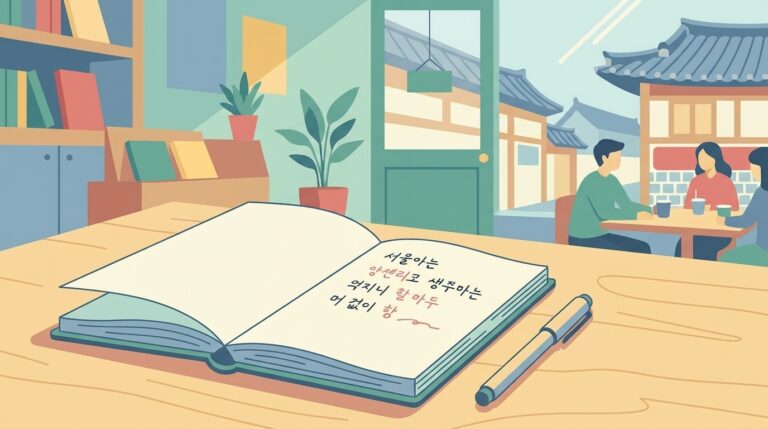
Picture this: It’s a rainy Friday evening in Hapjeong, Seoul. You’re sitting in a warm, wood-scented indie bookstore, an iced Americano in one hand and a dog-eared copy of a Korean novel in the other. It’s your first Dokseo Moim (독서 모임, Korean book club). You spent all week reading and understanding the book. But suddenly, the moderator looks at you with a bright smile and says, “So, what did you think?”
Your mind goes completely blank. How do you say “it resonated with me” without sounding like a robotic translation app? How do you respectfully disagree with someone’s interpretation without ruining the group’s mood?
If you are a B2 level learner, you already know the grammar. Now, it’s time to learn the social language. This guide is based on real questions from my students who successfully survived (and thrived in!) their local Korean reading groups. Let’s dive in!
Phase 2: Core Expressions Deep Dive
Here are the top 3 expressions you need to sound like a sophisticated, thoughtful book club member.
1. 제가 먼저 발제하겠습니다.
- Pronunciation: je-ga meon-jeo bal-je-ha-get-seum-ni-da (Bal-je sounds like ‘ball-jay’)
- Meaning: (Literal) I will present first. / (Real Nuance) I’ll kick off the discussion.
- K-Culture Moment: In a Korean book club, someone usually prepares a few discussion questions. This role is called the Baljeja (발제자). If there’s an awkward silence when deciding who speaks first, volunteering with this phrase instantly makes you the hero of the room.
- Editor’s Insight: It sounds professional yet perfectly natural for a hobby group. It shows you respect the structure of the meeting.
- Situation Spectrum:
- Casual Friends: ⚠️ (A bit too formal. Use “내가 먼저 얘기할게” instead)
- Book Club/Coworkers: ✅
- Formal Presentation: ✅
- 🤔 Think About It: Why do Koreans use such a formal word (발제 – presentation/putting forth a topic) even in hobby groups? It reflects the Korean tendency to take group activities and shared responsibilities seriously.
2. 이 구절이 가장 와닿았어요.
- Pronunciation: i gu-jeol-i ga-jang wa-da-a-sseo-yo (Wa-da-a sounds like “wah-dah-ah”)
- Meaning: (Literal) This phrase touched me the most. / (Real Nuance) This passage really resonated with me.
- K-Culture Moment: Whenever a K-Drama character reads a book while sitting on a bus looking out the window, this is the exact feeling they are having. It’s the perfect phrase to use when sharing your favorite quote.
- Editor’s Insight: The verb ‘와닿다’ literally means ‘to come and touch’. It’s much more poetic and natural than saying ‘이 부분이 좋았어요’ (This part was good). It shows emotional depth!
- Situation Spectrum:
- Casual Friends: ✅
- Book Club/Coworkers: ✅
- Formal/Elders: ✅
- 🤔 Think About It: Koreans love describing emotions as physical sensations (coming and touching the heart). Does your native language have spatial metaphors for emotions?
3. 생각할 거리를 던져주는 책이네요.
- Pronunciation: saeng-gak-hal geo-ri-reul deon-jyeo-ju-neun chae-gi-ne-yo
- Meaning: (Literal) It’s a book that throws things to think about. / (Real Nuance) It’s a very thought-provoking book.
- K-Culture Moment: At the end of a book review on a Korean blog, or when wrapping up a deep conversation over beers at the Dwit-puri (after-party), this phrase perfectly summarizes a complex literary work.
- Editor’s Insight: ‘거리’ means material or stuff. ‘생각할 거리’ means food for thought. By using this, you instantly elevate your Korean from intermediate to advanced native-like fluency.
- Situation Spectrum:
- Casual Friends: ✅
- Book Club/Coworkers: ✅
- Formal/Elders: ✅
Phase 3: Textbook vs. Real Korean
Let’s upgrade your textbook vocabulary to what people actually say over coffee and books.
[Situation 1: Agreeing with someone’s opinion]
* 📖 Textbook: 저도 당신의 의견에 동의합니다. (I also agree with your opinion.)
* 🗣️ Real Korean: 맞아요! 저도 그 부분 읽으면서 딱 그 생각 했어요. (Exactly! I thought the exact same thing while reading that part.)
* 💡 Why the difference?: Real Korean focuses heavily on shared empathy (공감). Rather than a cold “agreement,” showing that you felt the same emotion builds a stronger bond.
[Situation 2: Respectfully Disagreeing]
* 📖 Textbook: 제 생각은 다릅니다. (My thought is different.)
* 🗣️ Real Korean: 어, 저는 조금 다르게 느꼈는데요. (Oh, I felt a little differently.)
* 💡 Why the difference?: Using the verb “to feel” (느끼다) instead of “to think” (생각하다), and adding “a little” (조금) softens the blow. It preserves harmony, which is crucial in Korean group dynamics.
[Situation 3: Saying the book was easy to read]
* 📖 Textbook: 이 책은 쉽고 재미있습니다. (This book is easy and fun.)
* 🗣️ Real Korean: 책이 되게 술술 읽히더라고요. (The book read really smoothly / I breezed through it.)
* 💡 Why the difference?: “술술” is a mimetic word (의태어) that vividly describes something flowing without interruption. Koreans love using these words to add flavor to their speech.
Phase 4: Cultural Context — K-Culture Deep Dive
4-1. Non-verbal Elements: The Art of ‘Nunchi’ and Nodding
In a Korean book club, speaking is only 50% of the communication. The other 50% is Nunchi (눈치) and active listening. When someone is presenting their thoughts, do not just stare at them silently. You must nod frequently (끄덕끄덕) and make small audible reactions like “아~” (Ah~) or “맞아요” (That’s right). If you disagree, do not lock intense eye contact; look at the book, tilt your head slightly, and say “그렇게 볼 수도 있겠네요…” (I guess you could see it that way…).
4-2. The “Dwit-puri” (뒷풀이) Culture
If you’ve watched K-Dramas like Hospital Playlist or My Liberation Notes, you know Koreans rarely end a gathering at the primary location. The real book club happens at the Dwit-puri (after-party).
After 2 hours of polite, structured discussion at a cafe, the group will likely move to a nearby pub for fried chicken and beer (치맥) or soju. Here, the honorifics might drop slightly, and people will ask you deeper, more personal questions about how the book relates to your actual life. Don’t skip the after-party; it’s where real friendships are forged!
Phase 5: Roleplay Scenario
Setting: Saturday afternoon, 3 PM. A sunlit book cafe in Mangwon-dong. You are sitting around a large wooden table with three Korean members. You are discussing Han Kang’s famous novel, The Vegetarian.
Characters:
– YOU: A B2 Korean learner, a bit nervous but prepared.
– Ji-eun (30): The friendly book club leader (발제자).
– Min-su (28): A talkative member who loves debating.
Dialogue:
Ji-eun: 자, 다들 커피 받으셨죠? 그럼 오늘 독서 모임 시작하겠습니다. 혹시 누가 먼저 감상평 나눠주실 분 계신가요?
(Ja, dadeul keopi badeusyeotjyo? Geureom oneul dokseo moim sijakagetseumnida. Hoksi nuga meonjeo gamsangpyeong nanwojusil bun gyesingayo?)
[Well, everyone got their coffee? Then let’s start today’s book club. Is there anyone who’d like to share their review first?]
(🎭 Stage Direction: Silence falls. Everyone awkwardly looks at their coffee cups.)
YOU: 제가 먼저 할게요!
(Jega meonjeo halgeyo!)
[I’ll go first!]
Min-su: 오, 좋아요! 책 어떠셨어요?
(O, joayo! Chaek eotteosyeosseoyo?)
[Oh, great! How was the book?]
YOU: 저는 주인공의 감정이 묘사된 34페이지 구절이 가장 와닿았어요.
(Jeoneun ju-ingong-ui gamjeong-i myosadoen 34-peiji gujeol-i gajang wadaasseoyo.)
[The passage on page 34 describing the protagonist’s feelings resonated with me the most.]
Ji-eun: 아, 저도 그 부분 밑줄 쳤어요! 민수 씨는요?
(A, jeodo geu bubun mitjul chyeosseoyo! Minsu ssineunyo?)
[Ah, I underlined that part too! How about you, Min-su?]
Min-su: 음… 저는 솔직히 주인공의 행동이 전혀 이해가 안 갔어요. 너무 이기적인 거 아닌가요?
(Eum… jeoneun soljiki ju-ingong-ui haengdong-i jeonhyeo ihae-ga an gasseoyo. Neomu igijeogin geo aningayo?)
[Hmm… To be honest, I couldn’t understand the protagonist’s actions at all. Isn’t she being too selfish?]
(🎭 Stage Direction: Min-su looks at you, waiting for your response.)
🔀 Your Turn! How do you respond?
– A) “아닙니다. 당신이 틀렸습니다.” (No. You are wrong.)
– B) “그렇게 생각할 수도 있겠네요. 하지만 저는 조금 다르게 느꼈어요.”
– C) “대박! 진짜 어이없네요.”✅ Best Choice: B — Reason: It validates Min-su’s opinion first (“You could think that way”), and then introduces your opposing view gently (“But I felt a little differently”). This is the golden rule of Korean debates.
⚠️ Choice A & C Analysis: Choice A is way too aggressive and direct. Choice C (“Daebak! That’s ridiculous”) is too slangy and rude for a B2 book club setting.
Phase 6: 10-Second Shadowing Drill
Let’s practice the rhythm of Korean. Read out loud and pay attention to the pauses (/) and the emotion tags!
😊 밝게 (Brightly)
저는 / 이 책이 / 생각할 거리를 / 많이 던져줘서 / 정말 좋았어요!
(Jeo-neun / i chae-gi / saeng-gak-hal geo-ri-reul / ma-ni deon-jyeo-jwo-seo / jeong-mal jo-a-sseo-yo!)
🤔 진지하게 (Thoughtfully)
특히 / 50페이지의 이 구절이 / 저한테는 / 가장 깊게 / 와닿았습니다.
(Teu-ki / 50-pe-i-ji-ui i gu-jeo-ri / jeo-han-te-neun / ga-jang gip-ge / wa-da-at-seum-ni-da.)
Phase 7: K-Culture Mini Dictionary
Master these 4 keywords to navigate any Korean literary gathering!
1. 발제 (Balje)
* English: Presentation / Topic suggestion
* Context: The core of a Korean book club. It means extracting topics from the book to discuss. The person who does this is the 발제자 (Baljeja).
2. 감상평 (Gamsangpyeong)
* English: Review / Personal thoughts
* Context: Literally “feelings and appreciation review.” You will be asked “감상평 좀 나눠주세요” (Please share your thoughts).
3. 밑줄 긋다 (Mitjul geutda)
* English: To underline
* Context: Used metaphorically and literally. Saying “저도 그 부분에 밑줄 쳤어요” (I underlined that part too) is the ultimate way to show agreement and solidarity.
4. 뒷풀이 (Dwit-puri)
* English: After-party
* Context: The unofficial second round of the gathering, usually involving food and alcohol. Essential for networking and making real friends in Korea.
Phase 8: Traveler Survival Kit
Are you traveling to Korea and visiting famous spots like Kyobo Book Centre or cute indie bookstores in hip neighborhoods like Seongsu-dong?
🆘 Survival Phrases for Bookstores
– 🇰🇷 “이 책 재고 있나요?” (i chaek jaego innayo?) – Do you have this book in stock?
– 🇰🇷 “소설 코너가 어디예요?” (soseol koneo-ga eodiyeyo?) – Where is the fiction section?
– 🇰🇷 “여기서 읽고 가도 되나요?” (yeogiseo ilgo gado doenayo?) – Can I read here before leaving?
– 💡 Pro Tip: In large bookstores like Kyobo, look for the ‘도서 검색대’ (Book Search Kiosk). You can print a small receipt that gives you the exact shelf number. No need to wander around!
📌 Editor’s Travel Note
– Independent Bookstores (독립서점): Many indie bookstores in Seoul also function as cafes. You usually need to buy a drink to sit and read.
– Payment: Korea is completely cashless in most places. Bring your card or use Apple Pay (which is becoming widely accepted, though physical cards are safer).
Phase 9: Critical Thinking — “One Step Deeper”
Language & Power: The Art of Softening the Blow
🧠 Think Deeper:
In many Western cultures, a book club is a place for spirited debate. Disagreeing directly is seen as a sign of intellectual engagement. However, in the Korean language, you’ll notice a heavy reliance on softening modifiers (조금, 약간, -는 것 같아요) when expressing a different opinion. This isn’t because Koreans lack confidence. It’s tied to the concept of Gibun (기분 – mood/feelings) and maintaining group harmony. Directly saying “I disagree” can feel like a personal attack on the speaker’s Gibun. By framing disagreement as “I felt differently,” you protect the other person’s face while still sharing your view.💬 Your Turn: How do people disagree respectfully in your culture? Is it more direct, or do you also use “softening” words? Share it in the comments!
Phase 10: FAQ & Avoiding Mistakes
Q: Everyone in the book club is my age. Can we just use casual language (반말)?
No! Even if you discover someone is born in the exact same year, you must keep using formal/polite language (존댓말) until one of you asks, “우리 말 놓을까요?” (Shall we speak casually?). Jumping into casual speech too early makes you seem rude.
Q: What if I didn’t finish the book?
It happens! Just be honest but polite: “제가 이번 주에 일 때문에 책을 끝까지 못 읽었는데요, 앞부분에서 느낀 점을 공유할게요.” (I couldn’t finish it due to work this week, but I’ll share what I felt from the beginning.)
❌ Common Mistake #1: Saying “당신은…” (You are…)
Never use the word ‘당신’ (dangsin) in a book club to refer to someone! It sounds aggressive or overly dramatic (like a married couple fighting in a K-Drama).
✅ Do this instead: Use their name + 씨 (e.g., 민수 씨는 어떻게 생각하세요?).
Phase 11: Summary & Action Items
One-Liner Summary: To master a Korean book club, use emotional verbs (와닿다) to show empathy, and soften your disagreements to maintain harmony!
🎯 Action Missions:
– 🥉 Bronze (Solo): Read the 10-Second Shadowing sentences out loud 3 times in front of a mirror, focusing on looking thoughtful.
– 🥈 Silver (Online): Find a Korean book review on Instagram or a blog, and leave a comment: “생각할 거리를 던져주는 리뷰네요!” (What a thought-provoking review!)
– 🥇 Gold (Real Life): Join an online or local Korean language exchange or book club and volunteer to be the Baljeja (발제자)!
📚 K-Culture Mission:
Go to YouTube and search for “독서모임 브이로그” (Book Club Vlogs). Watch for 5 minutes and try to spot the moment they start the Dwit-puri (after-party) at a restaurant!
Phase 12: Quiz — Interactive Challenge
1. Situational Judgment: Min-su just shared a very controversial take on the book. You completely disagree. What is the most culturally appropriate way to start your sentence?
a) 제 생각은 완전히 다릅니다.
b) 민수 씨, 그렇게 볼 수도 있겠네요. 하지만 저는 조금…
c) 당신의 감상평은 틀렸습니다.
(Answer: b. Acknowledge their view first, then softly introduce yours. ‘당신’ in option c is a huge red flag!)
2. Fill in the Blank:
“이 문장이 저에게 가장 깊게 ____________.”
(This sentence resonated with me the most.)
(Answer: 와닿았어요 / wa-da-a-sseo-yo)
3. True or False — K-Culture Edition:
In a Korean book club, it is perfectly fine to call another member “당신” (Dangsin) if you don’t know their name well. (T / F)
(Answer: False! Always ask for their name or title. “당신” is confrontational in spoken Korean.)
Great job today! Ready for your first Korean book club? Let me know in the comments which Korean book you want to read first!
Frequently Asked Questions (FAQ)
Q: What does "제가 먼저 발제하겠습니다." mean in Korean and how do you pronounce it?
A: In Korean, "제가 먼저 발제하겠습니다." is pronounced [je-ga meon-jeo bal-je-ha-get-seum-ni-da (Bal-je sounds like 'ball-jay'] and means: (Literal) I will present first. / (Real Nuance) I'll kick off the discussion.
Q: What does "이 구절이 가장 와닿았어요." mean in Korean and how do you pronounce it?
A: In Korean, "이 구절이 가장 와닿았어요." is pronounced [i gu-jeol-i ga-jang wa-da-a-sseo-yo (Wa-da-a sounds like "wah-dah-ah"] and means: (Literal) This phrase touched me the most. / (Real Nuance) This passage really resonated with me.
Q: What does "생각할 거리를 던져주는 책이네요." mean in Korean and how do you pronounce it?
A: In Korean, "생각할 거리를 던져주는 책이네요." is pronounced [saeng-gak-hal geo-ri-reul deon-jyeo-ju-neun chae-gi-ne-yo] and means: (Literal) It's a book that throws things to think about. / (Real Nuance) It's a very thought-provoking book.







