

Phase 1: Empathy (Immersive Cold Open)
Hello! I’m the Lead Editor at Daily Hangul.
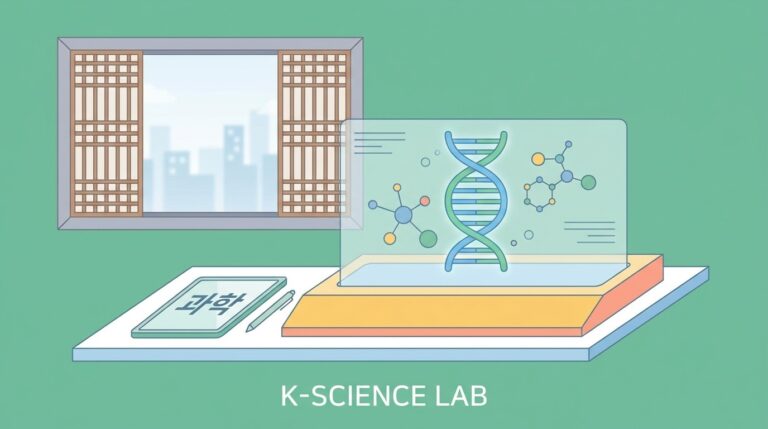
Imagine this: You’re watching a gripping K-Drama sci-fi thriller. The protagonist, a brilliant but rogue scientist, stands in a sleek, neon-lit underground lab in Gangnam. They look at a glowing holographic DNA strand and whisper something to their colleague. The English subtitles simply read: “We edited it.”
But if you listen closely, the Korean word they used wasn’t just “edited.” It carried a heavy, almost taboo weight. As a C1 learner, you already know basic Korean. You know how to order at a cafe and how to talk to your friends. But what happens when the conversation shifts to the future? To scientific discoveries, CRISPR technology, and the booming “K-Bio” industry?
If you find yourself at a tech networking event in Pangyo (Korea’s Silicon Valley) or reading a Naver News article about the latest biotechnology breakthroughs, knowing the precise terminology—and the cultural weight behind it—is what separates an intermediate learner from a true insider.
Transparency note: This guide is crafted from real questions asked by advanced learners who work in STEM, tech-journalism, or simply love deep, intellectual conversations with their Korean peers.
Phase 2: Core Expressions Deep Dive
Let’s break down the most essential expressions you need to discuss gene editing and biotech like a highly educated native speaker.
1. 유전자 가위 (CRISPR / Gene Scissors)
- Pronunciation: yujeonja gawi [yoo-jeon-jah gah-wee]
- Meaning: Literal: Gene scissors. Real nuance: CRISPR or gene-editing technology.
- K-Culture Moment: You’ll see this everywhere in Korean tech news. Unlike English where “CRISPR” is the standard colloquial term, the Korean public and media overwhelmingly use the vivid metaphor “유전자 가위” (gene scissors) to make complex science accessible.
- Editor’s Insight: It sounds almost like a craft tool, doesn’t it? But it’s used in highly professional contexts. When discussing biotech startups over coffee, dropping “유전자 가위 기술” instantly elevates your Korean fluency.
- Situation Spectrum:
- Casual with friends (Discussing news): ✅
- Semi-formal (Workplace/Seminars): ✅
- Formal (Academic presentations): ✅
- ና2 Think About It: Why does Korean media prefer “Gene Scissors” over a scientific acronym? How does visualizing science help integrate it into everyday public discourse in Korea?
2. 조작하다 (To Manipulate / To Fabricate)
- Pronunciation: jojakada [joh-jahk-hah-dah]
- Meaning: Literal: To operate/manipulate. Real nuance: To artificially alter something, often with a slightly negative or controversial undertone.
- K-Culture Moment: This word is a chameleon. In science, 유전자 조작 (genetic manipulation/modification) is a standard term. But in K-Pop or politics, 조작 means “rigging” (like the infamous Produce 101 voting scandal).
- Editor’s Insight: Be careful with your tone! In a lab, it’s just science. In a social setting, if you say someone “조작했다”, you’re accusing them of playing dirty.
- Situation Spectrum:
- Casual: ✅
- Semi-formal: ⚠️ (Ensure context is strictly scientific)
- Formal: ⚠️
- ና2 Think About It: Does your language use the same word for “scientific modification” and “fraudulent rigging”?
3. 윤리적 논란 (Ethical Controversy)
- Pronunciation: yullijeok nollan [yool-lee-jeok nohl-lahn]
- Meaning: Literal/Real nuance: Ethical controversy.
- K-Culture Moment: Whenever a K-Drama explores biotechnology (like Blood Free or clones in Seobok), the core conflict is always 윤리적 논란. South Korea is incredibly fast at adopting tech, but it also has deep traditional values. This phrase is the bridge between the two.
- Editor’s Insight: Want to sound incredibly smart during a hoesik (company dinner)? Use this phrase when someone brings up AI or biotech. It shows you can think critically about societal impacts.
- Situation Spectrum:
- Casual: ⚠️ (Might sound too serious for a pub)
- Semi-formal: ✅
- Formal: ✅
- ና2 Think About It: Korea balances hyper-modernity with Confucian ethics. How do you think an older Korean generation views editing human DNA compared to the younger generation?
Phase 3: Textbook vs. Real Korean
Let’s see how you can switch from “textbook robot” to “cool tech insider.”
[Talking about editing genes]
* ኂ1 Textbook Korean: 과학자들이 유전자를 변형했습니다. (Scientists have modified the genes.)
* ኄ3️ Real Korean: 연구진이 유전자를 건드렸어요. (The research team touched/tampered with the genes.)
* ኁ6 Why the difference?: “건드리다” (to touch/meddle with) adds a colloquial, slightly dramatic flair, often used in K-dramas to imply someone went past a boundary.
[Expressing amazement at a breakthrough]
* ኂ1 Textbook Korean: 이것은 매우 놀라운 과학적 발견입니다. (This is a very surprising scientific discovery.)
* ኄ3️ Real Korean: 이거 완전 획기적인데요? 판도가 바뀌겠어요. (This is totally groundbreaking. The game is going to change.)
* ኁ6 Why the difference?: Advanced speakers use “판도가 바뀌다” (the dynamic/landscape changes) to show they understand market or scientific impact, not just the science itself.
Bottom Note: At the C1 level, mastering “Real Korean” isn’t about using slang; it’s about using idiomatic phrases (판도가 바뀌다, 선을 넘다) that fit seamlessly into high-level intellectual discussions.
Phase 4: Cultural Context — K-Culture Deep Dive
4-1. Non-verbal cues in intellectual debates
When discussing heavy topics like 윤리적 논란 (ethical controversies) of gene editing with Korean colleagues, read the room (눈치, Nunchi). Even in a fierce debate, Koreans rarely point fingers directly or raise their voices aggressively in professional settings. Instead, they lean back, tilt their head slightly, suck in a quick breath through their teeth (the classic “Tss” sound), and say, “글쎄요… 그건 좀…” (Well… that’s a bit…). This indirectness isn’t a lack of confidence; it’s a way of preserving harmony while disagreeing.
4-2. K-Drama Connection: The “Mad Scientist” Trope
In Korean media, biotechnology is rarely just about science; it’s heavily intertwined with corporate greed (Chaebols) and morality. Dramas like Blood Free (lab-grown meat and genetics) or Seobok (human cloning) reflect Korea’s real-world anxiety. The country is a powerhouse in medical tech and “K-Bio,” yet traditional Confucian values dictate that the human body is sacred.
Critical View: While dramas make genetic engineering look like it’s done by one rogue genius in a basement, Korea’s actual biotech industry is highly regulated, heavily subsidized by the government, and operates in massive hubs like Songdo and Pangyo.
Phase 5: Real-Life Roleplay Scenario
Setting: Friday night, 8:00 PM at a high-end craft beer pub in Pangyo. You just finished a long tech conference on the future of healthcare. You are having drinks with a few Korean researchers you just met.
Characters:
– YOU: A foreign tech consultant/researcher (C1 level Korean).
– Min-su (34): A senior researcher at a K-Bio startup. Passionate but realistic.
– Ji-yoon (29): A biotech PR manager. Very trendy.
Dialogue:
Min-su: 오늘 세미나 어땠어요? 유전자 가위 기술 발표는 꽤 흥미롭지 않았나요?
(oneul semina eottaesseoyo? yujeonja gawi gisul balpyoneun kkoae heungmiropji anannayo?)
[How was the seminar today? Wasn’t the presentation on gene scissors tech quite interesting?]
YOU: 네, 완전 획기적이던데요. 기술 발전 속도가 진짜 무서울 정도예요.
(ne, wanjeon hoekgijeogideondeyo. gisul baljeon sokdoga jinjja museoul jeongdoyeyo.)
[Yeah, it was totally groundbreaking. The speed of technological advancement is almost scary.]
Ji-yoon: 맞아요. 근데 아직 상용화 되려면 멀었죠. 특히 그… 윤리적 논란 때문에요.
(majayo. geunde ajik sangyonghwa doeryeomyeon meoreotjyo. teuki geu… yullijeok nollan ttaemuneyo.)
[Right. But it’s a long way from commercialization. Especially because of… the ethical controversy.]
Min-su: 솔직히 기술 자체는 준비가 됐는데, 법적 규제가 너무 심해요. 우리나라는 유독 더 보수적이잖아요.
(soljikhi gisul jacheneun junbiga dwaenneunde, beopjeok gyujega neomu simhaeyo. urinaranun yudok deo bosujeogijanayo.)
[Honestly, the tech itself is ready, but the legal regulations are too strict. Our country is uniquely more conservative, you know.]
ቐ0️ Your Turn! How should you respond?
– A) “법을 바꿔야 합니다. 과학이 먼저입니다.” (We must change the law. Science comes first.)
– B) “맞아요. 유교 문화 때문에 신체를 건드리는 것에 대한 거부감이 큰 것 같아요.” (Right. I think there’s a strong aversion to altering the body due to Confucian culture.)
– C) “대박! 한국 사람들 진짜 고지식하네요!” (Jackpot! Koreans are seriously so stubborn!)✅ Best Choice: B — Reason: This is a spectacular C1 response. It shows not only advanced vocabulary but a deep understanding of why Korea is conservative about this (Confucianism). It invites an intellectual nod from Min-su and Ji-yoon.
⚠️ Choice A / C Analysis: A is too direct and aggressive for a friendly networking chat. C uses slang (“대박”) incongruous with an intellectual topic and uses a slightly offensive term (“고지식하다” – overly rigid) towards their culture.
Phase 6: 10-Second Shadowing Drill
Master the rhythm and intonation to sound like a native professional.
ኅ43 심각하게 / 인간의 유전자를 / 임의로 조작하는 건 / 엄청난 윤리적 논란을 / 피할 수 없을 겁니다.
(simgakhage / inganui yujeonjareul / imuiro jojakhaneun geon / eomcheongnan yullijeok nollaneul / pihal su eopseul geomnida.)
[Seriously / arbitrarily manipulating / human genes / won’t be able to avoid / massive ethical controversy.]
Tip: Pause slightly at the slashes (/). Put emphasis on “임의로” (arbitrarily) and “엄청난” (massive) to convey the weight of the statement.
Phase 7: K-Culture Mini Dictionary
1. 눈치
* Romanization: nunchi
* English: Situational awareness / reading the room
* Context: Crucial in Korean society. Knowing when to push a controversial scientific opinion and when to hold back requires excellent nunchi.
2. 회식
* Romanization: hoesik
* English: Company dinner / after-party
* Context: Where the real networking happens. Post-seminar hoesik is where scientists and investors speak freely over soju.
3. 팩트체크
* Romanization: paekteuchekeu
* English: Fact-check
* Context: Widely used in Korean media and daily life. If someone makes a wild claim about biotech, a Korean might jokingly say, “그거 팩트체크 된 거예요?” (Is that fact-checked?)
4. 줄기세포
* Romanization: julgisepeo
* English: Stem cell
* Context: A highly recognizable term in Korea due to past historical scientific scandals (like the Hwang Woo-suk case) and its current heavy use in premium K-Beauty dermatology clinics.
Phase 8: Traveler’s Survival Kit
You might think, “I’m just traveling to Korea, why do I need biotech vocabulary?” Welcome to Medical Tourism! Korea integrates advanced biotechnology (like stem cell treatments, DNA-based customized skin care, and advanced dermatology) into commercial travel experiences.
ሙ8 Survival Expressions for K-Beauty/Medical Clinics
– ቴ7ቴ7 “유전자 검사를 통한 맞춤형 스킨케어가 있나요?” (yujeonja geomsareul tonghan matchumhyeong seukinke-eoga innayo?)
– ኄ3️ Sound-alike: [yoo-jeon-jah geom-sah-reul tong-hahn maht-choom-hyeong skin-care-gah in-nah-yo?]
– ኂ0 Usage: High-end dermatology clinics in Gangnam or Apgujeong.
– ኁ6 Pro Tip: Many top-tier Korean clinics now offer cheek-swab DNA tests to prescribe completely customized serums.ኂ0 Editor’s Travel Note
– Language barrier: While major clinics have English translators, dropping terms like 줄기세포 시술 (stem cell treatment) shows you’ve done your research.
– Consultation Culture: In Korea, medical consultations (상담) are often free or very cheap before you commit to a procedure. Don’t be afraid to ask detailed questions!
Phase 9: Critical Thinking — “One Step Deeper”
ኔ0 Think Deeper: Tradition vs. Technology
Let’s look at this through the lens of Language & Cultural Identity. Historically, Korea was deeply rooted in Confucianism, which taught 신체발부 수지부모 (Our body, hair, and skin are inherited from our parents, and preserving them is the beginning of filial piety). Yet today, South Korea is a global leader in plastic surgery and genetic engineering. How does a society reconcile this?
The language reflects this tension. Notice how news anchors use extremely cautious, polite language (존댓말) when discussing bioethics, treating the “human genome” with an almost ancestral reverence, while using aggressive, fast-paced corporate jargon to discuss the profits of the same technology. This duality—reverence for the human form vs. the relentless drive for technological supremacy—is the defining characteristic of modern Korea.
ኁ7 Your Turn: In your culture, is genetic engineering viewed mostly as a medical miracle, a corporate commodity, or an ethical nightmare? Let us know in the comments!
Phase 10: FAQ & Avoiding Mistakes
Q: Can I use “조작하다” when fixing or modifying my computer?
No! While the Hanja (Chinese characters) can mean “to operate,” using 조작하다 in everyday life sounds like you are hacking or rigging something maliciously. For machines, use 작동하다 (to operate) or 수정하다 (to modify/edit text/settings).
Q: Is it polite to disagree strongly with an older Korean scientist at a seminar?
Yes and No. The content of your disagreement is fine, but the delivery must be softened. Never say “틀렸습니다” (You are wrong). Say “그 관점도 이해하지만…” (I understand that perspective, but…) or “다른 시각에서 보면…” (If we look at it from another angle…).
❌ Common Mistake #1: Translating “Edit” directly to “편집하다” when talking about genes in a casual setting.
✅ Do this instead: While 유전자 편집 is academically correct, Koreans love using the term 유전자 가위 (gene scissors) to sound natural and up-to-date with current media trends.
Phase 11: Summary & Action Items
One-Liner Summary: To discuss biotechnology like a local, you must balance cutting-edge terminology (유전자 가위) with an understanding of Korea’s deep-rooted ethical sensitivities (윤리적 논란).
Action Mission 3 Steps:
– ና5 Bronze (Solo): Read a Korean news headline containing “유전자 가위” and practice reading it aloud with proper intonation.
– ና4 Silver (Online): Go to a YouTube video about Korean biotech (or a sci-fi K-drama clip) and leave a comment: “이 기술의 발전이 놀랍지만, 윤리적 논란도 생각해봐야겠네요.” (The advancement of this tech is amazing, but we must also consider the ethical controversy.)
– ና3 Gold (Real World): If you visit a high-end Korean skincare clinic or tech expo, ask them about customized genetic solutions (유전자 맞춤형 솔루션).
K-Culture Mission:
Watch an episode of a Korean sci-fi drama (like Blood Free or The Silent Sea). Turn on the Korean subtitles and spot exactly when they use words related to genes (유전자) or manipulation (조작). Notice the intense background music that usually accompanies these words!
Phase 12: Quiz — Interactive Challenge
1. Situational Judgment:
You are at a tech startup pitch in Pangyo. The CEO claims they can alter human DNA flawlessly. You want to politely raise an ethical concern. What do you say?
– A) 대표님, 그건 너무 조작하는 거 아닙니까?
– B) 훌륭한 기술이지만, 윤리적 논란은 어떻게 해결하실 계획인가요?
– C) 유전자 가위는 불법입니다!
2. True or False – K-Culture Edition:
– Because South Korea is highly advanced in technology, the older generation has completely abandoned traditional Confucian views on the human body. (T / F)
(Answers below)
Click to reveal answers!
1. Answer: B. “It’s a great technology, but how do you plan to resolve the ethical controversy?” (A is aggressive and uses “조작” negatively. C is an abrupt accusation.)
2. Answer: False. There is still a profound tension between rapid tech advancement and deeply ingrained traditional views regarding the sanctity of the human body inherited from parents.
Frequently Asked Questions (FAQ)
Q: What does "유전자 가위 (CRISPR / Gene Scissors)" mean in Korean and how do you pronounce it?
A: In Korean, "유전자 가위 (CRISPR / Gene Scissors)" is pronounced [yujeonja gawi [yoo-jeon-jah gah-wee] and means: Literal: Gene scissors. Real nuance: CRISPR or gene-editing technology.
Q: What does "조작하다 (To Manipulate / To Fabricate)" mean in Korean and how do you pronounce it?
A: In Korean, "조작하다 (To Manipulate / To Fabricate)" is pronounced [jojakada [joh-jahk-hah-dah] and means: Literal: To operate/manipulate. Real nuance: To artificially alter something, often with a slightly negative or controversial undertone.
Q: What does "윤리적 논란 (Ethical Controversy)" mean in Korean and how do you pronounce it?
A: In Korean, "윤리적 논란 (Ethical Controversy)" is pronounced [yullijeok nollan [yool-lee-jeok nohl-lahn] and means: Literal/Real nuance: Ethical controversy.







