

Phase 1: The ‘Wait, Don’t Throw That!’ Moment
Hello there! I’m your lead editor at Daily Hangul, your veteran tutor and local cultural navigator.
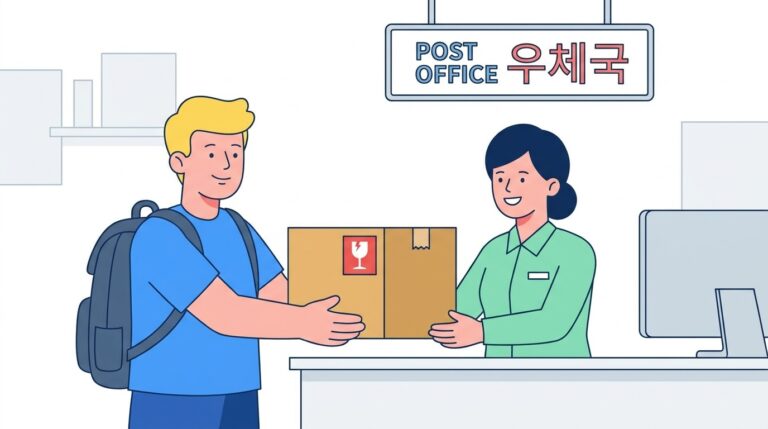
Picture this: You’ve just spent the afternoon in Myeongdong, buying exquisite glass bottles of K-beauty serums for your mom, or maybe you scored some rare K-Pop albums in Hongdae with delicate photocards inside. You pack them up and head to the Korean post office (우체국). The clerk is working with absolute Ppalli-ppalli (hurry-hurry) efficiency, scanning boxes and tossing them onto the conveyor belt like a seasoned basketball player.
Panic sets in. You want to scream, “Wait! My bias’s photocard is in there! It’s fragile!” But the English word “Fragile” gets lost in the bustling noise.
In Korea’s hyper-fast delivery culture, if a box doesn’t have a red 파손 주의 (Pason juui – Fragile) sticker, it will be treated like a sturdy brick. Knowing how to ask for this simple sticker will save your precious souvenirs (and your heart) from breaking. This guide is built from the real-life panics of my students who once shipped glass mugs and received puzzle pieces back home. Let’s make sure your K-hauls survive the trip!
Phase 2: Core Expressions Deep Dive
Let’s look at the magic words that will act as a shield for your package.
1. 파손 주의 스티커 붙여 주세요. (Please attach a fragile sticker.)
- Pronunciation: [pason juui seutikeo bucheo juseyo]
- Sound-alike guide: ‘Pa-son’ sounds like “pass on”. ‘Ju-ui’ sounds a bit like “chewy”.
- Meaning: Literal: “Damage warning sticker attach, please.” / Real nuance: “Please put a fragile sticker on this.”
- K-Culture Moment: This is the ultimate savior phrase for K-Pop fans. When you participate in photocard trades or send albums globally, this is the first thing you say to the postal worker so your package gets the VIP treatment.
- Editor’s Insight: 파손 (Pason) is a formal word for “damage” or “breakage,” usually only used for items, not people. Saying this sounds incredibly natural and polite to the post office staff.
- Situation Spectrum:
- Friends (Casual): 🚫 (You wouldn’t say this to a friend, you’d just say “Be careful, it breaks!”)
- Service Staff (Semi-formal): ✅
- Elders/Bosses (Formal): ⚠️ (Applicable if they are handling your package, but mostly used for postal workers).
- 🤔 Think About It: Why does Korea use the word “Warning” (주의) instead of just “Fragile”? It reflects a culture of emphasizing collective responsibility—warning the next handler in the supply chain to be cautious.
2. 안에 깨지기 쉬운 물건이 있어요. (There are fragile items inside.)
- Pronunciation: [ane kkaejigi swiun mulgeoni isseoyo]
- Sound-alike guide: ‘Kkae’ sounds like the ‘ke’ in “kettle” but with a sharper, tense K sound.
- Meaning: Literal: “Inside, easy-to-break items exist.” / Real nuance: “It’s fragile inside.”
- K-Culture Moment: You’re sending traditional Korean ceramics (청자 – Celadon) or a glass bottle of premium Soju you bought in Jeju Island. You say this while gently patting the box to emphasize its delicate nature.
- Editor’s Insight: The verb 깨지다 (kkaejida) means “to shatter” or “to break” (like glass or ceramics). You can’t use this for clothes or books. It paints a vivid picture for the clerk!
- Situation Spectrum:
- Friends (Casual): ✅ (Say: “안에 깨지기 쉬운 거 있어”)
- Service Staff (Semi-formal): ✅
- Elders/Bosses (Formal): ✅
- 🤔 Think About It: Notice how Korean describes the state of the object (“easy to break”) rather than just having a single universal adjective like “fragile”. How does your native language describe delicate objects?
Phase 3: Textbook vs Real Korean
How do native Koreans actually sound at the post office? Let’s compare.
[Warning the clerk about the contents]
* 📖 Textbook Korean: 내용물이 파손될 위험이 있습니다. (There is a risk that the contents may be damaged.)
* 🗣️ Real Korean: 이거 깨지는 거예요! 조심해 주세요. (Igeo kkaejineun geoyeyo! Josimhae juseyo. – This is something that breaks! Please be careful.)
* 💡 Why the difference?: Textbooks often teach formal, written language. In a busy post office, Koreans use direct, urgent conversational phrases to quickly grab the clerk’s attention.
[Asking for protective wrapping]
* 📖 Textbook Korean: 완충재로 포장해 주시겠습니까? (Would you please pack it with cushioning material?)
* 🗣️ Real Korean: 뽁뽁이 좀 더 감아주실 수 있나요? (Ppokppogi jom deo gamajusil su innayo? – Can you wrap it in a bit more bubble wrap?)
* 💡 Why the difference?: 뽁뽁이 (Ppokppogi) is an onomatopoeic slang word for bubble wrap (mimicking the popping sound). It’s universally used by everyone from kids to grandmas because it’s so much more fun and efficient to say than “cushioning material.”
Bottom Note: For B1 learners, using words like 뽁뽁이 will make native speakers smile and instantly recognize your deep understanding of daily Korean life!
Phase 4: Cultural Context — K-Culture Deep Dive
4-1. Non-Verbal Cues and “Nunchi”
When asking for a fragile sticker, non-verbal communication is key. Don’t just toss the box onto the scale. Place it down gently with two hands. Look slightly worried. Use your Nunchi (social sense) to read the room—if there is a line of 20 people behind you, have your box perfectly taped up before you get to the counter, and quickly ask for the sticker as you hand it over.
4-2. The “Ppalli-Ppalli” Delivery Culture
Korea boasts one of the fastest, most efficient delivery systems in the world. Order something at 11 PM, and it might be at your door by 7 AM the next day (Dawn Delivery). This speed is amazing, but it means packages are sorted at breakneck speeds.
In K-Dramas, you often see characters excitedly opening a Taekbae (delivery box). The unboxing experience is a huge part of Korean consumer culture, heavily featured in V-logs and K-Pop merch hauls. Because of this speed-focused system, postal workers rely on visual cues like the red 파손 주의 sticker. Without it, they assume the box contains clothes or books and will treat it with the standard, rapid handling.
Phase 5: Real-Life Roleplay Scenario
Let’s put you in the director’s chair. You are the main character in this mini-drama.
Setting: Seoul Central Post Office, 3:00 PM. The sound of packing tape ripping echoes through the hall. You are trying to ship a care package filled with K-beauty toners and traditional tea sets to your family.
Characters:
– YOU: An international resident who just spent 2 hours perfectly packing a box.
– Clerk Lee (45): A veteran postal worker. Friendly, but moving at the speed of light.
Dialogue:
Clerk Lee: 다음 분 오세요! 저울에 박스 올려주세요. 📦
(Daeum bun oseyo! Jeoure bakseu ollyeojuseyo.)
[Next person, please come! Please put the box on the scale.]
YOU: 네, 여기 있습니다. 미국으로 보낼 거예요.
(Ne, yeogi isseumnida. Migugeuro bonael geoyeyo.)
[Yes, here it is. I’m sending it to the US.]
Clerk Lee: 항공편이죠? 안에 뭐 들었어요? 액체 있나요?
(Hanggongpyeonijyo? Ane mwo deureosseoyo? Aekche innayo?)
[Airmail, right? What’s inside? Any liquids?]
YOU: 화장품이랑 컵이요. 안에 깨지기 쉬운 물건이 있어요.
(Hwajangpumirang keobiyo. Ane kkaejigi swiun mulgeoni isseoyo.)
[Cosmetics and cups. There are fragile items inside.]
(🎭 Stage Direction: Clerk Lee nods, typing rapidly on the keyboard, but hasn’t reached for the sticker yet.)
🔀 Your Turn! How should you respond to ensure your items are safe?
– A) “빨리 보내주세요!” (Please send it quickly!)
– B) “파손 주의 스티커 붙여 주세요.”
– C) “이거 진짜 비싼 거예요!” (This is really expensive!)✅ Best Choice: B — 파손 주의 스티커 붙여 주세요 (Pason juui seutikeo bucheo juseyo). This gives the clerk an exact, actionable request.
⚠️ Choice C Analysis: Telling them it’s expensive doesn’t legally or practically change how they sort the box unless you buy shipping insurance. The sticker is the universal code for “handle with care.”
Clerk Lee: 아, 유리컵이요? 네, 스티커 많이 붙여드릴게요. 영수증 여기 있습니다!
(A, yurikeobiyo? Ne, seutikeo mani bucheodeurilkkeyo. Yeongsujeung yeogi isseumnida!)
[Ah, glass cups? Okay, I’ll put plenty of stickers on it. Here is your receipt!]
Phase 6: 10-Second Shadowing Drill
Time to practice! Repeat this aloud, paying attention to the pauses and intonation.
🥺 안에 / 깨지기 쉬운 물건이 / 있어요. (A-ne / kkaejigi swiun mulgeoni / isseoyo.)
(Say this with a slightly concerned, pleading tone!)
😊 파손 주의 스티커 / 붙여 주세요! (Pa-son ju-ui seu-ti-keo / bu-cheo ju-se-yo!)
(Say this brightly and politely!)
Phase 7: K-Culture Mini-Dictionary
Here are the essential cultural keywords related to today’s topic:
1. 택배 (Taekbae)
* Romanization: taekbae
* English: Parcel delivery service
* Context: The lifeblood of Korean society. Koreans order almost everything via Taekbae. If you live in Korea, you will hear the joyful phrase “택배 왔습니다!” (Your package is here!) often.
2. 뽁뽁이 (Ppokppogi)
* Romanization: ppokppogi
* English: Bubble wrap
* Context: Derived from the popping sound (ppok-ppok). Essential for protecting your fragile K-goods.
3. 우체국 (Ucheguk)
* Romanization: ucheguk
* English: Post Office
* Context: Korean post offices are famously clean, efficient, and provide free tape, scissors, and packing tables for the public.
4. 탑로더 (Tamnodeo)
* Romanization: tamnodeo
* English: Top loader (Hard plastic card sleeve)
* Context: A crucial K-Pop fandom term. If you mail photocards, you MUST put them in a tamnodeo to prevent bending.
Phase 8: Traveler Survival Kit
Are you just visiting Korea? The post office is a tourist’s best friend when your suitcase is overflowing with K-snacks and souvenirs.
🆘 Survival Phrases #1: The Post Office
– 🇰🇷 “박스 어디서 사요?” (Bakseu eodiseo sayo?)
– 🗣️ Pronunciation guide: [Bak-seu uh-dee-suh sa-yo?]
– 📍 Where to use: Looking around a Korean post office.
– 💡 Pro Tip: Look for a display of flattened cardboard boxes numbered 1 to 5 (size 5 is the largest). You grab the box you need, pack your stuff at the packing station (자율포장대), and pay for the box with your shipping fee at the counter!📌 Editor’s Travel Note
– Packing Stations: Korean post offices provide tape, glue, scissors, and pens for free. You just need to bring your items!
– EMS: If you are sending items overseas, ask for “EMS” (Express Mail Service). It’s fast, reliable, and provides an English tracking number.
– Card vs Cash: Post offices gladly accept foreign credit cards.
Phase 9: Critical Thinking — “One Step Deeper”
🧠 Think Deeper: Trust and Efficiency in Korea
Korea’s delivery culture highlights an incredible level of societal trust. Couriers often leave expensive packages right outside your apartment door, and no one steals them. This high-trust environment allows for the “Ppalli-Ppalli” (super-fast) delivery system to thrive. However, this extreme efficiency means the system operates like a machine. If you don’t explicitly mark something as fragile (파손 주의), the machine treats it normally to maintain speed. The “Fragile” sticker is your way of briefly pausing that machine to request human delicacy.💬 Your Turn: Does your home country prioritize speed or careful handling when it comes to shipping? How safe is it to leave a package at your front door? Share in the comments!
Phase 10: FAQ & Avoiding Misunderstandings
Q: Can I just write “FRAGILE” in English on the box with a marker?
Yes! International postal workers will understand it. However, the Korean postal workers who handle the domestic sorting phase process things incredibly fast. A red 파손 주의 sticker is visually recognized much faster than handwritten English.
Q: What if I forget the word for fragile? Can I just say “조심해 주세요” (Please be careful)?
Absolutely. Pointing to the box and saying “조심해 주세요” (Josimhae juseyo) works perfectly as a backup.
❌ Common Mistake #1: Using the word 아프다 (Apeuda – to hurt/be sick) for items.
Many beginners say “상자가 아파요” (The box hurts/is sick) trying to say it will get damaged.
✅ Do This Instead: Remember that objects “break” (깨지다 – kkaejida) or get “damaged” (파손되다 – pasondoeda).
Phase 11: Summary & Action Items
- One-Liner Summary: Protect your precious K-goods at the post office by asking politely: “파손 주의 스티커 붙여 주세요” (Please attach a fragile sticker).
-
Action Mission 3 Steps:
- 🥉 Bronze (Solo): Look at any box in your house, point to it, and say “안에 깨지기 쉬운 물건이 있어요” out loud 3 times.
- 🥈 Silver (Online): Find a K-Pop unboxing video on YouTube and see if you can spot a “파손 주의” sticker on their package.
- 🥇 Gold (Real-world): Next time you visit a post office in Korea, successfully pack your box and ask the clerk for the sticker in Korean!
- K-Culture Mission: Go to Google Maps or KakaoMap Street View, find the Myeongdong Post Office (명동 우체국), and imagine walking in to ship your K-beauty haul.
Phase 12: Interactive Challenge (Quiz)
Let’s see what you’ve learned!
1. Fill in the blank:
You are shipping a glass bottle of Soju. You say to the clerk:
“안에 (_____) 쉬운 물건이 있어요.”
* A) 먹기 (eating)
* B) 깨지기 (breaking)
* C) 아프기 (hurting)
2. True or False – K-Culture Edition:
* “You need to bring your own tape and scissors when going to a Korean post office.”
3. Situational Judgment:
You want to ask for bubble wrap. Which of these phrases is the most natural, native-sounding way to ask?
* A) 완충재를 주세요. (Please give cushioning material.)
* B) 뽁뽁이 좀 주실 수 있나요? (Could you give me some bubble wrap?)
* C) 박스 안에 공기를 넣어주세요. (Please put air in the box.)
(Scroll down for answers!)
Click to see the answers 🎯
1. B (깨지기 – kkaejigi). Objects break, they don’t “hurt.”
2. False. Korean post offices have free packing stations equipped with tape, scissors, and glue!
3. B. “뽁뽁이” is the universally loved slang for bubble wrap.
Did you enjoy today’s Daily Hangul lesson? Drop a comment below if you’ve ever had a funny or stressful experience at a post office abroad!
Frequently Asked Questions (FAQ)
Q: What does "파손 주의 스티커 붙여 주세요. (Please attach a fragile sticker.)" mean in Korean and how do you pronounce it?
A: In Korean, "파손 주의 스티커 붙여 주세요. (Please attach a fragile sticker.)" is pronounced [pason juui seutikeo bucheo juseyo] and means: a key conversational Korean expression covered in this lesson.
Q: What does "안에 깨지기 쉬운 물건이 있어요. (There are fragile items inside.)" mean in Korean and how do you pronounce it?
A: In Korean, "안에 깨지기 쉬운 물건이 있어요. (There are fragile items inside.)" is pronounced [ane kkaejigi swiun mulgeoni isseoyo] and means: a key conversational Korean expression covered in this lesson.







