

Phase 1: Empathy (The Commuter’s Reality)
Hello there! It’s your Daily Hangul Editor.
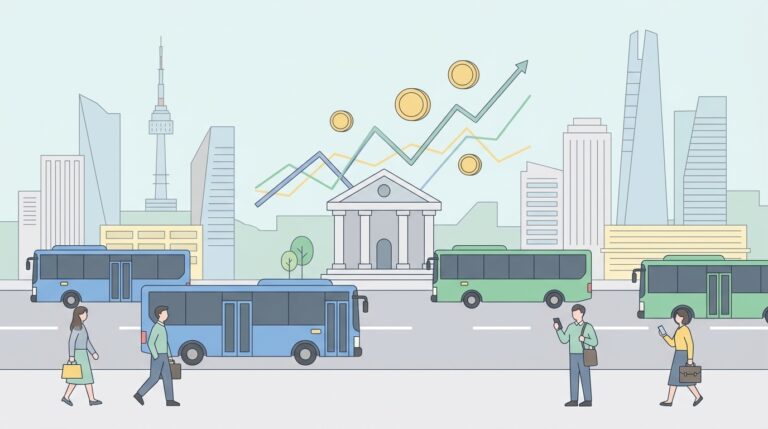
Picture this: It’s a scene straight out of the K-Drama My Liberation Notes (나의 해방일지). You’re standing at a bus stop in Gangnam, exhausted after a long day at work. The iconic blue bus arrives, you tap your T-money card, and finally sink into a seat. But as you look at the news screen on the bus, the headline flashes: “Seoul Bus Strike Imminent? The Bottomless Pit of the Semi-Public System.”
For beginners, public transport Korean is all about “How much is it?” and “Where is this station?” But as a C2 learner, you are living the real Korean professional life. You are paying taxes here. When the city announces fare hikes or debates the financial deficit of the “Semi-Public Bus System” (버스 준공영제), it affects your wallet.
If you want to move beyond ordering coffee and start debating social issues at the office water cooler with your Korean colleagues just like a true Seoulite, you need the vocabulary that captures the socio-economic nuances of Korean society. Let’s dive into the high-level expressions you need to survive and thrive in Korean public policy debates!
Phase 2: Core Expressions – Deep Dive
At the C2 level, we focus on idioms, economic terms, and the socio-cultural weight behind the words.
1. 밑 빠진 독에 물 붓기
- Pronunciation: [mit ppajin doge mul butgi] + [Sounds like: meet-ppa-jin doh-geh mool boot-gi]
- Meaning: (Literal) Pouring water into a bottomless jug / (Real nuance) Throwing money down the drain; an endless financial sinkhole.
- K-Culture Moment: This is the absolute favorite idiom of Korean journalists and angry taxpayers. When the government uses tax money to cover the deficits of private bus companies year after year without solving the root inefficiency, citizens sigh and use this phrase.
- Editor’s Insight: It evokes a sense of utter futility. You aren’t just saying “it’s expensive”; you are criticizing a systemic flaw that requires endless funding with no return.
- Situation Spectrum:
- Casual with friends: ✅ (Complaining about your own bad spending habits too!)
- Semi-formal (Coworkers): ✅
- Formal (Policy Debate/News): ✅
- 🤔 Think About It: Korea has a deep agrarian history where a ‘독’ (large earthenware jar) was essential for storing water and grains. Why do you think such traditional agricultural metaphors are still heavily used in modern high-tech Korean economic discussions?
2. 혈세 낭비
- Pronunciation: [hyeolse nangbi] + [Sounds like: hyul-seh nahng-bee]
- Meaning: (Literal) Waste of blood tax / (Real nuance) Waste of hard-earned taxpayers’ money.
- K-Culture Moment: You’ll hear this chanted at protests or written in the comment sections of Naver News when politicians approve inefficient bus routes (노선) just to please local voters.
- Editor’s Insight: ‘혈세’ (blood tax) is an incredibly powerful word. It shows that Koreans view taxes not just as a civic duty, but as their literal blood, sweat, and tears. Using this word instantly makes you sound like a politically aware local.
- Situation Spectrum:
- Casual with friends: ⚠️ (A bit too dramatic for light chats)
- Semi-formal (Coworkers): ✅
- Formal (Directly to your boss): 🚫 (Too aggressive unless you are analyzing a third-party issue)
- 🤔 Think About It: Does your native language have an emotional equivalent to “blood tax,” or are taxes viewed more clinically?
3. 재정 적자를 보전하다
- Pronunciation: [jaejeong jeokjareul bojeonhada] + [Sounds like: jae-jung juk-ja-reul bo-jun-ha-da]
- Meaning: (Literal/Real nuance) To cover/compensate for the financial deficit.
- K-Culture Moment: This is the core mechanism of the ‘Semi-Public Bus System’ (준공영제). The city controls the routes (public aspect), but private companies run the buses. If the routes don’t make money, the city covers the deficit. It’s a phrase you must know to read Korean business papers (경제 신문).
- Editor’s Insight: It’s highly formal and academic. Use this in a presentation or a formal debate, and your Korean counterparts will be incredibly impressed.
- Situation Spectrum:
- Casual with friends: 🚫 (Too stiff)
- Semi-formal (Coworkers): ⚠️ (Only in serious discussions)
- Formal (Business/Academic): ✅
Phase 3: Textbook vs. Real Korean
Let’s see how these concepts shift from textbook rigidity to real-world office banter.
[Discussing the Bus Fare Hike]
* 📖 Textbook Korean: 버스 회사의 적자 때문에 대중교통 요금이 인상될 예정입니다. (Due to the bus company’s deficit, public transport fares are scheduled to increase.)
* 🗣️ Real Korean: 아, 또 버스비 올라요? 내 월급 빼고 다 오르네. 완전 세금 먹는 하마라니까요. (Ah, bus fares going up again? Everything goes up except my salary. It’s totally a tax-eating hippo.)
* 💡 Why the difference?: Real Koreans use self-deprecating humor (“내 월급 빼고 다 오르네” – Everything rises except my salary) and vivid metaphors (“세금 먹는 하마” – tax-eating hippo) to cope with inflation and policy frustrations.
[Suggesting Efficiency Improvements]
* 📖 Textbook Korean: 효율성을 높이기 위해 버스 노선을 개편해야 합니다. (To increase efficiency, bus routes must be reorganized.)
* 🗣️ Real Korean: 안 타는 노선은 싹 다 정리해야지, 언제까지 밑 빠진 독에 물 붓기 할 거예요? (We need to clear out all the unused routes, how long are we going to pour water into a bottomless jug?)
* 💡 Why the difference?: Using “싹 다” (completely/all at once) adds an emotional emphasis typical of Korean conversational venting.
Phase 4: Cultural Context — K-Culture Deep Dive
4-1. The Non-Verbal ‘Nunchi’ of Policy Talk
When discussing taxes and public transport inefficiencies with Korean coworkers, non-verbal cues are vital. You don’t just state the facts; you must show empathy for the shared burden. A deep sigh (휴~), a slight clicking of the tongue (쯧쯧) while reading a news article on your phone, and shaking your head subtly before saying “혈세 낭비” creates a bond of shared civic frustration.
4-2. The K-Drama Connection: The Commuter’s Plight
Korean dramas like My Ahjussi (나의 아저씨) or Misaeng (미생) masterfully portray the soul-crushing nature of the daily commute (출퇴근). The bus is a sacred, albeit exhausting, public space. The “Semi-Public System” was actually introduced in 2004 to make these commutes more stable—ensuring buses arrived on time and drivers weren’t recklessly racing each other for passengers.
Critical View: While K-Dramas romanticize the melancholic bus ride looking out the window, reality involves navigating the political mess of strikes (파업), fare hikes, and tax burdens. Understanding the “Semi-Public” mechanism explains why the Seoul transit system is so magically efficient, but also why it’s a political ticking time bomb.
Phase 5: Real-World Roleplay Scenario
Setting: Tuesday, 12:30 PM. A chic but crowded cafe near Yeouido (Seoul’s financial district). You and your Korean coworker, Min-su, are grabbing an iced Americano after lunch. The cafe TV is broadcasting news about a potential strike by the Seoul Bus Union.
Characters:
– YOU: A foreign expat working as a senior manager in Seoul. You pay taxes and ride the blue bus every day.
– Min-su (35, Male): Your team member. Pragmatic, loves complaining about taxes, reads economic news daily.
Dialogue:
Min-su: 아휴, 또 버스 파업한대요. 출퇴근 어떻게 하라고 진짜… 😮💨
(Ahyu, tto beoseu pa-eophandaeyo. Chultoegeun eotteoke harago jinjja…)
[Ugh, they say there’s a bus strike again. How are we supposed to commute, seriously…]
YOU: 준공영제인데도 파업을 해요? 시에서 지원금 엄청 주잖아요.
(Jungongyeongje-indedo pa-eobeul haeyo? Si-eseo jiwongeum eomcheong jujanhayo.)
[They’re striking even with the semi-public system? The city gives them massive subsidies.]
Min-su: 그러니까요! 적자 나면 세금으로 다 보전해 주는데, 완전 모럴 해저드(Moral Hazard)죠.
(Geureonilkkayo! Jeokja namyeon segeumeuro da bojeonhae juneunde, wanjeon moreol haejeodeu-jyo.)
[Exactly! If they run a deficit, it’s all covered by taxes. It’s a total moral hazard.]
YOU: 맞아요. 매년 재정 부담이 커지는데 언제까지 이렇게 갈 수 있을지 모르겠어요.
(Majayo. Maenyeon jaejeong budami keojineunde eonjekkaji ireoke gal su isseulji moreugesseoyo.)
[Right. The financial burden grows every year, I don’t know how long we can keep going like this.]
Min-su: 내 말이요. 안 타는 노선은 좀 폐지하고 효율화해야지, 이건 완전…
(Nae mariyo. An taneun noseoneun jom pyejihago hyoyulhwa-haeyaji, igeon wanjeon…)
[That’s what I’m saying. They need to abolish unused routes and make it efficient, this is totally…]
🔀 Your Turn! How should you finish Min-su’s sentence?
– A) “…정말 나쁜 정책입니다.” (Textbook, but boring)
– B) “…돈이 아깝네요.” (Natural, but a bit basic for a C2 professional)
– C) “…밑 빠진 독에 물 붓기죠, 완전 혈세 낭비예요.” (Hitting the nail on the head!)✅ Best Choice: C — By using the exact idiom and advanced vocabulary, you align perfectly with the socio-economic tone of a Yeouido professional. You will instantly earn Min-su’s deep respect.
Phase 6: 10-Second Shadowing Drill
Master the intonation of a frustrated but analytical Seoul professional. Pay attention to the pauses!
😤 빈 차로 다니는 / 외곽 노선을 개편하지 않으면, / 이건 완전 / 밑 빠진 독에 / 물 붓기입니다.
(bin charo danineun / oegwak noseoneul gaehyeonhaji aneumyeon, / igeon wanjeon / mit ppajin doge / mul butgi-imnida.)
[If we don’t reorganize the suburban routes running empty, / this is completely / pouring water / into a bottomless jug.]
Phase 7: K-Culture Mini Dictionary
1. 준공영제
* Romanization: jun-gong-yeong-je
* English: Semi-public system
* Context: A hybrid system where the government regulates routes and fares, and guarantees profits, but private companies operate the vehicles. The pride and pain of Seoul transit.
2. 세금 먹는 하마
* Romanization: segeum meongneun hama
* English: Tax-eating hippo
* Context: A metaphorical term used in Korean media to describe public projects or policies that consume an exorbitant amount of taxpayer money with little return.
3. 지옥철 / 만원 버스
* Romanization: jiokcheol / manwon beoseu
* English: Hell subway / Fully packed bus
* Context: The quintessential Korean commuting experience. The physical discomfort often drives public demand for better transit, exacerbating the financial debate.
4. 노선 개편
* Romanization: noseon gaehyeon
* English: Route reorganization/reform
* Context: The political hot potato. Improving efficiency means cutting unused routes, but local politicians block this because residents will complain.
Phase 8: Expat & Traveler Survival Kit
If you are an expat or an advanced learner visiting Korea, bus strikes or route changes due to policy shifts can blindside you.
🆘 Survival Expressions for Transit Disruptions
– 🇰🇷 “오늘 버스 파업 때문에 배차 간격이 긴가요?” (oneul beoseu pa-eop ttaemune baecha gangyeogi gingayo?)
– 🗣️ English: Are the bus intervals long today due to the strike?
– 📍 Where to use: Asking people at the bus stop or checking with colleagues.
- 🇰🇷 “이 노선 우회해서 가나요?” (i noseon uhoehaeseo ganayo?)
- 🗣️ English: Is this route taking a detour?
- 📍 Where to use: Asking the bus driver during protests or route changes.
📌 Editor’s Transit Note
– The App: KakaoBus or Naver Map will show “우회” (Detour) in red if a route is changed, and will send alerts for “파업” (Strikes).
– The Real Talk: During strikes, the subway (지옥철) becomes 10x worse. Tell your boss: “파업 때문에 지하철로 우회하겠습니다” (I’ll take the subway due to the strike).
Phase 9: Critical Thinking — “One Step Deeper”
Language & Power: The Vocabulary of Civic Duty
🧠 Think Deeper:
Let’s look at the term “혈세” (Blood tax) and “보전하다” (To compensate/preserve). Korean vocabulary around public policy is highly moralistic. The semi-public bus system was designed with a collective, egalitarian mindset—ensuring that even someone living in a remote, unprofitable mountain village in Seoul gets a bus every 15 minutes. It reflects the Korean value of 공동체 (Community). However, when private entities exploit this collective good, the language used by citizens turns visceral (blood tax, moral hazard). It highlights the tension between Korea’s hyper-capitalist reality and its deep-rooted socialist-leaning expectations for public goods.💬 Your Turn: Does your country prioritize transit profitability (capitalism) or universal access (public good)? How does your language describe tax waste? Share in the comments!
Phase 10: FAQ & Common Mistakes
Q: Can I tell the bus driver that his company is “혈세 낭비”?
A: Absolutely NOT. The bus drivers are hardworking employees suffering from long hours. The “tax waste” debate is aimed at the corporate owners and city hall. Directing this at a driver is incredibly rude.
Q: Is ‘적자’ (deficit) used for personal finance too?
A: Yes! You can jokingly say “이번 달 내 통장 적자야” (My bank account is in the red this month).
❌ Common C2 Mistake #1: Saying “버스가 돈을 잃어요” (The bus loses money).
✅ Do This Instead: Use professional economic terms: “버스 회사가 적자를 내고 있어요” (The bus company is running a deficit).❌ Common C2 Mistake #2: Confusing ‘개선’ (Improvement) with ‘개편’ (Reorganization) when talking about bus lines.
✅ Do This Instead: For systems and routes, always use 노선 개편 (Route reform/reorganization). ‘개선’ is too generic.
Phase 11: Summary & Action Items
- One-Liner Summary: To discuss Seoul’s transit issues like a C2 native, you must master the economic idioms of “bottomless jugs” and “blood taxes” while understanding the delicate balance between public good and financial reality.
-
Action Mission 3 Steps:
- 🥉 Bronze: Stand in front of a mirror and dramatically sigh while saying “완전 밑 빠진 독에 물 붓기네.”
- 🥈 Silver: Search “버스 준공영제 파업” on YouTube and read the top Korean comments. See if you can spot the words you learned!
- 🥇 Gold: Next time you are in a taxi or with a Korean coworker, bring up a recent news article about transit fares and use “적자 보전” in your sentence.
- K-Culture Mission:
Watch an episode of My Liberation Notes and calculate how much of their life is spent on public transit. Ask yourself: Why is the government willing to spend billions of won to keep those buses running?
Phase 12: Interactive Quiz 🎯
1. Fill in the Blank:
“The city keeps covering the bus company’s deficits without any structural reform. This is completely ______________.”
A) 세금 내는 하마
B) 밑 빠진 독에 물 붓기
C) 혈세 보전
2. True or False – K-Culture Edition:
“The Seoul Semi-Public Bus System means the government owns all the buses and hires the drivers directly.”
3. Situational Judgment:
You are reading an official city hall report on bus efficiency. Which word are you most likely to see regarding changing the bus paths?
A) 노선 개선
B) 노선 개편
C) 길 바꾸기
(Answers: 1. B, 2. False – Private companies own the buses and hire drivers; the government just regulates routes and covers deficits, 3. B)
Frequently Asked Questions (FAQ)
Q: What does "밑 빠진 독에 물 붓기" mean in Korean and how do you pronounce it?
A: In Korean, "밑 빠진 독에 물 붓기" is pronounced [mit ppajin doge mul butgi] and means: (Literal) Pouring water into a bottomless jug / (Real nuance) Throwing money down the drain; an endless financial sinkhole.
Q: What does "혈세 낭비" mean in Korean and how do you pronounce it?
A: In Korean, "혈세 낭비" is pronounced [hyeolse nangbi] and means: (Literal) Waste of blood tax / (Real nuance) Waste of hard-earned taxpayers' money.
Q: What does "재정 적자를 보전하다" mean in Korean and how do you pronounce it?
A: In Korean, "재정 적자를 보전하다" is pronounced [jaejeong jeokjareul bojeonhada] and means: (Literal/Real nuance) To cover/compensate for the financial deficit.







