

Phase 1: Empathy & Immersion
Hello! I’m the Lead Editor at Daily Hangul.
Picture this K-Drama scene: The main character is sitting at a pojangmacha (street tent cart) late at night, or slumped over an office desk illuminated only by a monitor. They let out a long, heavy sigh—“Haaaa…”—rub their neck, and mutter a phrase that every Korean knows by heart. The subtitles might just say “I’m tired,” but is it just physical tiredness?
When you’re studying a new language, traveling around a bustling city like Seoul, or trying to keep up with the fast-paced K-Culture, you’re bound to feel exhausted. But if you try to directly translate “I’m tired” from English, you might end up using the wrong phrase, leaving Koreans confused. Knowing how to correctly express your fatigue not only prevents misunderstandings (like telling someone you’re ‘bored’ when you mean ‘tired’!) but also makes you sound like a true insider.
This guide is built from the real struggles of my beginner students. Let’s learn how to complain like a local!
Phase 2: Core Expressions Deep Dive
1. 피곤해요 (I’m tired)
- Pronunciation: pi-gon-hae-yo [pee-gohn-heh-yo]
- Meaning: Literal: I am tired. / Real nuance: My body is physically drained, or I lack energy.
- K-Culture Moment: You’ve just finished a full day of sightseeing in Myeongdong, or you’ve been working overtime (야근). You sit down on the subway, let out a sigh, and say this to your friend.
- Editor’s Insight: This is your go-to phrase for physical exhaustion. However, do NOT use this to mean you are “tired of” something (like “I’m tired of pizza”). It only means you need physical rest.
- Situation Spectrum:
- Casual with friends (피곤해): ✅
- Semi-formal with coworkers: ✅
- Formal with bosses: ⚠️ (Use sparingly; complaining to a boss isn’t always the best look!)
- 🤔 Think About It: Why do Koreans often say “I’m tired” as a greeting to close friends or coworkers? Could it be a way of seeking comfort and bonding over shared hard work?
2. 졸려요 (I’m sleepy)
- Pronunciation: jol-lyeo-yo [johl-lyuh-yo] (‘eo’ sounds like ‘uh’ in ‘up’)
- Meaning: Literal: I am sleepy. / Real nuance: My eyes are closing, I need a bed right now.
- K-Culture Moment: It’s 2 PM after a heavy meal of Korean BBQ. The “food coma” hits. A student studying for the university entrance exam at a study cafe slaps their cheeks to stay awake.
- Editor’s Insight: In English, we often say “I’m tired” when we mean “I need sleep.” In Korean, if you need sleep specifically, you MUST say 졸려요. If you say 피곤해요, they will tell you to take vitamins; if you say 졸려요, they will tell you to take a nap.
- Situation Spectrum:
- Casual with friends (졸려): ✅
- Semi-formal with coworkers: ⚠️
- Formal with bosses: 🚫 (Never tell your boss you are sleepy at work!)
- 🤔 Think About It: Do you differentiate between “tired” and “sleepy” in your native language as strictly as Koreans do?
3. 힘들어요 (It’s hard / I’m struggling)
- Pronunciation: him-deul-eo-yo [heem-deu-raw-yo] (‘eu’ sounds like the disgusted sound you make when stepping in gum)
- Meaning: Literal: It requires effort. / Real nuance: I am physically or emotionally drained; this situation is tough.
- K-Culture Moment: Carrying heavy luggage up the stairs of a subway station without an escalator. You pause, panting, and say this.
- Editor’s Insight: While 피곤해요 is internal (my body is tired), 힘들어요 is often external (this task/situation is making me tired). It’s incredibly common for expressing that you are having a hard time.
- Situation Spectrum:
- Casual with friends (힘들어): ✅
- Semi-formal with coworkers: ✅
- Formal with bosses: ⚠️
- 🤔 Think About It: Koreans use the word for “hard/difficult” to express personal exhaustion. What does this tell us about the connection between effort and emotion in Korean culture?
Phase 3: Textbook vs. Real Korean
[Expressing General Exhaustion]
* 📖 Textbook Korean: 저는 매우 피곤합니다. (I am very tired.)
* 🗣️ Real Korean: 아, 진짜 피곤해요. (Ah, I’m really tired.)
* 💡 Why it’s different: Koreans rarely use “저는 (I)” in conversation because the subject is obvious. Adding “아 (Ah)” at the start adds that crucial emotional flavor!
[When you desperately need sleep]
* 📖 Textbook Korean: 저는 졸립니다. (I am sleepy.)
* 🗣️ Real Korean: 아… 너무 졸려요. (Ah… I’m so sleepy.)
* 💡 Why it’s different: “너무 (too/so)” is the ultimate intensifier in modern Korean, used constantly in daily life to add dramatic flair.
Bottom Note for Beginners (A1): You don’t need complicated slang. Just dropping the “I am (저는)” and adding “진짜 (really)” or “너무 (so)” will instantly make you sound 10 times more natural!
Phase 4: Cultural Context — K-Culture Deep Dive
4-1. Non-verbal Elements: The “Aigo” Factor
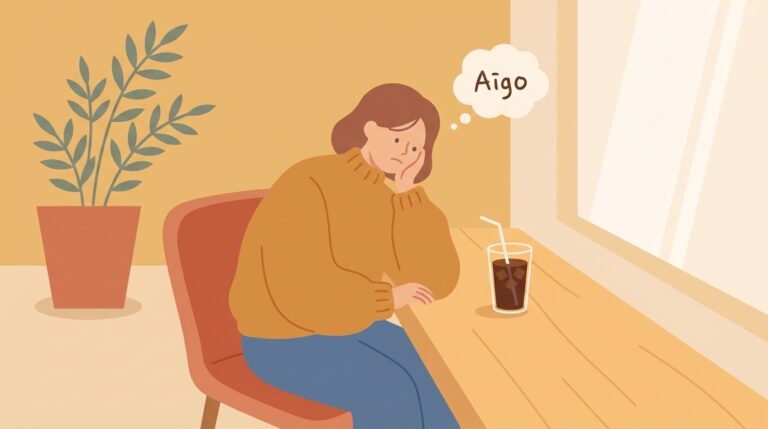
Language isn’t just words; it’s body language. When Koreans are tired, they don’t just say “피곤해요” with a straight face. They use a magic word: 아이고 (Aigo).
Action: Rub the back of your neck or softly stretch your shoulders, let out a sigh, and say, “Aigo… 진짜 피곤해요.” This is peak Korean Nunchi (reading the room)—you are signaling to others that you’ve worked hard and need a break, without demanding it aggressively.
4-2. K-Culture Link: The K-Drama Workplace & K-Travel
If you’ve watched K-Dramas like Misaeng, you know that Korean corporate culture often involves 야근 (Yageun – overtime work). Because everyone is working hard, expressing that you are “tired” (피곤해요) is almost a bonding activity among coworkers.
For a traveler, this phrase is a lifesaver. South Korea is a fast-paced country. You will walk a lot. Subway transfers can be long. When your travel buddy wants to visit the 5th cafe of the day, saying “피곤해요” is your ultimate survival tool to stop the itinerary and finally get some rest.
Phase 5: Real-Life Roleplay Scenario
Setting: 4:00 PM on a Thursday. You are at a sleek cafe in Hongdae. You and your Korean language exchange partner, Min-su, have been walking around shopping for 3 hours. You are exhausted.
Characters:
– YOU: A beginner Korean learner, feet hurting, desperately needing to sit down.
– Min-su (28): Your energetic Korean friend who wants to show you one more vintage shop.
Dialogue:
Min-su: 저기 빈티지 샵 하나 더 갈까요? 진짜 예뻐요!
(Jeogi bintiji syap hana deo galkkayo? Jinjja yeppeoyo!)
[Shall we go to one more vintage shop over there? It’s really pretty!]
YOU: 아… 민수 씨.
(Ah… Min-su ssi.)
[Ah… Min-su.]
🔀 Your Turn! How do you answer?
– A) “저는 안 졸려요.” (I am not sleepy.)
– B) “진짜 피곤해요. 조금 쉬어요.” (I’m really tired. Let’s rest a bit.)
– C) “지루해요.” (I’m bored.)✅ Best Choice: B — Reason: You clearly express your physical state (피곤해요) and offer a solution (쉬어요 – let’s rest).
⚠️ Choice A & C Analysis: ‘A’ means you aren’t sleepy, which doesn’t solve your tired feet. ‘C’ (bored) is a huge mistake! In English, you might say “I’m tired of walking,” but translating that to “bored” (지루해요) will offend Min-su, making him think you don’t like hanging out with him!
Min-su: 아! 미안해요. 제가 너무 많이 걸었네요. 여기서 커피 마시면서 쉬어요!
(Ah! Mianhaeyo. Jaega neomu mani georeonneyo. Yeogiseo keopi masimyeonseo swieoyo!)
[Ah! I’m sorry. I made us walk too much. Let’s rest here while drinking coffee!]
Phase 6: 10-Second Shadowing Drill
Let’s practice the rhythm! Read out loud, pausing at the slashes (/).
- 😩 Exhausted: 아이고, / 오늘 진짜 / 피곤해요. (Aigo, / oneul jinjja / pigonhaeyo.)
- 🥱 Sleepy: 밥을 먹어서 / 너무 / 졸려요. (Babeul meogeoseo / neomu / jollyeoyo.)
- 🥵 Struggling: 계단이 많아서 / 힘들어요. (Gyedani manaseo / himdeureoyo.)
Phase 7: K-Culture Mini Dictionary
1. 아이고
* Romanization: aigo
* English: Oh my / Ouch / Sigh
* Context: The ultimate Korean exclamation. Used when you’re tired, surprised, in pain, or frustrated. Saying this makes you sound 100% local.
2. 찜질방
* Romanization: jjimjilbang
* English: Korean bathhouse / Sauna
* Context: The ultimate remedy for “피곤해요”. Koreans go here to sweat out their fatigue, soak in hot water, and eat boiled eggs.
3. 야근
* Romanization: yageun
* English: Overtime work / Night shift
* Context: The primary reason Korean office workers are always saying “피곤해요”. A staple trope in K-Dramas.
4. 파이팅 / 화이팅
* Romanization: paiting / hwaiting
* English: Cheer up! / You can do it!
* Context: When someone says they are tired (피곤해요), the best response to encourage them is “화이팅!”
Phase 8: Traveler’s Survival Kit
When you are traveling, being tired is part of the package. Here is how you manage your energy levels in Korea!
🆘 Survival Phrases for the Tired Traveler
– 🇰🇷 “조금 쉬어요.” (jogeum swieoyo.)
– 🗣️ English: Let’s rest a little bit.
– 📍 Where to use: With your travel buddies or tour guide.
- 🇰🇷 “호텔로 가고 싶어요.” (hotello gago sipeoyo.)
- 🗣️ English: I want to go to the hotel.
- 📍 Where to use: In a taxi, or when telling your friends you are done for the day.
📌 Editor’s Travel Note
– Finding a place to rest: If you are too tired to walk but it’s too early for the hotel, just search for “카페” (Cafe) on KakaoMap or Naver Map. Korea has cafes on almost every corner, and it is perfectly acceptable to sit there for an hour with just one iced Americano to rest your feet!
Phase 9: Critical Thinking Corner — “A Step Deeper”
Media vs Reality: The ‘Pali-Pali’ Culture
If you watch K-Pop idols or K-Drama actors, they often talk about their grueling schedules. This reflects Korea’s famous 빨리빨리 (Pali-Pali / Hurry, Hurry) culture. Korea developed incredibly fast by working hard and fast. Consequently, being busy and tired is almost seen as a badge of honor or a sign that you are living a productive life. When Koreans say “피곤해요,” it’s not always a negative complaint; sometimes, it’s a mutual acknowledgment of hard work.
💬 Your Turn: In your culture, is complaining about being tired seen as a weakness, or is it a normal way to bond with coworkers? Share in the comments!
Phase 10: FAQ & Avoiding Mistakes
- Q: Can I say “피곤해요” to a shop owner or a taxi driver?
- A: You can, but they might be confused as to why you are sharing your personal feelings with them! It’s better used with people you are actually interacting or traveling with.
- Q: My friend asked me to go to a party, but I’m tired. Can I say “피곤해요”?
- A: Yes! “미안해요, 오늘 너무 피곤해요” (Sorry, I’m too tired today) is a perfectly polite and acceptable excuse to decline an invitation in Korea.
❌ Common Mistake #1: Translating “I’m tired of this” directly.
✅ Do this instead: Do not use “피곤해요” if you are annoyed or bored of something. If you are tired of eating the same food, or bored of a movie, use 지루해요 (It’s boring) or 질렸어요 (I’m sick of it). 피곤해요 is ONLY for physical/mental lack of energy!
Phase 11: Summary & Action Items
- One-Liner Summary: Use 피곤해요 when your body needs rest, and 졸려요 when your eyes are closing for sleep!
-
Action Mission:
- 🥉 Bronze (Solo): Stretch your arms, sigh, and say “아이고… 진짜 피곤해요” to yourself in the mirror.
- 🥈 Silver (Online): Comment on this post using “오늘 너무 피곤해요” and tell us why!
- 🥇 Gold (Real Life): Next time you are studying Korean and feel drained, message your language exchange partner: “공부해서 피곤해요!” (I’m tired from studying!)
- K-Culture Mission: Watch one episode of a modern-day K-Drama. Count how many times you spot a character rubbing their neck and sighing. I guarantee you’ll see it at least once!
Phase 12: Quiz — Interactive Challenge
1. Situational Judgment: You are watching a very slow, uninteresting movie. You want to tell your friend you are “tired of it.” Which phrase should you AVOID?
* A) 지루해요 (It’s boring)
* B) 재미없어요 (It’s not fun)
* C) 피곤해요 (I’m tired)
2. Fill in the Blank: After eating a massive bowl of Bibimbap, you can barely keep your eyes open.
“아… 너무 ( ).”
* A) 졸려요 (Sleepy)
* B) 힘들어요 (Hard)
3. True or False — K-Culture Edition:
Saying “아이고 (Aigo)” before complaining about being tired makes you sound rude and aggressive. (T/F)
(Answers: 1. C – Remember, 피곤해요 is only for physical exhaustion! / 2. A – Food comas require 졸려요! / 3. False – ‘Aigo’ actually softens the complaint and makes it sound natural!)
Frequently Asked Questions (FAQ)
Q: What does "피곤해요 (I'm tired)" mean in Korean and how do you pronounce it?
A: In Korean, "피곤해요 (I'm tired)" is pronounced [pi-gon-hae-yo [pee-gohn-heh-yo] and means: Literal: I am tired. / Real nuance: My body is physically drained, or I lack energy.
Q: What does "졸려요 (I'm sleepy)" mean in Korean and how do you pronounce it?
A: In Korean, "졸려요 (I'm sleepy)" is pronounced [jol-lyeo-yo [johl-lyuh-yo] and means: Literal: I am sleepy. / Real nuance: My eyes are closing, I need a bed right now.
Q: What does "힘들어요 (It's hard / I'm struggling)" mean in Korean and how do you pronounce it?
A: In Korean, "힘들어요 (It's hard / I'm struggling)" is pronounced [him-deul-eo-yo [heem-deu-raw-yo] and means: Literal: It requires effort. / Real nuance: I am physically or emotionally drained; this situation is tough.







