

Phase 1: Empathy (The K-Culture Cold Open)
Hello there! I’m your Daily Hangul Editor, your local Korean friend, and veteran tutor.
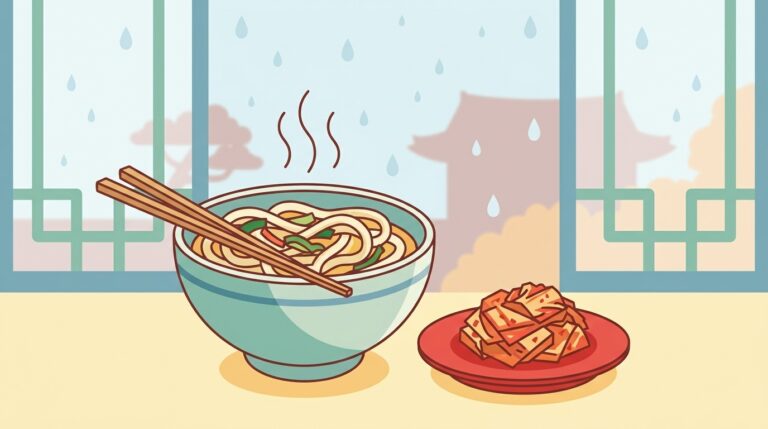
Imagine this: It’s a gloomy, rainy day in Seoul. You duck into a crowded, steamy restaurant to escape the downpour. The air is thick with the savory aroma of anchovy broth. All around you, people are enthusiastically slurping thick, hand-cut noodles from massive bowls, their faces turning red as they bite into crisp, garlic-heavy, unfermented kimchi.
Suddenly, you hear someone shout across the room: “Imo-nim! Geotjeori jom deo juseyo!”
If you’ve ever watched a K-Drama where the main characters bond over a cheap, warm meal after a long day, you know exactly what scene I’m talking about. In Korea, Kalguksu (칼국수, knife-cut noodles) and Geotjeori (겉절이, fresh unfermented kimchi) aren’t just food—they are a cultural institution. It’s the ultimate comfort food combo.
But here’s the catch: If you just eat the noodles quietly and leave, you’re missing out on half the experience. Knowing how to properly eat, praise, and request refills for this iconic duo will instantly upgrade your status from “lost tourist” to “respectable local foodie.” This guide is built from the real experiences of my students who wanted to know how to sound natural in a bustling Korean noodle shop. Let’s dive in!
Phase 2: Core Expressions Deep Dive
1. 국물이 정말 시원해요!
- Pronunciation: Gungmuri jeongmal siwonhaeyo! [Goong-moo-ree jung-mal shee-won-hae-yo!]
- Meaning: (Literal) The broth is really cold! vs. (Real Nuance) The hot broth is incredibly refreshing/hits the spot!
- K-Culture Moment: This is the classic “ahhh” moment. Picture a Korean dad taking a sip of boiling hot soup and exclaiming, “Ah, siwonhada!” It confuses every foreigner because the soup is clearly boiling!
- Editor’s Insight: At a B2 level, mastering this counter-intuitive expression is crucial. Siwonhada doesn’t just mean temperature-cold; it means “relieving,” “clearing,” or “satisfying to the stomach/soul.”
- Situation Spectrum:
- Casual with friends: ✅ (국물 시원하다! / Gungmul siwonhada!)
- Semi-formal (colleagues): ✅
- Formal (boss/elders): ✅ (It’s a great compliment to the chef!)
- ሴ Think About It: Why do Koreans use a word for “cool/refreshing” to describe boiling hot soup? How does this relate to the traditional Korean belief in Iyeolchiyeol (fighting heat with heat)?
2. 여기 겉절이 리필되나요?
- Pronunciation: Yeogi geotjeori ripildoenayo? [Yuh-gee gut-juh-ree ree-peel-dweh-na-yo?]
- Meaning: (Literal) Does fresh kimchi refill happen here? vs. (Real Nuance) Can I get a refill on the fresh kimchi?
- K-Culture Moment: You’re at a famous Kalguksu spot like Myeongdong Kyoja. You’ve eaten all the garlic-spicy Geotjeori, and your noodles are only half gone. You need more, ASAP.
- Editor’s Insight: Notice we use the English word “refill” (리필). Also, calling it Geotjeori instead of just Kimchi shows you know your stuff. Geotjeori is fresh, crunchy, and not sour, which perfectly balances the mild noodle broth.
- Situation Spectrum:
- Casual: ✅ (겉절이 좀 더 줘 / Geotjeori jom deo jwo)
- Semi-formal: ✅
- Formal: ⚠️ (Usually, the younger person in the group will ask the staff on behalf of everyone).
- ሴ Think About It: Korea is famous for free side-dish (banchan) refills. Does your home country have a similar “infinite refill” culture, or would you be charged extra?
3. 비 오는 날엔 역시 칼국수죠.
- Pronunciation: Bi oneun naren yeoksi kalguksujyo. [Bee oh-neun nah-ren yuk-shee kal-gook-soo-jyo.]
- Meaning: (Literal) On a rainy day, as expected, it’s Kalguksu. vs. (Real Nuance) Kalguksu is absolutely the best choice for a rainy day.
- K-Culture Moment: Walking out of the office with coworkers, it starts pouring. Someone suggests lunch. You drop this line, and everyone nods in deep respect.
- Editor’s Insight: The word yeoksi (역시) is pure magic. It means “as expected” or “of course.” It shows you share the collective cultural understanding that rainy days = warm flour-based foods (like noodles or pancakes).
- Situation Spectrum:
- Casual: ✅ (비 오니까 역시 칼국수지 / Bi onikka yeoksi kalguksuji)
- Semi-formal: ✅
- Formal: ✅
- ሴ Think About It: Food tied to weather is a huge part of Korean small talk. What is the “rainy day food” in your culture?
Phase 3: Textbook vs. Real Korean
[Praising the Food’s Harmony]
* ሴ Textbook Korean: 칼국수와 김치가 아주 잘 어울립니다. (The kalguksu and kimchi go very well together.)
* ሴ️ Real Korean: 와, 칼국수랑 겉절이 궁합 미쳤어요! (Wow, the synergy between the kalguksu and geotjeori is crazy!)
* ሴ Why the difference?: Koreans love the word “궁합” (gunghap – originally meaning marital compatibility) to describe perfect food pairings. Using “미쳤어요” (it’s crazy) is the ultimate modern compliment for food.
[Asking for a Refill]
* ሴ Textbook Korean: 김치를 더 주시겠습니까? (Would you please give me more kimchi?)
* ሴ️ Real Korean: 이모님~ 여기 겉절이 좀 더 주세요! (Auntie~ Please give us some more geotjeori here!)
* ሴ Why the difference?: Textbooks often teach overly formal, stiff requests. In busy restaurants, friendly but direct phrasing with “이모님” (Imo-nim – Auntie) or “사장님” (Sajang-nim – Boss) is much more natural and effective.
Bottom Note: For a B2 level, avoiding “미쳤어요” in front of your boss is smart. Instead, use “궁합이 정말 좋네요” (The pairing is really good) for a polite, sophisticated comment.
Phase 4: Cultural Context — K-Culture Deep Dive
4-1. Non-Verbal Cues: The Art of Scissors & Slurping
When you eat this combo, you will likely be handed a pair of tongs and scissors. Why? Geotjeori is often served in long, whole cabbage leaves to prove it’s freshly made. It’s your job to cut it into bite-sized pieces.
Also, forget what your parents taught you about eating quietly. In a Kalguksu shop, loud slurping (면치기 – myeonchigi) is practically required. It cools the noodles down and signals to the chef, “This is delicious!”
4-2. The K-Food Connection: Yin, Yang, and Garlic
Why does Geotjeori specifically go with Kalguksu? Most Kalguksu broths (seafood or chicken) are very mild and delicate. If you ate fermented, sour kimchi (신김치 – sin-kimchi) with it, the sourness would overpower the broth.
Geotjeori is freshly tossed in garlic, chili powder, and fish sauce. It’s bold, crunchy, and spicy. You take a bite of the intense Geotjeori, your mouth burns slightly, and then you wash it down with the warm, soothing noodle broth. It’s a culinary rollercoaster. This is why you’ll often see Korean vloggers and idols wrapping the long kimchi leaf around the noodles before slurping them up together!
Phase 5: Real-Life Roleplay Scenario
Setting: It’s 12:30 PM on a Tuesday. The monsoon rain is pouring outside. You are at a bustling, slightly noisy local Kalguksu shop in Jongno with your Korean team leader, Min-young. The steam is fogging up your glasses.
Characters:
– YOU: A foreign professional working in Seoul. You want to impress your boss with your Korean skills.
– Min-young (Team Leader): Friendly, loves food, treats you like a younger sibling.
Dialogue:
Min-young: 와, 밖에 비 엄청 오네요. 메뉴는 제가 골랐는데, 칼국수 괜찮아요?
(Wa, bakke bi eomcheong oneyo. Menyuneun jaega gollanneunde, kalguksu gwaenchanayo?)
[Wow, it’s really pouring outside. I picked the menu, is Kalguksu okay with you?]
YOU: 네, 팀장님! 비 오는 날엔 역시 칼국수죠.
(Ne, timjangnim! Bi oneun naren yeoksi kalguksujyo.)
[Yes, Team Leader! Kalguksu is definitely the best for a rainy day.]
Min-young: 오, 한국 사람 다 됐는데요? 여기요, 사장님! 칼국수 두 그릇 주세요.
(O, hanguk saram da dwaenneundeyo? Yeogiyo, sajangnim! Kalguksu du geureut juseyo.)
[Oh, you’re practically Korean now! Excuse me, boss! Two bowls of Kalguksu, please.]
(🎭 Stage Direction: The bowls arrive, along with a bright red plate of Geotjeori.)
Min-young: 국물 식기 전에 빨리 드세요.
(Gungmul sikgi jeone ppalli deuseyo.)
[Eat up quickly before the broth gets cold.]
YOU: 잘 먹겠습니다! (Takes a sip of the hot broth) 와…
(Jal meokgetseumnida! … Wa…)
[Thanks for the meal! … Wow…]
ሴ Your Turn! How should you react to the hot, delicious broth to impress your team leader?
– A) “국물이 너무 뜨거워요! 입천장 데일 뻔했어요.” (The broth is too hot! I almost burned the roof of my mouth.)
– B) “와, 국물이 정말 시원하네요!” (Wow, the broth is really refreshing/satisfying!)
– C) “칼국수 짱! 완전 미쳤어요!” (Kalguksu is the best! Totally crazy!)ሴ Best Choice: B — Using “시원하다” for a hot soup shows an advanced understanding of Korean culture and language. Your team leader will be deeply impressed.
⚠️ Choice C Analysis: “미쳤어요” (Crazy) and “짱” (Best) are fun, but too casual to use in front of a Team Leader during a work lunch.
(Continuing with choice B)
Min-young: 그쵸? 여긴 이 바지락 육수가 진짜 시원해요. 아, 겉절이도 먹어봐요.
(Geuchyo? Yeogin i bajirak yuksuga jinjja siwonhaeyo. A, geotjeorido meogeobwayo.)
[Right? The clam broth here is really satisfying. Ah, try the fresh kimchi too.]
YOU: (Eats the kimchi and noodles together) 와, 겉절이가 아삭아삭해서 칼국수랑 궁합이 최고네요.
(Wa, geotjeoriga asagasakhaeseo kalguksurang gunghabi choegoneyo.)
[Wow, the fresh kimchi is so crunchy, the synergy with the Kalguksu is the best.]
Min-young: 겉절이 벌써 다 먹었네. 제가 더 달라고 할게요.
(Geotjeori beolsseo da meogeonne. Jaega deo dallago halgeyo.)
[We already finished the kimchi. I’ll ask for more.]
YOU: 아, 제가 할게요! 이모님~ 여기 겉절이 리필되나요?
(A, jaega halgeyo! Imonim~ yeogi geotjeori ripildoenayo?)
[Ah, I’ll do it! Auntie~ can we get a refill on the fresh kimchi here?]
Phase 6: 10-Second Shadowing Drill
Let’s practice the most important survival phrase when you run out of that delicious kimchi. Follow the natural intonation and pauses!
ሴ Brightly and politely to the busy restaurant auntie:
이모님~ / 여기 / 겉절이 좀 / 더 주세요!
(I-mo-nim~ / yeo-gi / geot-jeo-ri jom / deo ju-se-yo!)
Phase 7: K-Culture Mini-Dictionary
1. 겉절이 (Geotjeori)
* Romanization: geotjeori
* English: Fresh, unfermented kimchi
* Context: Unlike standard kimchi which is aged and sour, geotjeori is made fresh daily. It’s crispy, sweet, and heavily seasoned, meant to be eaten immediately.
2. 면치기 (Myeonchigi)
* Romanization: myeonchigi
* English: Noodle slurping
* Context: A popular term popularized by Korean mukbang and variety shows. Hitting your lips with the noodles to make a loud slurping sound. It shows you are passionately enjoying the food.
3. 궁합 (Gunghap)
* Romanization: gunghap
* English: Synergy / Match / Harmony
* Context: Originally used for marital compatibility told by fortune tellers. Now widely used to describe food pairings that enhance each other (like Kalguksu and Geotjeori, or Beer and Fried Chicken).
4. 시원하다 (Siwonhada)
* Romanization: siwonhada
* English: Cool / Refreshing / Relieving
* Context: A complex emotional and physical adjective. Used for cool breezes, cold drinks, but also boiling hot soups that “clear” your throat and stomach, or getting a good massage.
Phase 8: Traveler’s Survival Kit
Whether you’re exploring Gwangjang Market or a local neighborhood alley, noodle shops have their own set of rules. Here are the top survival phrases you need.
ሴ Survival Phrase #1: Asking for an Apron
– ሴ “앞치마 좀 주시겠어요?” (Apchima jom jusigesseoyo?)
– ሴ English Pronunciation: [Ap-chee-ma jom joo-shee-geh-ssuh-yo?]
– ሴ Where to use: Noodle shops, BBQ places. Kalguksu broth will splash on your white shirt!ሴ Survival Phrase #2: Self-Serve Check
– ሴ “반찬은 셀프인가요?” (Banchaneun selpeuingayo?)
– ሴ English Pronunciation: [Ban-chan-eun self-eu-in-ga-yo?]
– ሴ Where to use: Small restaurants. If you see a sign saying “추가 반찬은 셀프” (Extra side dishes are self-serve), don’t ask the staff, just grab a plate and scoop it yourself!ሴ Survival Phrase #3: Adjusting Spiciness
– ሴ “양념장(다대기)은 따로 주세요.” (Yangnyeomjang(dadaegi)eun ttaro juseyo.)
– ሴ English Pronunciation: [Yang-nyum-jang-eun tta-ro joo-se-yo.]
– ሴ Where to use: Broth-based restaurants. Dadaegi is a spicy red paste often plopped into the soup. If you can’t handle spice, ask for it on the side!ሴ Editor’s Travel Note:
Kalguksu portions in Korea are notoriously huge. If you are traveling with someone who doesn’t eat much, check if the restaurant requires “1인 1메뉴” (One order per person). If they do, you usually can’t share one bowl between two people!
Phase 9: Critical Thinking — “A Step Deeper”
Food & Identity: The Philosophy of Balance
Why are Koreans so obsessed with finding the perfect gunghap (synergy) between foods like mild Kalguksu and spicy Geotjeori? It stems from the traditional philosophy of Yin and Yang (Eumyang-ohaeng). Korean meals are never just one flavor; they are engineered to balance temperature, texture, and taste. The hot soup warms the body, while the cold, spicy kimchi wakes up the palate. This “togetherness” on the plate also reflects the Korean community spirit—individual ingredients are good, but they are only considered “perfect” when they support and elevate each other.
ሴ Think Deeper:
Does your culture have food pairings that are considered “inseparable”? How does your culture balance flavors in a single meal?ሴ Your Turn: Share your country’s ultimate food “gunghap” in the comments below!
Phase 10: FAQ & Avoiding Common Mistakes
Q: Can I drink the broth directly from the heavy bowl, or do I have to use a spoon?
Yes, absolutely! Lifting the bowl with both hands and taking a big sip is highly encouraged. Just remember to say “Ah~ siwonhada!” after you put it down.
Q: Can I ask for unlimited Geotjeori refills?
Usually, yes! But use common sense. Asking for a refill 1-2 times is completely normal. However, taking a massive amount and leaving it uneaten is considered very rude.
Q: What if the Geotjeori is too spicy for me?
You can simply wash off a little bit of the spice in your broth, though it changes the broth’s color. Alternatively, ask the staff: “단무지 있나요?” (Do you have pickled radish?) to soothe the heat.
❌ Common Mistake #1: Calling Geotjeori “Kimchi-jjigae” or confusing it with fermented kimchi.
✅ Do this instead: Use the exact word “겉절이” (Geotjeori). The restaurant owner will be incredibly impressed that a foreigner knows the difference between fermented kimchi and fresh kimchi!❌ Common Mistake #2: Ordering “Siwonhan Kalguksu” (시원한 칼국수) thinking you will get cold noodles.
✅ Do this instead: If you want physically cold noodles, you must order Naengmyeon (냉면) or Kongguksu (콩국수). Remember, “siwonhada” is an emotional/physical reaction to eating it, not a menu temperature option!
Phase 11: Summary & Action Items
One-Liner Summary: To eat Kalguksu like a true Korean, praise the hot broth with “Siwonhada,” ask for Geotjeori refills confidently, and remember that rainy days equal noodle days!
⚡ Action Missions:
– ሴ Bronze (Solo): Stand in front of your mirror and practice asking for a refill: “이모님, 여기 겉절이 리필되나요?”
– ሴ Silver (Online): Find a YouTube video of a Korean eating Kalguksu and leave a comment: “비 오는 날엔 역시 칼국수죠!”
– ሴ Gold (Real World): Go to a Korean restaurant, find a side dish you like, and successfully ask for a refill in Korean.
ሴ K-Culture Mission:
The next time it rains where you live, skip the burger. Find a local Asian market, grab some fresh noodles and kimchi, and experience the magical gunghap for yourself!
Phase 12: Interactive Challenge (Quiz)
1. Situational Judgment:
You take a sip of the bubbling hot seafood Kalguksu broth. It tastes incredibly deep and relieves your tired stomach. What is the most natural, B2-level Korean reaction?
– A) 앗, 차가워요! (Ah, it’s cold!)
– B) 국물이 시원하네요. (The broth is refreshing/satisfying.)
– C) 김치 더 주세요. (Give me more kimchi.)
2. Fill in the Blank:
When it starts raining, Koreans collectively crave warm, flour-based foods.
“비 오는 날엔 ( ) 칼국수죠.” (Hint: “As expected / Of course”)
3. True or False (K-Culture Edition):
When eating at a busy, casual noodle shop, it is considered rude to slurp your noodles loudly.
(Answers: 1. B, 2. 역시(yeoksi), 3. False – Slurping or “Myeonchigi” shows you are enjoying the food!)
Did you enjoy this lesson? What is your favorite Korean noodle dish? Let me know in the comments!
Frequently Asked Questions (FAQ)
Q: What does "국물이 정말 시원해요!" mean in Korean and how do you pronounce it?
A: In Korean, "국물이 정말 시원해요!" is pronounced [Gungmuri jeongmal siwonhaeyo! [Goong-moo-ree jung-mal shee-won-hae-yo!] and means: (Literal) The broth is really cold! vs. (Real Nuance) The hot broth is incredibly refreshing/hits the spot!
Q: What does "여기 겉절이 리필되나요?" mean in Korean and how do you pronounce it?
A: In Korean, "여기 겉절이 리필되나요?" is pronounced [Yeogi geotjeori ripildoenayo? [Yuh-gee gut-juh-ree ree-peel-dweh-na-yo?] and means: (Literal) Does fresh kimchi refill happen here? vs. (Real Nuance) Can I get a refill on the fresh kimchi?
Q: What does "비 오는 날엔 역시 칼국수죠." mean in Korean and how do you pronounce it?
A: In Korean, "비 오는 날엔 역시 칼국수죠." is pronounced [Bi oneun naren yeoksi kalguksujyo. [Bee oh-neun nah-ren yuk-shee kal-gook-soo-jyo.] and means: (Literal) On a rainy day, as expected, it's Kalguksu. vs. (Real Nuance) Kalguksu is absolutely the best choice for a rainy day.







