

Phase 1: Empathy & The “Aha!” Moment
Hello there! It’s your Daily Hangul Editor.
Imagine this: You are working at a sleek tech company in Pangyo (Korea’s Silicon Valley), or perhaps you’re a grad student at a university in Seoul. You’ve just launched a massive survey to analyze consumer behavior or fandom preferences. The results come in, and you look at the data. A staggering 70% of respondents chose “보통이다” (Average/Neutral) on your Likert scale.
Are Koreans just perpetually unbothered? Why does no one click “매우 그렇다” (Strongly Agree)?
If you’ve ever tried to translate an English survey directly into Korean, you might have used “강력하게 동의한다” (I powerfully agree). While grammatically correct, to a Korean reader, this sounds like you are swearing a blood oath in a historical K-Drama.
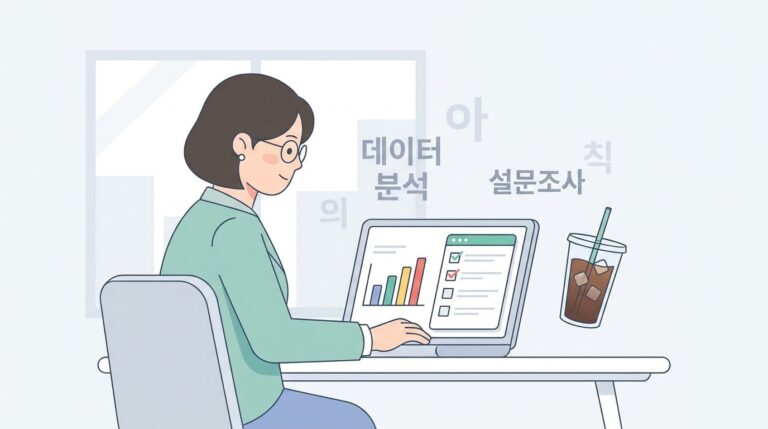
At the C1 level, language isn’t just about getting the grammar right; it’s about understanding the psychology of the people speaking it. Today, we are diving deep into the world of Data Analysis & Survey Design (설문 조사 설계 및 분석). By the end of this module, you won’t just know the vocabulary; you’ll understand how to decode the hidden Nunchi in Korean data. Let’s get started!
Phase 2: Core Expressions Deep Dive
To sound like a true professional, you need to master the exact phrasing Koreans use in surveys and data analysis.
1. 매우 그렇다 / 그렇지 않은 편이다
- Pronunciation: [mae-u geureota / geureochi aneun pyeonida]
- Meaning: Strongly Agree / Tend to Disagree
- K-Culture Moment: You open a Korean MBTI test (which Koreans absolutely love). The scale doesn’t say “Agree/Disagree.” It says “그렇다” (It is so) and “아니다” (It is not).
- Editor’s Insight: English surveys use verbs: “I agree.” Korean surveys use adjectives describing the state of things: “It is so” (그렇다). Adding “~편이다” (tend to) softens the blow. Koreans naturally gravitate towards softer, less absolute phrasing to avoid sounding arrogant or combative.
- Situation Spectrum:
- Casual surveys (MBTI with friends): ✅
- Professional corporate surveys: ✅
- Everyday verbal agreement: ⚠️ (Sounds too robotic in spoken conversation)
- 🤔 Think About It: Why do Koreans prefer “그렇지 않은 편이다” (I tend to not be that way) over “전혀 아니다” (Absolutely not)? How does this reflect the cultural value of maintaining harmony?
2. 유의미한 상관관계를 보이다
- Pronunciation: [yu-uimihan sang-gwangwangyereul boida]
- Meaning: To show a significant correlation
- K-Culture Moment: A scene in a K-Drama where the sharp-suited protagonist presents market research to the board of directors, proving why their new cosmetic line will beat the rival company.
- Editor’s Insight: This is the bread and butter of data analysis presentations. “유의미한” (significant/meaningful) is a high-level academic and corporate term. Using this in your presentation instantly upgrades your Korean from “student” to “expert.”
- Situation Spectrum:
- Friends chatting at a cafe: 🚫 (Way too formal)
- Office meetings / Academic presentations: ✅
- Emailing a professor: ✅
- 🤔 Think About It: In English, “significant” can just mean “important.” In Korean, “유의미한” literally means “having a meaning.” How does this change the way you interpret data points that fall outside the norm?
3. 주관식 문항 / 객관식 문항
- Pronunciation: [jugwansik munhang / gaekgwansik munhang]
- Meaning: Open-ended question / Multiple-choice question
- K-Culture Moment: High school students in a K-Drama agonizing over their CSAT (Suneung) exams. In Korea, almost all crucial exams are “객관식” (multiple choice), which heavily shapes how Koreans approach problems with a “finding the one right answer” mindset.
- Editor’s Insight: When designing a survey, you’ll need to decide whether to give options or let them write freely. Be warned: Koreans are notorious for skipping “주관식” (open-ended) questions in marketing surveys unless there is a massive reward attached!
- Situation Spectrum:
- School / Academic settings: ✅
- Professional Survey Design: ✅
- Casual conversations: ⚠️
- 🤔 Think About It: Does your education system favor open-ended discussions or multiple-choice precision? How might that affect how people answer surveys?
Phase 3: Textbook vs. Real Korean
Let’s look at how textbooks teach survey phrases versus what actually gets results in the Korean corporate wild.
[Asking for Survey Participation]
* 📖 Textbook Korean: 이 설문 조사에 참여해 주시겠습니까? (Would you please participate in this survey?)
* 🗣️ Real Korean: 1분만 시간 내주시면 추첨을 통해 기프티콘을 드립니다! (If you spare just 1 minute, we’ll give you a Gifticon through a lucky draw!)
* 💡 Why the difference?: In fast-paced Korea, time is money. Bribing participants with a Starbucks “Gifticon” (digital gift card) is practically an unwritten rule (국룰) in Korean market research.
[Reporting the Results]
* 📖 Textbook Korean: 결과가 아주 좋습니다. (The result is very good.)
* 🗣️ Real Korean: 데이터 상으로 긍정적인 지표가 확인되었습니다. (From the data, positive indicators have been confirmed.)
* 💡 Why the difference?: In C1/C2 business contexts, you must depersonalize your statements. Relying on “지표” (indicators) rather than simple adjectives (“good/bad”) sounds infinitely more professional.
Phase 4: Cultural Context — K-Culture Deep Dive
4-1. The Non-verbal Art of the “Neutral Option” (눈치와 설문조사)
When analyzing Korean survey data, you must understand Nunchi (눈치)—the subtle art of reading the room. Koreans often avoid the extreme ends of a Likert scale (매우 그렇다 / 전혀 그렇지 않다). Choosing an extreme can feel like “sticking out” or being too opinionated, which contradicts traditional values of modesty.
Therefore, if a Korean product survey shows a 40% “보통이다” (Average) and 45% “그렇다” (Agree), that is actually a massive success! If they hate it, they usually just won’t answer your survey at all.
4-2. The “Coffee Coupon” Economy (K-Business Culture)
Whether you are a university student doing a thesis or a marketer at Samsung, there is one universal truth: You cannot get survey responses in Korea without offering an “Ah-Ah” (아아 – Iced Americano).
The digital gifting culture via KakaoTalk is so deeply ingrained that budget proposals for any survey inherently include hundreds of dollars allocated solely for coffee “Gifticons.”
Phase 5: Real-Life Roleplay Scenario
Setting: It’s 2 PM on a Tuesday in a sleek glass meeting room in Pangyo. You and your Korean colleague, Min-ji (Senior Marketer, 30, sharp and pragmatic), are reviewing the dismal response rates of a recent consumer survey for a new app feature.
YOU (Data Analyst): 민지 선배님, 설문조사 응답률이 예상보다 너무 저조한데요.
(minji seonbaenim, seolmunjosa eungdamnyuri yesangboda neomu jeojohandeyo.)
[Senior Min-ji, the survey response rate is much lower than expected.]
Min-ji: 아, 그래요? 문항 수가 너무 많은 거 아니에요? 객관식 몇 개예요?
(a, geuraeyo? munhang suga neomu maneun geo anieyo? gaekgwansik myeot gaeyeyo?)
[Oh, really? Aren’t there too many questions? How many multiple-choice questions are there?]
YOU: 객관식 20개, 주관식 3개입니다. 유의미한 데이터를 얻으려면 이 정도는 필수라서요.
(gaekgwansik 20gae, jugwansik 3gae-imnida. yu-uimihan deiteoreul eodeuryeomeon i jeongdoneun pilsuraseoyo.)
[20 multiple choice, 3 open-ended. To get significant data, this amount is essential.]
Min-ji: (Sighs) 주관식이 3개나 있다고요? 한국 사람들은 주관식 보면 바로 창 닫아버려요. 보상도 없이 누가 그걸 다 써요.
(jugwansigi 3gaena itdagoyo? hanguk saramdeureun jugwansik bomeyon baro chang dadabeoryeoyo. bosangdo eopsi nuga geugeol da sseoyo.)
[Three open-ended questions? Koreans close the window the moment they see open-ended questions. Who would write all that without a reward?]
🔀 Your Turn! How will you respond as a savvy professional?
– A) “그래도 학술적으로 주관식이 꼭 필요합니다.” (But academically, open-ended questions are absolutely necessary.)
– B) “그럼 주관식은 선택 사항으로 바꾸고, 참여자 전원에게 스타벅스 기프티콘을 쏘는 건 어떨까요?” (Then how about making open-ended optional, and shooting a Starbucks Gifticon to all participants?)
– C) “진짜요? 대박. 그럼 그냥 다 지울게요.” (Really? Jackpot. Then I’ll just delete them all.)✅ Best Choice: B — Reason: You show flexibility, use proper business problem-solving, and suggest the magic word: 기프티콘 (Gifticon). You also effectively use the verb “쏘다” (to shoot/to treat), showing native-like flair!
⚠️ Choice A Analysis: Too stubborn. You’ll never get your data.
⚠️ Choice C Analysis: Too casual. “대박” is not appropriate for a professional meeting room in Pangyo.
Phase 6: 10-Second Shadowing Drill
Practice this sentence to sound like a persuasive Korean researcher. Pay attention to the pauses!
🥺 간단한 / 객관식 설문이니, / 많은 참여 / 부탁드립니다!
(gandanhan / gaekgwansik seolmun-ini, / maneun chamyeo / butakdeurimnida!)
Translation: It is a simple multiple-choice survey, so we ask for your generous participation!
Phase 7: K-Culture Mini Dictionary
1. 눈치 (Nunchi)
* Romanization: nunchi
* English: Social intuition / Reading the room
* Context: In data analysis, Nunchi explains why respondents avoid extreme answers and cluster in the “Average” or “Tend to agree” categories.
2. 기프티콘 (Gipeutikon)
* Romanization: gipeutikon
* English: Gifticon (Digital mobile voucher)
* Context: A portmanteau of “Gift” and “Icon.” Without these, your survey response rate will be near zero.
3. 국룰 (Gungnul)
* Romanization: gungnul
* English: Unwritten rule / National rule
* Context: Giving an iced americano for completing a survey is an absolute gungnul in Korea.
4. 팩폭 (Paekpok)
* Romanization: paekpok
* English: Fact-bombing (bluntly stating the hard truth)
* Context: Used when a data analyst presents hard, undeniable statistical evidence that destroys someone’s optimistic assumptions.
Phase 8: Traveler/Expat Survival Kit
Wait, what if YOU are the one being surveyed? If you walk around vibrant areas like Gangnam, Hongdae, or Sinchon, you will eventually be approached by people holding clipboards. Sometimes they are students doing a project… but often, they are pseudo-religious cult members pretending to do a psychological survey to recruit you.
🆘 Survival Expression #1: Dodging Street Surveys
– 🇰🇷 “죄송합니다, 바빠서요.” (joesonghamnida, bappaseoyo.)
– 🗣️ English guide: [Sorry, I’m busy.]
– 📍 Where to use: Sinchon, Gangnam, Hongdae streets.
– 💡 Pro Tip: Do not make eye contact, do not slow down. Keep walking while saying this. If they ask “심리 테스트 한 번만…” (Just one psychology test…), firmly say “괜찮습니다” (I’m okay/No thanks) and walk away.📌 Editor’s Travel Note
– QR Code Surveys: In Korean cafes or pop-up stores, you might see a sign saying “설문조사 참여 시 굿즈 증정” (Giveaway upon survey completion). These are safe! Just scan the QR code with your phone, click a few “보통이다” options, and claim your free K-Beauty samples or stickers!
Phase 9: Critical Thinking — “One Step Deeper”
🧠 Think Deeper: Language & Power in Data
In Korean surveys, the use of language deeply reflects the societal power distance. Notice how the survey always addresses the respondent in the highest polite form (참여해 주시겠습니까?), yet the response options for the user are written in the plain form (매우 그렇다 / 그렇지 않다).This is because the survey options are considered an individual’s “internal monologue.” In Korean, when you talk to yourself or state a universal truth, you use the plain form (-다). The survey creators humble themselves, while giving the respondent the “power” to state their objective truth.
💬 Your Turn: Have you noticed any differences in how surveys are written in your country? Do they use “I” statements like “I strongly agree”? Share your thoughts below!
Phase 10: FAQ & Avoiding Mistakes
Q: When writing a survey for Gen Z (대학생), can I use informal language (반말) to sound hip?
* A: MAYBE, but handle with care. Some trendy pop-up stores do use a casual, playful tone (예: “너의 최애템은 뭐야?” – What’s your bias item?), but for anything official, stick to 존댓말 (Polite language). Politeness equals professionalism in Korea, regardless of age.
Q: How do I translate “Neutral”?
* A: Never translate it as “중립” (Neutral—used for politics or car gears). Use “보통이다” (Average/Normal).
❌ Common Mistake #1: Translating “Strongly Agree” directly as “강력하게 동의한다.”
✅ Do this instead: Use “매우 그렇다” (Very much so) or “매우 동의함” for written scales. It sounds natural and culturally appropriate.
Phase 11: Summary & Action Items
One-Liner Summary: Mastering Korean survey design requires ditching direct translations and embracing indirect phrasing like “~편이다” and the power of the Gifticon.
Action Mission:
– 🥉 Bronze: Say “유의미한 결과를 보였습니다” (It showed a significant result) out loud 3 times in front of the mirror, pretending you are a CEO.
– 🥈 Silver: Next time you see a YouTube poll by a Korean creator, read the options and see if they use “그렇다” or “보통이다”.
– 🥇 Gold: Take a Korean MBTI test online. Don’t worry about the result—just analyze how the Likert scale phrasing is constructed in Korean!
Phase 12: Interactive Quiz
1. Situational Judgment: You need to increase the response rate for your company’s user satisfaction survey. What is the most culturally accurate strategy in Korea?
– A) Send a deeply emotional 5-page email begging for help.
– B) Offer a lottery for an Iced Americano Gifticon.
– C) Add more open-ended questions.
2. Fill in the Blank:
“이번 설문조사에서 A그룹과 B그룹 간에 ________ 상관관계가 나타났습니다.”
(In this survey, a ________ correlation appeared between Group A and Group B.)
– A) 유의미한 (significant)
– B) 강력한 (powerful)
– C) 보통의 (average)
(Answers: 1. B – Coffee is king. 2. A – ‘유의미한’ is the standard academic/corporate term for data significance.)
Did you get them right? Data might be objective, but the language used to gather it is profoundly human. See you in the next lesson!
Frequently Asked Questions (FAQ)
Q: What does "매우 그렇다 / 그렇지 않은 편이다" mean in Korean and how do you pronounce it?
A: In Korean, "매우 그렇다 / 그렇지 않은 편이다" is pronounced [mae-u geureota / geureochi aneun pyeonida] and means: Strongly Agree / Tend to Disagree
Q: What does "유의미한 상관관계를 보이다" mean in Korean and how do you pronounce it?
A: In Korean, "유의미한 상관관계를 보이다" is pronounced [yu-uimihan sang-gwangwangyereul boida] and means: To show a significant correlation
Q: What does "주관식 문항 / 객관식 문항" mean in Korean and how do you pronounce it?
A: In Korean, "주관식 문항 / 객관식 문항" is pronounced [jugwansik munhang / gaekgwansik munhang] and means: Open-ended question / Multiple-choice question






