

Phase 1: Empathy
Hello! I’m the Lead Editor of Daily Hangul, your veteran tutor and local culture navigator in Korea.
Picture this: You are watching a historical K-Drama (Sageuk). The powerful King or the noble scholar is sitting in a grand, elevated room with wide-open doors, surrounded by guests or politicians. Meanwhile, the Queen or the female lead is tucked away deep inside the compound, in a cozy, secluded room wrapped in warm light. Have you ever wondered why they are always in these specific spaces?
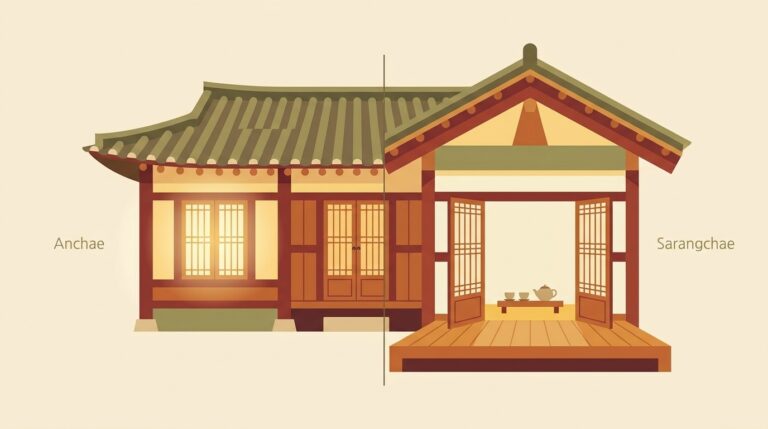
This isn’t just a set design choice; it’s a reflection of the traditional Korean house, the 한옥 (Hanok), and its strict division between the 안채 (Anchae) and the 사랑채 (Sarangchae).
For a C1-level learner, knowing the words ‘house’ or ‘room’ isn’t enough. Understanding the functional and philosophical division of these spaces unlocks a treasure trove of advanced Korean vocabulary, idiomatic expressions, and cultural nuances that Koreans still use today—even when sitting in a modern high-rise apartment! If you want to sound like a true insider and grasp the subtext of Korean social dynamics, we need to step over the threshold of the Hanok.
Note: The insights in this post are drawn from years of answering the exact questions advanced learners ask when they hit a ‘cultural wall’ in their language studies.
Phase 2: Core Expressions Deep Dive
Let’s explore how the architectural layout of the Hanok has given birth to expressions we use every day.
1. 안사람 (An-saram) / 바깥양반 (Bakkat-yangban)
- Pronunciation: [an-sa-ram] (‘an’ sounds like ‘on’ in ‘honor’) / [ba-kkat-yang-ban] (‘kkat’ is a tense, sharp ‘kat’ sound)
- Meaning: Literal: ‘Inside person’ / ‘Outside nobleman’. Real nuance: ‘Wife’ / ‘Husband’.
- K-Culture Moment: In a K-Drama set in the 1980s or 90s, you might hear a middle-aged man lovingly (or jokingly) referring to his wife as “우리 안사람 (our inside person)” to his colleagues at a hoesik (company dinner).
- Editor’s Insight: The Anchae (안채) was the inner quarters managed by women, while the Sarangchae (사랑채) was the outer quarters where men entertained guests. Thus, a wife became the ‘inside person’ and the husband the ‘outside person’. Today, young people rarely use this seriously, but it survives as an affectionate, retro, or slightly self-deprecating joke among married couples.
- Situation Spectrum:
- Friends (Joking context): ✅
- Co-workers (Semi-formal): ⚠️ (Only acceptable if you are much older and referring to your own spouse)
- Formal/Business: 🚫 (Use 아내/남편 instead)
- 🤔 Think About It: How does your native language refer to spouses? Do the terms reflect historical gender roles or physical spaces in the home like Korean does?
2. 사랑방 (Sarangbang)
- Pronunciation: [sa-rang-bang] (‘sa’ like in ‘safari’, ‘rang’ like ‘rung’, ‘bang’ like ‘bong’ with an ‘a’)
- Meaning: Literal: ‘The guest room in the Sarangchae’. Real nuance: A local hangout spot or community hub.
- K-Culture Moment: You find a cozy indie cafe in your neighborhood where everyone seems to know each other, chatting with the barista. A local reviewer might write on Naver Maps: “여기는 우리 동네 사랑방이에요!” (This is our neighborhood’s Sarangbang!)
- Editor’s Insight: Historically, the Sarangbang was where the male head of the household studied, wrote poetry, and invited guests to discuss politics or art. It was the original ‘networking hub’. In modern Korea, a Sarangbang refers to any welcoming place where people gather to socialize—like a beloved local pub, cafe, or even an online forum!
- Situation Spectrum:
- Friends (Casual): ✅
- Co-workers (Semi-formal): ✅
- Formal/Business: ✅ (Often used in PR: “A new cultural Sarangbang for citizens”)
- 🤔 Think About It: Koreans love communal spaces. Is there a specific word in your culture that signifies a ‘third place’ outside of work and home where the community naturally gathers?
3. 내조 (Naejo) / 외조 (Oejo)
- Pronunciation: [nae-jo] (‘nae’ like ‘net’) / [oe-jo] (‘oe’ like ‘way’)
- Meaning: Literal: ‘Inner assistance’ / ‘Outer assistance’. Real nuance: Spousal support behind the scenes.
- K-Culture Moment: At an award ceremony, an actor wins the Daesang (Grand Prize) and says in his speech, “항상 곁에서 완벽하게 내조해 준 아내에게 감사합니다” (I thank my wife who has perfectly supported me from the inside).
- Editor’s Insight: Again, linked to the Anchae (inner) and Sarangchae (outer). Naejo traditionally meant a wife taking care of the household so the husband could focus on outside work. Oejo was the opposite. Interestingly, as dual-income households become the norm, you’ll often hear about a husband doing Oejo (supporting his successful wife’s career). It’s a prime example of an old architectural concept evolving with modern feminism.
- Situation Spectrum:
- Friends (Casual): ✅
- Co-workers (Semi-formal): ✅
- Formal/Business: ✅
- 🤔 Think About It: Can you think of a word in English that captures this specific nuance of “behind-the-scenes, domestic support that enables public success”?
Phase 3: Textbook vs. Real Korean
Let’s see how these Hanok-derived concepts shift in modern, everyday Korean.
[Referring to a beloved local hangout spot]
* 📖 Textbook Korean: 이곳은 사람들이 자주 모이는 장소입니다. (This is a place where people gather often.)
* 🗣️ Real Korean: 완전 우리 동네 사랑방이야! (It’s totally our neighborhood Sarangbang!)
* 💡 Why the difference?: The textbook version is too clinical. Calling it a Sarangbang immediately injects warmth, nostalgia, and a sense of tight-knit community (Jeong / 정).
[Introducing your spouse playfully to close friends]
* 📖 Textbook Korean: 제 아내를 소개합니다. (Let me introduce my wife.)
* 🗣️ Real Korean: 인사해, 우리 안사람이야~ / 우리 집 바깥양반이야! (Say hi, this is my inner-person / our house’s outside-nobleman!)
* 💡 Why the difference?: While ‘와이프’ (wife) or ‘남편’ (husband) are standard, using these Hanok terms among close friends in a modern setting adds a witty, slightly theatrical humor, playing on traditional stereotypes.
Phase 4: Cultural Context — K-Culture Deep Dive
4-1. Non-Verbal Cues: The Sacred Threshold
When navigating a Hanok or any traditional Korean space, your feet must follow the rules of the Anchae and Sarangchae. The doors separating these spaces have a raised wooden frame called the 문지방 (Munjibang – threshold).
Golden Rule: NEVER step on the threshold; always step over it. Stepping on it is considered incredibly bad luck and disrespectful, historically believed to be the neck of the house spirit. If you do this in a Hanok cafe, an elder might give you some serious Nunchi (side-eye)!
4-2. K-Drama Connection: Framing Power and Privacy
If you watch a historical drama like Mr. Sunshine or The Red Sleeve, pay attention to the camera angles. The Sarangchae is often filmed from the outside looking in, with doors thrown wide open, showcasing the scholar’s connection to nature and society. The dialogue here is formal, political, and loud.
In contrast, scenes in the Anchae are filmed intimately. The sliding doors are often closed or slightly ajar. The dialogue here is whispered, emotional, and deals with family secrets or hidden plots. The Hanok isn’t just a house; it’s a storytelling device that visualizes the public vs. private lives of the characters.
Phase 5: Interactive Roleplay Scenario
Setting: Saturday afternoon, 2:00 PM. You are in Bukchon Hanok Village at a trendy, newly renovated Hanok cafe. The cafe is divided into two distinct areas: a cozy indoor room where you have to take your shoes off, and an airy, open wooden pavilion outside.
Characters:
– YOU: An expat living in Seoul, familiar with the city but still mastering cultural nuances.
– Ji-hoon (30): Your Korean friend, an architecture enthusiast who loves explaining things.
Dialogue:
Ji-hoon: 와, 사람 진짜 많다. 우리 어디 앉을까? 안쪽 방에 앉을까, 아니면 밖에 마루에 앉을까?
(Wa, saram jinjja manta. Uri eodi anjeulkka? Anjjok bang-e anjeulkka, animyeon bakke maru-e anjeulkka?)
[Wow, there are so many people. Where should we sit? Should we sit in the inner room, or outside on the wooden floor?]
YOU: 음, 밖에 마루가 시원해 보이는데. 저기가 사랑채 같은 곳인가?
(Eum, bakke maruga siwonhae boineunde. Jeogiga sarangchae gateun gosinga?)
[Hmm, the outside wooden floor looks cool. Is that place like the Sarangchae?]
Ji-hoon: 오, 맞아요! 밖에서 손님들이 차 마시면서 이야기하는 곳이니까 딱 사랑채 분위기지.
(O, majayo! Bakkeseo sonnimdeuri cha masimyeonseo iyagihaneun gosinikka ttak sarangchae bunwigiji.)
[Oh, exactly! It’s exactly the Sarangchae vibe since it’s where guests drink tea and chat outside.]
YOU: 그럼 안쪽에 신발 벗고 들어가는 곳은 안채 느낌이네요.
(Geureom anjjoge sinbal beotgo deureoganeun goseun anchae neukkimineyo.)
[Then the place inside where you take off your shoes feels like the Anchae.]
Ji-hoon: 정확해! (Laughs) 이 동네 사람들 여기 자주 오던데, 완전 이거네.
(Jeonghwakhae! I dongne saramdeul yeogi jaju odeonde, wanjeon igeone.)
[Spot on! The locals come here a lot, so it’s totally a…]
🔀 Your Turn! How should you finish Ji-hoon’s sentence?
– A) “완전 유명한 카페네!” (It’s a totally famous cafe!)
– B) “완전 동네 사랑방이네!” (It’s totally the neighborhood Sarangbang!)
– C) “완전 바깥양반이네!” (It’s totally an outside nobleman!)✅ Best Choice: B — Calling it a ‘동네 사랑방’ (neighborhood Sarangbang) perfectly captures the function of the space as a communal gathering spot, proving your advanced cultural fluency.
⚠️ Choice C Analysis: Completely wrong context. ‘바깥양반’ refers to a husband, not a building or a hangout spot!
Phase 6: 10-Second Shadowing Drill
Let’s practice delivering that perfect local phrase. Remember to pause at the slashes!
😊 여기는 / 우리 동네 / 사!랑!방!이에요.
(yeogi-neun / uri dongne / sa!rang!bang! i-e-yo.)
[This is our neighborhood’s hangout spot.]
Pro Tip: Put a warm, enthusiastic emphasis on ‘사랑방’.
Phase 7: K-Culture Mini-Dictionary
1. 안채 (Anchae)
* Romanization: an-chae
* English: Inner Quarters
* Context: The deeply private, female-led space of a Hanok. The matriarch ruled this domain.
2. 사랑채 (Sarangchae)
* Romanization: sa-rang-chae
* English: Outer/Guest Quarters
* Context: The public, male-led space for studying and socializing. The origin of the modern ‘Sarangbang’.
3. 대청마루 (Daecheong-maru)
* Romanization: dae-cheong-ma-ru
* English: Main Wooden Floor
* Context: The large, open wooden floor connecting the rooms in a Hanok. In summer, doors were lifted to the ceiling to let the breeze through here.
4. 문지방 (Munjibang)
* Romanization: mun-ji-bang
* English: Door Threshold
* Context: The raised wooden frame at the bottom of traditional doors. Stepping over it (not on it) is a crucial point of Korean etiquette.
Phase 8: Traveler’s Survival Kit (Hanok Edition)
If you visit Bukchon Hanok Village in Seoul or Jeonju Hanok Village, you’ll need these specific phrases to navigate the architecture!
🆘 Survival Expression #1: The Golden Rule of Hanoks
– 🇰🇷 “신발 벗고 들어가나요?” (sinbal beotgo deureoganayo?)
– 🗣️ English guide: [shin-bal but-go deu-reo-ga-na-yo?]
– 📍 Where to use: Hanok cafes, traditional restaurants, guesthouses.
– 💡 Pro Tip: Look for a lowered step (현관) at the entrance. If there are shoes neatly lined up, always take yours off before stepping onto the wooden floor!🆘 Survival Expression #2: Showing Appreciation
– 🇰🇷 “마루가 너무 시원해요.” (maruga neomu siwonhaeyo.)
– 🗣️ English guide: [ma-ru-ga neo-mu shi-won-hae-yo.]
– 📍 Where to use: When sitting on the Daecheong-maru in summer. Koreans will love that you know the word ‘마루’!📌 Editor’s Travel Note
– Silence is Golden: Bukchon Hanok Village is an actual residential area. Keep your voice down, as the layout of the Hanok (especially the outer Sarangchae) means sound travels easily to the street.
– Socks Check: Because you will be taking your shoes off constantly in Hanok spaces, make sure you wear clean, hole-free socks!
Phase 9: Critical Thinking Corner — “Going One Step Deeper”
Architecture & Gender Roles: Space as Identity
The physical division of the Anchae and Sarangchae is a textbook manifestation of Confucian spatial philosophy (남녀유별 – distinction between men and women). Architecture wasn’t just about shelter; it was a physical tool to enforce social hierarchies. The Sarangchae faced outward, connecting men to the world of politics and business, while the Anchae faced inward, confining women to domestic duties but giving them absolute control over the household economy.
However, language evolves faster than architecture. Today, the physical Hanoks are mostly cafes or guesthouses, but the vocabulary lives on. Modern Korean women, who are leading in global business and politics, might ironically use terms like Oejo (outer support) to describe their husbands helping them. By taking these patriarchal architectural terms and flipping them, modern Koreans are reshaping their cultural identity without erasing their history.
💬 Your Turn: Does your culture have a type of historical architecture that divided people by gender, class, or rank? How has the language around that architecture changed today? Share your thoughts in the comments!
Phase 10: FAQ & Mistake Prevention
Q: If I’m a woman, can I still use the word ‘사랑방’ (Sarangbang) since it was historically a male space?
Yes, absolutely! The gendered history of the physical room has been completely detached from the modern metaphorical use of the word. A popular online community for mothers (맘카페) is frequently referred to as “엄마들의 사랑방” (The mothers’ Sarangbang).
Q: Can I call my boss’s wife “안사람”?
NO. This is a massive mistake. “안사람” should only be used by someone referring to their own wife, or by older people talking informally. For your boss’s wife, use the highly respectful “사모님” (Samonim).
❌ Common Mistake #1: Stepping on the 문지방 (Munjibang) in a Hanok restaurant.
✅ How to fix it: Always take a consciously wider step to go over the raised wooden threshold between rooms.
Phase 11: Summary & Action Items
- One-Liner Summary: The traditional Hanok’s division into the private Anchae and public Sarangchae gave birth to advanced vocabulary like Sarangbang and Naejo, which are now used to describe modern social dynamics.
-
Action Mission 3 Steps:
- 🥉 Bronze (Solo): Look at your own home. Which room functions as your Sarangbang (social hub) and which is your Anchae (private sanctuary)?
- 🥈 Silver (Online): Leave a comment in Korean on a friend’s Instagram photo of a cafe saying, “완전 동네 사랑방 같아!” (Looks totally like a local hangout!)
- 🥇 Gold (Real World): Visit a Hanok cafe in Korea, sit on the maru, and casually drop the word ‘사랑방’ in conversation with a local.
- K-Culture Mission: Watch an episode of a historical K-Drama (like Under the Queen’s Umbrella or Mr. Queen). Notice the doors and thresholds. Can you spot when a character crosses from the outer political world into the inner private world?
Phase 12: Interactive Challenge — Quiz Time!
1. Situational Judgment:
You want to express gratitude to your husband for supporting your busy career by doing all the cooking and cleaning. Which term fits best?
A) 나의 바깥양반 (My outside nobleman)
B) 완벽한 외조 (Perfect outer assistance)
C) 동네 사랑방 (Neighborhood hangout)
2. Fill in the Blank:
“This indie bookstore is the local ________ for writers in Mapo-gu.”
“이 독립 서점은 마포구 작가들의 ________ 이에요.”
3. True or False – Hanok Etiquette Edition:
“When passing from the living room to the bedroom in a traditional Hanok, it is good manners to step firmly on the wooden threshold (문지방) to show you are entering.”
👉 Click here for the answers!
- B) 완벽한 외조. (Because he is supporting your outside success from behind the scenes!)
- 사랑방 (Sarangbang). (The perfect metaphor for a community hub).
- False. (Never step ON the threshold; always step OVER it!)
Frequently Asked Questions (FAQ)
Q: What does "안사람 (An-saram) / 바깥양반 (Bakkat-yangban)" mean in Korean and how do you pronounce it?
A: In Korean, "안사람 (An-saram) / 바깥양반 (Bakkat-yangban)" is pronounced [an-sa-ram] and means: Literal: 'Inside person' / 'Outside nobleman'. Real nuance: 'Wife' / 'Husband'.
Q: What does "사랑방 (Sarangbang)" mean in Korean and how do you pronounce it?
A: In Korean, "사랑방 (Sarangbang)" is pronounced [sa-rang-bang] and means: Literal: 'The guest room in the Sarangchae'. Real nuance: A local hangout spot or community hub.
Q: What does "내조 (Naejo) / 외조 (Oejo)" mean in Korean and how do you pronounce it?
A: In Korean, "내조 (Naejo) / 외조 (Oejo)" is pronounced [nae-jo] and means: Literal: 'Inner assistance' / 'Outer assistance'. Real nuance: Spousal support behind the scenes.







