

Phase 1: Empathy (The K-Culture Cold Open)
Hello! I’m your Daily Hangul editor.
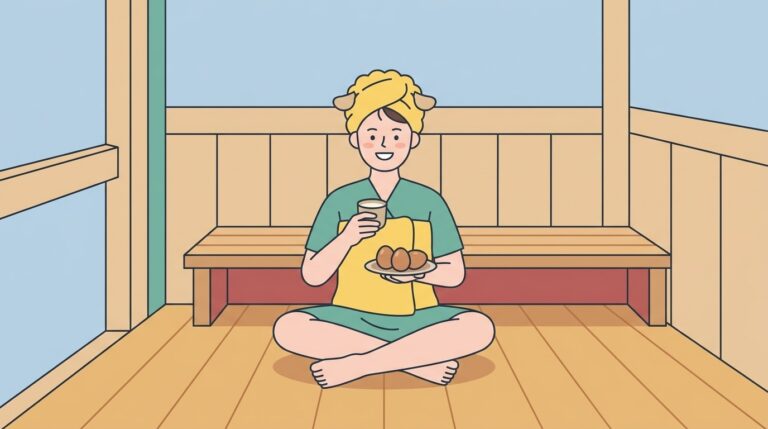
Imagine this: You walk into a wooden room heated to 80°C. In Finland, you might be naked, pouring water over hot rocks, and enjoying the serene silence of nature. But in Korea? You are wearing a matching orange T-shirt and shorts, sitting next to an ajumma (middle-aged lady) peeling roasted eggs, while a group of friends in the corner are laughing with towels folded like sheep horns on their heads. Welcome to the Korean Jjimjilbang (찜질방)!
If you’ve watched K-Dramas like Crash Landing on You or Legend of the Blue Sea, you’ve definitely seen characters fleeing to these 24-hour public bathhouses/saunas when they run away from home. But surviving a Korean sauna is completely different from a Finnish one. If you don’t know the unique vocabulary of the Jjimjilbang, you might end up confused when someone says the boiling hot room is “cool,” or you might miss out on the ultimate post-sweat snacks.
This guide is based on real experiences of my students who survived their first Korean sauna trips. Let’s dive in!
Phase 2: Deep Dive into Key Expressions
1. 아, 시원하다! (Ah, siwonhada!)
- Pronunciation: [a, siwonhada] – sounds like “Ah, shee-won-ha-da”
- Meaning: Literal: Ah, it’s cool! / Real nuance: Ah, that hits the spot! (Refreshing/Relieving)
- K-Culture Moment: You are sitting in a 90°C salt room sweating buckets. Suddenly, an older Korean man walks in, sits on the burning floor, closes his eyes, and sighs: “Ah~ Siwonhada!” Wait, cool? No! In Korea, feeling a deep physical relief (from hot soup, a massage, or a hot sauna) is described as “refreshing.”
- Editor’s Insight: This isn’t just a word; it’s a deep sigh of the soul. It’s the feeling of all your stress and muscle tension melting away.
- Situation Spectrum:
- Casual (Friends): ✅
- Semi-formal (Colleagues): ✅
- Formal (Boss/Elders): ⚠️ (Okay to express your own feeling, but don’t force it on them)
- 🤔 Think About It: Why do Koreans use the same word for a cold iced Americano and a boiling hot sauna? What does this say about the Korean concept of “relieving stress”?
2. 땀 좀 뺄까요? (Ttam jom ppaelkkayo?)
- Pronunciation: [ttam jom ppaelkkayo] – sounds like “ttam jom ppel-kka-yo”
- Meaning: Literal: Shall we extract some sweat? / Real nuance: Shall we go sweat it out in the sauna?
- K-Culture Moment: In Finland, a sauna is often a solitary, meditative experience. In Korea, it’s a social activity! Friends or couples will use this phrase to suggest moving from the cool resting area into one of the hot kiln rooms (Hanjeungmak).
- Editor’s Insight: The verb 빼다 (to remove/extract) is used here because sweating in Korea is seen as “detoxing” or “extracting toxins” from the body.
- Situation Spectrum:
- Casual (Friends): ✅
- Semi-formal (Colleagues): ✅
- Formal (Boss/Elders): 🚫 (Too direct)
- 🤔 Think About It: Sweating is usually seen as gross in many cultures, but in Korea, it’s a bonding activity. Do you have a similar “suffering together” bonding activity in your culture?
3. 지지다 (Jijida)
- Pronunciation: [jijida] – sounds like “jee-jee-da”
- Meaning: Literal: To pan-fry / Real nuance: To press one’s aching body against a very hot surface to relieve pain.
- K-Culture Moment: “뜨거운 바닥에 등 좀 지지고 싶다” (I want to fry my back on a hot floor). If you hear a Korean say this during a rainy day or after a hard week of work, they are officially experiencing “K-fatigue.”
- Editor’s Insight: This is a very B1/B2 level local expression! It’s slightly informal but extremely native. It shows you truly understand Korean physical remedies.
- Situation Spectrum:
- Casual (Friends): ✅
- Semi-formal (Colleagues): ✅
- Formal (Boss/Elders): 🚫
- 🤔 Think About It: This word originally means cooking food on a hot pan (like making pancakes). Why compare human bodies to pancakes?
Phase 3: Textbook vs. Real Korean
[Suggesting a trip to the sauna]
* 📖 Textbook: 사우나에 가고 싶습니다. (I want to go to the sauna.)
* 🗣️ Real Korean: 오늘 찜질방 가서 지질까? (Shall we go to the Jjimjilbang and fry ourselves today?)
* 💡 Why the difference?: While ‘사우나’ is understood, ‘찜질방’ implies the whole cultural complex (food, sleeping, different temperature rooms). ‘지질까’ adds that native “I need deep physical rest” vibe.
[Commenting on the heat]
* 📖 Textbook: 여기는 너무 뜨겁네요. (It is very hot here.)
* 🗣️ Real Korean: 와, 땀 장난 아니다! (Wow, this sweat is no joke!)
* 💡 Why the difference?: “장난 아니다” (It’s no joke) is the ultimate Korean slang to emphasize that something is intense or extreme.
Phase 4: Cultural Context — K-Culture Deep Dive
4-1. Non-Verbal Cues in the Jjimjilbang
In a Finnish sauna, eye contact might be minimal as people respect personal space. In a Korean Jjimjilbang, personal space is much more flexible. Don’t be surprised if strangers sit quite close to you in the common resting areas. Also, Nunchi (눈치) is crucial here: if the “Ice Room” (얼음방) is full, don’t hog the space. Stay for 5 minutes and rotate out for the next person!
4-2. The K-Drama Connection: Sheep Heads & Snacks
Have you ever wondered why characters in K-Dramas wear towels rolled up like two giant croissants on their heads? It’s called 양머리 (Yangmyeori – Sheep Head). It actually started in reality, became popularized by dramas like My Lovely Sam Soon, and is now a fun tradition for teenagers and tourists.
Also, a Jjimjilbang without eating Sikhye (식혜 – sweet rice punch) and Maekbanseok Gyeran (맥반석 계란 – stone-roasted eggs) is considered a sin in Korea. The combination of cold, sweet hydration and protein is the Korean way of recovering after “extracting sweat.”
Phase 5: Real-Life Roleplay Scenario
Setting: Saturday afternoon, inside a bustling Jjimjilbang in Seoul. You and your Korean colleague, Min-su, are wearing identical blue Jjimjilbang uniforms. You just stepped out of the 70°C Hwangto (yellow clay) room.
Characters:
– YOU: An expat who is enjoying their first Jjimjilbang experience, but is incredibly thirsty.
– Min-su (32): Your cheerful Korean coworker who loves to “fry” his back on weekends.
Dialogue:
Min-su: 아휴~ 시원하다! (Ahyu~ siwonhada!)
[English] Ahhh~ That’s refreshing!
YOU: 시원하다고요? 저 지금 죽을 것 같아요… (Siwonhadagoyo? Jeo jigeum jugeul geot gatayo…)
[English] Refreshing? I feel like I’m going to die right now…
Min-su: 하하! 한국에서는 뜨거운 걸 시원하다고 해요. 땀 좀 더 뺄까요? (Haha! Hangugeseoneun tteugeoun geol siwonhadago haeyo. Ttam jom deo ppaelkkayo?)
[English] Haha! In Korea, we call hot things ‘refreshing.’ Shall we sweat a bit more?
YOU: 아니요, 한증막은 이제 그만 갈래요. (Aniyo, hanjeungmageun ije geuman gallaeyo.)
[English] No, I don’t want to go into the hot kiln anymore.
Min-su: 그럼 우리 매점 갈까요? 제가 살게요! (Geureom uri maejeom galkkayo? Jaega salgeyo!)
[English] Then shall we go to the snack bar? It’s my treat!
(🎭 Stage Direction: Min-su points to the snack bar filled with colorful drinks and eggs)
YOU: 오, 좋아요! 뭐 먹을까요? (O, joayo! Mwo meogeulkkayo?)
[English] Oh, great! What should we eat?
Min-su: 찜질방에서는 무조건 식혜랑 계란이죠! (Jjimjilbangeseoneun mujogeon sikhyerang gyeranijo!)
[English] At a Jjimjilbang, it’s unconditionally Sikhye and eggs!
🔀 Your Turn! How do you respond?
– A) “계란은 싫어요. 밥 먹고 싶어요.” (I hate eggs. I want to eat rice.)
– B) “대박! 저 양머리도 해 주세요!” (Daebak! Make a sheep-head towel for me too!)
– C) “아, 감사합니다! 잘 먹겠습니다!” (Ah, thank you! I will eat well!)✅ Best Choice: B or C.
– Why B is great: It shows you really know K-Culture! Min-su will be thrilled to fold the towel for you.
– Why C is safe: It’s the standard, polite way to accept a treat.
– ⚠️ Why A is risky: It’s a bit too direct and dismissive of the cultural experience.
Min-su: (Smiles) 알겠어요! 식혜 두 잔이랑 계란 세 개 주세요! (Algesseoyo! Sikhye du janirang gyeran se gae juseyo!)
[English] Got it! Two glasses of Sikhye and three eggs, please!
YOU: 키로 계산하는 거 맞죠? (Kiro gyesanhaneun geo matjyo?)
[English] We pay with the key wristband, right?
Min-su: 오~ 어떻게 알았어요? 한국인 다 됐네요! (O~ eotteoke arasseoyo? Hangugin da dwaenneyo!)
[English] Oh~ How did you know? You’re basically Korean now!
Phase 6: 10-Second Shadowing Drill
Practice this sentence to sound like a true Korean Ajossi (uncle) or Ajumma (auntie) relaxing in the heat:
😤 아휴~~~ / 너무 뜨거운데, / 진짜 / 시원하다!
(Ahyu~~~ / neomu tteugeounde, / jinjja / siwonhada!)
[Whew~~~ / It’s so hot, but / really / refreshing!]
Tips: Drag out the “휴~~~” (hyu~~~) like you are releasing all your stress. Pause briefly at the slashes (/) for dramatic effect!
Phase 7: K-Culture Mini Dictionary
1. 찜질방
* Romanization: Jjimjilbang
* English: Korean public bathhouse and sauna complex
* Context: ‘Jjimjil’ means applying heat or cold to the body. It’s a 24-hour facility where people sleep, eat, play games, and sweat.
2. 식혜
* Romanization: Sikhye
* English: Traditional sweet rice beverage
* Context: The soulmate of the Jjimjilbang. Served ice-cold to lower your body temperature after a hot sauna.
3. 양머리
* Romanization: Yangmyeori
* English: Sheep-head towel
* Context: Folding a towel into three parts and rolling the ends to look like sheep horns. A must-do for Jjimjilbang selfies.
4. 때밀이
* Romanization: Ttaemiri
* English: Korean body scrub / Scrubber
* Context: Before putting on the Jjimjilbang uniform, you go to the gender-separated bathhouse (목욕탕). Getting a ‘Ttaemiri’ massage removes dead skin cells. It hurts, but your skin will feel like a baby’s!
Phase 8: Traveler Survival Kit
Heading to a Jjimjilbang during your Korea trip? Memorize these!
🆘 Survival Phrases TOP 3
– 🇰🇷 “여기 수건 한 장 더 주세요.” (Yeogi sugeon han jang deo juseyo.)
– 🗣️ English: “Please give me one more towel here.”
– 🇰🇷 “찜질복 사이즈 큰 거 있어요?” (Jjimjilbok saijeu keun geo isseoyo?)
– 🗣️ English: “Do you have a larger size for the sauna clothes?”
– 🇰🇷 “키로 계산할게요.” (Kiro gyesanhalgeyo.)
– 🗣️ English: “I will pay with my key (wristband).”📌 Editor’s Travel Note
– No Cash Needed: In modern Jjimjilbangs, you don’t carry your wallet. Your locker key has an RFID chip. Tap it to buy food, use massage chairs, or play arcade games. You pay the total bill at the front desk when you leave!
– Nudity Alert: The Jjimjilbang (sauna rooms/snack areas) is co-ed and you wear the provided uniform. However, the initial washing area (목욕탕) is strictly gender-separated and strictly nude. No swimsuits allowed!
Phase 9: Critical Thinking Corner — “One Step Deeper”
🧠 Think Deeper: Media vs. Reality
In K-Dramas, actors wake up in the Jjimjilbang looking fresh, their hair perfectly styled, having romantic conversations over Sikhye. The reality? You might find yourself sleeping on a thin mat on a hard wooden floor, listening to a symphony of snoring from twenty different strangers. Your hair will be plastered to your forehead with sweat, and the “romantic” eggs might give you the hiccups. Yet, this slightly chaotic, totally unglamorous shared experience is exactly what makes the Jjimjilbang so charming. It’s a space where social status disappears—everyone wears the same uniform, sweating together in equality.💬 Your Turn: Have you ever visited a place that looked completely different in reality compared to a movie or drama? Share your story in the comments!
Phase 10: FAQ & Mistake Prevention
- “Can I wear my swimsuit in the bathhouse part?”
- NO. This is a huge cultural faux pas. In the gender-segregated wet areas, you must be completely naked. Wearing clothes or swimsuits is considered unsanitary. Just embrace it; nobody is looking at you!
- “Can I bring my phone into the sauna rooms?”
- Maybe, but risky. Most people leave their phones in their lockers or outside the very hot rooms (like the 80°C+ Hanjeungmak) because the extreme heat can literally fry your battery.
- “Can I sleep anywhere?”
- Yes! Grab a mat (매트) and a hard block pillow (베개) and find an empty spot on the floor in the common areas.
❌ Common Mistake #1: Throwing water on the heat source.
✅ Do this instead: In a Finnish sauna, you throw water on rocks (Löyly) to create steam. In a Korean Jjimjilbang, do NOT throw water on the salt, clay, or charcoal heaters! It will damage the facility and anger the staff.
Phase 11: Summary & Action Items
- One-Liner Summary: A Korean Jjimjilbang isn’t just a place to sweat; it’s a cultural playground where hot means “refreshing” (시원하다) and eating eggs is mandatory!
-
Action Mission 3 Steps:
- 🥉 Bronze (Solo): Stand in a hot shower today, close your eyes, and say, “아휴~ 시원하다!” out loud.
- 🥈 Silver (Online): Find a YouTube vlog of someone visiting a Korean Jjimjilbang and comment “땀 빼고 싶어요!” (I want to sweat it out!).
- 🥇 Gold (Real Life): Visit a local Korean mart, buy a bottle of Sikhye, and try making a “Yangmyeori” with a towel at home!
- K-Culture Mission: Watch episode 3 of Crash Landing on You and spot the Jjimjilbang scenes. Look at how they use the wristbands to pay!
Phase 12: Quiz — Interactive Challenge
1. Situational Judgment: You step into a boiling hot sauna and sit next to an older Korean man. He sighs deeply and says, “아~ 시원하다!” What is he feeling?
– A) He wishes the AC was turned on.
– B) He is feeling deep physical relief and relaxation.
– C) He is complaining about the cold.
(Answer: B. Remember, ‘siwonhada’ in this context means refreshing/relieving!)
2. Fill in the Blank:
Korean friend: “오늘 우리 찜질방 가서 _____ 좀 뺄까요?”
– A) 돈 (Money)
– B) 땀 (Sweat)
– C) 눈물 (Tears)
(Answer: B. 땀을 빼다 means to sweat it out.)
3. True or False – K-Culture Edition:
You can wear a bikini in the Korean Jjimjilbang’s gender-separated shower area to feel more comfortable.
(Answer: FALSE. Complete nudity is required for hygiene reasons in the wet areas!)
Frequently Asked Questions (FAQ)
Q: What does "아, 시원하다! (Ah, siwonhada!)" mean in Korean and how do you pronounce it?
A: In Korean, "아, 시원하다! (Ah, siwonhada!)" is pronounced [a, siwonhada] and means: Literal: Ah, it's cool! / Real nuance: Ah, that hits the spot! (Refreshing/Relieving)
Q: What does "땀 좀 뺄까요? (Ttam jom ppaelkkayo?)" mean in Korean and how do you pronounce it?
A: In Korean, "땀 좀 뺄까요? (Ttam jom ppaelkkayo?)" is pronounced [ttam jom ppaelkkayo] and means: Literal: Shall we extract some sweat? / Real nuance: Shall we go sweat it out in the sauna?
Q: What does "지지다 (Jijida)" mean in Korean and how do you pronounce it?
A: In Korean, "지지다 (Jijida)" is pronounced [jijida] and means: Literal: To pan-fry / Real nuance: To press one's aching body against a very hot surface to relieve pain.







