

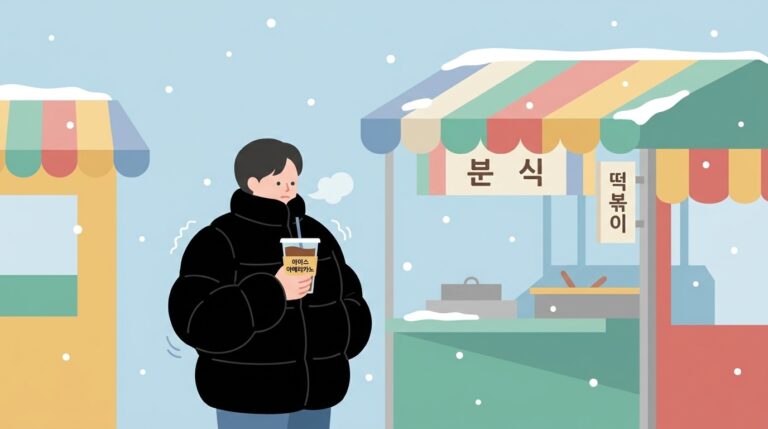
Phase 1: Empathy — Welcome to the Korean Winter!
Hello! I’m your Daily Hangul Editor, your local Korean friend and veteran tutor.
Picture this: You are in Seoul in January. You step out of the subway station, and a sudden blast of Siberian wind hits your face. In K-Dramas, this is the exact moment the handsome male lead softly wraps his scarf around the heroine’s neck and says, “Aren’t you cold?” But in reality? Everyone on the street is wrapped up like black burritos in massive puffer jackets, speed-walking with their hands deep in their pockets!
When you are freezing in Korea, simply translating “It is cold” from your textbook won’t cut it. You need to know the real phrases Koreans use to bond over the freezing weather. Whether you’re shivering at a bus stop, running into a convenience store for survival, or ordering a hot soup, expressing the cold is actually one of the best ice-breakers (pun intended) in Korea.
This guide is based on real questions from students who survived the Korean winter. Let’s dive in and learn how to complain about the cold like a true local!
Phase 2: Core Expressions Deep Dive
1. 추워요 (I’m cold / It’s cold)
- Pronunciation: chuwoyo [choo-wuh-yo]
- Meaning: It’s cold (Polite standard)
- K-Culture Moment: You’re at a café, and the AC is blasting in winter, or someone opens the door and a draft comes in. You casually cross your arms, look at your Korean friend, and say this to hint, “Let’s move somewhere else.”
- Editor’s Insight: This is your bread-and-butter phrase. It’s polite, safe, and works in 99% of situations. Remember, Korean often drops the subject (I/It). You don’t need to say “I am cold”—just “chuwoyo” is enough!
- Situation Spectrum:
- Friends (Casual – 추워): ✅
- Coworkers (Semi-formal – 추워요): ✅
- Boss/Elders (Formal – 춥습니다): ✅
- 🤔 Think About It: In Korean culture, talking about the weather is the ultimate polite conversation starter. Do you use the weather to fill awkward silences in your culture, too?
2. 너무 추워요 (It’s sooo cold)
- Pronunciation: neomu chuwoyo [nuh-moo choo-wuh-yo]
- Meaning: It’s too cold / It’s very cold
- K-Culture Moment: You are waiting for the bus, stomping your feet. You look at the person next to you (or your friend) and emphasize just how freezing it is.
- Editor’s Insight: Neomu used to mean “too much” (negative), but nowadays Koreans use it for “very” or “super” all the time. Drag out the “muuu” to sound more natural: “Neo-muuuu chuwoyo!”
- Situation Spectrum:
- Friends (Casual): ✅
- Coworkers (Semi-formal): ✅
- Boss/Elders (Formal): ⚠️ (Use ‘정말 춥습니다’ instead)
- 🤔 Think About It: Why do you think modern Koreans prefer the slightly exaggerated ‘너무’ over the grammatically standard ‘매우’ (very)?
3. 얼어 죽을 것 같아요 (I feel like I’m going to freeze to death)
- Pronunciation: eoreo jugeul geot gatayo [uh-ruh joo-geul gut ga-ta-yo]
- Meaning: Literal: I think I will freeze and die. Real nuance: It’s absolutely freezing!
- K-Culture Moment: You just stepped out of a warm Jjimjilbang (Korean sauna) into the minus 10-degree night air. You wrap your arms around yourself and dramatically declare this to your friends.
- Editor’s Insight: Koreans love using the word 죽다 (to die) for exaggeration. Starving? 배고파 죽겠다 (I’ll die of hunger). Sleepy? 졸려 죽겠다 (I’ll die of sleepiness). It shows you’re perfectly adopting the dramatic Korean flair!
- Situation Spectrum:
- Friends (Casual): ✅
- Coworkers (Semi-formal): ✅
- Boss/Elders (Formal): 🚫 (Too dramatic and casual for the boss!)
- 🤔 Think About It: Does your native language have dramatic idioms related to “dying” from weather or physical states?
Phase 3: Textbook vs. Real Korean
[Complaining about the wind]
* 📖 Textbook Korean: 바람이 많이 붑니다. (The wind blows a lot.)
* 🗣️ Real Korean: 아, 칼바람 미쳤다! (Ah, the knife-wind is crazy!)
* 💡 Why the difference?: Koreans use “칼바람” (knife-wind) to vividly describe the sharp, biting winter wind that feels like it’s cutting your cheeks.
[When your hands are freezing]
* 📖 Textbook Korean: 손이 춥습니다. (My hands are cold.)
* 🗣️ Real Korean: 손 시려워요! (My hands are freezing/numb!)
* 💡 Why the difference?: Korean distinguishes between general cold weather (춥다) and body parts feeling numb/freezing (시렵다).
[Agreeing that it’s cold]
* 📖 Textbook Korean: 네, 날씨가 춥습니다. (Yes, the weather is cold.)
* 🗣️ Real Korean: 그쵸! 진짜 너무 추워요. (Right?! It’s seriously so cold.)
* 💡 Why the difference?: “그쵸” (short for 그렇지요) is the magic word for agreement and building empathy. Empathy is everything in Korean conversations.
Bottom Note: For A2 learners, sticking to “진짜 너무 추워요” (It’s really so cold) and “손 시려워요” (My hands are freezing) will make you sound incredibly natural without using overly heavy slang!
Phase 4: Cultural Context — K-Culture Deep Dive
4-1. Non-Verbal Cues: The Art of the Shiver
When expressing the cold in Korea, body language is key. Don’t just stand still and say “추워요.” You must rub your hands together, blow on them, stomp your feet slightly, and let out a little “으으으” (Euuu) sound before speaking. Also, Korean Nunchi (reading the room) tells us that if a coworker says “추워요,” they might be politely asking you to turn off the AC or close the window.
4-2. K-Food Connection: The “Eol-juk-a” Paradox
You’ll notice a hilarious phenomenon in Korea during winter. Even when it’s -15°C outside, if you go to a café, you will see Koreans ordering Iced Americanos. There’s even a popular acronym for this: 얼죽아 (Eol-juk-a), which stands for 얼어 죽어도 아이스 아메리카노 (Iced Americano even if I freeze to death).
On the flip side, winter is the prime season for Pojangmacha (street food tents). In K-Dramas, you always see the characters standing outside eating Odeng (fish cakes on skewers) and drinking the hot broth out of a paper cup. Eating hot, spicy food together is a way Koreans share Jeong (warmth/affection) to fight off the physical cold.
Phase 5: Real-world Roleplay Scenario
Setting: Friday night, 8:00 PM. Exit 11 of Gangnam Station. The Siberian wind is howling, and you are waiting for your Korean coworkers to go to a team dinner (회식). You are wearing a warm coat, but it’s not enough.
Characters:
– YOU: A foreign professional in Korea, surviving your first real Korean winter.
– Minsu (32): Your friendly Korean coworker who just arrived, wearing a massive black long padding jacket.
Dialogue:
Minsu: 앗, OO씨! 오래 기다렸어요?
(at, OO-ssi! orae gidaryeosseoyo?)
[Ah, OO! Did you wait long?]
(🎭 Stage Direction: Minsu runs over, rubbing his hands together and shivering)
YOU: 아니요, 방금 왔어요.
(aniyo, banggeum wasseoyo.)
[No, I just arrived.]
Minsu: 하… 오늘 날씨 진짜 미쳤네요. 너무 춥죠?
(ha… oneul nalssi jinjja micheonneyo. neomu chupjyo?)
[Hah… the weather today is really crazy. It’s so cold, right?]
🔀 Your Turn! How do you reply?
– A) 네. 춥습니다. (Ne. chupsseumnida. – Yes. It is cold.)
– B) 그쵸! 진짜 얼어 죽을 것 같아요! (Geuchyo! jinjja eoreo jugeul geot gatayo! – Right?! I seriously feel like I’ll freeze to death!)
– C) 저는 안 추워요. (Jeoneun an chuwoyo. – I am not cold.)
✅ Best Choice: B — Why? You are matching Minsu’s energy. Using “그쵸” builds instant rapport, and the slight exaggeration of “얼어 죽을 것 같아요” will make Minsu laugh and feel closer to you.
⚠️ Choice A Analysis: It’s grammatically perfect, but sounds like a robot. It kills the conversational mood.
⚠️ Choice C Analysis: Even if you aren’t that cold, bluntly saying “I’m not cold” can make the other person feel awkward. Remember, weather talk is about bonding!
Minsu: 하하, 맞아요! 빨리 따뜻한 국물 먹으러 가요!
(haha, majayo! ppalli ttatteushan gungmul meogeureo gayo!)
[Haha, exactly! Let’s hurry and go eat some hot soup!]
Phase 6: 10-Second Shadowing Drill
Let’s practice sounding like a local! Focus on the emotion and where to pause.
- 🥶 (Shivering, teeth chattering):
으으 / 진짜 / 너무 추워요!mu chu-wo-yo!)
(eu-eu / jinjja / neo
[Ugh / seriously / it’s soooo cold!] -
🥺 (Looking at your friend appealingly):
손이 / 너무 / 시려워요.
(son-i / neo-mu / si-ryeo-wo-yo.)
[My hands / are so / freezing.]
Phase 7: K-Culture Mini Dictionary
Here are 4 essential winter culture keywords you need to survive in Korea!
1. 얼죽아 (Eol-juk-a)
* Romanization: eol-juk-a
* English: Iced Americano even if I freeze to death
* Context: The stubborn Korean café culture trait where people drink iced coffee regardless of sub-zero temperatures.
2. 롱패딩 (Long Padding)
* Romanization: rong-pae-ding
* English: Long puffer jacket
* Context: The unofficial winter uniform of South Korea. It looks like a giant black sleeping bag. If you are in Seoul in January, you will buy one.
3. 핫팩 (Hot Pack)
* Romanization: hat-paek
* English: Pocket hand warmer
* Context: Sold at every convenience store. You shake it, and it stays hot for 12 hours. A must-have survival item.
4. 온돌 (Ondol)
* Romanization: on-dol
* English: Korean floor heating system
* Context: While Western houses heat the air, Korean houses heat the floor. There is nothing better than lying flat on a warm Ondol floor after a cold day!
Phase 8: Traveler Survival Kit
If you are traveling in Korea during winter, these phrases will literally save you.
🆘 Survival Phrases
– 🇰🇷 “핫팩 어디 있어요?” (hat-paek eodi isseoyo?)
– 🗣️ English: Where are the hot packs?
– 📍 Where to use: Convenience stores (CU, GS25, 7-Eleven).
- 🇰🇷 “따뜻한 물 주세요.” (ttatteushan mul juseyo.)
- 🗣️ English: Please give me warm water.
- 📍 Where to use: Restaurants (Korean restaurants usually serve freezing cold water by default!).
🇰🇷 “히터 좀 켜주실 수 있나요?” (hiteo jom kyeojusil su innayo?)
- 🗣️ English: Could you please turn on the heater?
- 📍 Where to use: Taxis, cafes.
📌 Editor’s Travel Note
– Ondol Caution: If you stay in an Airbnb, make sure you know how to operate the “Boiler” (보일러) panel on the wall. If you don’t turn it on, the floor will be like ice.
– Subway Seats: Don’t be surprised if your butt suddenly gets very warm on the subway. The seats are heated in winter!
Phase 9: Critical Thinking Corner — “A Step Deeper”
Food & Identity: Why Hot Soup?
In Korean culture, food is deeply tied to emotional warmth and community. During the harsh winters, Koreans don’t just eat to survive; they gather around a boiling pot of Jeongol (hot pot) or Gukbap (soup with rice) to share warmth. The act of sharing a bubbling, communal dish in the freezing cold is a manifestation of Jeong (정)—the invisible bond of affection and community. The physical heat of the food compensates for the bitter cold outside, turning a simple meal into a shared survival experience.
🧠 Think Deeper:
Koreans believe that sharing hot food brings people closer together emotionally. Is there a specific winter food in your culture that you must eat with others?💬 Your Turn: How does your culture fight the winter blues? Do you have an equivalent to the Korean “Hot Soup” culture? Share in the comments!
Phase 10: FAQ & Avoiding Misunderstandings
- Q: Can I ask an elder “추워요?” (Are you cold?)
- A: No! If you want to ask your boss or a senior if they are cold, say “날씨가 많이 춥죠?” (The weather is very cold, right?). Directly asking their physical state with a simple “추워요?” can sound too casual or lack respect.
- Q: Can I use “얼어 죽을 것 같아요” at work?
- A: Maybe with your peers at lunch, but don’t say it in a formal meeting or to the CEO! Stick to “오늘 정말 춥습니다” (It is really cold today) in formal settings.
❌ Common Mistake #1: Confusing 춥다 and 차갑다.
Foreigners often touch a cold glass of water and say “물 너무 추워요” (The water is cold). Wrong!
– 춥다 (chupda) = The weather or room is cold. You feel cold.
– 차갑다 (chagapda) = An object (water, food, metal) is cold to the touch.
✅ Do this instead: “물이 너무 차가워요.” (The water is too cold.)
Phase 11: Summary & Action Items
One-Liner Summary: To survive the Korean winter, drop the textbook “춥습니다” and bond with locals by saying “진짜 너무 추워요!” (It’s seriously so cold!).
Action Mission:
– 🥉 Bronze (Solo): Stand in front of your mirror, cross your arms, shiver, and say “으으, 너무 추워요!” 3 times.
– 🥈 Silver (Online): Find a K-Pop idol’s winter vlog or Weverse post and comment: “오늘 정말 추워요! 감기 조심하세요!” (It’s really cold today! Be careful not to catch a cold!).
– 🥇 Gold (Real World): Next time you enter a Korean restaurant or café on a cold day, rub your hands and say “아~ 너무 추워요!” to your friend so the staff can hear your perfect local reaction!
K-Culture Mission: Watch any winter episode of a K-Drama today. I guarantee you will spot someone wearing a Long Padding or buying a Hot Pack. Point it out when you see it!
Phase 12: Interactive Quiz
Let’s test your Korean winter survival skills!
1. Situational Judgment: You are at a convenience store. You want to buy that magical item that keeps your hands warm. What do you ask the clerk?
– A) 아이스 아메리카노 주세요. (Iced Americano, please.)
– B) 핫팩 어디 있어요? (Where are the hot packs?)
– C) 너무 추워요. (I’m too cold.)
(Hint: C is a statement, not a question! B is what you need.)
2. Fill in the Blank:
You grab a cold can of soda from the fridge. You touch it and say:
“앗, 이거 너무 ( _______ )!”
– A) 추워요 (chuwoyo)
– B) 차가워요 (chagawoyo)
(Answer: B. Remember the difference between weather/feelings and objects!)
3. True or False — K-Culture Edition:
“Koreans only drink hot coffee when it’s snowing outside.”
(Answer: False! Remember ‘Eol-juk-a’ (얼죽아)? Many Koreans will drink Iced Americanos even if they freeze to death!)
How did you do? Stay warm, stay curious, and see you in the next Daily Hangul lesson! 🥶☕
Frequently Asked Questions (FAQ)
Q: What does "추워요 (I'm cold / It's cold)" mean in Korean and how do you pronounce it?
A: In Korean, "추워요 (I'm cold / It's cold)" is pronounced [chuwoyo [choo-wuh-yo] and means: It's cold (Polite standard)
Q: What does "너무 추워요 (It's sooo cold)" mean in Korean and how do you pronounce it?
A: In Korean, "너무 추워요 (It's sooo cold)" is pronounced [neomu chuwoyo [nuh-moo choo-wuh-yo] and means: It's too cold / It's very cold
Q: What does "얼어 죽을 것 같아요 (I feel like I'm going to freeze to death)" mean in Korean and how do you pronounce it?
A: In Korean, "얼어 죽을 것 같아요 (I feel like I'm going to freeze to death)" is pronounced [eoreo jugeul geot gatayo [uh-ruh joo-geul gut ga-ta-yo] and means: Literal: I think I will freeze and die. Real nuance: It's absolutely freezing!






