

Phase 1: Empathy (Immersive Opening)
Hello! I’m your Daily Hangul editor.
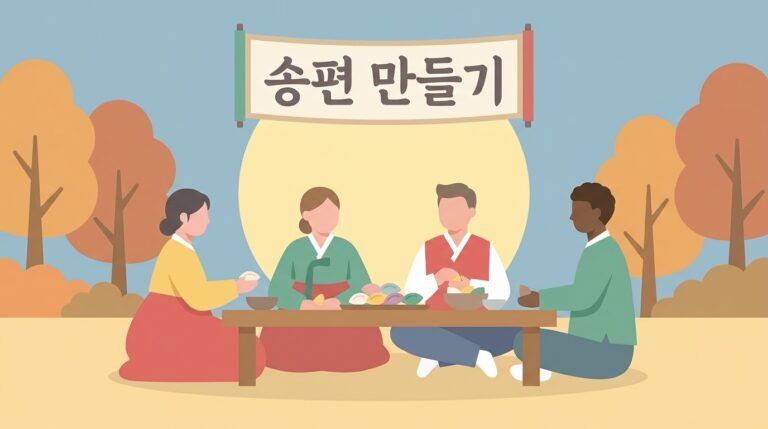
Picture this: You are watching a K-Drama. It’s autumn. The protagonist enters their family home, and suddenly, the entire living room floor is covered with newspaper. Mountains of jeon (Korean pancakes) are frying in the corner, and the whole family is sitting around a low wooden table, vigorously stuffing sesame seeds and sugar into colorful rice dough.
Then, an aunt suddenly looks at the protagonist and says, “So, when are you getting married?” The protagonist sighs, aggressively squeezing the rice dough… Sounds familiar?
Welcome to Chuseok (추석), Korea’s Thanksgiving! It is a beautiful holiday filled with full moons, endless feasts, and performing Charye (차례)—the ancestral rites. But behind the beautiful traditions, there’s an intense game of Nunchi going on. Knowing the right phrases during Chuseok won’t just help you survive the holiday; it will make your Korean friends (and their grandmothers) instantly treat you like family. Let’s dive in!
Phase 2: Core Expressions Deep Dive
1. 풍성한 한가위 보내세요
- Pronunciation: [pungseonghan hangawi bonaeseyo]
- Meaning: (Literal) Have a bountiful Hangawi. / (Real) Happy Chuseok!
- K-Culture Moment: You’ll see this phrase everywhere—on K-Pop idols’ Instagram stories, department store banners, and the spam texts from that one store you bought socks from three years ago. Hangawi is the beautiful, pure Korean word for Chuseok.
- Editor’s Insight: Saying “Happy Chuseok” directly translated (추석 축하해요) sounds extremely awkward in Korean. Instead, we wish each other a “bountiful” (풍성한) time, emphasizing the harvest aspect of the holiday.
- Situation Spectrum:
- Casual (Friends): ✅ (Usually shortened to “즐추!” – jeul-chu)
- Semi-formal (Co-workers): ✅
- Formal (Boss/Elders): ✅
- 🤔 Think About It: Why do Koreans focus on wishing for an “abundant” or “bountiful” holiday rather than just a “happy” one? How does Korea’s agrarian history influence modern greetings?
2. 송편 예쁘게 빚었네!
- Pronunciation: [songpyeon yeppeuge bijeonne!] + [‘bijeonne’ sounds like ‘bee-juhn-neh’]
- Meaning: (Literal) You shaped the Songpyeon prettily! / (Real) Wow, your rice cakes look great!
- K-Culture Moment: You’re at a Korean friend’s house. You manage to make a perfect half-moon-shaped rice cake. The grandmother claps her hands and says this, followed immediately by the classic myth: “송편을 예쁘게 빚어야 예쁜 딸을 낳는대요” (They say you have to make pretty Songpyeon to have a pretty daughter).
- Editor’s Insight: Notice the verb 빚다 (bitda). We don’t use ‘만들다’ (make) for Songpyeon. ‘빚다’ implies carefully crafting something with your hands, like pottery or dumplings.
- Situation Spectrum:
- Casual (Friends): ✅
- Semi-formal (Co-workers): ⚠️ (Only if actually making food together)
- Formal (Boss/Elders): 🚫 (Elders say this to you, not the other way around)
- 🤔 Think About It: Does your culture have food-related superstitions regarding marriage or children?
3. 차례 지내고 올게요
- Pronunciation: [charye jinaego olgeyo]
- Meaning: (Literal) I’ll come back after performing the ancestral rites. / (Real) I’ll be busy doing family duties, so I’ll be unreachable for a bit.
- K-Culture Moment: It’s Chuseok morning. You’re trying to schedule a gaming session or a coffee meetup with a Korean friend. They text you this. It means they are currently dressed nicely, standing in front of a table full of food, bowing to their ancestors.
- Editor’s Insight: “차례(를) 지내다” is the set phrase for performing holiday ancestral rites. It’s the ultimate “Do Not Disturb” sign in Korean culture.
- Situation Spectrum:
- Casual (Friends): ✅
- Semi-formal (Co-workers): ✅
- Formal (Boss/Elders): ✅
- 🤔 Think About It: Why is remembering ancestors so strictly scheduled into the national holiday calendar in Korea?
Phase 3: Textbook vs Real Korean
[Greeting someone for the holiday]
* 📖 Textbook: 추석을 축하합니다. (I congratulate you on Chuseok.)
* 🗣️ Real Korean: 연휴 푹 쉬시고, 맛있는 거 많이 드세요! (Rest well during the long weekend, and eat lots of delicious things!)
* 💡 Why the difference?: Chuseok is less about “congratulating” an event and more about resting from work and eating heartily with family.
[Asking about holiday plans]
* 📖 Textbook: 추석에 무엇을 할 예정입니까? (What do you plan to do on Chuseok?)
* 🗣️ Real Korean: 이번에 본가 내려가요? (Are you going down to your parents’ house this time?)
* 💡 Why the difference?: Historically, everyone leaves Seoul to go to their hometowns in the countryside. “Going down” (내려가다) is the default assumption for Chuseok!
[Wishing friends a good holiday on Instagram/Kakaotalk]
* 📖 Textbook: 즐거운 추석이 되기를 바랍니다. (I hope it becomes a fun Chuseok.)
* 🗣️ Real Korean: 다들 즐추!! 🌕 (Everyone, Happy Chuseok!!)
* 💡 Why the difference?: “즐추” is the ultimate MZ generation abbreviation for 즐거운 추석 (Jeulgeoun Chuseok).
Bottom Note: For B2 (Intermediate) learners, using phrases like “본가 내려가요?” will instantly make you sound like a true local who understands the holiday migration!
Phase 4: Cultural Context — K-Culture Deep Dive
4-1. Non-verbal: The Art of the Bow (절 – Jeol)
When performing Charye, you don’t just nod. You perform a deep, full-body bow called Jeol. But there’s a strict rule! For women, the right hand goes over the left. For men, the left hand goes over the right. Also, you bow twice to the ancestors, but only once to living elders (like your grandparents). Doing a double bow to a living person is considered very bad luck!
4-2. K-Food Connection: The Jesasang (Ancestral Table) Rules
If you watch K-Dramas, you’ll see families arguing over where to place the apples and pears on the table. This is because setting the Jesasang is practically a science. Have you heard of 홍동백서 (Hong-dong-baek-seo)? It means “Red fruits to the East, White fruits to the West.” Every dish has a specific coordinate. It shows the extreme respect and formality Koreans put into food meant for their ancestors. Next time you eat at a traditional Korean restaurant, notice the careful arrangement of side dishes—it stems from this cultural respect for table setting!
Phase 5: Real-Life Roleplay Scenario
Setting: It’s the afternoon before Chuseok. You’ve been invited to your Korean friend Min-su’s family home in the countryside. You are sitting on the floor in the living room with Min-su and his grandmother, surrounded by colorful dough and sweet fillings.
Characters:
– YOU: An expat experiencing traditional Chuseok for the first time.
– Min-su (30): Your helpful and jokester Korean friend.
– Grandmother (Halmeoni): Min-su’s sweet, traditional grandmother.
Dialogue:
할머니 (Grandma): 아이고, 우리 민수 친구는 한국말도 잘하고 예쁘네. 여기 앉아봐요.
(Aigo, uri Minsu chinguneun hangukmaldo jalhago yeppeune. Yeogi anjabwayo.)
[Oh my, Min-su’s friend speaks Korean so well and is so pretty. Sit here.]
(🎭 Stage Direction: Grandma pats the cushion next to her)
YOU: 감사합니다, 할머니! 제가 뭘 도와드릴까요?
(Gamsahamnida, halmeoni! Jaega mwol dowadeurilkkayo?)
[Thank you, grandmother! What can I help with?]
민수 (Min-su): 오늘 우리 송편 공장 가동해야 돼. 여기 반죽 보이지?
(Oneul uri songpyeon gongjang gadonghaeya dwae. Yeogi banjuk boiji?)
[We have to run our Songpyeon factory today. You see this dough here?]
YOU: 우와, 반죽 색깔이 진짜 예뻐요! 어떻게 빚는 거예요?
(Uwa, banjuk saekkkari jinjja yeppeoyo! Eotteoke binneun geoyeyo?)
[Wow, the dough colors are so pretty! How do I shape it?]
민수 (Min-su): 반죽을 동그랗게 만들고, 안에 깨를 넣은 다음에, 반달 모양으로 꾹꾹 누르면 돼.
(Banjugeul donggeurake mandeulgo, ane kkaereul noeun daeume, bandal moyangeuro kkukkkuk nureumyeon dwae.)
[Make the dough round, put the sesame filling inside, and press it firmly into a half-moon shape.]
YOU: 이렇게요? 생각보다 어렵네요… 앗, 옆구리가 터졌어요!
(Ireokeyo? Saenggakboda eoryeomneyo… at, yeopguriga teojyeosseoyo!)
[Like this? It’s harder than I thought… Oops, the side burst!]
할머니 (Grandma): 괜찮아, 처음엔 다 그래. 다시 한 번 해봐.
(Gwaenchana, cheoeumen da geurae. Dasi han beon haebwa.)
[It’s okay, everyone does that at first. Try it one more time.]
(🎭 Stage Direction: You carefully make another one and hold it up)
할머니 (Grandma): 어머! 이번엔 송편을 아주 예쁘게 빚었네!
(Eomeo! Ibeonen songpyeoneul aju yeppeuge bijeonne!)
[Oh my! You shaped the Songpyeon so prettily this time!]
민수 (Min-su): 오~ 송편 예쁘게 빚으면 나중에 예쁜 딸 낳는다는데?
(O~ songpyeon yeppeuge bijeumyeon najung-e yeppeun ttal nanneundaneunde?)
[Oh~ They say if you make pretty Songpyeon, you’ll have a pretty daughter later!]
🔀 Your Turn! How should you respond to Min-su?
– A) “아, 네. 좋은 딸을 낳고 싶습니다.” (Ah, yes. I want to have a good daughter.)
– B) “진짜요? 할머니, 저 소질 있나 봐요!” (Really? Grandma, I think I have a talent for this!)
– C) “저 아직 결혼할 생각 없는데요?” (I don’t have thoughts of getting married yet though?)✅ Best Choice: B — Reason: It shows you appreciate the compliment playfully and turns the attention affectionately back to the grandmother. It perfectly reads the nunchi of the warm atmosphere.
⚠️ Choice C Analysis: While it might be true, saying this too bluntly to traditional elders can kill the festive, warm mood. Save this answer for drinks with Min-su later!
Phase 6: 10-Second Shadowing Drill
Let’s practice the essential holiday greeting! Pay attention to the pauses and the bright energy.
😊 가족들과 / 맛있는 거 많이 드시고, / 풍성한 한가위 / 보내세요~!
(Gajokdeulgwa / masinneun geo mani deusigo, / pungseonghan hangawi / bonaeseyo~!)
[Eat lots of delicious food with your family, and have a bountiful Hangawi!]
Phase 7: K-Culture Mini Dictionary
1. 명절 증후군 (myeongjeol jeunghugun)
* English: Holiday Syndrome
* Context: The physical and mental stress experienced by Koreans (often mothers and daughters-in-law) due to cooking massive amounts of food and dealing with nagging relatives during Chuseok.
2. 귀성길 (gwiseonggil)
* English: The journey home
* Context: The massive traffic jam that occurs when millions of Seoulites drive down to their hometowns. If you hear “귀성길 전쟁” (Journey home war), it means the highway is a parking lot.
3. 눈치 (nunchi)
* English: The subtle art of gauging others’ moods
* Context: Crucial during Chuseok. Knowing when to help with the dishes, when to avoid the topic of employment/marriage, and when to slip your younger cousins some pocket money.
4. 전부치기 (jeonbuchigi)
* English: Frying Korean pancakes
* Context: The ultimate Chuseok labor. Families sit for hours frying battered vegetables, fish, and meat. It makes the whole house smell like oil (and causes backaches!).
Phase 8: Traveler’s Survival Kit
Traveling in Korea during Chuseok can be tricky. Many shops close, and train tickets vanish in seconds.
🆘 Survival Expression #1
– 🇰🇷 “연휴에 문 열어요?” (yeonhyue mun yeoreoyo?)
– 🗣️ English: Are you open during the holidays?
– 📍 Where to use: Restaurants, cafes, dry cleaners.
– 💡 Pro Tip: Always ask this a few days before Chuseok. Don’t trust Google Maps during the holiday; call or ask in person!🆘 Survival Expression #2
– 🇰🇷 “오늘 KTX 입석 있어요?” (oneul KTX ipseok isseoyo?)
– 🗣️ English: Are there any KTX standing tickets today?
– 📍 Where to use: Train stations.
– 💡 Pro Tip: All seats sell out months in advance. Your only hope is a standing ticket (입석) or taking an express bus!🆘 Survival Expression #3
– 🇰🇷 “남은 거 포장해 주실 수 있나요?” (nameun geo pojanghae jusil su innayo?)
– 🗣️ English: Can you pack the leftovers to go?
– 📍 Where to use: At a Korean friend’s house or a restaurant.
– 💡 Pro Tip: Koreans always cook too much for Chuseok. Asking to take some home is actually a huge compliment to the chef!📌 Editor’s Travel Note
Seoul becomes surprisingly quiet on the day of Chuseok. It’s the best time to visit ancient palaces like Gyeongbokgung, which often offer free admission for the holiday!
Phase 9: Critical Thinking — “One Step Deeper”
Changing Traditions & Gender Roles (Media vs Reality)
🧠 Think Deeper:
Historically, the heavy burden of preparing the Jesasang (ancestral table) and making Songpyeon fell almost entirely on the women of the family, while men performed the actual Charye bowing ceremony. This imbalance is the root cause of the infamous “Holiday Syndrome” (명절 증후군). However, if you watch recent K-Dramas or vloggers, you’ll see a massive shift. Modern Korean families are increasingly ordering pre-made holiday food online, skipping the ancestral rites to travel overseas, or strictly dividing the cooking labor equally among men and women. The language is changing too—instead of demanding strict adherence to tradition, younger generations prioritize family bonding.💬 Your Turn: How are traditional holidays changing in your country? Are younger generations altering the way food is prepared or how families gather? Share your thoughts below!
Phase 10: FAQ & Avoiding Mistakes
Q: I’m invited to a Korean friend’s house for Chuseok. What should I bring?
Yes, you absolutely should bring a gift! The best Chuseok gifts are practical: a box of premium fruits (apples/pears), a Spam gift set (yes, Spam is a luxury gift in Korea!), or premium cooking oil.
Q: I have different religious beliefs. Do I have to bow to the ancestors?
No! Koreans are very understanding. If bowing (Jeol) goes against your religious beliefs, you can simply stand respectfully and bow your head slightly (묵념), or just politely observe. Just explain, “저는 종교적인 이유로 묵념만 하겠습니다” (I will just bow my head for religious reasons).
❌ Common Mistake #1: Saying “추석 축하해요” (Congratulations on Chuseok). Chuseok is not a birthday or a promotion. Always use “명절 잘 보내세요” (Have a good holiday).
❌ Common Mistake #2: Wearing revealing clothes to a Charye ceremony. Even if it’s hot, wear clean, modest clothing (long pants, socks) when the ancestral table is set.
Phase 11: Summary & Action Items
- One-Liner Summary: Chuseok is all about rich traditions, making pretty Songpyeon, and showing respect to both ancestors and living relatives through food and polite greetings!
-
Action Mission:
- 🥉 Bronze (Solo): Say “풍성한 한가위 보내세요!” out loud 3 times with a bright smile.
- 🥈 Silver (Online): Leave a comment on your favorite K-Pop idol’s social media saying: “오빠/언니, 명절 푹 쉬시고 맛있는 거 많이 드세요!” (Rest well during the holiday and eat lots of delicious food!)
- 🥇 Gold (Real World): Ask your local Korean restaurant owner or a Korean friend: “이번 연휴에 고향 내려가세요?” (Are you going down to your hometown this holiday?)
- K-Culture Mission: Search for “추석 브이로그” (Chuseok Vlog) on YouTube and try to spot the moment they start frying jeon or making Songpyeon!
Phase 12: Interactive Quiz
1. Situational Judgment: You are at work the day before the Chuseok holiday. You are leaving the office and saying goodbye to your boss. What is the BEST phrase to say?
– A) 부장님, 추석 축하합니다!
– B) 부장님, 풍성한 한가위 보내십시오!
– C) 부장님, 차례 지내고 올게요!
(Answer: B. It is the most polite and natural holiday greeting for a superior. A is awkward, and C means YOU are leaving to do rites right now.)
2. True or False – K-Culture Edition:
During Chuseok, you should do a deep double bow (two times) to your living grandparents to show extra respect.
(Answer: FALSE. You only bow twice to deceased ancestors. Bowing twice to a living person is considered a terrible faux pas! Bow to living elders only once.)
3. Fill in the Blank:
Korean Grandma: “송편을 예쁘게 _____ 예쁜 딸을 낳는대요.”
– A) 먹어야 (eat)
– B) 사야 (buy)
– C) 빚어야 (shape/make)
(Answer: C. We use ‘빚다’ to describe the delicate hand-crafting of Songpyeon.)
How did you do? Ready to conquer Korea’s biggest holiday? Happy Chuseok, everyone! 🌕
Frequently Asked Questions (FAQ)
Q: What does "풍성한 한가위 보내세요" mean in Korean and how do you pronounce it?
A: In Korean, "풍성한 한가위 보내세요" is pronounced [pungseonghan hangawi bonaeseyo] and means: (Literal) Have a bountiful Hangawi. / (Real) Happy Chuseok!
Q: What does "송편 예쁘게 빚었네!" mean in Korean and how do you pronounce it?
A: In Korean, "송편 예쁘게 빚었네!" is pronounced [songpyeon yeppeuge bijeonne!] and means: (Literal) You shaped the Songpyeon prettily! / (Real) Wow, your rice cakes look great!
Q: What does "차례 지내고 올게요" mean in Korean and how do you pronounce it?
A: In Korean, "차례 지내고 올게요" is pronounced [charye jinaego olgeyo] and means: (Literal) I'll come back after performing the ancestral rites. / (Real) I'll be busy doing family duties, so I'll be unreachable for a bit.







