

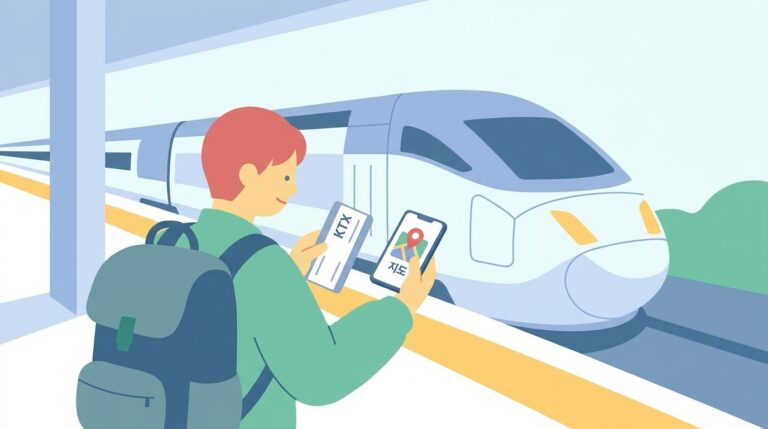
Hello there! This is your lead editor at Daily Hangul. Have you ever watched a K-Drama where the main characters decide to take a spontaneous, romantic train trip to the ocean? They grab some boiled eggs, a bottle of cider, and just hop on a train.
Well, as your local culture navigator who has traveled to every corner of South Korea, I hate to break the illusion, but real life isn’t always a K-Drama! If you try to hop on a KTX (Korea Train eXpress) to Busan on a Friday evening without a plan, you might end up sitting on the floor near the restroom doors for three hours.
Today, we are going to dive into the essential survival skills for planning a train trip in Korea. Whether you are aiming for the blazing fast KTX or planning a classic ‘Rail-ro’ (내일로, a famous youth rail pass) backpacking adventure, knowing the right words will save you from travel disasters and make you look like a total insider. Let’s get your tickets sorted!
Phase 2: Core Expressions Deep Dive
Let’s look at the absolute must-know phrases for booking your train tickets.
1. [목적지]행 기차표 예매하려고요. (I’d like to book a train ticket to [Destination].)
- Pronunciation: [Mokjeokji]haeng gichapyo yemaeharyeogoyo. (haeng sounds like the ‘hang’ in hanging, but slightly shorter)
- Meaning: Literal: Intending to advance-purchase a train ticket bound for [Destination]. / Real nuance: I want to book a ticket to [Destination].
- K-Culture Moment: You’ll see this word ‘행’ (haeng) everywhere in Korean transit. If you’ve watched the zombie thriller movie Train to Busan (부산행 – Busan-haeng), you already know this word! It literally means ‘bound for’.
- Editor’s Insight: The word 예매 (yemae) specifically means ‘buying in advance’. If you are buying a ticket for a train leaving in 5 minutes, you’d use 표를 사다 (pyoreul sada – to buy a ticket). But for travel planning, 예매 is your golden word.
- Situation Spectrum:
- Casual with friends: ✅ (e.g., “우리 부산행 예매하자!”)
- Semi-formal (Ticket Counter): ✅
- Formal: ✅
- 🤔 Think About It: In Korean, the destination comes before the word ‘bound for’ (Busan-bound vs. Bound for Busan). How does this SOV (Subject-Object-Verb) structure change how you think about your destination compared to your native language?
2. KTX 매진됐나요? (Is the KTX sold out?)
- Pronunciation: K-T-X maejindwaennayo? (mae-jin sounds like ‘meh-jin’)
- Meaning: Literal: Has KTX become sold out? / Real nuance: Are there any KTX tickets left?
- K-Culture Moment: This is the phrase that breaks hearts during ‘명절’ (traditional holidays like Chuseok or Seollal). Getting a train ticket during these times is called ‘티켓팅 전쟁’ (ticketing war), and idol fans use the same term ‘매진’ when concert tickets vanish in seconds.
- Editor’s Insight: Koreans love speed and efficiency. KTX and SRT (Super Rapid Train) tickets sell out incredibly fast on weekends. If you hear “매진입니다” (It’s sold out), you need to quickly ask for alternatives!
- Situation Spectrum:
- Casual: ✅
- Semi-formal: ✅
- Formal: ✅
- 🤔 Think About It: The concept of ‘Ticketing Wars’ is huge in Korea, from trains to K-Pop concerts. Why do you think Korea developed such a hyper-competitive ‘first-come, first-served’ digital culture?
3. 입석이라도 괜찮으세요? (Are you okay with a standing ticket?)
- Pronunciation: Ipseogirado gwaenchaneuseyo? (ip-seok sounds like ‘eep-suck’)
- Meaning: Literal: Are you okay even if it’s standing? / Real nuance: There are no seats, you have to stand. Is that okay?
- K-Culture Moment: If you’ve ever done the ‘Rail-ro’ (내일로) pass, you know ‘입석’ (standing) all too well. Young backpackers often buy standing tickets to save money, bringing small foldable mats to sit in the space between train cars.
- Editor’s Insight: The grammar point ‘-라도’ (even if it’s just…) is incredibly useful. It shows you are settling for the second-best option.
- Situation Spectrum:
- Ticket Counter Agent to you: ✅
- You to a friend: ✅ (“입석이라도 끊을까?” – Should we buy standing tickets at least?)
Phase 3: Textbook vs. Real Korean
Textbooks teach you to be perfectly polite, but at a busy train station, efficiency is key!
[Asking for the next train]
* 📖 Textbook Korean: 다음 기차는 몇 시에 출발합니까? (What time does the next train depart?)
* 🗣️ Real Korean: 다음 차 언제예요? (When is the next car?)
* 💡 Why the difference?: Koreans use the word 차 (cha – car/vehicle) for almost all ground transportation, including trains and buses. It’s shorter and faster.
[Asking for a window seat]
* 📖 Textbook Korean: 창가 쪽 좌석으로 주시겠습니까? (Could you please give me a seat by the window?)
* 🗣️ Real Korean: 창가 자리 있어요? (Do you have a window seat?)
* 💡 Why the difference?: 좌석 (jwaseok) sounds a bit formal. 자리 (jari – spot/seat) is used much more naturally in everyday conversation.
Bottom Note: As a B2 learner, try using ‘자리’ instead of ‘좌석’ and ‘차’ instead of ‘기차’ to sound instantly more like a local!
Phase 4: Cultural Context — K-Culture Deep Dive
4-1. Non-verbal Nuances
When you are at the ticket counter, the staff is usually typing rapidly on their computers. It’s totally acceptable (and encouraged) to have your travel app (like Korail Talk or Naver Maps) open and physically point to the train time you want.
Also, remember the Korean concept of 눈치 (Nunchi). If there is a huge line behind you, it’s not the best time to slowly debate your travel itinerary with the agent. Have your destination, preferred time, and train type (KTX, ITX, Mugunghwa) ready in your head!
4-2. The Romance of ‘Rail-ro’ (내일로) Travel
For Korean youth, taking a train isn’t just about getting from Point A to Point B. The 내일로 (Rail-ro) pass allows young adults unlimited travel on regular trains (and recently, limited KTX access) for a certain number of days.
If you watch travel variety shows like 2 Days & 1 Night (1박 2일), you’ll see cast members eating specific train foods. Eating a 삶은 계란 (salmeun gyeran – hard-boiled egg) and drinking 바나나맛 우유 (bananamat uyu – banana-flavored milk) or cider on a slow Mugunghwa-ho train is the ultimate K-travel nostalgia trope. Unlike subways where eating is heavily frowned upon, long-distance trains have a more relaxed dining culture (though smelly foods are still a no-go!).
Phase 5: Real-life Roleplay Scenario
Let’s put you to the test. You are the star of this mini-movie!
- Setting: Friday, 5:30 PM. The ticket counter at Seoul Station. The giant electronic board is flashing red with “매진” (Sold Out) signs. You need to get to Busan for a weekend trip with friends.
- Characters:
- YOU: An expat living in Seoul, trying to organize a last-minute trip.
- Agent: A fast-talking, efficient Korail staff member.
Agent: 어서 오세요. 어디로 가시나요?
(Eoseo oseyo. Eodiro gasinayo?)
[Welcome. Where are you heading?]
YOU: 오늘 저녁 부산행 KTX 표 있나요?
(Oneul jeonyeok busanhaeng K-T-X pyo innayo?)
[Do you have KTX tickets to Busan for this evening?]
Agent: (Typing rapidly) 잠시만요… 아, 오늘 저녁 KTX는 전부 매진입니다.
(Jamsimanyo… Ah, oneul jeonyeok K-T-X-neun jeonbu maejinimnida.)
[Just a moment… Ah, all KTX trains for this evening are sold out.]
YOU: 네? 전부요? SRT도 없나요?
(Ne? Jeonbuyo? S-R-T-do eomnayo?)
[What? All of them? Are there no SRTs either?]
(Stage Direction: You look at your phone in panic)
Agent: 네, 주말이라서요. 대신 밤 9시에 출발하는 무궁화호 입석은 있습니다.
(Ne, jumariraseoyo. Daesin bam ahopsie chulbalhaneun mugunghwaho ipseogeun isseumnida.)
[Yes, because it’s the weekend. Instead, there are standing tickets for the Mugunghwa train departing at 9 PM.]
YOU: 무궁화호면 부산까지 얼마나 걸리죠?
(Mugunghwahomyeon busankkaji eolmana geollijo?)
[If it’s the Mugunghwa, how long does it take to get to Busan?]
Agent: 5시간 반 정도 소요됩니다. 예매해 드릴까요?
(Daseot sigan ban jeongdo soyodoemnida. Yemaehae deurilkkayo?)
[It takes about 5 and a half hours. Shall I book it for you?]
🔀 Your Turn! How do you respond?
– A) “아니요, 너무 오래 걸리네요. 다음에 갈게요.” (No, that takes too long. I’ll go next time.)
– B) “5시간 입석이요? 음… 혹시 내일 아침 첫 차는 자리 있나요?” (5 hours standing? Hmm… By any chance, are there seats on the first train tomorrow morning?)
– C) “대박… 그냥 서서 갈게요. 주세요!” (Daebak… I’ll just stand. Give it to me!)✅ Best Choice: B — Reason: Standing for 5.5 hours on a slow train is brutal! Asking for the ‘첫 차’ (first train) the next morning is a very smart, flexible traveler move.
⚠️ Choice C Analysis: ‘대박’ (Daebak – jackpot/crazy) is too casual for a service interaction. Also, your legs will hate you.
Phase 6: 10-Second Shadowing Drill
Practice these natural rhythms. The slashes (/) indicate where you should pause slightly.
- 🥺 When begging for a ticket: 저기요, / 혹시 취소된 표 / 하나도 없나요? (jeogiyo, / hoksi chwisodoen pyo / hanado eomnayo? – Excuse me, are there absolutely no canceled tickets?)
- 😊 When asking for preference: KTX / 창가 자리로 / 두 장 주세요! (K-T-X / changga jariro / du jang juseyo! – Two KTX tickets for window seats, please!)
- 😤 When confirming details: 이거 / 부산 가는 기차 / 맞죠? (igeo / busan ganeun gicha / matjo? – This is the train going to Busan, right?)
Phase 7: K-Culture Mini Dictionary
1. 내일로 (Rail-ro)
* Romanization: Nae-il-ro
* English: Rail-ro pass
* Context: A highly popular train pass for youth (traditionally under 25, though age limits vary now) allowing unlimited travel. It represents youthful freedom, budget travel, and sleeping in guesthouses.
2. 매진 (Mae-jin)
* Romanization: Mae-jin
* English: Sold out
* Context: You will see this glowing in red on ticketing apps and boards. Always have a backup plan!
3. KTX vs. SRT vs. 무궁화호 (Mugunghwa-ho)
* Romanization: K-T-X vs. S-R-T vs. Mu-gung-hwa-ho
* English: High-speed train vs. Super Rapid Train vs. Slower regional train
* Context: KTX usually departs from Seoul Station. SRT departs from Suseo Station (Gangnam area). Mugunghwa-ho is the romantic, slow, older train that stops at smaller rural stations.
4. 역방향 / 순방향 (Yeok-bang-hyang / Sun-bang-hyang)
* Romanization: Yeok-bang-hyang / Sun-bang-hyang
* English: Backward-facing seat / Forward-facing seat
* Context: KTX trains have both. Backward-facing seats are often slightly cheaper but can cause motion sickness for some. Always double-check this when booking!
Phase 8: Traveler’s Survival Kit
If your phone dies and you need to navigate the train station manually, these are your lifelines!
🆘 Survival Expression #1: Where do I board?
– 🇰🇷 “어디서 타요?” (Eodiseo tayo?)
– 📍 Where to use: After buying your ticket, when looking for the platform.
– 💡 Pro Tip: Train platforms in Korea are called 타는 곳 (taneun got – boarding place) on signs, not 플랫폼 (platform).🆘 Survival Expression #2: Is this the right train?
– 🇰🇷 “이거 부산 가는 거 맞아요?” (Igeo busan ganeun geo majayo?)
– 📍 Where to use: Standing in front of the train, double-checking with the conductor or another passenger.🆘 Survival Expression #3: I missed my train.
– 🇰🇷 “기차를 놓쳤어요.” (Gichareul nochyeosseoyo.)
– 📍 Where to use: At the ticket counter. They can often refund a portion of your ticket or put you on the next available train as a standee.📌 Editor’s Travel Note
– The App: Download the Korail Talk app. It has an English version, but the Korean version is often less buggy. You can book, cancel, and show your mobile ticket right from the app.
– Ticket Checking: Unlike in Europe, there are no physical gates to scan your ticket before getting on a KTX. The conductors check seats digitally. If you sit in an unreserved seat, they will find you!
Phase 9: Critical Thinking Corner — “One Step Deeper”
🧠 Think Deeper: Global Era & Reality vs. Media
In Korean indie films and older K-Dramas, train travel is often depicted as a slow, soulful journey where strangers share life stories over shared snacks. However, modern Korean train travel, especially the KTX, is a symbol of Korea’s “빨리빨리” (Ppal-li Ppal-li / Hurry, hurry) culture. Businessmen commute daily between Seoul and Busan (a 2.5-hour trip). People sit quietly, staring at smartphones or working on laptops. The linguistic shift from “기차” (romantic train) to just “KTX” or “차” (car) reflects this shift from travel-as-an-experience to travel-as-pure-efficiency.
💬 Your Turn: Does your country have a romanticized view of a certain type of transportation (like road trips or old railways)? How does the reality differ from the movies? Let me know in the comments!
Phase 10: FAQ & Common Mistakes
Q: If I’m traveling with a Korean senior, should I book the tickets for them?
Yes! Navigating ticketing apps is actually a common stress point for older generations in Korea (digital divide). Stepping up to handle the “예매” (booking) will earn you massive respect points.
Q: Can I eat my McDonald’s burger on the KTX?
Technically, eating is allowed. Culturally? A strong-smelling burger or cup noodles will earn you serious side-eye (눈치) from everyone in the cabin. Stick to odorless snacks, coffee, or the classic boiled eggs!
❌ Common Mistake #1: Assuming “KTX” means all trains.
✅ How to fix it: KTX is a specific brand of high-speed train. Don’t go to the ticket counter and ask “KTX 주세요” if you actually want a cheap, slow ticket to a small town. Use ‘기차표’ (train ticket) generally.❌ Common Mistake #2: Mixing up Seoul Station and Yongsan Station.
✅ How to fix it: Generally, KTX lines heading South-East (Busan) leave from Seoul Station. Lines heading South-West (Gwangju, Mokpo) leave from Yongsan Station. Always check the departure station!
Phase 11: Summary & Action Items
One-Liner Summary: Mastering train travel in Korea means knowing how to ‘예매’ (book in advance), asking about ‘매진’ (sold out) status, and navigating the fast-paced station culture.
Action Mission:
– 🥉 Bronze (Solo): Say “부산행 기차표 예매하려고요” out loud 3 times right now, focusing on the natural rhythm.
– 🥈 Silver (Online): Look up the Korail website (letskorail.com) and try to find the word ‘예매’ or ‘승차권’ (ticket).
– 🥇 Gold (Real World): Download the Korail Talk app, change the language to Korean, and try to search for a route from Seoul to Busan for this coming weekend!
K-Culture Mission:
Next time you watch a K-Drama, look closely at the train scenes. Are they on a sleek KTX or an old Mugunghwa-ho? Notice how the characters act differently depending on the train!
Phase 12: Quiz — Interactive Challenge
1. Situational Judgment: You arrive at the station and see your train departs in 5 minutes. You run to the counter. What should you say?
A) 부산행 기차표 예매하려고요.
B) 다음 차 언제예요?
C) 지금 출발하는 부산행 기차표 한 장 주세요!
2. True or False – K-Culture Edition:
It is illegal to eat anything on a KTX train, just like the Seoul subway. (T/F)
3. Fill in the Blank:
You want a window seat. “( _______ ) 자리 있어요?”
(Answers: 1. C – A is for advance booking, 2. False – You can eat, but avoid strong smells, 3. 창가)
Frequently Asked Questions (FAQ)
Q: What does "[목적지]행 기차표 예매하려고요. (I'd like to book a train ticket to [Destination].)" mean in Korean and how do you pronounce it?
A: In Korean, "[목적지]행 기차표 예매하려고요. (I'd like to book a train ticket to [Destination].)" is pronounced [Mokjeokji] and means: Literal: Intending to advance-purchase a train ticket bound for [Destination]. / Real nuance: I want to book a ticket to [Destination].
Q: What does "KTX 매진됐나요? (Is the KTX sold out?)" mean in Korean and how do you pronounce it?
A: In Korean, "KTX 매진됐나요? (Is the KTX sold out?)" is pronounced [K-T-X maejindwaennayo? (mae-jin sounds like 'meh-jin'] and means: Literal: Has KTX become sold out? / Real nuance: Are there any KTX tickets left?
Q: What does "입석이라도 괜찮으세요? (Are you okay with a standing ticket?)" mean in Korean and how do you pronounce it?
A: In Korean, "입석이라도 괜찮으세요? (Are you okay with a standing ticket?)" is pronounced [Ipseogirado gwaenchaneuseyo? (ip-seok sounds like 'eep-suck'] and means: Literal: Are you okay even if it's standing? / Real nuance: There are no seats, you have to stand. Is that okay?







