

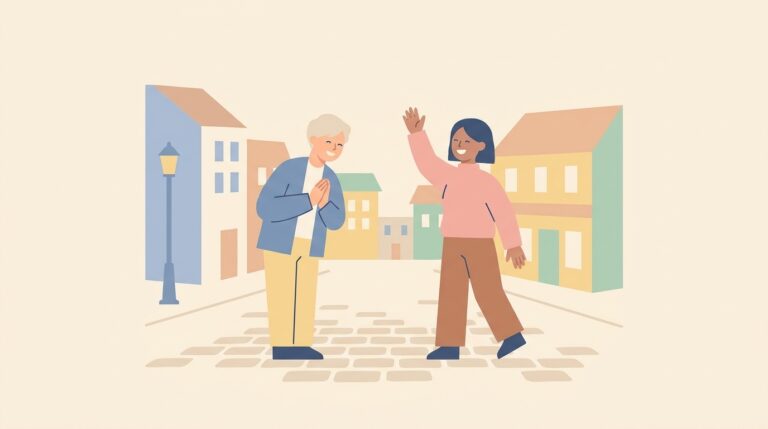
Phase 1: Empathy & The Moment of Truth
Hello! I’m your Daily Hangul Editor.
Picture this: You are watching a K-Drama award ceremony. Your favorite actor wins the Daesang (Grand Prize). As they walk up to the stage, they don’t just wave. They stop, fold their body perfectly in half—a full 90 degrees—and bow to the senior actors. The subtitles simply read: “Thank you.” But was it really just a simple ‘thank you’?
Or maybe you’ve experienced this in real life. You walk into a Korean convenience store in Myeongdong, and the cashier softly sings out, “Annyeonghaseyo~” while slightly dipping their head. Do you wave back? Do you nod? Do you bend in half like that actor on TV?
In Korea, Jondaetmal (존댓말, Polite Language) isn’t just about the words you speak. It’s a full-body experience. Speaking formally without the proper body language is like eating Samgyeopsal (pork belly) without Ssamjang (dipping sauce)—something vital is missing! If you just casually wave ‘Hi’ while saying a formal greeting to a Korean elder, they might smile, but inside, they’ll be a bit confused.
Don’t worry! This guide is built from the real-life sweaty-palm moments of students just like you. Let’s master the art of the Korean bow so you can navigate Seoul with the confidence of a true local!
Phase 2: Core Expressions & The Physical Bow
Let’s break down the most essential phrases that must ALWAYS be accompanied by a bow.
1. 안녕하세요
- Pronunciation: annyeonghaseyo (an-nyong-ha-se-yo)
- Meaning: Hello / How are you? (Literal: Are you at peace?)
- K-Culture Moment: When a new employee joins the company in a K-Drama, they stand nervously in the middle of the office, shout this phrase, and bow 45 degrees.
- Editor’s Insight: The depth of your bow matches the situation. A casual 15-degree nod for the barista, a standard 30-to-45-degree bow for a coworker, and a deep 90-degree “folder bow” for a VIP or your partner’s parents.
- Situation Spectrum:
- Close Friends (Casual): 🚫 (Use ‘안녕’ without a bow instead)
- Coworkers (Semi-formal): ✅ (30 degrees)
- Elders/Boss (Formal): ✅ (45 degrees)
- 🤔 Think About It: Why does the standard Korean greeting ask about “peace” (안녕)? Historically, Korea went through many turbulent times, so checking if someone survived the night peacefully became the ultimate sign of care. How does your native language’s greeting reflect your history?
2. 감사합니다
- Pronunciation: gamsahamnida (gam-sa-ham-ni-da)
- Meaning: Thank you.
- K-Culture Moment: At a K-Pop fan meeting, idols will place their hands on their stomach and bow deeply to their fans. This is called a Baekkop Insa (Belly-button bow).
- Editor’s Insight: If you drop your wallet on the subway and a stranger hands it to you, a quick “Gamsahamnida” with a slight head drop shows immense gratitude. You don’t need a full 90-degree bow here, just a sincere dip.
- Situation Spectrum:
- Close Friends (Casual): ⚠️ (A bit stiff, say ‘고마워’ instead)
- Coworkers (Semi-formal): ✅
- Elders/Boss (Formal): ✅
- 🤔 Think About It: When Koreans say thank you, they often lower themselves physically to elevate the other person. How is gratitude expressed physically in your culture?
3. 수고하셨습니다
- Pronunciation: sugohasyeotseumnida (su-go-ha-syot-seum-ni-da)
- Meaning: Thank you for your hard work / Good job today.
- K-Culture Moment: The director yells “Cut!” on a drama set. Immediately, the entire cast and crew start bowing to each other in all directions, repeating this phrase like a chorus.
- Editor’s Insight: This is the magic word to say when leaving the office or finishing a group project. But beware: saying this to your boss can sometimes be seen as you “evaluating” their work.
- Situation Spectrum:
- Close Friends (Casual): ⚠️ (Say ‘수고했어’)
- Coworkers (Semi-formal): ✅
- Elders/Boss (Formal): 🚫 (It’s safer to say ‘감사합니다’ or ‘먼저 들어가겠습니다’ to seniors)
- 🤔 Think About It: Acknowledging collective effort is huge in Korea. Why is there a specific phrase for “your hard work” rather than just saying “bye”?
Phase 3: Textbook vs. Real Korean
- Greeting the owner at a neighborhood restaurant
- 📖 Textbook Korean: “안녕히 계십시오.” (Stay in peace, very formal)
- 🗣️ Real Korean: “잘 먹었습니다!” (I ate well!) + a slight head bow (목례).
- 💡 Why the difference?: Acknowledging the food is the highest form of respect to a restaurant owner in Korea. It builds instant rapport.
- Passing a colleague in the hallway for the 3rd time
- 📖 Textbook Korean: “안녕하세요.” + 45-degree bow.
- 🗣️ Real Korean: A silent smile + a tiny, quick head nod.
- 💡 Why the difference?: Bowing formally every single time you see someone in a single day is exhausting. The first greeting is deep; subsequent ones are just micro-nods of acknowledgment.
Phase 4: Cultural Context — K-Culture Deep Dive
4-1. The Non-Verbal Magic: Eye Contact & Hands
Bowing isn’t just about the back. It involves Nunchi (눈치)—reading the room.
– Eyes: In Western cultures, making eye contact while shaking hands is respectful. In Korea, staring straight into someone’s eyes while bowing can seem aggressive. Drop your gaze naturally to the floor or their chest level.
– Hands: Keep your hands out of your pockets! Pockets are the ultimate enemy of politeness in Korea. Either place them politely at your sides or lightly clasped in front of you.
4-2. The K-Pop Connection: The “Folder Bow” (폴더 인사)
If you follow K-Pop, you’ve definitely seen the Folder Bow. Rookies bend completely at the waist (90 degrees) when greeting senior artists (Sunbaenims). It looks like a flip phone closing!
Critical View: Do normal Koreans do this every day? No. The K-Pop industry has an exaggerated, hyper-hierarchical culture. If you do a “folder bow” to a barista in Seoul, they might panic, thinking they did something terribly wrong. Save the 90-degree bow for apologies or extreme formal gratitude.
Phase 5: Real-Life Roleplay Scenario
Setting: Friday, 9:00 PM. Outside a lively Samgyeopsal place in Gangnam. The company dinner (회식 – Hoesik) has just finished. You are standing on the sidewalk with your team, smelling delightfully of roasted pork and garlic.
Characters:
– YOU: A foreign employee trying to impress the team.
– Min-su: Your friendly 30-something Korean coworker.
– Mr. Kim: Your department boss (strict but soft-hearted).
Dialogue:
Min-su: 아, 진짜 배부르다. 다들 조심히 들어가세요!
(A, jinjja baebureuda. Dadeul josimhi deureogaseyo!)
[Ah, I’m so full. Everyone get home safely!]
(🎭 Stage Direction: Min-su does a 30-degree bow to the boss and gives you a warm nod.)
Mr. Kim: 그래, 민수 씨도 조심히 가고. (Looks at you) 뫄뫄 씨도 한국 삼겹살 입에 맞았어요?
(Geurae, Minsu ssi-do josimhi gago. Mwamwa ssi-do hanguk samgyeopsal ibe majasseoyo?)
[Right, you get home safely too, Min-su. Did the Korean BBQ suit your taste?]
(🎭 Stage Direction: Mr. Kim smiles warmly at you, waiting for your response before he heads to his taxi.)
🔀 Your Turn! Decision Point: How do you respond to your boss?
- A) (Wave one hand brightly) “네! 굿바이!”
- B) (Stand straight, hands in pockets) “네, 맛있었어요. 수고하셨습니다.”
- C) (Take hands out of pockets, do a 45-degree bow) “네, 정말 맛있게 잘 먹었습니다. 조심히 들어가세요!”
✅ Best Choice: C — Why? Hands are out of pockets, the physical bow matches the polite Jondaetmal, and saying “I ate well” (잘 먹었습니다) followed by “Get home safely” (조심히 들어가세요) is the perfect combo for a boss.
⚠️ Choice B Analysis: Saying “Sugohasyeotseumnida” to a boss can be seen as slightly presumptuous (like you are evaluating him), and hands in pockets is a big no-no!
❌ Choice A Analysis: Waving is strictly for friends or young children. Waving at your boss might give him a minor heart attack.
Phase 6: 10-Second Shadowing Drill
Read these aloud while actually doing the physical head nod. Feel the rhythm!
- 😊 Brightly to a cashier:
안녕 / 하세요~
(an-nyeong / ha-se-yo~)
Action: Slight head dip! -
😌 Gratefully to an elder:
정말 / 감사 / 합니다.
(jeong-mal / gam-sa / ham-ni-da.)
Action: Hands together in front, 45-degree bow! -
😤 Polite but firm to a colleague:
오늘 / 수고 / 하셨습니다!
(o-neul / su-go / ha-syot-seum-ni-da!)
Action: 30-degree bow, confident smile!
Phase 7: K-Culture Mini Dictionary
1. 눈치 (Nunchi)
* Romanization: nunchi
* Meaning: Social tact / Reading the room.
* Context: It’s the silent radar you use to know when to bow and how deep to bow. Without Nunchi, language skills aren’t enough.
2. 목례 (Mok-rye)
* Romanization: mok-rye
* Meaning: An eye/head nod.
* Context: The most common ‘casual’ bow. Used when entering cafes, making eye contact with neighbors, or passing colleagues for the second time.
3. 존댓말 (Jondaetmal)
* Romanization: jondaetmal
* Meaning: Honorific / Polite language.
* Context: The language of respect. Remember: Jondaetmal is spoken with your mouth, but completed with your body (the bow).
4. 회식 (Hoesik)
* Romanization: hoesik
* Meaning: Company dinner.
* Context: A crucial bonding event in Korean corporate culture, heavily reliant on hierarchical etiquette, pouring drinks with two hands, and lots of bowing when leaving.
Phase 8: Traveler’s Survival Kit
Are you traveling to Seoul? You will bow at least 20 times a day. Here is your cheat sheet!
🆘 Survival Bowing Top 3
– 🛒 Convenience Store / Cafe:
“안녕하세요~” (Annyeonghaseyo) + Small head nod (목례).
– 🚕 Exiting a Taxi:
“감사합니다!” (Gamsahamnida) + Nod your head as you close the door.
– 🍽️ Leaving a Restaurant:
“잘 먹었습니다!” (Jal meogeotseumnida – I ate well!) + 15-degree bow to the counter staff.📌 Editor’s Travel Note
– Eye Contact: Don’t stare intensely at the staff while bowing. Just look naturally downward.
– No Tip Required: In Korea, excellent service is part of the culture. Bowing and saying “Thank you” sincerely replaces the monetary tip. Do not leave money on the table; they will chase you down the street to give it back!
Phase 9: Critical Thinking — “A Step Deeper”
🧠 Think Deeper: Language & Power (Physical Space)
In Korean culture, the language you use (Jondaetmal vs. Banmal) dictates the power dynamic and distance between two people. But notice how this is mapped onto the physical body. When you bow, you are literally making yourself physically smaller and lower than the other person. The higher their status (age, rank), the lower you go.
This shows that Korean respect isn’t just an abstract grammatical concept—it occupies physical space. In Western cultures, equality is often expressed physically (standing tall, eye-to-eye, firm handshakes). In Korea, harmony is maintained by physically acknowledging the social structure.
💬 Your Turn: Does your culture use physical space or body language to show respect or hierarchy? Share your thoughts in the comments!
Phase 10: FAQ & Avoiding Misunderstandings
Q: “Do I have to bow to people younger than me?”
A: Yes! But the depth changes. If a younger person bows 45 degrees to you, you don’t just stand like a statue. You acknowledge them with a slight nod (목례). Respect goes both ways.
Q: “I feel awkward bowing. Can I just shake hands?”
A: In business, Koreans often combine them! They will shake your hand while simultaneously bowing. Just remember to use two hands (or support your right forearm with your left hand) when shaking hands with an elder.
❌ Common Mistake #1: Waving “Hello” or “Goodbye” to an elder or boss.
✅ Do this instead: Waving is strictly for children and close friends. Always replace the wave with a bow when speaking to adults or seniors.❌ Common Mistake #2: Bowing with one hand in your pocket, holding a coffee cup in the other.
✅ Do this instead: It looks arrogant. Take your hand out of your pocket before you dip your head.
Phase 11: Summary & Action Items
One-Liner Summary: In Korea, speaking polite Jondaetmal without bowing is only half the greeting—your body must match your words!
Action Mission 3-Step Challenge:
– 🥉 Bronze (Solo): Stand in front of a mirror, put your hands at your sides, and practice saying “안녕하세요” with a 30-degree bow.
– 🥈 Silver (Online): Drop a comment below using Jondaetmal to say “Thank you for your hard work” to the Daily Hangul team!
– 🥇 Gold (Real World): Next time you visit a Korean restaurant or market, do a slight head dip when you say “감사합니다” and see how their smile brightens.
🎬 K-Culture Mission:
Watch one episode of a Korean workplace drama (like Misaeng or Extraordinary Attorney Woo). Count how many times the main character bows in the first 10 minutes. Notice the difference between a boss’s nod and a rookie’s folder bow!
Phase 12: Quiz — Interactive Challenge
Test your Nunchi!
1. Situational Judgment: You are leaving your part-time job at a cafe. Your manager (older than you) is still working. What do you do?
– A) Wave your hand and shout “안녕!” (Annyeong!)
– B) Say “수고하셨습니다” (Sugohasyeotseumnida) with a 90-degree folder bow.
– C) Say “먼저 들어가겠습니다” (I will leave first) and bow 45 degrees.
2. True or False — K-Culture Edition:
“When bowing to your boss, you should maintain intense, unblinking eye contact to show confidence.” (True / False)
3. Fill in the Blank:
When shaking hands with a Korean elder, it is polite to support your right arm with your left ______.
(Scroll down for answers!)
…
…
…
Answers:
1. C (A is disrespectful. B uses ‘Sugohasyeotseumnida’ which is risky to say to a boss, and 90 degrees is overkill. C is perfectly polite!).
2. False (Intense eye contact while bowing is seen as confrontational. Drop your gaze naturally).
3. Hand / forearm (Using two hands shows respect!).
Frequently Asked Questions (FAQ)
Q: What does "안녕하세요" mean in Korean and how do you pronounce it?
A: In Korean, "안녕하세요" is pronounced [annyeonghaseyo (an-nyong-ha-se-yo] and means: Hello / How are you? (Literal: Are you at peace?)
Q: What does "감사합니다" mean in Korean and how do you pronounce it?
A: In Korean, "감사합니다" is pronounced [gamsahamnida (gam-sa-ham-ni-da] and means: Thank you.
Q: What does "수고하셨습니다" mean in Korean and how do you pronounce it?
A: In Korean, "수고하셨습니다" is pronounced [sugohasyeotseumnida (su-go-ha-syot-seum-ni-da] and means: Thank you for your hard work / Good job today.







