

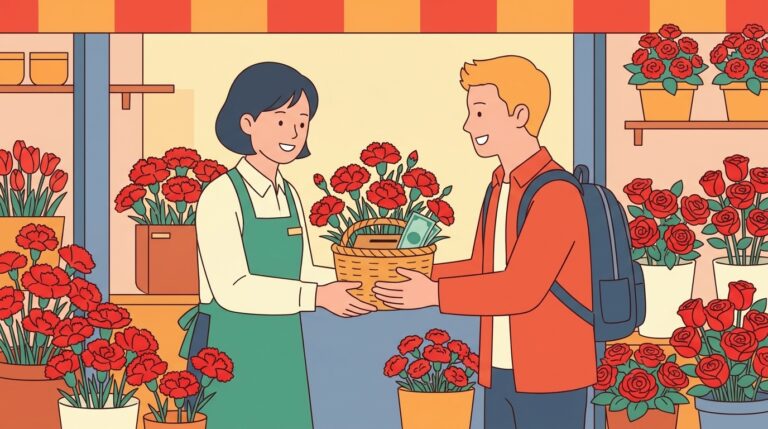
Phase 1: Empathy & The “Flower Shop” Magic
Hello! I’m the Lead Editor of Daily Hangul.
Imagine this: It’s early May in Seoul. You’re walking near a subway station, and suddenly, every single flower shop has baskets of red flowers spilling onto the sidewalk. You remember a scene from a K-Drama where the protagonist hands their parents a beautiful floral box… and suddenly, a long string of 50,000-won bills gets pulled out of it! Welcome to May in Korea. May 8th is Parents’ Day (어버이날), and the ultimate symbol of respect is the red carnation.
Walking into a chaotic Korean flower shop during this season can be intimidating. “What if I buy the wrong flower?” “How do I ask for packaging?” Don’t worry. I’ve had countless beginner students panic about buying flowers for their Korean host family or partner’s parents. If you know just a few essential phrases, you won’t just survive the holiday rush—you’ll be treated like a true local!
Phase 2: Deep Dive into Key Expressions
1. 카네이션 바구니 있어요?
- Pronunciation: kaneisyeon baguni isseoyo? (The ‘eo’ in isseoyo sounds like the ‘u’ in ‘uh-oh’)
- Meaning: Literal: Carnation basket exist? / Real: Do you have carnation baskets?
- K-Culture Moment: In Korea, giving a single stem of a flower for Parents’ Day is rare. Elaborate baskets (바구니) or boxes are the standard. You’ll see these stacked high in front of shops.
- Editor’s Insight: This is the perfect ice-breaker when you walk into a busy shop. It immediately tells the owner exactly what you need.
- Situation Spectrum:
- Casual (Friends): ⚠️ (Needs to drop ‘yo’)
- Semi-formal (Shop owners/Strangers): ✅
- Formal (Boss/Elders): ✅
- 🤔 Think About It: Why do Koreans prefer large, beautifully arranged baskets over simple bouquets for Parents’ Day? How does this connect to the Korean concept of ‘체면’ (Chemyon – saving face or maintaining dignity)?
2. 예쁘게 포장해 주세요.
- Pronunciation: yeppeuge pojanghae juseyo. (The ‘eu’ in yeppeuge sounds like the disgusted sound you make when stepping in gum. ‘pp’ is a strong, tense sound!)
- Meaning: Literal: Beautifully package please. / Real: Please wrap it beautifully.
- K-Culture Moment: Presentation is EVERYTHING in Korea. Whether it’s K-Beauty products, café desserts, or flowers, the packaging shows your sincerity.
- Editor’s Insight: Even if the flower is already in a pot or basket, saying this prompts the florist to add a nice ribbon or a clear carrying bag.
- Situation Spectrum:
- Casual: ⚠️
- Semi-formal: ✅
- Formal: ✅
- 🤔 Think About It: In your home country, is the gift itself more important, or the way it is wrapped?
Phase 3: Textbook vs. Real Korean
[Asking for a Recommendation]
* 📖 Textbook Korean: 어떤 꽃이 좋습니까? (Which flower is good? – Very stiff and robotic)
* 🗣️ Real Korean: 요즘 제일 잘 나가는 게 뭐예요? (What’s the best seller these days?)
* 💡 Why the difference?: Korea is a fast-paced, trend-sensitive society. Asking for the ‘best seller’ ensures you’re giving something modern and popular, like the trendy “Money Box.”
[Leaving the Shop]
* 📖 Textbook Korean: 안녕히 계세요. (Goodbye.)
* 🗣️ Real Korean: 수고하세요~ (Keep up the good work!) or 많이 파세요~ (Sell a lot!)
* 💡 Why the difference?: Acknowledging someone’s hard work (수고) is deeply embedded in Korean culture. Saying “Sell a lot” is a warm, culturally savvy way to wish a small business owner well, especially on a busy holiday.
Phase 4: Cultural Context — K-Culture Deep Dive
4-1. Non-Verbal Nunchi (눈치)
When you hand the flowers to a Korean elder (like your partner’s parents), always use two hands. Give a slight bow. This shows immense respect. Also, read the room (Nunchi): don’t give the flowers casually like “Here you go!” Treat the transaction as a meaningful ceremony.
4-2. K-Drama Connection: The “Yongdon Box”
Have you seen family K-Dramas where a parent receives a box of flowers, looks mildly appreciative, but then their eyes go wide when they pull out cash hidden inside? This is the famous 용돈박스 (Yongdon-bakseu / Pocket Money Box)! In Korea, giving cash to parents is the ultimate sign of a successful, caring child. Florists specifically sell carnation boxes designed to hold rolled-up 50,000 won bills. It’s a hilarious but heartwarming reality of modern Korean love languages.
Phase 5: Real-Life Roleplay Scenario
Setting: May 7th, 6:00 PM. A bustling flower shop near Hongdae Station. Red carnations are everywhere. You are an expat wanting to surprise your Korean host mother for Parents’ Day.
Characters:
– YOU: A bit nervous but ready to use your Korean.
– Florist (사장님): A friendly but extremely busy middle-aged owner.
Dialogue:
사장님: 어서 오세요! 카네이션 찾으세요?
(eoseo oseyo! kaneisyeon chajeuseyo?)
[Welcome! Are you looking for carnations?]
YOU: 네, 카네이션 바구니 있어요?
(ne, kaneisyeon baguni isseoyo?)
[Yes, do you have carnation baskets?]
사장님: 네, 저기 앞에 있는 게 다 카네이션이에요.
(ne, jeogi ape inneun ge da kaneisyeon-ieyo.)
[Yes, everything out front are carnations.]
YOU: 우와, 예쁘네요. 이거 얼마예요?
(uwa, yeppeuneyo. igeo eolmayeyo?)
[Wow, it’s pretty. How much is this?]
사장님: 그건 3만 5천 원이에요.
(geugeon sam-man o-cheon won-ieyo.)
[That one is 35,000 won.]
YOU: 음… 저쪽 상자는 뭐예요?
(eum… jeojjok sangjaneun mwoyeyo?)
[Hmm… what is that box over there?]
사장님: 아, 저건 ‘용돈박스’예요. 돈을 넣을 수 있어요.
(a, jeogeon ‘yongdon-bakseu’yeyo. doneul noeul su isseoyo.)
[Ah, that’s a ‘pocket money box’. You can put cash in it.]
🔀 Your Turn! How should you respond to ensure a good purchase?
– A) 깎아주세요! (Give me a discount!)
– B) 그럼 이 바구니로 할게요. 예쁘게 포장해 주세요!
– C) 그냥 주세요. (Just give it to me.)✅ Best Choice: B — “I’ll take this basket then. Please wrap it beautifully!” It clearly states your choice and ensures it looks presentable.
⚠️ Choice A Analysis: Haggling at a busy flower shop on the day before Parents’ Day is a big No-No. Prices are usually fixed for holidays!
사장님: 네, 리본 달아서 예쁘게 해 드릴게요!
(ne, ribon daraseo yeppeuge hae deurilgeyo!)
[Yes, I’ll attach a ribbon and make it pretty!]
YOU: 감사합니다! 많이 파세요!
(gamsahamnida! mani paseyo!)
[Thank you! Sell a lot!]
[Bonus K-Culture Scenario]
Later that evening, you hand the basket to your host mother.
You: 어머님, 어버이날 축하드려요! (Mother, Happy Parents’ Day!)
Host Mom: 아이고~ 뭘 이런 걸 다 샀어! 돈 아깝게! (Oh my~ Why did you buy all this! What a waste of money! While smiling brightly and taking pictures for her friends)
Phase 6: 10-Second Shadowing Drill
Let’s practice your tone!
😊 사장님, / 이거 / 예~~~쁘게 / 포장해 주세요!
(sajangnim, / igeo / ye~~~ppeuge / pojanghae juseyo!)
Tip: Stretch out the ‘ye’ in yeppeuge to sound extra friendly and enthusiastic!
Phase 7: K-Culture Mini Dictionary
1. 어버이날
* Romanization: eobeoinal
* English: Parents’ Day (May 8th)
* Context: Unlike Mother’s Day and Father’s Day in many Western countries, Korea combines both into one major day of gratitude.
2. 카네이션
* Romanization: kaneisyeon
* English: Carnation
* Context: The ultimate symbol of Parents’ Day. Red means love and respect. Never give white carnations, as white flowers are for funerals in Korea!
3. 용돈박스
* Romanization: yongdon-bakseu
* English: Pocket Money Box
* Context: A popular floral gift box designed to hold cash. It reflects the practical side of Korean gifting culture.
4. 눈치
* Romanization: nunchi
* English: Social intuition / Reading the room
* Context: Knowing that you should order your flowers a few days before May 8th to avoid the crazy lines is an example of having quick ‘nunchi’!
Phase 8: Traveler Survival Kit
If you are traveling in Korea in May, you will definitely see these flower stands everywhere. Here are your survival phrases:
🆘 Survival Expression #1: 이거 얼마예요?
– 🇰🇷 (igeo eolmayeyo?)
– 🗣️ English Sound: Ee-guh ul-ma-yeh-yo?
– 📍 Where to use: Flower shops, street markets, convenience stores.
– 💡 Pro Tip: If you can’t understand the fast numbers, just pull up the calculator app on your phone and politely gesture for them to type it in!📌 Editor’s Travel Note
– Cash vs. Card: Korea is a “Card Heaven,” but temporary street flower stalls set up just for Parents’ Day might prefer cash or bank transfer (계좌이체 – gyejwa-iche). Keep a 50,000 won bill handy!
– Tipping: There is NO tipping culture in Korea. Do not tip the florist; just say “수고하세요!” (Keep up the good work).
Phase 9: Critical Thinking Corner — “One Step Deeper”
Media vs. Reality: The Practicality of Love
In K-Dramas, you might see a parent shed a tear over a beautifully handwritten letter and a single flower. While letters are cherished, real Korean society is deeply practical. The immense popularity of the “Yongdon Box” (cash hidden in flowers) shows a shift in how love is expressed. In many Western cultures, giving cash to parents might seem “cold” or “lazy.” But in Korea, providing practical financial support is considered the warmest, most considerate sign of a successful child taking care of their parents.
💬 Your Turn: In your culture, is giving cash to your parents considered a good gift or a taboo? Share your thoughts in the comments!
Phase 10: FAQ & Avoiding Misunderstandings
Q: “Can I buy a white carnation because it looks more elegant?”
A: NO! In Korea, white flowers (especially white chrysanthemums, but white flowers in general) are strictly associated with funerals and condolences. Always stick to red or bright pink for Parents’ Day.
Q: “Is it okay to just send a text message for Parents’ Day?”
A: Maybe, but not recommended. If you have a close relationship with Korean parents/host family, a simple text is considered lacking in “Jeong” (정 – warmth/affection). A small gift or at least a heartfelt phone call is much better.
❌ Common Mistake: Trying to negotiate the price of a flower basket on May 7th or 8th.
✅ Do this instead: Accept the holiday premium pricing. If you want a cheaper option, buy a single potted carnation (카네이션 화분 – kaneisyeon hwabun) instead of a massive basket.
Phase 11: Summary & Action Items
- One-Liner Summary: Survive the May 8th rush by asking “카네이션 바구니 있어요?” and remembering to say “예쁘게 포장해 주세요!”
-
Action Mission:
- 🥉 Bronze (Solo): Say “사장님, 예쁘게 포장해 주세요” out loud 3 times right now.
- 🥈 Silver (Online): Search the hashtag #어버이날용돈박스 on Instagram and see how crazy the cash-flower arrangements get!
- 🥇 Gold (Real Life): Visit a Korean florist (or any shop), buy a small item, and practice saying “많이 파세요!” when you leave.
Phase 12: Quiz — Interactive Challenge
1. Fill in the Blank:
You want the florist to make your gift look amazing.
“사장님, [_______] 포장해 주세요.”
(Hint: beautifully)
2. True or False — K-Culture Edition:
“It is highly recommended to buy beautiful white carnations for Parents’ Day to show pure love.” (T/F)
3. Situational Judgment:
You just paid for your flowers on a very busy holiday. As you walk out the door, what is the best phrase to yell out to the tired shop owner?
– A) 안녕히 주무세요 (Good night)
– B) 수고하세요 (Keep up the good work)
– C) 미안해요 (I’m sorry)
(Answers: 1. 예쁘게 (yeppeuge), 2. False! White is for funerals., 3. B)
Frequently Asked Questions (FAQ)
Q: What does "카네이션 바구니 있어요?" mean in Korean and how do you pronounce it?
A: In Korean, "카네이션 바구니 있어요?" is pronounced [kaneisyeon baguni isseoyo? (The 'eo' in isseoyo sounds like the 'u' in 'uh-oh'] and means: Literal: Carnation basket exist? / Real: Do you have carnation baskets?
Q: What does "예쁘게 포장해 주세요." mean in Korean and how do you pronounce it?
A: In Korean, "예쁘게 포장해 주세요." is pronounced [yeppeuge pojanghae juseyo. (The 'eu' in yeppeuge sounds like the disgusted sound you make when stepping in gum. 'pp' is a strong, tense sound!] and means: Literal: Beautifully package please. / Real: Please wrap it beautifully.







