

Phase 1: Empathy (Immersive Open)
Hello there! I’m the Lead Editor at Daily Hangul.
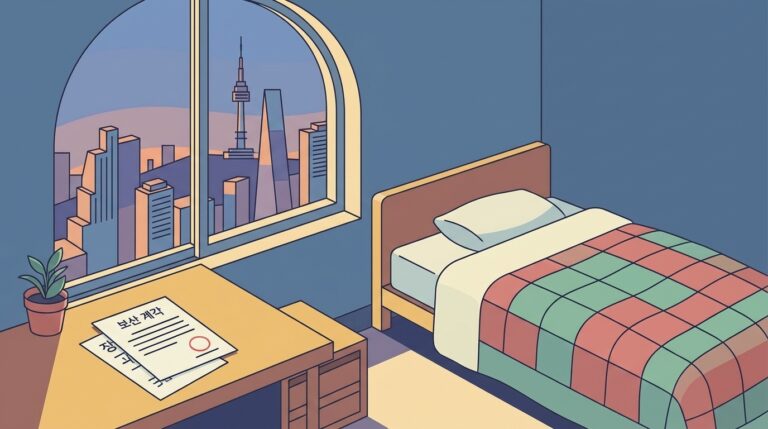
Picture this: You’re watching your favorite K-Drama. The main character, having just moved to Seoul, walks into a real estate agency. They look at a tiny, cozy rooftop room (Oktapbang) overlooking the city lights. It’s romantic, right? But then the realtor says a number, and the subtitles read: “The deposit is 10 million won.” Wait, $10,000 USD just to rent a tiny room?!
Welcome to the Korean real estate market. If you are planning to study, work, or live in Korea, you will inevitably have to visit a Budongsan (Real Estate Agency) and look for a Won-room (Studio apartment). The Korean housing system—specifically the heavy reliance on huge deposits (Bojeunggeum)—is totally unique and often a massive culture shock for foreigners.
If you just use a translation app to say “I want to rent a house,” you might end up confused, overpaying, or missing out on a great deal. Today, I’m going to share the insider secrets of Korean real estate language so you can negotiate like a true Seoulite.
Note: This guide is based on real struggles and questions from expats who have successfully found their dream (or at least, highly practical) homes in Korea!
Phase 2: Deep Dive into Core Expressions
Let’s look at the absolute must-know phrases when you walk into a Korean real estate agency.
1. 보증금 얼마에 월세 얼마예요?
- Pronunciation: bojeunggeum eolmae wolse eolmayeyo? [bo-jeung-geum ul-ma-eh wol-seh ul-ma-yeh-yo?]
- Meaning: What is the deposit and what is the monthly rent? (Literal: Deposit at how much, monthly rent is how much?)
- K-Culture Moment: In K-Dramas, you’ll often hear characters summarizing rent with just two numbers: “천에 오십” (1000/50). This means a 10,000,000 KRW deposit and 500,000 KRW monthly rent. This phrase is the ultimate icebreaker at the Budongsan.
- Editor’s Insight: Think of Bojeunggeum as a massive security deposit that the landlord holds onto (and earns interest on) while you live there. You get it all back when you move out. Asking this question immediately shows the realtor you understand how the Korean system works.
- Situation Spectrum:
- Casual with friends: ✅ (e.g., 너네 집 보증금 얼마야?)
- Realtor/Semi-formal: ✅ (Perfect for inquiries)
- Formal/Elders: ⚠️ (Slightly direct, but okay in business contexts)
- 🤔 Think About It: Why does Korea have such high deposits? Historically, due to high interest rates, landlords preferred large lump sums of cash to invest in banks or other properties rather than collecting high monthly rent. Does your country have anything similar?
2. 관리비는 따로인가요?
- Pronunciation: gwallibineun ttaroingayo? [gwal-li-bi-neun tta-ro-in-ga-yo?]
- Meaning: Is the maintenance fee separate? (Is it not included in the rent?)
- K-Culture Moment: You finally find a cheap room for 400,000 KRW! But wait… the Gwallibi (maintenance fee) is 150,000 KRW, making it way over budget. This is a common trap for first-time renters in Seoul.
- Editor’s Insight: Gwallibi covers building cleaning, elevator use, and sometimes internet or water. But gas and electricity are usually separate. Always ask this to avoid hidden costs.
- Situation Spectrum:
- Casual: 🚫
- Realtor/Landlord: ✅
- Formal: ✅
- 🤔 Think About It: Koreans love bundled services (internet + water + TV), but the exact inclusions vary wildly by building. It reflects a culture where neighborhood and building management are highly localized.
3. 보증금 조절 되나요?
- Pronunciation: bojeunggeum jojeol doenayo? [bo-jeung-geum jo-jeol dwe-na-yo?]
- Meaning: Can the deposit be adjusted?
- K-Culture Moment: You don’t have $10,000 for a deposit. You ask this magic question. The realtor calls the landlord to negotiate: “If they pay a bit more monthly, can you lower the deposit to $5,000?”
- Editor’s Insight: This is the ultimate insider flex. In Korea, you can often negotiate the ratio between deposit and rent. Raising the deposit lowers the rent, and vice versa. Using “조절 되나요?” (Can it be adjusted?) sounds incredibly natural and polite.
- Situation Spectrum:
- Casual: 🚫
- Realtor: ✅ (Highly recommended)
- Formal: ✅
- 🤔 Think About It: Negotiation in Korea isn’t always a hard “no.” It’s about finding a middle ground. How is renting negotiation perceived in your culture?
Phase 3: Textbook vs. Real Korean
Let’s compare what language apps teach you versus what actual Koreans say on the street.
[Situation 1: Asking the price of the apartment]
* 📖 Textbook: 이 방의 월세는 얼마입니까? (How much is the monthly rent of this room?)
* 🗣️ Real Korean: 천에 오십 맞춰주실 수 있어요? (Can you match it to 10 million / 500 thousand?)
* 💡 Why the difference?: Koreans drop the zeros when talking about large sums in real estate. “천” means 10,000,000 (10 million) and “오십” means 500,000 (500 thousand). It’s all about speed and efficiency (Palli-palli culture).
[Situation 2: Asking what utilities are included]
* 📖 Textbook: 관리비에 무엇이 포함되어 있습니까? (What is included in the maintenance fee?)
* 🗣️ Real Korean: 가스비랑 전기세는 별도죠? (Gas and electricity are separate, right?)
* 💡 Why the difference?: Instead of asking an open-ended question, Koreans confirm the negative space. They already assume internet and water might be included, so they immediately check the most expensive utilities: gas (heating) and electricity (A/C).
Phase 4: Cultural Context — K-Culture Deep Dive
4-1. Non-verbal Element: The Art of ‘Nunchi’ at the Realtor
When you walk into a Budongsan, don’t look overly desperate or completely lost. In Korean real estate, Nunchi (reading the room) is key. If the realtor thinks you don’t know the market prices, they might show you properties that are hard to rent out. Stand confident, hold a notebook (or your phone with a real estate app open), and nod thoughtfully.
4-2. K-Drama Connection: The Rooftop vs. Semi-Basement Trope
If you’ve watched Parasite or Fight for My Way, you are familiar with the extremes of cheap Korean housing: the Banjiha (semi-basement) and the Oktapbang (rooftop room).
– The Reality Check: K-Dramas make Oktapbangs look like romantic hideaways where you drink soju under the stars. In reality? They are freezing in the winter, boiling in the summer, and the water pressure can be terrible.
– The Lesson: When looking for a Won-room, don’t let K-drama aesthetics blind you. Focus on practical questions: “수압 괜찮아요?” (Is the water pressure okay?) and “채광은 어때요?” (How is the natural light?).
Phase 5: Real-Life Roleplay Scenario
Setting: A rainy Saturday afternoon. You are sitting in a cozy, slightly cluttered real estate agency near a university in Seoul. The walls are covered with maps. Mr. Kim, a friendly realtor in his 50s, offers you a paper cup of sweet instant coffee (Mix Coffee).
Characters:
– YOU: An expat who just got a job in Seoul. Your budget is tight.
– Realtor Kim: Friendly, talks a bit fast, but genuinely wants to help you find a place.
Dialogue:
Realtor Kim: 어서 오세요! 어떤 방 찾으세요? ☕
(eoseo oseyo! eotteon bang chajeuseyo?)
[Welcome! What kind of room are you looking for?]
YOU: 안녕하세요. 원룸 찾고 있는데요.
(annyeonghaseyo. wonrum chatgo inneundeyo.)
[Hello. I’m looking for a studio.]
Realtor Kim: 예산이 어떻게 되세요?
(yesani eotteoke doeseyo?)
[What is your budget?]
YOU: 보증금 천만 원에 월세 50만 원 정도요.
(bojeunggeum cheonman wone wolse osimman won jeongdoyo.)
[Around a 10 million won deposit and 500,000 won for rent.]
Realtor Kim: 아… 요즘 그 가격이면 반지하밖에 없는데…
(a… yojeum geu gagyeogimyeon banjihabakke eomneunde…)
[Ah… these days, at that price, there are only semi-basements…]
(🎭 Stage Direction: Mr. Kim sighs and taps his calculator)
YOU: 아, 지상층은 없나요? 조금 좁아도 괜찮은데요.
(a, jisangcheungeun eomnayo? jogeum jobado gwaenchaneundeyo.)
[Ah, are there any above-ground floors? It’s okay if it’s a bit small.]
Realtor Kim: 음, 마침 역 근처에 하나 나온 게 있긴 한데. 이건 보증금이 2천이에요.
(eum, machim yeok geuncheoe hana naon ge itgin hande. igeon bojeunggeumi icheonieyo.)
[Hmm, there happens to be one near the station that just came out. But the deposit is 20 million.]
🔀 Your Turn! How should you respond?
– A) “그건 너무 비싸요. 안 할래요.” (That’s too expensive. I won’t do it.)
– B) “보증금 조절 되나요? 보증금 천에 월세 55로 맞춰주실 수 있어요?” (Can the deposit be adjusted? Can you match it to 10 million deposit and 550,000 rent?)
– C) “대박! 당장 계약할게요!” (Awesome! I’ll sign the contract right now!)✅ Best Choice: B — Reason: In Korea, everything is negotiable. Offering a slightly higher rent to lower the deposit is a very common and smart move.
⚠️ Choice A & C Analysis: A is too abrupt and rude. C is reckless; you haven’t even seen the room or asked about the Gwallibi (maintenance fee)!
Realtor Kim: 아, 주인이 월세 받는 걸 좋아해서 조절 될 수도 있어요. 한번 물어볼게요!
(a, juini wolse banneun geol joahaeseo jojeol doel sudo isseoyo. hanbeon mureobolgeyo!)
[Ah, the landlord likes receiving monthly rent, so it might be adjustable. Let me ask!]
YOU: 네, 부탁드립니다! 그리고 관리비는 얼마예요?
(ne, butakdeurimnida! geurigo gwallibineun eolmayeyo?)
[Yes, please do! And how much is the maintenance fee?]
Realtor Kim: 관리비는 5만 원이고, 수도랑 인터넷 포함이에요.
(gwallibineun oman wonigo, sudorang inteonet pohamieyo.)
[The maintenance fee is 50,000 won, and water and internet are included.]
Phase 6: 10-Second Shadowing Drill
Let’s practice the most crucial negotiation phrase. Speak out loud with the right feeling!
🥺 사장님, / 보증금 조절 / 되나요?
(sajangnim, / bojeunggeum jojeol / doenayo?)
Pro-Tip: Pause slightly at the slashes (/). Make your tone polite but slightly hopeful (🥺), as if you are asking a favor from a kind uncle.
Phase 7: K-Culture Mini Dictionary
Here are the essential real estate keywords you must know:
1. 부동산
* Romanization: budongsan
* English: Real Estate Agency
* Context: Also called 공인중개사 (Realtor). Look for the brightly lit offices with tons of A4 papers plastered on the windows detailing prices.
2. 원룸
* Romanization: wonrum
* English: Studio Apartment (One-room)
* Context: The standard living space for university students and single workers. Literally a single room containing a bed, kitchen sink, and bathroom attached.
3. 전세 / 월세
* Romanization: jeonse / wolse
* English: Huge Lump-sum Deposit Lease / Monthly Rent
* Context: Jeonse is uniquely Korean: you give the landlord a massive sum (e.g., $100,000) instead of paying monthly rent, and get it all back when you move out. Wolse is the standard monthly rent, but still requires a relatively high deposit.
4. 관리비
* Romanization: gwallibi
* English: Maintenance Fee
* Context: The hidden killer of budgets. Always ask what exactly is included (internet, water, cleaning) and what is separate (별도 – byeoldo), like gas and electricity.
Phase 8: Traveler/Expats Survival Kit
If you are just visiting Korea for a short time, you might not rent a studio. But if you are staying for a few months (like for a language program), this is vital!
🆘 Survival Phrases for House Hunting
– 🇰🇷 “집 좀 보러 왔는데요.” (jip jom boreo wanneundeyo.)
– 🗣️ Guide: [jip jom bo-ruh wan-neun-deh-yo]
– 📍 Where to use: Walking into any real estate agency.
– 💡 Pro Tip: Don’t be shy! Just walk in and say this, and they will immediately sit you down and start asking your budget.
📌 Editor’s Real Estate Note
– Useful Apps: 직방 (Zigbang), 다방 (Dabang), 네이버 부동산 (Naver Real Estate). Use them to check average prices in the neighborhood before visiting the agency.
– The “Fake Listing” Warning: Beware of 허위매물 (heowimaemul). If an apartment on an app looks too good to be true (huge room, luxury furniture, crazy cheap deposit), it is likely a fake listing to lure you into the agency. Always rely on actual visits!
Phase 9: Critical Thinking — “One Step Deeper”
🧠 Think Deeper: Media vs Reality (The K-Drama Housing Illusion)
Have you ever noticed that in K-Dramas, even poor protagonists living in Oktapbangs (rooftops) have beautifully decorated rooms with fairy lights, massive wooden tables, and amazing views of the N Seoul Tower? The reality of Seoul housing is much grittier. High deposits make it incredibly difficult for young Koreans to move out of their parents’ homes. The phrase “지옥고” (Ji-Ok-Go) was coined to describe the living conditions of young people: Jiha (basement), Oktapbang (rooftop), and Gosiwon (tiny dormitory). Learning real estate Korean isn’t just about vocabulary; it’s a window into the economic struggles and realities of modern Korean youth.
💬 Your Turn: Does your city have a housing crisis for young people? How do young people usually afford their first apartment in your culture? Share in the comments!
Phase 10: FAQ & Avoiding Mistakes
Q: Can a foreigner actually sign a housing contract in Korea?
Yes! But you will absolutely need your Alien Registration Card (ARC – 외국인등록증) and a Korean bank account to transfer the deposit safely.
Q: Can I bargain with the realtor?
You don’t bargain the fee with the realtor, but you ask the realtor to bargain with the landlord on your behalf. They act as a mediator.
❌ Common Mistake #1: Assuming appliances are not included.
✅ Do this instead: Ask “풀옵션이에요?” (Is it fully furnished?). Most Korean studios come with a washing machine, fridge, A/C, and sometimes a bed and microwave!❌ Common Mistake #2: Confusing “Contract Period” (계약 기간).
✅ Do this instead: Remember that the standard lease for a Won-room is usually 1 or 2 years. If you leave early, you are responsible for paying the rent until a new tenant is found!
Phase 11: Summary & Action Items
One-Liner Summary: To master Korean real estate, always confirm the Deposit (Bojeunggeum), Monthly Rent (Wolse), and Maintenance Fee (Gwallibi).
Action Mission 3 Steps:
– 🥉 Bronze (Solo): Look at your own room and say your rent out loud in Korean numbers.
– 🥈 Silver (Online): Download the ‘Zigbang’ (직방) app, zoom into a neighborhood in Seoul you like, and read the “Deposit/Rent” numbers on the screen.
– 🥇 Gold (Real Life): If you are in Korea, walk into a real estate agency and ask, “투룸 보증금 천에 월세 얼마 정도 해요?” (How much is a 2-room with a 10 million deposit around here?)
K-Culture Mission:
Next time you watch a modern K-Drama, look closely at the main character’s house. Can you spot if it’s a Banjiha (basement), Oktapbang (rooftop), or a standard Won-room? Try to guess what their Bojeunggeum might be!
Phase 12: Quiz — Interactive Challenge
1. Situational Judgment: You found a room for 500,000 KRW a month. You want to ask if the internet and water are separate costs. What do you say?
* A) 월세가 너무 비싸요. (The rent is too expensive.)
* B) 관리비는 따로인가요? (Is the maintenance fee separate?)
* C) 풀옵션이에요? (Is it fully furnished?)
2. Fill in the Blank:
To ask if you can adjust the deposit amount, you say:
“보증금 ( _______ ) 되나요?”
3. True or False – K-Culture Edition:
In Korea, you usually pay the deposit directly in cash to the realtor when you view the room. (T / F)
🚨 Click here for the Answers!
1. B (This is the most natural way to check for extra costs.)
2. 조절 (Jo-jeol – adjustment/negotiation)
3. False! Never give cash! You always wire the deposit directly to the Landlord’s bank account after verifying their identity via the property registry.
Happy house hunting! Let me know if you have any questions below. 👋
Frequently Asked Questions (FAQ)
Q: What does "보증금 얼마에 월세 얼마예요?" mean in Korean and how do you pronounce it?
A: In Korean, "보증금 얼마에 월세 얼마예요?" is pronounced [bojeunggeum eolmae wolse eolmayeyo? [bo-jeung-geum ul-ma-eh wol-seh ul-ma-yeh-yo?] and means: What is the deposit and what is the monthly rent? (Literal: Deposit at how much, monthly rent is how much?)
Q: What does "관리비는 따로인가요?" mean in Korean and how do you pronounce it?
A: In Korean, "관리비는 따로인가요?" is pronounced [gwallibineun ttaroingayo? [gwal-li-bi-neun tta-ro-in-ga-yo?] and means: Is the maintenance fee separate? (Is it not included in the rent?)
Q: What does "보증금 조절 되나요?" mean in Korean and how do you pronounce it?
A: In Korean, "보증금 조절 되나요?" is pronounced [bojeunggeum jojeol doenayo? [bo-jeung-geum jo-jeol dwe-na-yo?] and means: Can the deposit be adjusted?







