

Phase 1: Empathy & K-Culture Cold Open
Hello, skincare enthusiasts! It’s your Daily Hangul Editor.
Picture this: You’re watching your favorite K-Drama. The female lead is getting ready for bed after a long, stressful day. She sits at her vanity, pulls out a cotton pad, and proceeds to rhythmically pat her face. Chwap, chwap, chwap. Next, she drops a shiny, viscous liquid onto her cheeks. The subtitles simply read: “She applies her skincare.”
But if you’re standing in the middle of Olive Young in Myeongdong, staring at a massive wall of 500 different bottles, you know it’s not that simple. The staff asks you, “Do you prefer a 닦토 (dak-tto)? How about an 앰플 (ampoule) for your 속당김 (sok-dang-gim)?”
Suddenly, your textbook Korean feels entirely useless.
At the C1 level, you don’t just want to buy a moisturizer; you want to express your exact skin condition, understand the nuances of the K-Beauty routine, and navigate Olive Young like a true local. This guide is based on real questions from expats who wanted to move past “I have dry skin” and start speaking the true language of K-Beauty!
Phase 2: Core Expressions Deep Dive
1. 수부지 (Su-bu-ji)
- Pronunciation: su-bu-ji [sounds like: soo-boo-jee]
- Meaning: Combination skin (Literal: Moisture-lacking oily skin / Oily on the outside, dry on the inside)
- K-Culture Moment: If Koreans love categorizing their personalities with MBTI, they love categorizing their skin just as much. Subuji is an abbreviation for 수분 부족형 지성 (Moisture-lacking oily skin). You’ll see this word plastered all over K-Beauty YouTube thumbnails and Olive Young sale tags.
- Editor’s Insight: This word is a lifesaver. It immediately tells the staff you need something hydrating but not greasy. It shows you deeply understand both your skin and modern Korean beauty jargon.
- Situation Spectrum:
- Casual friends/Beauty staff: ✅
- Semi-formal (Co-workers): ✅
- Formal (A dermatologist): ⚠️ (They will understand, but might use the full medical term)
- 🤔 Think About It: Why does Korean culture rely heavily on hyper-specific abbreviations (줄임말) for everyday concepts? Does your native language have a specific word for “oily but dehydrated” skin?
2. 닦토 (Dak-tto) & 흡토 (Heup-tto)
- Pronunciation: dak-tto [sounds like: dak-toh] / heup-tto [sounds like: hup-toh]
- Meaning: Wiping toner & Absorbing toner
- K-Culture Moment: In K-Beauty, the method of application is a noun itself. Dak-tto (닦아내는 토너) is poured on a cotton pad to wipe away dead skin cells. Heup-tto (흡수시키는 토너) is patted directly into the skin with your hands.
- Editor’s Insight: If you buy a thick, essence-like toner and try to use it as a dak-tto, a Korean beauty guru might gently scold you. Knowing the difference between wiping (닦다) and absorbing (흡수하다) elevates your skincare routine.
- Situation Spectrum:
- Casual: ✅
- Semi-formal: ✅
- Formal: ⚠️
- 🤔 Think About It: Koreans transformed verbs (wiping/absorbing) into nouns (wiping-toner). How does this reflect the fast-paced, efficiency-driven (빨리빨리) culture of Korea?
3. 속당김 (Sok-dang-gim)
- Pronunciation: sok-dang-gim [sounds like: soak-dahng-gheem]
- Meaning: Inner dryness (Literal: Inside-pulling)
- K-Culture Moment: You’re complaining to a coworker about the harsh office heater during a Korean winter. You say, “My face feels tight.” That uncomfortable, tight feeling beneath the surface of the skin? That’s sok-dang-gim.
- Editor’s Insight: Instead of just saying 건조해요 (It’s dry), saying 속당김이 심해요 (The inner dryness is severe) makes you sound incredibly fluent. It pinpoints the exact discomfort.
- Situation Spectrum:
- Casual: ✅
- Semi-formal: ✅
- Formal: ✅
- 🤔 Think About It: The Korean language has rich vocabulary to describe physical sensations (like tight, bouncy, sticky). How important is “texture” and “feeling” in K-Culture compared to your culture?
Phase 3: Textbook vs. Real Korean
[Situation 1: Describing your skin type]
* 📖 Textbook Korean: 제 피부는 복합성입니다. (My skin is combination.)
* 🗣️ Real Korean: 저 수부지라서 속당김이 심해요. (I’m a ‘subuji’ so my inner dryness is severe.)
* 💡 Why the difference?: Koreans love efficiency. “Subuji” packs a complex dermatological condition into three syllables, instantly communicating what products you need.
[Situation 2: Applying your toner]
* 📖 Textbook Korean: 화장솜에 스킨을 묻혀서 얼굴을 닦으세요. (Put skin lotion on a cotton pad and wipe your face.)
* 🗣️ Real Korean: 닦토로 결 정리하고 앰플 쫀쫀하게 올려주세요. (Prep your skin texture with a wiping toner and layer a bouncy ampoule on top.)
* 💡 Why the difference?: K-Beauty treats skincare like architecture. You “prep the texture” (결 정리) and “raise/layer” (올리다) products, treating the skin as a canvas.
Bottom Note: At the
C1 (Upper-Intermediate/Advanced)level, avoid translating directly from English. Embrace the tactile, sensory verbs Koreans use for cosmetics!
Phase 4: Cultural Context — K-Culture Deep Dive
4-1. Non-Verbal Cues: The Art of “Chwap-Chwap”
When applying an ampoule, don’t just rub it in like a sunscreen! Watch any Korean applying skincare; they will gently but firmly pat their face. The sound it makes is chwap-chwap (촵촵). This isn’t just for show. In K-Beauty, rubbing causes friction and aging, while patting increases heup-su (absorption) and boosts blood circulation.
Also, observe the Korean Nunchi (눈치) at cosmetic stores. When testing a product, Koreans rarely apply it directly to their face. They test the bal-lim-seong (발림성 – spreadability) on the back of their hand, patting it in to see if it leaves a sticky residue.
4-2. The K-Beauty Connection: The “Gwang” Obsession
Why so many toners and ampoules? It all leads back to the ultimate K-Beauty goal: 물광 (Mul-gwang / Water-glow) or 속광 (Sok-gwang / Inner-glow). K-Dramas always feature leads with skin that looks like a freshly peeled hard-boiled egg. This cannot be achieved with makeup alone; it requires layering (레이어링) thin layers of hydration (toner) and targeted nutrients (ampoule).
Phase 5: Real-Life Roleplay Scenario
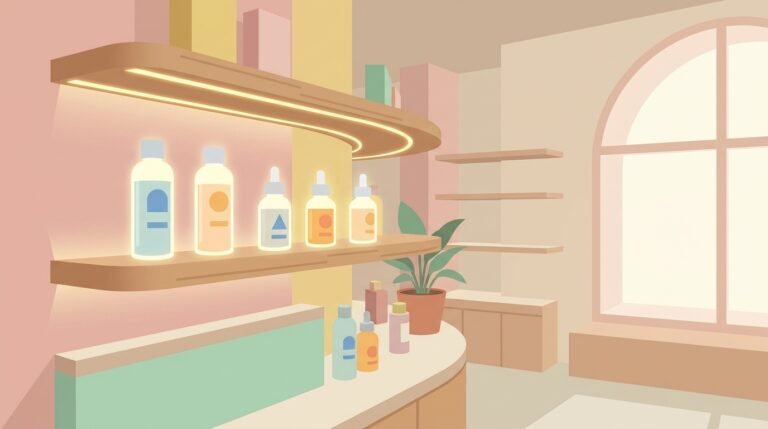
Setting: Friday evening, 7 PM. The flagship Olive Young in Myeongdong. Bright LED lights, a K-Pop hit blasting through the speakers, and shelves packed with colorful bottles. You are standing in the ‘Skincare Best’ aisle, trying to revamp your winter routine.
Characters:
– YOU: An expat who knows their way around a sheet mask, but needs targeted help for winter skin.
– Ji-won (20s): Olive Young staff. Energetic, speaks incredibly fast, and knows every product ingredient by heart.
Dialogue:
Ji-won: 찾으시는 제품 있으세요? 😊
(chajeusineun jepum isseuseyo?)
[Are you looking for any specific product?]
(🎭 Stage Direction: Ji-won approaches with a friendly smile, holding a little basket.)
YOU: 아, 네. 기초 제품 좀 바꾸려고요. 토너랑 앰플이요.
(a, ne. gicho jepum jom bakkuryeogoyo. toneorang ampeuriyo.)
[Ah, yes. I’m thinking of changing my basic skincare. Toner and ampoule.]
Ji-won: 평소에 피부 타입이 어떻게 되세요?
(pyeongso-e pibu taib-i eotteoke doeseyo?)
[What is your usual skin type?]
🔀 Your Turn! How should you answer?
– A) “얼굴이 건조해요.” (My face is dry.)
– B) “저 수부지인데, 겨울이라 그런지 속당김이 너무 심해요.”
– C) “지성 피부 파이팅!” (Oily skin fighting!)✅ Best Choice: B — “I’m a subuji (combination), but maybe because it’s winter, my inner dryness is very severe.” This is the ultimate C1 flex. It gives Ji-won the exact parameters to find your holy grail product.
⚠️ Choice A Analysis: Too basic. She won’t know if you need oil or water.
(Assuming you chose B)
Ji-won: 아, 수부지시구나! 그럼 닦토보다는 흡토가 좋아요.
(a, subujisiguna! geureom dakttobodaneun heupttoga joayo.)
[Ah, you’re combination! Then an absorbing toner is better than a wiping toner.]
YOU: 흡토요? 콧물 제형 같은 거 말씀이신가요?
(heupttoyo? konmul jehyeong gateun geo malsseumisingayo?)
[Absorbing toner? You mean the ones with a runny-nose (viscous) texture?]
Ji-won: 네, 맞아요! 패드 쓰지 마시고 손으로 촵촵 흡수시켜주세요. 그리고 이 앰플 레이어링 해주시면 속당김 싹 잡혀요.
(ne, majayo! paedeu sseuji masigo soneuro chwapchwap heupsusikyeojuseyo. geurigo i ampeul reieoring haejusimyeon sokdanggim ssak japhyeoyo.)
[Yes, exactly! Don’t use a pad, just pat it in with your hands. And if you layer this ampoule, it will completely fix your inner dryness.]
YOU: 오, 발림성이 되게 쫀쫀하네요. 메이크업 전에 바르면 안 밀려요?
(o, ballimseong-i doege jjonjjonhaneyo. meieukeop jeone bareumyeon an millyeoyo?)
[Oh, the spreadability is very bouncy/firm. Won’t it pill if I apply it before makeup?]
Ji-won: 네! 마무리감은 산뜻해서 화장 진짜 잘 먹어요.
(ne! mamurigam-eun santteutaeseo hwajang jinjja jal meogeoyo.)
[Yes! The finish is refreshing, so your makeup will sit beautifully.]
YOU: 대박. 그럼 이걸로 할게요!
(daebak. geureom igeollo halgeyo!)
[Awesome. I’ll take this one then!]
Phase 6: 10-Second Shadowing Drill
Time to practice! Pay attention to the pauses (/) and the intonation.
🥺 저 / 수부지인데, / 속당김 없는 앰플 / 추천해 주실 수 있나요?
(jeo / su-bu-ji-in-de, / sok-dang-gim eom-neun am-peul / chu-cheon-hae ju-sil su in-na-yo?)
(Meaning: I have combination skin, could you recommend an ampoule that prevents inner dryness?)
Phase 7: K-Culture Mini Dictionary
1. 올영 (Olyeong)
* Romanization: ol-yeong
* English: Short for Olive Young
* Context: The undisputed king of Korean health and beauty stores. Saying “Let’s go to Olyeong” instantly makes you sound like a local.
2. 쫀쫀하다 (Jjon-jjon-ha-da)
* Romanization: jjon-jjon-ha-da
* English: Firm, bouncy, elastic texture
* Context: A highly sought-after texture in K-Beauty. It means the ampoule isn’t watery but grips the skin tightly, leaving it plump and firm.
3. 화장 안 밀리다 (Hwa-jang an mil-li-da)
* Romanization: hwa-jang an mil-li-da
* English: Makeup doesn’t pill / rub off
* Context: When a skincare product doesn’t absorb well, your foundation can clump up into little balls. This phrase is vital when buying morning skincare.
4. 인생템 (In-saeng-tem)
* Romanization: in-saeng-tem
* English: Holy Grail item (Literal: Life item)
* Context: The best product you’ve used in your entire life. You’ll see this word everywhere in Korean beauty reviews.
Phase 8: Traveler’s Survival Kit (Olive Young Edition)
🆘 Survival Phrases for K-Beauty Shopping
– 🇰🇷 “이거 테스터 써봐도 돼요?” (igeo teseuteo sseobwado dwaeyo?) – Can I try the tester for this?
– 🇰🇷 “새 제품으로 주세요.” (sae jepumeuro juseyo.) – Please give me a new (unopened) one.
– 🇰🇷 “면세 되나요?” (myeonse doenayo?) – Is this tax-free?
– 📍 Where to use: Olive Young, Innisfree, Chicor, any road-shop cosmetic store.📌 Editor’s Travel Note
– The Hwahae App (화해): If you are serious about K-Beauty, download this app. It analyzes all ingredients and ranks products by skin type. Koreans trust it religiously.
– Tax-Free: Most Olive Young stores in tourist areas (Myeongdong, Hongdae, Gangnam) offer “Immediate Tax Refund” at the register. Bring your physical passport!
– 1+1 and 2+1: Korea loves “One plus One” deals (원플러스원). If the tag says 1+1, make sure you actually bring two items to the counter!
Phase 9: Critical Thinking — “One Step Deeper”
🧠 Think Deeper: Media vs Reality (The Myth of the 10-Step Skincare Routine)
If you read Western beauty magazines, you might think every Korean woman strictly follows a grueling 10-step skincare routine every single night. However, modern Korean reality is quite different. Due to demanding work hours and skin fatigue from too many products, many Koreans now practice 스킵케어 (Skip-care) or “Diet Skincare.” Instead of 10 steps, they focus on high-quality, multi-tasking products—like using a highly saturated toner pad followed immediately by a potent ampoule. The media sold a fantasy of maximalism, but modern K-Culture is shifting toward smart minimalism.
💬 Your Turn: How is the beauty standard of your culture portrayed in the media? Is it accurate to what people actually do every morning? Share in the comments!
Phase 10: FAQ & Avoiding Mistakes
Q: “Can I just ask for ‘Lotion’?”
No! This is a massive trap. In the West, “lotion” means a general moisturizer. In K-Beauty, “스킨/토너 (Skin/Toner)” is the watery first step. “앰플/에센스 (Ampoule/Essence)” is the concentrated nutrient step. “로션/에멀전 (Lotion/Emulsion)” is a milky, lightweight moisturizer, and “크림 (Cream)” is the heavy sealer. If you ask for lotion, you won’t get a thick winter moisturizer!
Q: “Can I tell the staff my skin hurts? (피부가 아파요)”
If your skin feels tight or dry, do not say “아파요” (It hurts). They will tell you to go to a dermatologist! Say “당겨요” (It feels tight/pulled).
❌ Common Mistake: Using generic adjectives like 좋다 (good) or 나쁘다 (bad) to describe skincare.
✅ Do This Instead: At the C1 level, use sensory descriptors! 끈적거려요 (It’s sticky), 촉촉해요 (It’s moist/hydrating), 산뜻해요 (It’s fresh/lightweight).
Phase 11: Summary & Action Items
One-Liner Summary: To navigate K-Beauty like a local, define your exact skin condition (수부지, 속당김) and understand the sensory textures of your routine (닦토, 쫀쫀하다).
Action Mission 3 Steps:
– 🥉 Bronze (Solo): Look at your current skincare products. Are they dak-tto or heup-tto? Say it out loud in Korean.
– 🥈 Silver (Online): Go to YouTube and search “수부지 인생템” (Combination skin holy grail items). Watch a 5-minute video and listen for the words you learned today.
– 🥇 Gold (Real-world): Visit a Korean cosmetic store (or online shop like YesStyle/Olive Young Global) and ask a question or write a review using “속당김” or “밀리다.”
K-Culture Mission:
Next time you watch a K-Drama, look closely at the vanity table of the main character. Can you spot the toner pads? Notice how they apply their ampoule with the signature chwap-chwap method!
Phase 12: Interactive Quiz
1. Situational Judgment:
You are buying an ampoule to use in the morning before work. You want to make sure it won’t ruin your foundation. What should you ask the staff?
– A) 이거 바르면 얼굴이 아파요?
– B) 메이크업 전에 바르면 안 밀려요?
– C) 이거 닦토인가요?
2. Fill in the Blank:
겨울이라서 피부가 너무 건조해요. 얼굴에 ( )이 너무 심해요.
(Hint: Inner dryness)
3. True or False – K-Culture Edition:
In Korea, “Skin” (스킨) and “Toner” (토너) refer to the exact same step in the skincare routine. (T / F)
(Answers: 1. B – You want to ensure it doesn’t pill. / 2. 속당김 (sok-dang-gim) / 3. True – They are used interchangeably as the watery first step after cleansing.)
Frequently Asked Questions (FAQ)
Q: What does "수부지 (Su-bu-ji)" mean in Korean and how do you pronounce it?
A: In Korean, "수부지 (Su-bu-ji)" is pronounced [su-bu-ji [sounds like: soo-boo-jee] and means: Combination skin (Literal: Moisture-lacking oily skin / Oily on the outside, dry on the inside)
Q: What does "닦토 (Dak-tto) & 흡토 (Heup-tto)" mean in Korean and how do you pronounce it?
A: In Korean, "닦토 (Dak-tto) & 흡토 (Heup-tto)" is pronounced [dak-tto [sounds like: dak-toh] and means: Wiping toner & Absorbing toner
Q: What does "속당김 (Sok-dang-gim)" mean in Korean and how do you pronounce it?
A: In Korean, "속당김 (Sok-dang-gim)" is pronounced [sok-dang-gim [sounds like: soak-dahng-gheem] and means: Inner dryness (Literal: Inside-pulling)







