

Phase 1: The Cold Open – Welcome to the ‘Bread Pilgrimage’
Hello there! I’m the Lead Editor at Daily Hangul, your veteran tutor and local culture navigator.
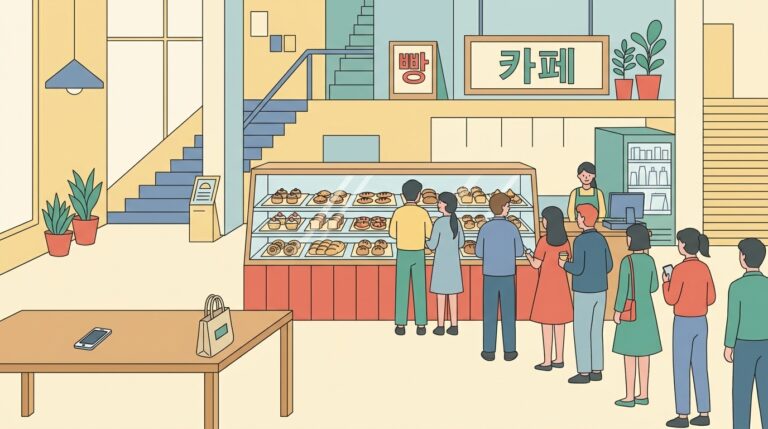
Imagine this: It’s a sunny Saturday afternoon. You and your Korean friend have driven an hour outside of Seoul to visit a massive, three-story ‘Mega Bakery Cafe’ by the river. The doors open, and the scent of freshly baked butter and roasted coffee hits you. It’s paradise! But then… you look around. There are at least 300 people here.
You panic and rush toward the bread tongs. But your Korean friend suddenly sprints in the opposite direction, throws their expensive iPhone and a designer bag onto an empty table, and walks away.
You freeze. Are they crazy?! Someone is going to steal that!
Welcome to Korea’s Mega Bakery Cafe culture, where the unwritten rules of survival are just as fascinating as the aesthetic pastries. If you don’t know the cultural nuances of this space, you might end up holding a tray full of delicious bread with absolutely nowhere to sit.
This guide is built on the real-life panic moments of my B2-level students. Today, we are going to learn how to navigate these giant aesthetic cafes like a true Korean insider. Let’s dive in!
Phase 2: Deep Dive into Core Expressions
To survive a mega cafe, you need more than just “아메리카노 주세요 (Americano, please).” Here are the three most critical expressions you’ll need.
1. 자리부터 맡을게요 / 맡자
- Pronunciation: [ja-ri-bu-teo ma-teul-ge-yo / mat-ja] (Sounds like: jah-ree-boo-tuh mah-teul-geh-yo)
- Meaning: Literal: “I will take/reserve the seat first.” / Real nuance: “Let’s secure a table before we do anything else.”
- K-Culture Moment: You’ll hear this the second you walk through the cafe doors. In Korean cafes, you never order first if the place is crowded. You must claim your territory. Leaving a personal item (a phone, a scarf, a bag) is the universal sign of “This seat is taken.”
- Editor’s Insight: The verb 맡다 (mat-da) has many meanings (to smell, to take charge of), but here it means ‘to reserve or occupy a space’. It carries a sense of urgency.
- Situation Spectrum:
- Friends (Casual): 자리부터 맡자! (ja-ri-bu-teo mat-ja!) ✅
- Coworkers (Semi-formal): 저희 자리부터 맡을까요? (jeo-hui ja-ri-bu-teo ma-teul-kka-yo?) ✅
- Boss/Elders (Formal): 자리부터 먼저 잡으시죠. (ja-ri-bu-teo meon-jeo ja-beu-si-jyo) ⚠️ (Use ‘잡다’ instead of ‘맡다’ to sound more polite)
- 🤔 Think About It: Why does Korea have such a strong culture of leaving expensive items unattended to reserve seats? Does this high-trust behavior exist in your home country?
2. 여기 시그니처가 뭐예요?
- Pronunciation: [yeo-gi si-geu-ni-cheo-ga mwo-ye-yo?] (Sounds like: yuh-gee shee-geu-nee-chuh-gah mwo-yeh-yo?)
- Meaning: Literal: “What is the signature here?” / Real nuance: “What is your best-selling or most famous item?”
- K-Culture Moment: Mega cafes always have that one visually stunning drink or bread that everyone posts on Instagram. It might be a garlic cheese bread shaped like a garlic bulb, or a latte with black sesame cream.
- Editor’s Insight: Koreans love using the Konglish word ‘시그니처’ (signature) to denote the specialty of the house. If you are overwhelmed by the 50 types of bread, just ask this!
- Situation Spectrum:
- Staff (Polite): ✅
- Friends (Casual): 야, 여기 시그니처가 뭐래? (ya, yeo-gi si-geu-ni-cheo-ga mwo-rae?) ✅
- 🤔 Think About It: Why do you think Korean cafes put so much effort into creating highly visual ‘signature’ items? How does social media shape culinary trends in Korea?
3. 자율 포장대가 어디 있나요?
- Pronunciation: [ja-yul po-jang-dae-ga eo-di in-na-yo?] (Sounds like: jah-yool po-jang-dae-gah uh-dee een-nah-yo?)
- Meaning: Literal: “Where is the autonomous packaging stand?” / Real nuance: “Where is the self-packing station for leftovers?”
- K-Culture Moment: Because the bread looks so good, you will inevitably buy way more than you can eat. Mega cafes usually don’t pack leftovers for you at the counter because they are too busy. Instead, they have a ‘자율 포장대’ (Self-packaging station) equipped with bags, paper, and even mini-ovens!
- Editor’s Insight: Don’t feel embarrassed about taking leftovers home. It’s totally expected. Just don’t bring your messy plate to the busy barista!
- Situation Spectrum:
- Staff (Polite): ✅
- Friends: 자율 포장대 가서 싸올게. (ja-yul po-jang-dae ga-seo ssa-ol-ge) ✅
- 🤔 Think About It: How does the ‘self-service’ culture in Korea balance efficiency and customer service?
Phase 3: Textbook vs Real Korean
Let’s see how the language evolves from the classroom to the bustling cafe floor.
[Securing a Seat]
* 📖 Textbook Korean: 우리가 먼저 저 의자에 앉읍시다. (Let us sit on that chair first.)
* 🗣️ Real Korean: 헐, 저기 자리 났다. 빨리 찜해! (Omg, a seat opened up over there. Call dibs, quick!)
* 💡 Why is it different?: ‘찜하다’ originally comes from steaming food, but in slang, it means to call dibs on something or someone. It reflects the fast-paced, competitive nature of securing space in Korea.
[Asking for Recommendations]
* 📖 Textbook Korean: 이 식당에서 가장 유명한 빵은 무엇입니까? (What is the most famous bread in this restaurant?)
* 🗣️ Real Korean: 여기 뭐가 제일 잘 나가요? (What sells the best here?)
* 💡 Why is it different?: ‘잘 나가다’ literally means ‘to go out well’, but idiomatically means ‘to be popular or sell well’. It focuses on consumer trends rather than traditional fame.
Bottom Note: At a B2 level, start using ‘잘 나가다’ or ‘찜하다’ with your Korean friends. It instantly elevates you from a ‘student’ to someone who actually lives the culture.
Phase 4: Cultural Context — K-Culture Deep Dive
4-1. Non-Verbal Nuances: The ‘Nunchi’ Game
In a packed mega cafe, finding a seat requires masterful 눈치 (Nunchi)—the art of reading the room. You don’t just stand aimlessly. You scan the room for people who have empty cups, have put their coats on, or have stopped talking and are looking at their phones.
You casually hover nearby (not too close to be rude, but close enough to establish dominance over other roaming customers). But remember: Never stare directly into their souls. Keep your eyes on the table, occasionally glancing away.
4-2. K-Travel & K-Media Connection
Mega bakery cafes have become essential destinations for domestic travel. Koreans call this 빵지순례 (Bread Pilgrimage). In recent K-Dramas (especially those featuring young rich chaebols or aesthetic weekends), you’ll often see scenes filmed in these massive, architectural wonders with ocean or forest views (뷰맛집).
These cafes aren’t just about coffee; they are about space consumption. Since many young Koreans live in small apartments or studios, these gigantic cafes serve as their weekend ‘living rooms’ and ‘gardens’.
Phase 5: Real-life Roleplay Scenario
Setting: Sunday, 2:00 PM. A colossal, 3-story bakery cafe in Gimpo overlooking the Han River. The line for bread is 20 meters long. The noise is a mix of espresso machines and hundreds of chatting people.
Characters:
– YOU: An expat who just wants a quiet cup of coffee and a croissant.
– Min-su (32): Your enthusiastic Korean friend who drove you here.
Dialogue:
민수: 와, 사람 진짜 많다. 눈치게임 시작이다!
(Wa, saram jinjja manta. Nunchigame sijagida!)
(English: Wow, there are so many people. The Nunchi game begins!)
YOU: 빵 줄이 너무 긴데? 우리 빨리 줄부터 서자.
(Ppang juri neomu ginde? Uri ppalli julbuteo seoja.)
(English: The bread line is too long. Let’s line up first.)
민수: 안 돼! 빵 샀는데 자리 없으면 서서 먹어야 해.
(An dwae! Ppang sanneunde jari eopseumyeon seoseo meogeoya hae.)
(English: No! If we buy bread and have no seat, we have to eat standing up.)
(🎭 Stage Direction: Min-su frantically scans the second floor.)
민수: 앗! 저기 창가 자리 일어날 것 같아. 내가 자리부터 맡을게!
(At! Jeogi changga jari ireonal geot gata. Naega jaributeo mateulge!)
(English: Ah! Looks like that window seat is about to leave. I’ll secure the seat first!)
YOU: 그래, 그럼 내가 빵 고르고 있을게. 여기 시그니처가 뭐야?
(Geurae, geureom naega ppang goreugo isseulge. Yeogi sigeunicheoga mwoya?)
(English: Okay, then I’ll pick out the bread. What’s the signature here?)
민수: 여기 대파 크림치즈 베이글이 제일 잘 나가. 그거 꼭 담아!
(Yeogi daepa keurimchijeu beigeuri jeil jal naga. Geugeo kkok dama!)
(English: The green onion cream cheese bagel sells the best here. Make sure to grab that!)
(🎭 Stage Direction: 15 minutes later, you arrive at Min-su’s table with a tray full of bread. You realize you bought way too much.)
YOU: 빵이 다 너무 맛있어 보여서 좀 많이 샀어…
(Ppangi da neomu masisseo boyeoseo jom mani sasseo…)
(English: All the bread looked so good, I bought a bit too much…)
민수: ㅋㅋㅋ 괜찮아. 남으면 싸가면 되지.
(Kkk gwaenchana. Nameumyeon ssagamyeon doeji.)
(English: Lol it’s fine. If there’s leftovers, we can pack them up.)
🔀 Your Turn! How do you ask the staff about packing the leftovers?
– A) “아줌마, 이거 포장해 주세요!” (Ajumma, pack this please!)
– B) “남은 빵 포장되나요?” (Can I get the leftover bread packed?)
– C) “자율 포장대가 어디 있나요?” (Where is the self-packaging station?)✅ Best Choice: C — In mega cafes, the staff at the counter are usually too overwhelmed to pack half-eaten bread. Asking for the self-packaging station is the most culturally accurate and polite move.
⚠️ Choice A Analysis: NEVER call cafe staff ‘Ajumma’ (middle-aged woman). It’s considered rude in a modern service setting. Use ‘저기요’ (Excuse me) instead.
Phase 6: 10-Second Shadowing Drill
Master the intonation to sound like a local. Follow the slashes (/) for natural pauses!
😤 단호하게 (Firmly):
우리 / 빵 고르기 전에 / 자리부터 / 맡자! / mat-ja!)
(u-ri / ppang go-reu-gi jeo-ne / ja-ri-bu-teo
Tip: Drag out the ‘teo’ slightly to show emphasis!
😊 친절하게 (Politely):
혹시 / 자율 포장대가 / 어디 있나요?
(hok-si / ja-yul po-jang-dae-ga / eo-di in-na-yo?)
Tip: Start with ‘hok-si’ (by any chance) to sound incredibly soft and polite.
Phase 7: K-Culture Mini-Dictionary
1. 빵지순례 (Ppang-ji-sun-rye)
* English: Bread Pilgrimage
* Context: A portmanteau of ‘빵’ (Bread) and ‘성지순례’ (Pilgrimage). It refers to the trend of traveling far distances specifically to visit famous bakeries.
2. 뷰맛집 (Byu-mat-jip)
* English: View Hotspot
* Context: ‘맛집’ means a delicious restaurant, but Koreans attach ‘맛집’ to anything that is excellent. A ‘뷰맛집’ means a cafe or restaurant known for its stunning scenery.
3. 눈치 게임 (Nunchi Game)
* English: Game of reading the room
* Context: The unspoken psychological battle of trying to time your actions perfectly—like hovering near a table right as someone is putting on their coat, beating others to the seat.
4. 카공족 (Ka-gong-jok)
* English: Cafe Study Tribe
* Context: People who study or work in cafes for long hours. While common in franchise cafes, doing this on a weekend in a Mega Bakery Cafe is generally frowned upon due to the crowds.
Phase 8: Traveler Survival Kit
If you are traveling outside Seoul, you will definitely encounter these cafes. Here are your absolute survival phrases:
🆘 Survival Phrases for Mega Cafes
– 🇰🇷 “여기 먹고 갈게요.” (yeo-gi meok-go gal-ge-yo) – “I will eat here.”
– 🇰🇷 “빵 좀 데워 주시겠어요?” (ppang jom de-wo ju-si-ge-sseo-yo?) – “Could you heat up the bread a bit?”
– 🇰🇷 “영수증 버려 주세요.” (yeong-su-jeung beo-ryeo ju-se-yo) – “Please throw away the receipt.” (Koreans rarely keep paper receipts!)
📌 Editor’s Travel Note:
– Transport: Most Mega Bakery Cafes (in Paju, Gimpo, Yongin) are hard to reach by subway. Use Kakao T to call a taxi, or rent a car via Socar if you have an international license.
– Payment: Korea is a cashless society. Always have a credit card ready. Apple Pay works in many large cafes now, but a physical card is safer.
– Bussing: Unlike restaurants, in cafes, you MUST return your tray to the ‘Return’ (반납구 – ban-nap-gu) counter when you leave. Leaving it on the table is a big faux pas!
Phase 9: Critical Thinking — “One Step Deeper”
🧠 Think Deeper: Space and Social Identity
Why are Koreans so obsessed with massive, elaborately decorated cafes? It’s deeply tied to urban living conditions. Over 60% of Koreans live in high-density apartments. Personal spaces are relatively small, and entertaining friends at home is rare. Therefore, the ‘Cafe’ acts as a public living room. When Koreans travel to a Mega Bakery Cafe on the weekend, they aren’t just buying a $6 coffee; they are renting “aesthetic space” and a sense of luxury that they can capture and share on Instagram. It’s an accessible escape from the concrete jungle.
💬 Your Turn:
Where do people in your culture go when they want to escape the city and spend a long afternoon chatting? Do you have a culture of “renting space” through coffee? Let us know in the comments!
Phase 10: FAQ & Avoiding Common Mistakes
Q: “Can I really leave my laptop on the table to reserve a seat?”
A: Yes! Korea is famous for its high-trust society regarding personal belongings. People leave MacBooks, wallets, and phones. However, always take your passport and cash with you just in case.
Q: “If I want to ask someone if a chair is taken, what do I say?”
A: Simply point to the chair and ask: “여기 자리 있나요?” (Is this seat taken? / yeo-gi ja-ri in-na-yo?)
❌ Common Mistake #1: Trying to pay for bread and drinks separately.
✅ Do this instead: In Korea, you put all your bread on a tray, bring it to the cashier, and order your drinks at the same time. You pay for everything in one transaction.❌ Common Mistake #2: Tipping the barista because the cafe looks fancy.
✅ Do this instead: Absolutely NO tipping in Korea. It will confuse the staff, and they might chase you down the street to give your money back!
Phase 11: Summary & Action Items
One-Liner Summary: In Korea’s Mega Bakery Cafes, secure your seat with your belongings first (자리부터 맡을게요), find the signature menu, and pack your own leftovers!
Action Mission:
– 🥉 Bronze (Solo): Stand in front of a mirror and practice saying “우리 자리부터 맡자!” with urgency 3 times.
– 🥈 Silver (Online): Go to Google Maps or Kakao Map, search for ‘파주 대형 카페’ (Paju mega cafe), and read one Korean review. Try to spot the word ‘뷰맛집’ or ‘빵지순례’!
– 🥇 Gold (Real World): Next time you go to a Korean cafe, try asking the staff, “여기 시그니처가 뭐예요?” instead of just ordering an Americano.
Phase 12: Interactive Quiz
Let’s test your Mega Cafe survival skills!
1. Situational Judgment: You find a great table, but there is a half-empty lipstick and a scarf on the chair. What does this mean?
– A) Someone forgot their items. I should give them to the staff and sit down.
– B) The seat is ‘찜’ (reserved). I need to find another table.
– C) It’s free gifts for the next customer!
2. Fill in the Blank:
You bought too much garlic bread. You want to take it home. You ask the staff:
“저기요, 혹시 ( _______ )가 어디 있나요?”
– A) 화장실 (Restroom)
– B) 시그니처 (Signature)
– C) 자율 포장대 (Self-packaging station)
3. True or False – K-Culture Edition:
In a Korean cafe, it is perfectly fine to leave your tray on the table when you go home. (T/F)
(Answers: 1. B – Never touch the items! 2. C 3. False – Always return your tray to the 반납구!)
Frequently Asked Questions (FAQ)
Q: What does "자리부터 맡을게요 / 맡자" mean in Korean and how do you pronounce it?
A: In Korean, "자리부터 맡을게요 / 맡자" is pronounced [ja-ri-bu-teo ma-teul-ge-yo / mat-ja] and means: Literal: "I will take/reserve the seat first." / Real nuance: "Let's secure a table before we do anything else."
Q: What does "여기 시그니처가 뭐예요?" mean in Korean and how do you pronounce it?
A: In Korean, "여기 시그니처가 뭐예요?" is pronounced [yeo-gi si-geu-ni-cheo-ga mwo-ye-yo?] and means: Literal: "What is the signature here?" / Real nuance: "What is your best-selling or most famous item?"
Q: What does "자율 포장대가 어디 있나요?" mean in Korean and how do you pronounce it?
A: In Korean, "자율 포장대가 어디 있나요?" is pronounced [ja-yul po-jang-dae-ga eo-di in-na-yo?] and means: Literal: "Where is the autonomous packaging stand?" / Real nuance: "Where is the self-packing station for leftovers?"







