

Phase 1: Empathy (The K-Culture Cold Open)
Hello! I am the Lead Editor of Daily Hangul.
Picture this: You are watching an intense episode of Hospital Playlist or Dr. Romantic. Someone suddenly collapses on the street. The protagonist sprints over, checks their pulse, and intensely shouts to the crowd, “Call 119! Bring an AED!” It is a dramatic, pulse-pounding moment that makes for great television.
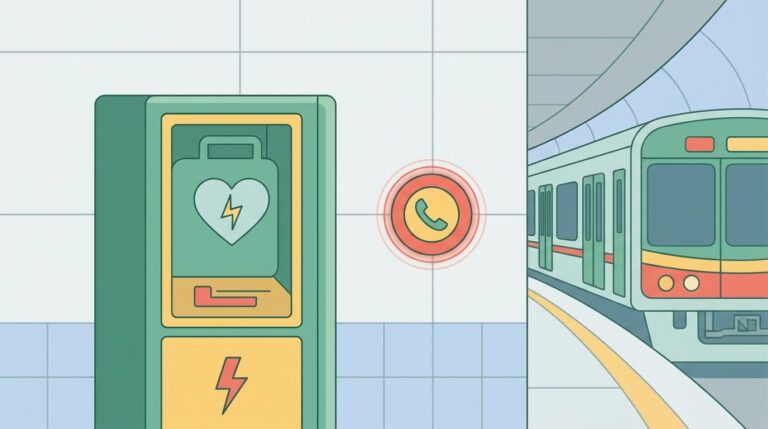
But what if you are the main character in real life? Imagine you are at a crowded Seoul subway station, or hiking up Bukhansan, and a real medical emergency happens. At a C2 level of Korean, you already know how to order food, debate societal issues, and negotiate business deals. But in a life-or-death situation, the “Golden Time” (골든타임) waits for no one. Do you know the exact Korean terminology to initiate CPR, delegate tasks to bystanders, and locate an AED in those crucial four minutes?
This guide is not just about vocabulary; it is about saving lives while navigating the nuances of Korean crowd psychology and emergency protocols. Let’s dive in.
Phase 2: Core Expressions Deep Dive
1. 환자분, 제 말 들리세요? 괜찮으세요?
- Pronunciation: [Hwanjabun, je mal deulliseyo? Gwaenchaneuseyo?] – Sound-alike: Hwan-ja-boon, je mal deul-li-se-yo? Gwaen-chan-eu-se-yo?
- Meaning: Patient (Sir/Ma’am), can you hear me? Are you okay?
- K-Culture Moment: In K-Dramas, doctors always tap the person’s shoulders firmly while shouting this. In Korea, addressing a stranger respectfully even in an emergency is ingrained. “환자분” (patient) is the standard respectful term used by medical professionals and trained bystanders.
- Editor’s Insight: You must speak loudly and clearly. It is not just to wake the person, but to signal to the people around you that an emergency is unfolding.
- Situation Spectrum:
- Casual (Friends): ⚠️ (You would use their name instead: “민수야, 정신 차려!”)
- Semi-formal (Strangers): ✅
- Formal (Elders/Superiors): ✅
- 🤔 Think About It: Why use the honorific “~시” (들리세요, 괜찮으세요) for an unconscious stranger? In Korean culture, maintaining a person’s dignity and social respect is paramount, even when they are incapacitated.
2. 거기 파란 모자 쓰신 분, 119에 신고해 주세요!
- Pronunciation: [Geogi paran moja sseusin bun, il-il-gue singohae juseyo!] – Sound-alike: Geo-gi pa-ran mo-ja sseu-shin boon, il-il-goo-e shin-go-hae joo-se-yo!
- Meaning: You there in the blue hat, please call 119!
- K-Culture Moment: The “Bystander Effect” is universal, but in a dense city like Seoul, people might assume someone else will call. CPR training in Korea strictly emphasizes pointing out specific characteristics (color of clothes, glasses) to assign direct responsibility.
- Editor’s Insight: Notice it’s 119 (il-il-gu), not 911. Also, using “~쓰신 분” (the person wearing…) is the most socially appropriate way to single out a stranger politely but firmly.
- Situation Spectrum:
- Casual (Friends): 🚫 (Use names)
- Semi-formal/Formal (Strangers in public): ✅
- 🤔 Think About It: How does pointing out a specific person using descriptive honorifics reflect the Korean approach to collective versus individual responsibility?
3. 심폐소생술 할 줄 아시는 분 계세요? 자동 제세동기(AED) 좀 가져다주세요!
- Pronunciation: [Simpyesosaengsul hal jul asineun bun gyeseyo? Jadong jesedonggi(A-E-D) jom gajeodajuseyo!] – Sound-alike: Shim-pye-so-saeng-sool hal jool a-shi-neun boon gye-se-yo? Ja-dong je-se-dong-gi (A-E-D) jom ga-jeo-da-joo-se-yo!
- Meaning: Is there anyone who knows how to do CPR? Please bring an Automated External Defibrillator (AED)!
- K-Culture Moment: You will often hear AED pronounced simply by its English letters (에이이디), but the formal term “자동 제세동기” is written on all official subway and building signs in Korea.
- Editor’s Insight: “심폐소생술” is quite a mouthful. At a C2 level, articulating this quickly and clearly is a true test of your Korean fluency under pressure.
- Situation Spectrum:
- Public Emergency: ✅
- 🤔 Think About It: Korea has one of the highest densities of AEDs in public transport globally. How does this reflect the “Ppal-li Ppal-li” (hurry up) culture translated into public safety infrastructure?
Phase 3: Textbook vs. Real Korean
[Calling for an Ambulance]
* 📖 Textbook Korean: 응급 상황입니다. 구급차를 보내주십시오. (It is an emergency. Please send an ambulance.)
* 🗣️ Real Korean: 여기 강남역 3번 출구 쪽인데 사람 쓰러졌어요! 빨리 와주세요! (I’m by Gangnam Station Exit 3, someone collapsed! Please come quickly!)
* 💡 Why the difference?: Dispatchers need location and status immediately. “사람 쓰러졌어요” (someone collapsed) is the most visceral, efficient way to trigger an emergency response.
[Asking for an AED]
* 📖 Textbook Korean: 실례하지만, 가장 가까운 자동 제세동기가 어디에 위치해 있습니까? (Excuse me, where is the nearest Automated External Defibrillator located?)
* 🗣️ Real Korean: 저기요, 여기 AED(에이이디) 어딨어요? 빨리요! (Excuse me, where’s the AED here? Hurry!)
* 💡 Why the difference?: In a life-or-death situation, extreme politeness takes a back seat to speed. Dropping to a slightly more urgent, less formal register is socially acceptable and necessary.
Phase 4: Cultural Context — K-Culture Deep Dive
4-1. Non-verbal Nuances in Emergencies
In a Korean emergency, direct eye contact—which is usually avoided with elders or superiors—is absolutely necessary. When you point at someone to call 119, you must lock eyes with them. Furthermore, the Korean “Nunchi” (눈치) culture can actually be a hindrance here; people might hesitate, trying to read the room or fearing legal repercussions. You must break the Nunchi by taking authoritative command.
4-2. The Medical K-Drama Reality vs. Good Samaritan Law
If you watch a medical K-Drama like Romantic Doctor, Teacher Kim, heroes jump in without a second thought. However, in reality, Koreans are often highly aware of the 착한 사마리아인 법 (Good Samaritan Law). Historically, bystanders feared being sued for broken ribs caused by chest compressions. While the law protects well-intentioned rescuers, this cultural memory means foreigners stepping up and speaking fluent, commanding Korean can be the crucial catalyst that shakes the crowd out of their paralysis.
Phase 5: Real-Life Roleplay Scenario
Setting: A Friday evening, 6:30 PM. The platform of Sindorim Station, one of the most crowded transfer stations in Seoul. The screeching of trains and chatter of commuters fills the air. Suddenly, an elderly man gasps and collapses a few feet away from you.
Characters:
* YOU (Reader): A seasoned expat in Korea who just completed a CPR renewal course.
* Min-su (30s): A panicked office worker standing next to you.
* Subway Staff (50s): Rushing to the scene.
Dialogue:
YOU: 환자분! 괜찮으세요? 제 말 들리세요?
(Hwanjabun! Gwaenchaneuseyo? Je mal deulliseyo?)
[Patient! Are you okay? Can you hear me?]
(🎭 Stage Direction: You tap the man’s collarbones firmly. No response. No breathing.)
YOU: 심정지입니다! 제가 심폐소생술 할게요!
(Simjeongji-imnida! Jaega simpyesosaengsul halgeyo!)
[It’s cardiac arrest! I will perform CPR!]
Min-su: 어, 어떡해… 피, 피가 나는 것 같은데…
(Eo, eotteokhae… pi, piga naneun geot gateunde…)
[Uh, what do we do… I think he’s bleeding…]
YOU: 거기 안경 쓰시고 넥타이 매신 분! 119에 바로 신고해 주세요!
(Geogi angyeong sseusigo nektai maesin bun! Il-il-gue baro singohae juseyo!)
[You there with the glasses and tie! Please call 119 immediately!]
Min-su: 네, 네! 지금 전화할게요!
(Ne, ne! Jigeum jeonhwahalgeyo!)
[Yes, yes! I’ll call right now!]
(🎭 Stage Direction: You begin chest compressions. A subway staff member runs over with a walkie-talkie.)
Staff: 비키세요! 무슨 일입니까?
(Bikiseyo! Museun irimnikka?)
[Move aside! What is going on?]
🔀 Your Turn! How do you respond while continuing compressions?
* A) “이분 아파요. 도와주세요.”
* B) “심정지 환자입니다! 빨리 역에 있는 자동 제세동기(AED) 가져다주세요!”
* C) “제가 의사입니다. 물러서세요.”✅ Best Choice: B — Clear, factual, and gives a direct command for the AED, which subway staff have immediate access to.
⚠️ Choice A Analysis: Too basic and vague for a C2 speaker. It doesn’t convey the urgency or medical state.
⚠️ Choice C Analysis: Unless you are actually a licensed medical doctor in Korea, never claim to be one legally.
Staff: 아, 네! 바로 AED 가져오겠습니다!
(A, ne! Baro A-E-D gajeo-ogetseumnida!)
[Ah, yes! I will bring the AED immediately!]
Phase 6: 10-Second Shadowing Drill
Master the rhythm of saving a life. In an emergency, your voice must be loud, your pauses distinct, and your tone authoritative.
😤 거기 / 빨간 점퍼 입으신 분! / 119에 / 신고해 주세요! (Geo-gi / ppal-gan jeom-peo i-beu-shin boon! / il-il-gu-e / shin-go-hae joo-se-yo!)
😤 자동 제세동기 / 아시는 분 / 빨리 가져다주세요! (Ja-dong je-se-dong-gi / a-shi-neun boon / ppal-li ga-jeo-da-joo-se-yo!)
Phase 7: K-Culture Mini Dictionary
1. 119 (일일구)
* Romanization: il-il-gu
* English: Emergency telephone number for Fire and Ambulance.
* Context: Unlike the US (911) or the UK (999), Korea uses 119 for medical emergencies and fires. Police are 112.
2. 심폐소생술 (CPR)
* Romanization: sim-pye-so-saeng-sul
* English: Cardiopulmonary Resuscitation
* Context: Literally “Heart-Lung-Revival-Technique.” It is heavily promoted in South Korean military training and corporate safety drills.
3. 골든타임
* Romanization: gol-deun-ta-im
* English: Golden Time (Golden Hour)
* Context: A widely used Konglish term referring to the crucial first 4 minutes after cardiac arrest where CPR can prevent brain damage.
4. 자동 심장 충격기 / 제세동기
* Romanization: ja-dong sim-jang chung-gyeok-gi / je-se-dong-gi
* English: Automated External Defibrillator (AED)
* Context: You will see signs for these in almost every subway station, large apartment complex, and public building in Korea.
Phase 8: Traveler Survival Kit
Even if you live in Korea, navigating an emergency requires absolute clarity.
🆘 Survival Phrases TOP 3
* 🇰🇷 “구급차 불러주세요!” (Gugeupcha bulleojuseyo!) – Please call an ambulance!
* 🇰🇷 “여기 심정지 환자가 있어요!” (Yeogi simjeongji hwanjaga isseoyo!) – There is a cardiac arrest patient here!
* 🇰🇷 “AED 쓸 줄 아시는 분?” (AED sseul jul asineun bun?) – Anyone know how to use an AED?
* 📍 Where to use: Subway stations, hiking trails, crowded streets.
* 💡 Pro Tip: If you cannot speak Korean well in a panic, download the Emergency Ready App (안전디딤돌) provided by the Korean government. It connects you to emergency services with translation support and maps out the nearest AEDs and shelters.
📌 Editor’s Travel Note:
* Emergency Numbers: 119 (Fire/Medical), 112 (Police), 1339 (Medical Information, though integrated into 119 in many regions now).
* Costs: Using a 119 ambulance in a genuine medical emergency in Korea is generally free of charge, regardless of nationality. Do not hesitate to call out of fear of medical bills!
Phase 9: Critical Thinking — “One Step Deeper”
🧠 Think Deeper: Language & Power — Shifting Societal Responsibility
In Korean culture, the emphasis on hierarchy and social harmony sometimes inadvertently causes the “Bystander Effect” during crises. People fear overstepping their boundaries or taking an action that might cause harm, heavily influenced by historical precedents of the Good Samaritan Law (착한 사마리아인 법). By utilizing advanced Korean honorifics descriptively—”거기 안경 쓰신 분” (You there wearing glasses)—you are doing something brilliant linguistically. You are conferring social status and direct responsibility onto an individual, breaking the collective paralysis. The language itself acts as a tool of empowerment, forcing a shift from “someone should help” to “I must help because I have been respectfully chosen.”
💬 Your Turn: Have you ever witnessed a medical emergency in your home country? How do the cultural expectations of bystanders differ from what you see in Korea? Share in the comments!
Phase 10: FAQ & Avoiding Misunderstandings
- Q: Can I use Banmal (casual language) during a severe emergency?
- A: Yes and No. If you are screaming “비켜요!” (Move!) or “빨리요!” (Hurry!), dropping the highest levels of politeness is totally acceptable. However, when issuing instructions to specific adults, adding “~분” (person) and “~주세요” (please) is still standard to assert authority without causing offense.
- Q: Will the 119 dispatcher understand English?
- A: Yes. 119 has a three-way translation system. However, stating “강남역 3번 출구, 심정지” (Gangnam Station Exit 3, Cardiac Arrest) in Korean will save precious minutes before the translator connects.
❌ Common Mistake #1: Shouting “911에 전화해!”
✅ Do this instead: Shouting “911” will confuse Koreans. Always specify “119” (일일구).❌ Common Mistake #2: Asking “누가 좀 도와주세요” (Someone please help).
✅ Do this instead: It is too vague. Point and say: “거기 모자 쓰신 분, 119 전화해 주세요!” (You in the hat, call 119!)
Phase 11: Summary & Action Items
- One-Liner Summary: In a Korean medical emergency, bypass the bystander effect by using specific descriptive honorifics to assign tasks, and confidently request “119” and an “AED” to protect the Golden Time.
-
Action Mission:
- 🥉 Bronze: Stand in front of a mirror and practice pointing while saying: “거기 파란 셔츠 입으신 분, 119에 신고해 주세요!”
- 🥈 Silver: Look up the exact location of the AED in your apartment building, office, or regular subway station.
- 🥇 Gold: Enroll in a local CPR course in Korea (many fire stations offer them for free!) to practice these terms in real-time.
- K-Culture Mission: Next time you ride the Seoul Metro, look around the platform. Take a photo of the AED box (자동 심장 충격기/제세동기) and note exactly where it is located.
Phase 12: Quiz — Interactive Challenge
1. Situational Judgment: Someone collapses at a cafe. You begin CPR. What is the most culturally and linguistically effective way to get someone to call for an ambulance?
* A) “여러분, 제발 도와주세요!”
* B) “거기 노트북 하시는 분, 119에 신고해 주세요!”
* C) “경찰에 전화해요! 112!”
2. Fill in the Blank:
“심정지 환자입니다! 빨리 _________ 좀 가져다주세요!”
* A) 소화기 (Fire extinguisher)
* B) 자동 제세동기 (AED)
* C) 처방전 (Prescription)
3. True or False – K-Culture Edition:
“If you call a 119 ambulance in Korea for a genuine medical emergency, you will be charged a massive fee, similar to the US healthcare system.”
(Answers: 1. B – Pointing out specific people is standard CPR protocol; 2. B; 3. False – 119 ambulances operated by the fire department are free for emergencies.)
Frequently Asked Questions (FAQ)
Q: What does "환자분, 제 말 들리세요? 괜찮으세요?" mean in Korean and how do you pronounce it?
A: In Korean, "환자분, 제 말 들리세요? 괜찮으세요?" is pronounced [Hwanjabun, je mal deulliseyo? Gwaenchaneuseyo?] and means: Patient (Sir/Ma'am), can you hear me? Are you okay?
Q: What does "거기 파란 모자 쓰신 분, 119에 신고해 주세요!" mean in Korean and how do you pronounce it?
A: In Korean, "거기 파란 모자 쓰신 분, 119에 신고해 주세요!" is pronounced [Geogi paran moja sseusin bun, il-il-gue singohae juseyo!] and means: You there in the blue hat, please call 119!
Q: What does "심폐소생술 할 줄 아시는 분 계세요? 자동 제세동기(AED) 좀 가져다주세요!" mean in Korean and how do you pronounce it?
A: In Korean, "심폐소생술 할 줄 아시는 분 계세요? 자동 제세동기(AED) 좀 가져다주세요!" is pronounced [Simpyesosaengsul hal jul asineun bun gyeseyo? Jadong jesedonggi(A-E-D] and means: Is there anyone who knows how to do CPR? Please bring an Automated External Defibrillator (AED)!






