

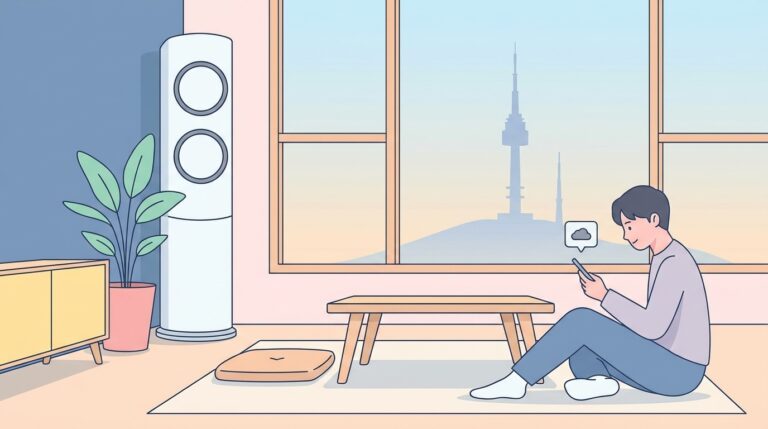
Phase 1: Welcome to the Gray Sky (The K-Culture Cold Open)
Hello! I’m the Lead Editor at Daily Hangul. Imagine this: You wake up on the second day of your dream trip to Seoul. You run to the window of your Airbnb, expecting a sparkling view of Namsan Tower. But… it looks like someone put a gray filter over the city. You think, ‘Oh, is it foggy today?’ Then you notice the locals on the street below. Every single person is wearing a heavy-duty mask.
Welcome to the reality of Korean spring and winter: 미세먼지 (Fine Dust).
In K-Dramas, couples always seem to have perfect picnics by the Han River under crystal-clear blue skies. But in reality, surviving the fine dust season is a huge part of modern Korean culture. In the corner of your hotel room, Airbnb, or even your favorite Seoul cafe, you will see a sleek, tall machine. That is the Air Purifier. But what if it’s turned off? Today, we are going to learn how to save your lungs and politely ask someone to turn on the air purifier. Trust me, knowing this makes you look like a true Seoul local!
Phase 2: Core Expressions Deep Dive
Let’s look at the absolute must-know survival phrases for this situation. Don’t worry, A1 beginners! We’ll keep it simple.
1. 공기청정기 (Air Purifier)
- Pronunciation: gong-gi-cheong-jeong-gi [Sounds like: gong-ghee-chung-jung-ghee]
- Meaning: Air purifier (Literal: Air cleaning machine)
- K-Culture Moment: You’ll see these everywhere—banks, subways, restaurants, and classrooms. If you go to a giant, aesthetic cafe in Seongsu-dong, they will have massive, futuristic-looking air purifiers blending in with the decor.
- Editor’s Insight: Yes, this is a very long word! If it’s too hard to say, don’t panic. You can simply point at the machine and say 이거 (igeo – this).
- Situation Spectrum:
- Casual: ✅
- Semi-formal: ✅
- Formal: ✅
- 🤔 Think About It: Why are air purifiers so common in Korea? It’s not just about health; it’s about hospitality. Providing clean air is now a basic way Korean businesses show they care about their guests.
2. 켜 주세요 (Please turn it on)
- Pronunciation: kyeo ju-se-yo [Sounds like: kyo (as in Tokyo) joo-seh-yo]
- Meaning: Please turn it on (Literal: Turn on and give me the favor)
- K-Culture Moment: You can use this for the AC in summer, the heater in winter, or the TV to watch your favorite K-Pop music show.
- Editor’s Insight:
주세요 (ju-se-yo)is the magic wand of the Korean language. It means ‘please give me’ or ‘please do this for me.’ Just attach it to the end of your request!- Situation Spectrum:
- Casual: ⚠️ (Use ‘켜 줘’ for close friends)
- Semi-formal (Cafes, Airbnb): ✅
- Formal: 🚫 (Needs higher honorifics)
- 🤔 Think About It: The word
주세요 (ju-se-yo)comes from the verb ‘to give.’ Why do Koreans frame asking for an action as ‘giving a favor’? How does this reflect the culture of politeness?3. 미세먼지 안 좋아요 (The fine dust is bad)
- Pronunciation: mi-se-meon-ji an jo-a-yo [Sounds like: mee-seh-mun-jee ahn jo-ah-yo]
- Meaning: The fine dust is bad today.
- K-Culture Moment: This is the ultimate Korean small talk in spring! Instead of talking about the rain, colleagues in the office elevator will sigh and say, ‘Ah, the fine dust is so bad today, right?’
- Editor’s Insight:
안 (an)means ‘not’, and좋아요 (jo-a-yo)means ‘good’. So literally, ‘Fine dust not good.’ Super simple, but very natural!- Situation Spectrum:
- Casual: ✅ (Drop the ‘yo’ -> 미세먼지 안 좋아)
- Semi-formal: ✅
- Formal: ⚠️
- 🤔 Think About It: How do you make small talk about the weather in your country? Is there a specific weather condition that everyone complains about?
Phase 3: Textbook vs. Real Korean
Let’s see how language changes when you step out of the textbook and into a real Seoul cafe.
[Situation 1: Asking to turn on the machine]
* 📖 Textbook Korean: 공기청정기를 켜 주시겠습니까? (gong-gi-cheong-jeong-gi-reul kyeo ju-si-get-seum-ni-kka? – Would you please turn on the air purifier?)
* 🗣️ Real Korean: 저기요, 공기청정기 좀 켜 주세요. (jeo-gi-yo, gong-gi-cheong-jeong-gi jom kyeo ju-se-yo.)
* 💡 Why the difference?: Textbooks use rigid, formal endings. In real life, adding 좀 (jom - a little) softens your request and makes you sound much more native and polite!
[Situation 2: When the word is too long]
* 📖 Textbook Korean: 공기청정기 (gong-gi-cheong-jeong-gi)
* 🗣️ Real Korean: 이거 (i-geo – this)
* 💡 Why the difference?: Efficiency! If you are pointing directly at the machine, Koreans will just say “이거 좀 켜 주세요” (Please turn this on). Don’t stress over 6-syllable words!
Phase 4: Cultural Context — K-Culture Deep Dive
4-1. Non-verbal Cue: The ‘Eye Nunchi’
When you want to ask a cafe worker to turn on the air purifier, don’t yell across the room. Use 눈치 (Nunchi). Make gentle eye contact, raise your hand slightly, and say “저기요~” (Excuse me). Also, when pointing at the air purifier, use your whole hand rather than a single index finger. It’s considered much more polite!
4-2. K-Travel & Survival Connection
If you travel to Korea between March and May, you will experience the fine dust season. During this time, opening a window to ‘get some fresh air’ is actually the worst thing you can do! Hotels and Airbnbs keep their windows strictly closed and run the air purifiers 24/7. If your room feels stuffy, do not open the window. Instead, find the remote control with the word 전원 (Power) and press it!
Phase 5: Real-Life Roleplay Scenario
Setting: Saturday morning, 10:00 AM. You are staying at an Airbnb in Hongdae. You look outside, and the sky is a hazy yellowish-gray. You feel a tickle in your throat. Your friendly Airbnb host, Ji-hoon, is in the living room.
Characters:
– YOU: A beginner Korean learner, experiencing your first Korean spring.
– Ji-hoon (28): Your friendly Airbnb host who speaks a little English.
Dialogue:
Ji-hoon: 좋은 아침이에요! 잘 잤어요? ☀️
(jo-eun a-chim-i-e-yo! jal ja-sseo-yo?)
[Good morning! Did you sleep well?]
(🎭 Stage Direction: Ji-hoon is making coffee in the kitchen)
YOU: 네, 잘 잤어요. 그런데 밖이 왜 이래요? 안개예요?
(ne, jal ja-sseo-yo. geu-reon-de ba-kki wae i-rae-yo? an-gae-ye-yo?)
[Yes, I slept well. But why does outside look like this? Is it fog?]
Ji-hoon: 아… 아니요. 오늘 미세먼지 안 좋아요. 콜록콜록.
(a… a-ni-yo. o-neul mi-se-meon-ji an jo-a-yo. kol-lok-kol-lok.)
[Ah… no. The fine dust is bad today. Cough cough.]
YOU: 미세먼지요? 어쩐지 목이 아파요.
(mi-se-meon-ji-yo? eo-jjeon-ji mo-gi a-pa-yo.)
[Fine dust? No wonder my throat hurts.]
Ji-hoon: 네, 그래서 오늘 창문 열면 절대 안 돼요!
(ne, geu-rae-seo o-neul chang-mun yeol-myeon jeol-dae an dwae-yo!)
[Yes, so you absolutely must not open the window today!]
YOU: 앗, 그럼 방이 답답한데 어떡하죠?
(at, geu-reom bang-i dap-dap-han-de eo-tteok-ha-jo?)
[Oh, then the room feels stuffy, what should we do?]
Ji-hoon: 거실에 하얀 기계 있죠? 그거 켜면 돼요.
(geo-si-re ha-yan gi-gye it-jjo? geu-geo kyeo-myeon dwae-yo.)
[There’s a white machine in the living room, right? You just need to turn that on.]
YOU: 아! 공기청정기요?
(a! gong-gi-cheong-jeong-gi-yo?)
[Ah! The air purifier?]
Ji-hoon: 맞아요! 빙고!
(ma-ja-yo! bing-go!)
[That’s right! Bingo!]
🔀 Your Turn! How do you ask Ji-hoon to turn it on?
– A) “창문 좀 열어주세요.” (Please open the window.)
– B) “공기청정기 좀 켜 주세요.” (Please turn on the air purifier.)
– C) “공기청정기 켜!” (Turn on the air purifier!)✅ Best Choice: B — It’s polite, uses ‘jom’ to soften the request, and perfectly fits the situation!
⚠️ Choice A Analysis: NEVER ask to open the window on a high fine dust day! Your host will panic.
⚠️ Choice C Analysis: This is half-speech (banmal) and sounds like a command. You should only use this with a very close friend or a younger sibling.
Ji-hoon: 네, 지금 바로 켜 줄게요! (Beep!)
(ne, ji-geum ba-ro kyeo jul-ge-yo!)
[Yes, I’ll turn it on for you right now!]
Phase 6: 10-Second Shadowing Drill
Time to practice your pronunciation! Read this out loud. Pay attention to the slashes for pauses.
🥺 A bit desperately: 저기요, / 공기청정기 좀 / 켜 주세요.
(jeo-gi-yo, / gong-gi-cheong-jeong-gi jom / kyeo ju-se-yo.)
[Excuse me, / could you please / turn on the air purifier?]
Pro Tip: Drag out the ‘좀 (jom)’ slightly to sound extra polite. “joooom kyeo juseyo~”
Phase 7: K-Culture Mini Dictionary
1. 눈치 (nunchi)
* Meaning: The subtle art of reading the room.
* Context: A crucial Korean social skill. If you see everyone wearing masks, your nunchi should tell you the air quality is bad today!
2. 미세미세 (MiseMise)
* Meaning: The most popular fine dust weather app in Korea.
* Context: The app has a famous angry red devil face for bad days, and a smiling face for good days. Checking this app is a morning ritual in Korea.
3. 삼겹살 (samgyeopsal)
* Meaning: Pork belly.
* Context: There is an old Korean myth that eating greasy pork belly ‘washes away’ the fine dust from your throat. Even if it’s not scientifically proven, it’s a great excuse to eat K-BBQ!
4. KF94
* Meaning: Korean Filter 94% mask.
* Context: Long before COVID-19, Koreans wore these specific masks to block out fine dust particles. A regular cloth mask won’t work!
Phase 8: Traveler Survival Kit
If you are traveling in Seoul during spring or winter, memorize these expressions!
🆘 Survival Expression #1: Direct Request
– 🇰🇷 “이거 좀 켜 주세요.” (i-geo jom kyeo ju-se-yo.)
– 🗣️ English guide: [ee-guh jom kyo joo-seh-yo]
– 📍 Where to use: Airbnb, Hotel, Cafe (while pointing at the machine)
– 💡 Pro Tip: Pointing and saying ‘this (이거)’ saves you from struggling with long vocabulary words.🆘 Survival Expression #2: Asking about the air
– 🇰🇷 “오늘 미세먼지 심해요?” (o-neul mi-se-meon-ji sim-hae-yo?)
– 🗣️ English guide: [oh-neul mee-seh-mun-jee sheem-heh-yo?]
– 📍 Where to use: Asking hotel reception or Airbnb host if you should wear a mask.
– 💡 Pro Tip: ‘심해요’ means ‘Is it severe/bad?’
📌 Editor’s Travel Note:
– Must-have App: Download ‘MiseMise’ or use Naver Weather. If the app shows a red or black icon, wear a mask!
– Pharmacy run: Walk into any pharmacy (약국) and ask for a “KF94 마스크 주세요” (KF94 mask, please).
Phase 9: Think Deeper — Media vs. Reality
🧠 Think Deeper: The K-Drama Illusion vs. Real Seoul
If you’ve watched 200 K-Dramas like I have, you probably think Seoul is a city of permanent blue skies where people ride bicycles along the Han River every day. But the reality is, during the ‘Fine Dust Season’ (mostly Spring), the sky can be gray for weeks. However, this has created a unique aspect of modern Korean culture: Mega Indoor Spaces. Because people couldn’t hang out outdoors, Korea developed some of the most spectacular indoor shopping malls (like Starfield), underground cities (COEX), and massive aesthetic cafes equipped with industrial air purifiers. Koreans didn’t just complain about the dust; they built an entire lifestyle around avoiding it while still having fun!
💬 Your Turn: Have you ever visited a place that looked totally different from how it appeared in movies or TV shows? Share your story in the comments!
Phase 10: FAQ & Common Mistakes
Q: Can I ask a busy cafe worker to turn on the air purifier?
Yes! Korean cafes prioritize customer comfort. Just say “저기요~ 공기청정기 좀 켜 주세요.” They will gladly do it.
Q: My Korean friend sent a message saying ‘Eat pork belly today.’ Why?
It means the fine dust is terrible today! It’s an inside joke/cultural habit to eat K-BBQ on dusty days.
❌ Common Mistake #1: Asking to open the window (창문 열어주세요) on a hazy day because the room feels stuffy.
✅ Do this instead: Ask to turn on the air purifier (공기청정기 켜주세요) or the AC (에어컨 켜주세요). Opening the window will let toxic dust inside!
Phase 11: Summary & Action Items
One-Liner Summary: To survive Korea’s dusty days, keep the windows closed and simply point to the machine saying, “이거 좀 켜 주세요 (Please turn this on).”
Action Mission:
– 🥉 Bronze (Solo): Say “공기청정기 좀 켜 주세요” 3 times out loud while pointing at a random object in your room.
– 🥈 Silver (Online): Go to a K-Drama forum and share the fun fact about why Koreans eat pork belly on dusty days.
– 🥇 Gold (Real Life): Next time you are in a Korean Airbnb or cafe and the air feels stuffy, actually use this phrase to get the purifier turned on!
K-Culture Mission: Download a Korean weather app like ‘Naver Weather’ or ‘MiseMise’. Check the air quality in Seoul right now. Is it a good day to go outside?
Did you find this helpful? What other survival phrases do you want to learn? Let me know below! 👇
Phase 12: Interactive Quiz
Test your fine dust survival skills!
1. Situational Judgment: You are in a Seoul taxi. The driver is coughing, and the sky is gray. The window is open, and dust is coming in. What should you NOT say?
– A) 기사님, 창문 좀 닫아주세요. (Driver, please close the window.)
– B) 기사님, 창문 좀 열어주세요. (Driver, please open the window.)
– C) 오늘 미세먼지 심해요. (The fine dust is bad today.)
2. True or False – K-Culture Edition:
In Korea, eating spicy tteokbokki is believed to wash fine dust out of your throat. (T / F)
(Answers: 1: B – Never ask to open the window! / 2: False – The myth is about eating greasy Pork Belly (Samgyeopsal), not tteokbokki!)
Frequently Asked Questions (FAQ)
Q: What does "공기청정기 (Air Purifier)" mean in Korean and how do you pronounce it?
A: In Korean, "공기청정기 (Air Purifier)" is pronounced [gong-gi-cheong-jeong-gi [Sounds like: gong-ghee-chung-jung-ghee] and means: Air purifier (Literal: Air cleaning machine)
Q: What does "켜 주세요 (Please turn it on)" mean in Korean and how do you pronounce it?
A: In Korean, "켜 주세요 (Please turn it on)" is pronounced [kyeo ju-se-yo [Sounds like: kyo (as in Tokyo] and means: Please turn it on (Literal: Turn on and give me the favor)
Q: What does "미세먼지 안 좋아요 (The fine dust is bad)" mean in Korean and how do you pronounce it?
A: In Korean, "미세먼지 안 좋아요 (The fine dust is bad)" is pronounced [mi-se-meon-ji an jo-a-yo [Sounds like: mee-seh-mun-jee ahn jo-ah-yo] and means: The fine dust is bad today.







