

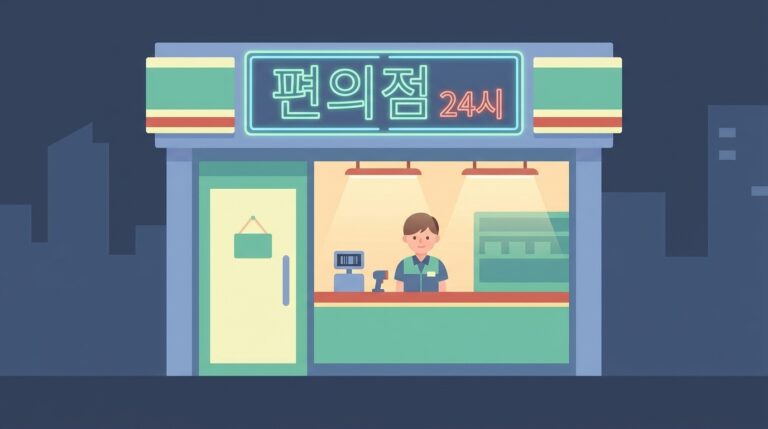
Phase 1: Empathy & The Glow of the 24-Hour Neon Sign
Hello there! This is your Lead Editor at Daily Hangul.
Picture this: It’s 2 AM in Seoul. The neon sign of a GS25 or CU convenience store hums quietly in the background. In almost every modern K-Drama—whether it’s Itaewon Class, My Mister, or Backstreet Rookie—there is a pivotal scene set in this exact brightly-lit sanctuary. A young protagonist, wearing a uniform vest, is eating an expired triangular gimbap (폐기 삼각김밥) while studying for civil service exams or dealing with a drunken, unruly customer. The subtitles usually just say ‘I work part-time,’ but the cultural weight of that scene? It’s immense.
Today, we are going deep. As C2 learners, you already know how to ask ‘How much is this?’ But to truly understand Korea, you need to understand the language of its youth, its labor, and its shifting social hierarchies. The convenience store is a microcosm of the Korean economy. Knowing the vocabulary surrounding the 알바 (Alba)—from minimum wage to workplace treatment—transforms you from a passing tourist into someone who truly gets the socio-cultural fabric of modern Korea.
Let’s step behind the counter and explore the real Korean convenience store life.
Phase 2: Core Expressions Deep Dive
1. 최저시급
- Pronunciation: choejeosigeup [chweh-juh-shee-geup]
- Meaning: Minimum hourly wage (Literal) vs. The baseline of youth survival (Real nuance)
- K-Culture Moment: Every December, the news is flooded with debates about next year’s choejeosigeup. In K-Dramas, when a character is looking at job postings on the ‘Alba Heaven’ (알바천국) app, they are calculating if the choejeosigeup is enough to pay their tiny studio apartment’s rent (월세).
- Editor’s Insight: This isn’t just an economic term; it’s an emotional one. When young Koreans talk about choejeosigeup, it often carries a tone of resignation or solidarity regarding the struggles of being a student or job-seeker.
- Situation Spectrum:
- Casual with friends: ✅
- Semi-formal (news/debates): ✅
- Formal (to a boss while complaining): 🚫 (Tread carefully!)
- 🤔 Think About It: In Korea, the minimum wage is applied uniformly across the country, unlike in the US where it varies by state. How does this uniform standard affect the way young people view moving to Seoul for jobs?
2. 갑질
- Pronunciation: gapjil [gap-jeel] (Sounds like the sharp snap of an angry boss’s fingers)
- Meaning: Power tripping / Abusing one’s power over a subordinate.
- K-Culture Moment: A customer screaming at a part-timer to kneel and apologize because they didn’t provide a plastic bag. Videos of these ‘Gapjil’ incidents frequently go viral in Korea, sparking nationwide outrage.
- Editor’s Insight: The word comes from contract terminology where ‘Gap’ (갑) is the contractor (powerful) and ‘Eul’ (을) is the subcontractor (powerless). Being an ‘Alba’ means you are inherently ‘Eul’. Recognizing and calling out gapjil is a huge part of modern Korean social justice.
- Situation Spectrum:
- Casual (venting to friends): ✅
- Semi-formal (social commentary): ✅
- Formal (accusing someone directly): ⚠️ (Very aggressive)
- 🤔 Think About It: Why did a society built on Confucian respect develop such a specific word for power abuse? Does your language have a direct equivalent for ‘Gapjil’?
3. 주휴수당
- Pronunciation: juhyusudang [joo-hyoo-soo-dang]
- Meaning: Weekly holiday allowance.
- K-Culture Moment: A convenience store owner schedules a worker for exactly 14.5 hours a week. Why? Because under Korean labor law, working 15 hours or more requires the employer to pay juhyusudang (an extra day’s pay). This ‘wage-hacking’ is a common source of friction.
- Editor’s Insight: If you can discuss juhyusudang in Korean, locals will be mind-blown by your deep understanding of their labor laws. It’s the ultimate ‘I know the real Korea’ flex.
- Situation Spectrum:
- Casual (among Alba workers): ✅
- Semi-formal (interviews/HR): ✅
- Formal/Boss: ⚠️ (Usually a tense topic!)
- 🤔 Think About It: Many part-timers juggle three different 14-hour jobs just to survive because employers avoid paying this allowance. How does policy shape the lifestyle of the youth?
Phase 3: Textbook vs. Real Korean
[Describing a Part-Time Job]
* 📖 Textbook: 저는 파트타임으로 일해요. (jeoneun pateutaimeuro ilhaeyo – I work part-time.)
* 🗣️ Real Korean: 저 편의점 알바해요. (jeo pyeonuijeom albahaeyo – I do convenience store alba.)
* 💡 Why the difference?: ‘Alba’ (from the German Arbeit) is the absolute standard term. Nobody says ‘part-time’ in daily conversation.
[Dealing with Rude Customers]
* 📖 Textbook: 무례한 고객이 왔어요. (muryehan gogaegi wasseoyo – A rude customer came.)
* 🗣️ Real Korean: 오늘 완전 진상 왔어. (oneul wanjeon jinsang wasseo – An absolute ‘jinsang’ came today.)
* 💡 Why the difference?: ‘진상’ (Jinsang) is a highly visceral slang term that captures the entitlement and irrationality of terrible customers, deeply rooted in the service industry’s collective exhaustion.
[Saying Goodbye at the Store]
* 📖 Textbook: 안녕히 계세요. (annyeonghi gyeseyo – Please stay in peace / Goodbye.)
* 🗣️ Real Korean: 수고하세요~ (sugohaseyo~ – Keep up the hard work~)
* 💡 Why the difference?: Acknowledging someone’s labor as you leave is the polite norm. It shows empathy for their hard work.
Bottom Note: At a C2 level, smoothly dropping terms like ‘진상’ (Jinsang) or ‘알바생’ (Albasaeng) into your social conversations makes you sound incredibly fluent and culturally attuned.
Phase 4: Cultural Context — K-Culture Deep Dive
4-1. Non-Verbal Nuances: The Empathy Nod
When interacting with an Alba worker, especially late at night, the Korean Nunchi (social awareness) dictates a quiet respect. Don’t toss your credit card on the counter. Hand it to them, or place it gently in the card reader. When leaving, a slight, almost imperceptible head bow accompanied by a quiet “수고하세요” speaks volumes. It says: “I see you working the graveyard shift for minimum wage, and I respect your hustle.”
4-2. The ‘Alba’ Trope in K-Dramas & Reality
In dramas, the convenience store is where the rich chaebol heir accidentally meets the hardworking, poor female lead. He buys all the expired milk; she gets mad; they fall in love.
Critical Reality Check: In reality, the night shift (야간 알바 – yagan alba) is grueling. It involves unloading heavy delivery trucks (물류 정리 – mullyu jeongni), fighting off sleep, and navigating complex POS (Point of Sale) systems for 2+1 promotions and utility bill payments. The romanticization in media often masks the precarious reality of youth labor rights in Korea.
Phase 5: Real-Life Roleplay Scenario
Setting: It’s 2:30 AM at a CU convenience store in Sinchon, a bustling university district. The store is quiet except for the hum of the refrigerators. You are buying some midnight ramen and a beer after a long study session.
Characters:
* YOU: An advanced expat living in Seoul, familiar with the local vibe.
* Ji-hoon (22): A college student working the night shift. He has dark circles under his eyes and is wearing a CU vest over a hoodie.
Dialogue:
Ji-hoon: 어서 오세요…
(eoseo oseyo…)
[Welcome…]
(🎭 Stage Direction: Ji-hoon stifles a yawn as you place your items on the counter.)
YOU: 안녕하세요. 이거 결제 부탁드릴게요.
(annyeonghaseyo. igeo gyeolje butakdeurilkkeyo.)
[Hello. I’d like to pay for these, please.]
Ji-hoon: 네. 봉투 필요하신가요?
(ne. bongtu piryohasingayo?)
[Yes. Do you need a bag?]
YOU: 아니요, 괜찮습니다. 그냥 가져갈게요.
(aniyo, gwaenchanseumnida. geunyang gajyeogalkkeyo.)
[No, it’s okay. I’ll just carry them.]
Ji-hoon: 신분증 확인 잠깐 할게요.
(sinbunjeung hwagin jamkkan halkkeyo.)
[I’ll need to check your ID for a second. (Because of the beer)]
YOU: 아, 네. 여기 있습니다. 오늘 야간 타임이신가 봐요. 피곤하시겠어요.
(a, ne. yeogi isseumnida. oneul yagan taimisinga bwayo. pigonhasigesseoyo.)
[Ah, yes. Here it is. Looks like you’re on the night shift today. You must be tired.]
Ji-hoon: 하하, 네. 내일 오전 강의도 있는데 큰일이네요.
(haha, ne. naeil ojeon ganguido inneunde keunirineyo.)
[Haha, yes. I even have a morning lecture tomorrow, so I’m in big trouble.]
Ji-hoon: 영수증 버려드릴까요?
(yeongsujeung beoryeodeurilkkayo?)
[Shall I throw away the receipt for you?]
🔀 Your Turn! How do you reply and say goodbye?
– A) “네, 버려주세요. 안녕히 계세요.” (Yes, please throw it away. Goodbye.)
– B) “네, 버려주세요. 수고하세요!” (Yes, please throw it away. Keep up the hard work!)
– C) “네. 알바 화이팅!” (Yes. Alba fighting!)✅ Best Choice: B — It hits the perfect balance of polite and culturally empathetic.
⚠️ Choice C Analysis: While well-intentioned, telling a stranger “Fighting!” out of nowhere can feel a bit overly familiar or slightly patronizing. “수고하세요” is the gold standard.
YOU: 네, 버려주세요. 수고하세요!
(ne, beoryeojuseyo. sugohaseyo!)
[Yes, please throw it away. Keep up the hard work!]
Ji-hoon: 감사합니다. 조심히 가세요.
(gamsahamnida. josimhi gaseyo.)
[Thank you. Have a safe trip back.]
🎬 Bonus K-Culture Scenario: The 2+1 Trap
You bring two identical drinks to the counter. The POS system makes a distinct beeping melody.
Worker: 손님, 이거 2+1 행사 상품인데 하나 더 가져오시겠어요?
(sonnim, igeo tupulleoseuwon haengsa sangpuminde hana deo gajyeoosigesseoyo?)
[Customer, this is a 2-for-1 event item. Would you like to bring one more?]
YOU: 아, 진짜요? 금방 가져올게요!
(a, jinjja-yo? geumbang gajyeoolkkeyo!)
[Oh, really? I’ll be right back with it!]
Phase 6: 10-Second Shadowing Drill
Let’s practice a phrase that shows deep consideration when the store is busy or the worker is struggling with the register.
😊 천천히 / 하셔도 돼요. / 수고가 / 많으십니다.
(cheoncheonhi / hasyeodo dwaeyo. / sugoga / maneusimnida.)
[You can take your time. You are working really hard.]
Tip: Say the first part with a warm smile (😊) and the second part with genuine respect. Your intonation should drop slightly at the end to sound sincere, not sarcastic.
Phase 7: K-Culture Mini Dictionary
1. 알바생
* Romanization: alba-saeng
* English: Part-time worker
* Context: The suffix ‘생’ (saeng) implies a student. Even if the worker isn’t a student, society often views part-time work as a ‘student’s phase’.
2. 폐기
* Romanization: pyegi
* English: Discarded / Past-expiration items
* Context: Convenience store workers are often allowed to eat the ‘pyegi’ bento boxes or gimbap. It’s a bittersweet symbol of the frugal Alba lifestyle.
3. 진상
* Romanization: jinsang
* English: An incredibly rude or unreasonable customer
* Context: A term heavily used in the service industry to describe someone committing Gapjil.
4. 대타
* Romanization: daeta
* English: A substitute / Covering a shift
* Context: “오늘 대타 뛰어야 돼” (I have to cover a shift today) is a phrase you’ll hear endlessly among Korean university students.
Phase 8: Traveler Survival Kit
Even as an advanced learner, the fast-paced convenience store interactions can catch you off guard. Here are the absolute essentials.
🆘 Survival Expressions TOP 3
– 🇰🇷 “봉투(는) 괜찮아요.” (bongtuneun gwaenchanayo) — I don’t need a bag.
– 🇰🇷 “영수증 버려주세요.” (yeongsujeung beoryeojuseyo) — Please throw away the receipt.
– 🇰🇷 “이거 행사 상품인가요?” (igeo haengsa sangpumingayo?) — Is this an event/promo item?📌 Editor’s Travel Note
– Self-Checkout: Look for 무인 계산대 (muin gyesandae). You’ll need to scan the barcode and insert your card. No cash accepted here!
– Tipping Culture: Do NOT tip the convenience store worker. It will cause intense confusion and they will chase you down the street to give your money back.
Phase 9: Critical Thinking Corner — “One Step Deeper”
Language & Power (Korean in the Hierarchy)
🨀 Think Deeper:
In the past, older customers frequently used Banmal (반말 – informal language) to Alba workers simply because the workers were younger. The hierarchy of Age outranked the professionalism of the Service environment. However, modern Korean youth have heavily pushed back against this Gapjil. Today, you’ll see campaigns in convenience stores saying, “알바생도 누군가의 귀한 자식입니다” (The part-timer is also someone’s precious child). The shift towards using 존댓말 (Jondaetmal – polite language) regardless of age in the service sector reflects a rapidly democratizing social consciousness in Korea. Language is evolving to protect the powerless.💬 Your Turn: How are retail and service workers treated in your culture? Is there a linguistic difference in how you speak to a store clerk versus a corporate boss? Let’s discuss in the comments!
Phase 10: FAQ & Avoiding Misunderstandings
Q: Is it okay to say “수고하세요” to someone significantly older than me?
A: NO! In Korean culture, telling an elder or a superior to “keep working hard” (수고하세요) is considered patronizing. If the convenience store worker is an older Ahjumma or Ahjussi, it’s much safer to smile, bow slightly, and say “감사합니다” (Thank you) or “안녕히 계세요” (Goodbye).
Q: I heard workers don’t get paid minimum wage sometimes. Can I ask them about it?
A: Maybe, but generally No. Unless you are close friends, asking a worker about their choejeosigeup or juhyusudang is deeply intrusive.
❌ Common Mistake #1: Assuming that because you are the “Customer” (손님), you don’t need to use polite language. Always use 존댓말 (Jondaetmal) to service workers. Treating an Alba worker with respect using high-level Korean is the true mark of a C2 speaker.
Phase 11: Summary & Action Items
One-Liner Summary: Mastering the vocabulary of the Alba life—like choejeosigeup and jinsang—gives you a profound, empathetic lens into the realities of Korean youth and social hierarchy.
Action Mission 3 Stages:
* 🥉 Bronze (Solo): Stand in front of a mirror and practice the 10-second shadowing drill with the correct empathetic tone.
* 🥈 Silver (Online): Go to a Korean forum or YouTube video about part-time jobs and leave a comment: “대한민국 모든 알바생들 화이팅!” (Cheering for all part-timers in Korea!)
* 🥇 Gold (Real World): Visit a Korean convenience store or market. Make your purchase, take your receipt, and confidently say “수고하세요!” as you leave.
🎬 K-Culture Mission:
Watch the first episode of the K-Drama Backstreet Rookie (편의점 샛별이) or Itaewon Class. Spot the moments where they talk about shifts, pyegi food, or deal with a jinsang customer. Notice the power dynamics in their language!
Phase 12: Quiz — Interactive Challenge
1. Situational Judgment:
You are at a convenience store. The worker is looking for an item you asked for, but it’s taking a long time. They look stressed. What is the most culturally empathetic (and advanced) thing to say?
* A) 빨리 해주세요. (Hurry up, please.)
* B) 천천히 하셔도 돼요. (You can take your time.)
* C) 최저시급 받는데 대충 하세요. (You get minimum wage, just do it roughly.)
2. True or False — K-Culture Edition:
“In Korea, if a convenience store worker provides excellent service, you should leave a small tip on the counter.”
3. Fill in the Blank:
That customer was screaming at the part-timer just because they didn’t smile. What an absolute _________!
(Hint: A 2-syllable word for a terrible customer)
🔍 Click to reveal answers!
1. B – Showing patience with “천천히 하셔도 돼요” is incredibly kind. (C is highly offensive!)
2. False – Tipping is not part of Korean culture and will cause extreme confusion.
3. 진상 (Jinsang) – The ultimate label for someone committing Gapjil at a store.
Frequently Asked Questions (FAQ)
Q: What does "최저시급" mean in Korean and how do you pronounce it?
A: In Korean, "최저시급" is pronounced [choejeosigeup [chweh-juh-shee-geup] and means: Minimum hourly wage (Literal) vs. The baseline of youth survival (Real nuance)
Q: What does "갑질" mean in Korean and how do you pronounce it?
A: In Korean, "갑질" is pronounced [gapjil [gap-jeel] and means: Power tripping / Abusing one's power over a subordinate.
Q: What does "주휴수당" mean in Korean and how do you pronounce it?
A: In Korean, "주휴수당" is pronounced [juhyusudang [joo-hyoo-soo-dang] and means: Weekly holiday allowance.







