

Treat a Korean Soldier to a Meal Like a True Local! Secret Phrases to Show You Care
Phase 1: Empathy (Welcome to the Real Korea!)
Hello! This is your Daily Hangul Editor.
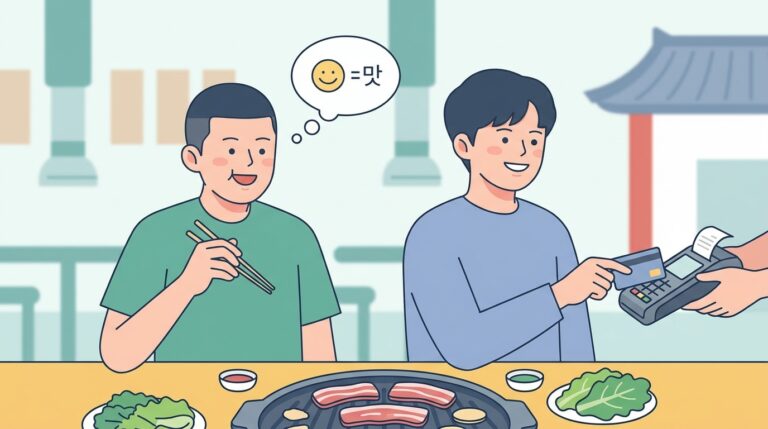
Picture this K-Drama scene: The male lead, sporting a fresh buzz cut, sits in a smoky Korean BBQ restaurant. He looks like he hasn’t eaten a proper meal in days, devouring pork belly (Samgyeopsal) as if his life depends on it. His friend smiles, pats him on the shoulder, and says something that makes the tough soldier tear up. The subtitles just say, “Eat up.” But was it really just about the food?
If you spend enough time in Korea, you’ll inevitably see this: young men in military uniforms roaming the streets, surrounded by friends treating them to a massive feast. Mandatory military service is a deeply ingrained part of Korean society. When a soldier gets his first leave (휴가, hyuga), taking him out for a meal isn’t just a friendly gesture—it’s a cultural rite of passage.
If you have a Korean friend going to or coming back from the army, knowing what to say (and who pays the bill!) will instantly upgrade you from “foreign friend” to “true local insider.” This guide is built from the real experiences of our tutoring students who wanted to show support but didn’t know how to navigate the cultural Nunchi (눈치)!
Phase 2: Core Expressions Deep Dive
1. 많이 먹어. 내가 쏠게!
- Pronunciation: mani meogeo. naega ssolge! [ma-ni / muh-guh. nae-ga / ssol-ggeh!] (The ‘ss’ sounds like the sharp hiss of a snake)
- Meaning: Literal: Eat a lot. I will shoot! / Real nuance: Eat as much as you want. It’s on me!
- K-Culture Moment: You’ll hear this in almost every K-Drama when a senior treats a junior, or a friend treats a soldier. The word 쏘다 (to shoot) is the ultimate slang for treating someone to a meal or drinks.
- Editor’s Insight: This isn’t just about paying money. It’s a verbal warm hug. It tells the soldier, “Don’t worry about your thin military wallet today; I’ve got you covered.”
- Situation Spectrum:
- Casual (Friends): ✅
- Semi-formal (Coworkers): ⚠️ (Use ‘제가 쏘겠습니다’ instead)
- Formal (Boss/Elders): 🚫
- 🤔 Think About It: Why do Koreans use the aggressive word “shoot” (쏘다) for buying a meal? It implies a bold, cool action—like firing a winning shot. Does your language have a fun slang word for treating someone?
2. 고생이 많다. 언제 제대해?
- Pronunciation: gosaengi manta. eonje jedaehae? [go-saeng-ee / man-ta. uhn-jeh / jeh-dae-hae?]
- Meaning: Literal: You have a lot of hardship. When do you discharge? / Real nuance: You’re working so hard. When are you finally out of the army?
- K-Culture Moment: This is the standard greeting for any soldier on leave. It’s an acknowledgment of their sacrifice. In K-Pop fandoms, fans also say this when their favorite idol finishes their military service!
- Editor’s Insight: ‘고생’ (hardship) is a deeply empathetic word in Korean. Saying this validates their physical and mental struggles in the military.
- Situation Spectrum:
- Casual (Friends): ✅
- Semi-formal (Coworkers): ✅
- Formal (Boss/Elders): 🚫 (Never say this to elders; it sounds condescending)
- 🤔 Think About It: Korean has many expressions acknowledging someone’s effort (수고하셨습니다, 고생하셨습니다). Why is recognizing hard work so central to Korean greetings?
3. 군대 밥은 먹을 만해?
- Pronunciation: gundae babeun meogeul manhae? [goon-dae / ba-beun / muh-geul / man-hae?]
- Meaning: Literal: Is army food worth eating? / Real nuance: Is the food on base edible/okay?
- K-Culture Moment: Food is a national obsession in Korea. Asking about someone’s meals is equivalent to asking “How are you?” Naturally, asking a soldier about the notorious army food (jjambap) is a great icebreaker.
- Editor’s Insight: The phrase ‘~을 만하다’ means “bearable” or “okay.” You’re playfully acknowledging that military food probably isn’t great, but asking if they are surviving it.
- Situation Spectrum:
- Casual (Friends): ✅
- Semi-formal (Coworkers): ⚠️
- Formal (Boss/Elders): 🚫
- 🤔 Think About It: Why are Koreans so concerned about whether others have eaten well? How does this tie back to the country’s history?
Phase 3: Textbook vs. Real Korean
[When offering to pay for the meal]
* 📖 Textbook Korean: 제가 계산하겠습니다. (I will calculate/pay.)
* 🗣️ Real Korean: 오늘은 내가 쏜다! (Today, I’m shooting!)
* 💡 Why the difference?: “Calculate” sounds incredibly stiff and transactional. “Shooting” reflects the warm, generous, and slightly dramatic nature of Korean friendship.
[When comforting their hard work]
* 📖 Textbook Korean: 수고하십니다. (You are putting in effort.)
* 🗣️ Real Korean: 고생이 많다! (You’re going through a lot!)
* 💡 Why the difference?: “수고하다” is often used top-down (boss to employee). “고생하다” emphasizes raw empathy for physical/mental hardship, perfect for a tired soldier.
[When asking about their discharge date]
* 📖 Textbook Korean: 언제 군대가 끝납니까? (When does the military finish?)
* 🗣️ Real Korean: 언제 제대해? (When do you get discharged?)
* 💡 Why the difference?: ‘제대’ (discharge) is the exact cultural term everyone uses. Using the right vocabulary shows you really understand their situation.
Phase 4: Cultural Context — K-Culture Deep Dive
4-1. Non-Verbal Elements: The Art of Grilling
When treating a soldier, you must take control of the tongs. Do not let the soldier cook! They’ve been following orders, cleaning, and working hard on base. This meal is their sanctuary. Taking charge of the grill is a non-verbal way of saying, “Relax, you’re off duty now.”
4-2. K-Culture Connection: The ‘Saje’ Craving
Have you watched the hit drama D.P.? Notice how the soldiers look longingly at convenience store food or fried chicken? In the military, soldiers eat Jjambap (짬밥, slang for military food), which is notoriously bland.
When they come out on leave, they crave Saje (싸제, slang for civilian goods/food). This is why you never take a soldier on leave to a delicate, quiet salad bar. You take them to a loud, greasy, soulful Samgyeopsal (BBQ) restaurant or a fried chicken joint! It’s the ultimate taste of freedom.
Phase 5: Practical Roleplay Scenario
Setting: Friday, 7 PM. A smoky BBQ restaurant in Hongdae. The sizzle of pork belly fills the air. You are with Minwoo (21), your Korean friend who just came out on his first military leave. He has a buzz cut and looks excited.
Minwoo: 와, 진짜 오랜만에 고기 먹는다! 🥩
(wa, jinjja oraenmane gogi meongneunda!)
(Wow, it’s been so long since I had meat!)
(🎭 Stage Direction: Minwoo stares at the grill with sparkling eyes)
YOU: 많이 먹어. 부대 밥은 어때? 먹을 만해?
(mani meogeo. budae babeun eottae? meogeul manhae?)
(Eat a lot. How’s the food on base? Is it edible?)
(🎭 Stage Direction: You hand him a pair of chopsticks)
Minwoo: 아휴, 말도 마. 맨날 똑같은 반찬이야.
(ahyu, maldo ma. maennal ttoggateun banchaniya.)
(Ugh, don’t even ask. It’s the same side dishes every day.)
YOU: 고생이 많다. 언제 제대해?
(gosaengi manta. eonje jedaehae?)
(You’re going through a lot. When do you get discharged?)
Minwoo: 나? 아직 1년 남았어… 슬프다.
(na? ajik illyeon namasseo… seulpeuda.)
(Me? I still have 1 year left… I’m sad.)
YOU: 하하! 시간 금방 갈 거야. 고기나 더 먹자.
(haha! sigan geumbang gal geoya. gogina deo meokja.)
(Haha! Time will fly by. Let’s just eat more meat.)
Minwoo: 고마워! 참, 오늘 내 몫은 내가 낼게. 나도 월급 받아!
(gomawo! cham, oneul nae mokseun naega naelge. nado wolgeup bada!)
(Thanks! Oh, I’ll pay for my share today. I get a military salary too!)
🔀 Your Turn! How should you respond?
– A) “아, 고마워! 그럼 반씩 내자.” (Oh, thanks! Let’s split it then.)
– B) “에이~ 오늘은 내가 쏠게! 휴가잖아!” (No way~ I’m treating today! It’s your leave!)
– C) “진짜? 그럼 네가 다 사!” (Really? Then you buy it all!)✅ Best Choice: B — Unwritten rule of Korean culture: NEVER let a soldier on their first leave pay for a meal. Their salary is small, and treating them is a sign of respect for their service.
⚠️ Choice A & C Analysis: Dutch pay (splitting the bill) is common among young Koreans, but not with a soldier on leave. Making them pay everything (C) is a massive cultural faux pas!
YOU: 에이~ 오늘은 내가 쏠게! 휴가잖아!
(ei~ oneureun naega ssolge! hyugajana!)
(No way~ I’m treating today! It’s your leave!)
Minwoo: 진짜? 와, 감동이다. 잘 먹을게!
(jinjja? wa, gamdongida. jal meogeulge!)
(Really? Wow, I’m touched. I’ll eat well!)
YOU: 그래, 부족하면 더 시키고!
(geurae, bujokamyeon deo sikigo!)
(Yeah, if it’s not enough, order more!)
🎬 Bonus K-Culture Roleplay: The Photo Booth
(After the meal, Minwoo drags you to a “Life Four Cuts” photo booth—a staple Gen Z Korean culture.)
Minwoo: 우리 네컷 사진 찍자! 나 군복 입었잖아.
(uri nekeot sajin jjikja! na gunbok ibeotjana.)
(Let’s take a 4-cut photo! I’m wearing my uniform.)
YOU: 좋아! 나는 선글라스 쓸게. 넌 이 토끼 머리띠 해!
(joa! naneun seongeullaseu sseulge. neon i tokki meoritti hae!)
(Great! I’ll wear sunglasses. You wear this bunny headband!)
Minwoo: 군복에 토끼 머리띠? 완벽하네!
(gunboge tokki meoritti? wanbyeokane!)
(A bunny headband with a military uniform? Perfect!)
Phase 6: 10-Second Shadowing Drill
Speak out loud to get the exact K-Drama vibe! Pause at the slashes and match the emotion.
😊 많이 / 먹어. / 오늘은 / 내가 / 쏠게!
(ma-ni / muh-guh. / o-neu-reun / nae-ga / ssol-ggeh!)
(Vibe: Bright, generous, smiling, patting your friend’s shoulder!)
🥺 고생이 / 많다. / 부대 밥은 / 먹을 만해?
(go-saeng-ee / man-ta. / boo-dae ba-beun / muh-geul / man-hae?)
(Vibe: Empathetic, slightly concerned, tilting your head)
Phase 7: K-Culture Mini Dictionary
1. 눈치 (Nunchi)
* Pronunciation: nunchi
* English: Situational awareness / Reading the room
* Context: Knowing that you should grab the bill before the soldier does is a prime example of having “good nunchi.”
2. 휴가 (Hyuga)
* Pronunciation: hyuga
* English: Vacation / Military leave
* Context: The most sacred word for a Korean man in his 20s. The first leave is usually called “100-day leave” (백일휴가).
3. 짬밥 (Jjambap)
* Pronunciation: jjambap
* English: Military food (Slang)
* Context: It also metaphorically means “experience level.” If someone has “high jjambap,” they are a veteran or senior.
4. 제대 (Jedae)
* Pronunciation: jedae
* English: Military discharge
* Context: The ultimate finish line. Idols returning from the army are celebrated with “제대 축하” (Happy Discharge) banners.
Phase 8: Traveler Survival Kit
If you’re taking your soldier friend out for Korean BBQ, you must know how to order like a boss!
🆘 Survival Phrases for Korean BBQ
– 🇰🇷 “사장님, 여기 1인분 더 주세요!” (sajangnim, yeogi irinbun deo juseyo!)
– 🗣️ English: Boss, one more portion here, please!
– 📍 Where to use: BBQ restaurants, Dakgalbi places.
– 💡 Pro Tip: Don’t just say “Excuse me.” Hold up your hand and confidently call out “Sajangnim!” (Owner).📌 Editor’s Travel Note
– Call Bells: Most tables have a little call bell (벨). Just press it!
– Paying the Bill: You don’t pay at the table in Korea. Take the small bill on your table to the front counter when leaving.
– Tipping: ZERO. Korea has absolutely no tipping culture. If you leave money on the table, the waiter will run down the street to give it back to you!
Phase 9: Critical Thinking — “One Step Deeper”
🧠 Think Deeper: Food & Identity (음식과 정체성)
Why is “buying a meal” the ultimate expression of care in Korea? Historically, Korea went through immense poverty following the Korean War. Offering someone a hearty, warm meal became the purest form of love and survival. Even today, the Korean greeting “밥 먹었어?” (Did you eat?) doesn’t literally mean “Are you hungry?”—it means “Are you doing well? I care about you.” Treating a soldier to Samgyeopsal isn’t just about calories; it’s a profound cultural ritual transferring strength and community spirit to someone serving the country.💬 Your Turn: In your culture, what is the ultimate gesture or gift to show someone “I appreciate your hard work”? Let us know in the comments!
Phase 10: FAQ & Avoiding Misunderstandings
Q: Can I use “내가 쏠게” (I’ll shoot/pay) to my boss or an older person?
A: NO! It’s too casual. If you want to treat someone older, politely say, “오늘은 제가 대접하겠습니다” (I will treat you today).
Q: Do Korean soldiers get paid? Why are they considered ‘broke’?
A: Yes, they do. The military salary has increased recently, but it’s still relatively small compared to a full-time civilian job. Treating them is a gesture of respect, not necessarily charity.
❌ Common Mistake #1: Splitting the bill (Dutch pay) with a soldier on their first leave.
✅ Do this instead: Sneak to the counter and pay while they are in the restroom, or firmly say “내가 쏠게!” (It’s on me!).❌ Common Mistake #2: Asking “언제 제대해?” (When do you get discharged?) to a soldier who just enlisted.
✅ Do this instead: They will get depressed if they just started! Instead, say, “다치지 말고 건강히 다녀와” (Don’t get hurt and come back healthy).
Phase 11: Summary & Action Items
One-Liner Summary: Treating a Korean soldier on leave is about taking charge of the grill and warmly declaring, “내가 쏠게!” (It’s on me!).
🔥 Action Mission 3 Steps:
– 🥉 Bronze (Solo): Stand in front of a mirror and practice saying “많이 먹어. 내가 쏠게!” with a confident smile.
– 🥈 Silver (Online): Find a K-Pop idol who was recently discharged and comment “제대를 축하합니다! 고생 많았어요!” on their video.
– 🥇 Gold (Real Life): The next time you grab food with a Korean friend, surprise them by paying and confidently saying, “오늘은 내가 쏜다!”
🎖️ Special K-Culture Mission:
Watch an episode of the K-Drama Crash Landing on You or D.P., and spot the scene where soldiers eat together. Pay attention to how aggressively they eat meat!
Phase 12: Interactive Challenge (Quiz)
1. Situational Judgment: You are treating a soldier friend to BBQ. He tries to pull out his credit card. What is the most culturally appropriate thing to say?
– A) “그래, 다음엔 내가 살게!” (Okay, I’ll buy next time!)
– B) “오늘은 내가 쏠게. 넌 많이 먹기나 해!” (I’m shooting today. You just eat a lot!)
– C) “더치페이 하자.” (Let’s Dutch pay.)
(Answer: B. It’s the ultimate ‘Nunchi’ move to insist on paying for their leave!)
2. True or False – K-Culture Edition:
– In a Korean BBQ restaurant, you should leave a 15% tip if the waiter changes your grill often. (T/F)
(Answer: FALSE. Korea has absolutely zero tipping culture. Do not leave a tip!)
3. Fill in the Blank:
You want to ask your friend if the military food is okay.
“부대 밥은 먹을 [_____]?”
(Answer: 만해 (manhae). It means ‘Is it bearable/edible?’)
Frequently Asked Questions (FAQ)
Q: What does "많이 먹어. 내가 쏠게!" mean in Korean and how do you pronounce it?
A: In Korean, "많이 먹어. 내가 쏠게!" is pronounced [mani meogeo. naega ssolge! [ma-ni / muh-guh. nae-ga / ssol-ggeh!] and means: Literal: Eat a lot. I will shoot! / Real nuance: Eat as much as you want. It's on me!
Q: What does "고생이 많다. 언제 제대해?" mean in Korean and how do you pronounce it?
A: In Korean, "고생이 많다. 언제 제대해?" is pronounced [gosaengi manta. eonje jedaehae? [go-saeng-ee / man-ta. uhn-jeh / jeh-dae-hae?] and means: Literal: You have a lot of hardship. When do you discharge? / Real nuance: You're working so hard. When are you finally out of the army?
Q: What does "군대 밥은 먹을 만해?" mean in Korean and how do you pronounce it?
A: In Korean, "군대 밥은 먹을 만해?" is pronounced [gundae babeun meogeul manhae? [goon-dae / ba-beun / muh-geul / man-hae?] and means: Literal: Is army food worth eating? / Real nuance: Is the food on base edible/okay?







