

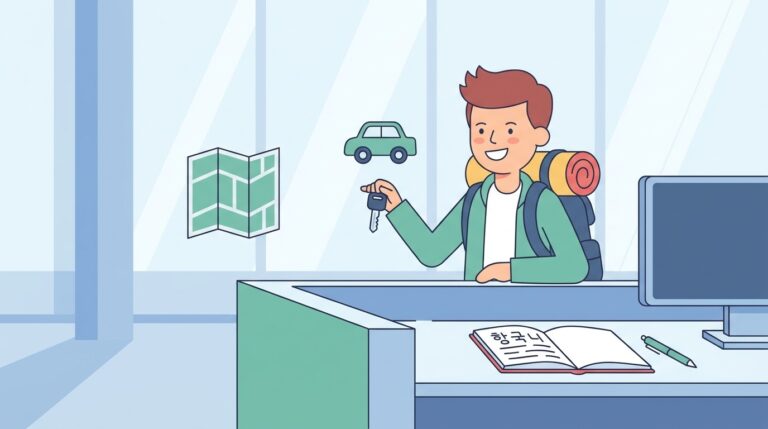
Phase 1: Empathy (Immersive Opening)
Hello there! I’m your Daily Hangul Editor.
Imagine this: You’re in Jeju Island. The sun is shining, the ocean breeze is blowing, and you’re ready to recreate that iconic K-Drama scene where the protagonists drive along the coastal road with a catchy K-Pop OST blasting in the background. It’s the ultimate dream! But wait… before you can hit the road, you are standing at the rental car desk at the airport, and the agent is looking at you, waiting for you to speak.
Your translation app says one thing, but you want to sound natural, polite, and confident. If you don’t know the right words, you might end up with a manual transmission car when you only know how to drive an automatic, or worse—miss out on the full insurance coverage!
Don’t worry. This guide is based on real SOS messages I’ve received from my students who were sweating at the Jeju Airport rental counters. Today, we’re going to learn exactly how to ask to rent a car, get the right insurance, and sound like a local while doing it.
Phase 2: Core Expressions Deep Dive
Let’s master the most essential phrases you’ll need at the counter.
1. 차 렌트하고 싶어요.
- Pronunciation: [cha ren-teu-ha-go si-peo-yo] (The ‘teu’ sounds like the disgusted ‘ugh’ sound, but shorter!)
- Meaning: I want to rent a car. (Literal: Car rent-do want.)
- K-Culture Moment: You’ll hear this exactly like this in Korean vlogs when YouTubers travel to Jeju or Busan. Koreans love using the English word “rent” (렌트) instead of the traditional Korean verb for borrowing.
- Editor’s Insight: This is your golden ticket. It’s polite, clear, and perfectly natural. You can use it as soon as you walk up to the desk.
- Situation Spectrum:
- Casual with friends: ✅ (차 렌트하자!)
- Semi-formal (Clerk/Staff): ✅ (차 렌트하고 싶어요.)
- Highly Formal/Business: ⚠️ (Use ‘차량을 대여하고 싶습니다’ instead.)
- 🤔 Think About It: Why do Koreans use the English word ‘rent’ (렌트) for cars, but the native Korean word ‘빌리다’ (to borrow/rent) for things like books or umbrellas? How does language adapt to modern commercial services?
2. 오토인가요?
- Pronunciation: [o-to-in-ga-yo?]
- Meaning: Is it an automatic transmission?
- K-Culture Moment: In older K-Dramas, manual cars were everywhere. Today, almost everyone in Korea drives an ‘오토’ (Auto). However, it’s always good to double-check, especially if you’re renting a specialized vehicle like a truck or an older sports car.
- Editor’s Insight: ‘오토’ is Konglish for ‘Automatic’. If you ask for an “automatic transmission” in full English, the clerk might pause. Just say “오토인가요?” and they’ll instantly nod.
- Situation Spectrum:
- Casual: ✅ (이거 오토야?)
- Semi-formal: ✅ (오토인가요?)
- Formal: 🚫 (Not applicable, just use the semi-formal.)
- 🤔 Think About It: Koreans love shortening words for efficiency (Automatic -> Auto). Are there words in your language that are shortened to the point where the original word is almost forgotten?
3. 완전 자차 포함해 주세요.
- Pronunciation: [wan-jeon ja-cha po-ham-hae ju-se-yo]
- Meaning: Please include full collision damage waiver (full insurance).
- K-Culture Moment: Korean roads can be tricky. Narrow alleys, aggressive taxi drivers, and the famous “scooters appearing out of nowhere.” Full insurance is the ultimate peace of mind for your K-Trip.
- Editor’s Insight: ‘완전’ means complete/full. ‘자차’ is short for self-car insurance. This phrase is the secret to a stress-free trip. If you don’t say this, you might end up paying for a tiny scratch!
- Situation Spectrum:
- Casual: 🚫
- Semi-formal (Counter staff): ✅
- Formal: ✅
- 🤔 Think About It: Insurance shows our desire for safety and risk avoidance. Have you noticed how Koreans emphasize “safety first” (안전 제일) in public spaces?
Phase 3: Textbook vs. Real Korean
Let’s see how textbook Korean compares to what you’ll actually hear at the rental shop.
[Telling the clerk you want to rent a car]
* 📖 Textbook Korean: 자동차를 대여하고 싶습니다. (I would like to lease a vehicle.)
* 🗣️ Real Korean: 차 렌트하려고요. (I’m planning to rent a car.)
* 💡 Why it’s different: “대여” (Lease/Rent) is very formal and bureaucratic. In everyday life, Koreans use the Konglish “렌트” (Rent) combined with “하다” (to do).
[Asking about the GPS]
* 📖 Textbook Korean: 차량에 내비게이션 시스템이 있습니까? (Does the vehicle possess a navigation system?)
* 🗣️ Real Korean: 내비 있죠? (It has a navi, right?)
* 💡 Why it’s different: Efficiency! “Navigation” is simply shortened to “내비” (Na-bi). Add “있죠?” to confirm something you expect to be true.
Bottom Note: For an A2 learner, using these slightly shortened, conversational forms will immediately make you sound less like a robot and more like an insider!
Phase 4: Cultural Context — K-Culture Deep Dive
4-1. Non-Verbal Cues (The Art of Two Hands)
When you rent a car, you MUST show your passport and International Driving Permit (IDP). When handing these over, don’t just slide them across the counter with one hand! Use two hands, or hold your right wrist with your left hand while giving the documents. This is a crucial sign of respect in Korea.
4-2. K-Culture Connection: The Jeju Road Trip
If you watch any Korean reality show or vlog (like In the Soop or BTS Bon Voyage style travel logs), renting a car in Jeju is a rite of passage. But there’s a catch: Google Maps driving directions do not work in Korea due to national security laws.
If you rent a car, the built-in GPS (내비) will be your best friend. Even better, download Naver Map or Kakao Navi on your phone. Also, Koreans love their coffee, so the first stop after the rental counter is almost always a drive-thru for an “아아” (Iced Americano) to keep the driver awake!
Phase 5: Real-Life Roleplay Scenario
Setting: Friday morning, 9:30 AM. You’ve just landed at Jeju International Airport. You take the shuttle to the rental car company. The office is bustling with tourists. You walk up to the counter, ready for your coastal adventure.
Characters:
– YOU: A traveler who wants a compact car for 3 days.
– Staff (Jiyeon): A friendly but busy rental agent.
Dialogue:
Jiyeon: 안녕하세요! 예약하셨나요? 😊
(an-nyeong-ha-se-yo! ye-yak-ha-syeon-na-yo?)
[Hello! Did you make a reservation?]
YOU: 아니요, 예약 안 했어요. 지금 차 렌트하고 싶어요.
(a-ni-yo, ye-yak an hae-sseo-yo. ji-geum cha ren-teu-ha-go si-peo-yo.)
[No, I didn’t make a reservation. I want to rent a car now.]
Jiyeon: 네, 국제 면허증하고 여권 보여주세요. 어떤 차 찾으세요?
(ne, guk-je myeon-heo-jeung-ha-go yeo-gwon bo-yeo-ju-se-yo. eo-tteon cha cha-jeu-se-yo?)
[Okay, please show me your International Driving Permit and passport. What kind of car are you looking for?]
(🎭 Stage Direction: You hand over your documents with two hands)
YOU: 작은 차 있어요? 3일 빌릴 거예요.
(ja-geun cha i-sseo-yo? sam-il bil-ril geo-ye-yo.)
[Do you have a small car? I will rent it for 3 days.]
Jiyeon: 네, 아반떼 가능해요. 보험은 어떻게 하시겠어요?
(ne, a-ban-tte ga-neung-hae-yo. bo-heom-eun eo-tteo-ke ha-si-ge-sseo-yo?)
[Yes, an Avante is available. What would you like to do about insurance?]
🔀 Your Turn! How should you respond about the insurance?
– A) “보험 필요 없어요.” (I don’t need insurance.)
– B) “완전 자차 포함해 주세요.” (Please include full coverage.)
– C) “제일 싼 걸로 주세요.” (Give me the cheapest one.)✅ Best Choice: B — Always go for full coverage (완전 자차) in Korea. The alleys are tight, and parking spaces can be notoriously small! Choice A is very risky, and Choice C might leave you with high deductibles.
YOU: 완전 자차 포함해 주세요. 그리고 이거 오토인가요?
(wan-jeon ja-cha po-ham-hae ju-se-yo. geu-ri-go i-geo o-to-in-ga-yo?)
[Please include full coverage. And is this automatic?]
Jiyeon: 네, 오토예요. 내비게이션도 다 있습니다! 결제 도와드릴게요.
(ne, o-to-ye-yo. nae-bi-ge-i-syeon-do da it-seum-ni-da! gyeol-je do-wa-deu-ril-ge-yo.)
[Yes, it’s automatic. It has navigation too! I’ll help you with the payment.]
Phase 6: 10-Second Shadowing Drill
Time to practice out loud! Pay attention to the pauses (/) and the emotions.
- 😊 밝게 (Brightly): 안녕하세요! / 지금 / 차 렌트하고 싶어요.
(an-nyeong-ha-se-yo! / ji-geum / cha ren-teu-ha-go si-peo-yo.) - 🧐 꼼꼼하게 (Carefully): 보험은 / 완전 자차로 / 해주세요.
(bo-heom-eun / wan-jeon ja-cha-ro / hae-ju-se-yo.) - 🤔 궁금하게 (Curiously): 혹시 / 이 차 / 오토인가요?
(hok-si / i cha / o-to-in-ga-yo?)
Phase 7: K-Culture Mini Dictionary
Driving in Korea comes with its own vocabulary. Here are 4 essential “Car Konglish” terms you must know!
1. 내비 (Nae-bi)
* English: GPS / Navigation
* Context: Koreans rarely say “GPS”. If you need directions, you turn on the “Nae-bi”.
2. 블랙박스 (Beul-laek-bak-seu)
* English: Dashcam
* Context: Literally “Black box”. Almost 99% of cars in Korea have dashcams for security and insurance purposes. Do not be surprised if your rental has one recording the road!
3. 하이패스 (Ha-i-pae-seu)
* English: Hi-Pass (Electronic toll collection)
* Context: If you drive on Korean highways, you’ll see blue lanes marked “하이패스”. Ask your rental company if your car has a Hi-Pass card installed so you can breeze through tolls.
4. 오픈카 (O-peun-ka)
* English: Convertible
* Context: Literally “Open car”. If you want to look super cool driving down the Jeju coast, ask to rent an “오픈카”!
Phase 8: Traveler Survival Kit
Are you planning to drive in Korea? Here are the survival phrases and tips you’ll need.
🆘 Survival Phrases for the Road
– 🇰🇷 “기름은 만땅으로 채워야 하나요?” (gi-reum-eun man-ttang-eu-ro chae-wo-ya ha-na-yo?)
– 🗣️ Meaning: Do I need to return it with a full tank of gas?
– 📍 Where to use: Before you drive away from the rental lot.
– 💡 Pro Tip: ‘만땅’ is slang for a full tank. It’s universally understood at gas stations and rentals!📌 Editor’s Travel Note
– Navigation Apps: Delete Google Maps for driving in Korea. Download Naver Map or Kakao Navi. They are the only ones that provide accurate, real-time driving routes and speed camera alerts.
– Speed Bumps: Korea has a LOT of speed bumps (방지턱 – bang-ji-teok), especially near schools. Your Naver Map will yell at you to slow down. Listen to it!
– International Permit: You absolutely CANNOT rent a car without a physical International Driving Permit (IDP) and your home country’s driver’s license. Digital copies are usually rejected.
Phase 9: Critical Thinking — “One Step Deeper”
🧠 Think Deeper: Media vs. Reality
In K-Dramas, wealthy CEOs are always seen driving imported luxury cars on perfectly empty, scenic coastal roads or speeding down grand bridges. However, the reality of driving in major Korean cities like Seoul is quite different. The streets are often narrow, parking spaces are incredibly tight (which is why smaller cars are popular), and the traffic jams can be intense. The Korean driving culture requires quick reflexes and “Nunchi” (reading the room)—you have to smoothly merge and navigate around delivery scooters. The drama shows the romance of driving, but reality requires a lot of practical skill!💬 Your Turn: Does your country have a “driving stereotype” shown in movies that is completely different from the frustrating reality? Share in the comments!
Phase 10: FAQ & Avoiding Mistakes
Q: Can I just show my driver’s license from my home country?
A: No! You MUST bring your passport, your home country’s driver’s license, AND a valid International Driving Permit (IDP). If you forget the IDP, you cannot rent a car. No exceptions!
Q: Can I use the word “빌려주세요” (Please lend me) instead of “렌트하고 싶어요”?
A: Yes, you can! “차를 빌리고 싶어요” is perfectly fine. However, “렌트” (Rent) is the industry standard word used by companies and locals for cars.
❌ Common Mistake #1: Not checking the fuel policy.
✅ Do this instead: Take a picture of the dashboard showing the gas level before you leave. In Korea, you usually just return the car with the exact same amount of gas it had when you picked it up.❌ Common Mistake #2: Ignoring the dashcam (블랙박스).
✅ Do this instead: Don’t turn it off. It’s there to protect you in case of an accident. It’s your digital witness!
Phase 11: Summary & Action Items
- One-Liner Summary: To start your Korean road trip, confidently say “차 렌트하고 싶어요” (I want to rent a car) and don’t forget the “완전 자차” (full insurance)!
-
Action Mission 3 Steps:
- 🥉 Bronze (Solo): Look in the mirror and practice handing over an invisible passport with two hands while saying, “차 렌트하고 싶어요!”
- 🥈 Silver (Online): Go to Google Maps or Naver Map, search for Jeju Airport, and find the “렌터카” (Rent-a-car) shuttle bus area on Street View.
- 🥇 Gold (Real-world): If you are in Korea, go to a rental desk and use the phrase “완전 자차 포함해 주세요” to secure your ride!
- K-Culture Mission: Watch any episode of a Korean reality travel show (like BTS In the Soop or Hyori’s Homestay). Notice who does the driving and how they use the ‘Nae-bi’ (GPS)!
-
Engagement: What is your dream road trip destination in Korea? Jeju Island? The East Coast? Let me know below!
Phase 12: Quiz — Interactive Challenge
1. Fill in the Blank:
You are at the counter and want to ensure you don’t pay for every little scratch. You say:
“_________ 포함해 주세요!” (Please include full insurance!)
Hint: It sounds like ‘wan-jeon ja-cha’.
2. True or False – K-Culture Edition:
“Google Maps is the best app for driving directions in Korea.”
3. Situational Judgment:
The clerk asks what kind of transmission you prefer. You want an automatic. What do you say?
– A) 매뉴얼 주세요. (Give me manual.)
– B) 오토인가요? (Is it automatic?)
– C) 차가 예뻐요. (The car is pretty.)
(Answers: 1. 완전 자차, 2. False! You must use Naver Map or Kakao Navi, 3. B)
Frequently Asked Questions (FAQ)
Q: What does "차 렌트하고 싶어요." mean in Korean and how do you pronounce it?
A: In Korean, "차 렌트하고 싶어요." is pronounced [cha ren-teu-ha-go si-peo-yo] and means: I want to rent a car. (Literal: Car rent-do want.)
Q: What does "오토인가요?" mean in Korean and how do you pronounce it?
A: In Korean, "오토인가요?" is pronounced [o-to-in-ga-yo?] and means: Is it an automatic transmission?
Q: What does "완전 자차 포함해 주세요." mean in Korean and how do you pronounce it?
A: In Korean, "완전 자차 포함해 주세요." is pronounced [wan-jeon ja-cha po-ham-hae ju-se-yo] and means: Please include full collision damage waiver (full insurance).







